Welcome, Summer Readers!

Summer Readers Have Fun!: read books, do activities, win prizes. Text appears atop a sketch of a campground or local park with two figures in a canoe on a lake and horseshoes in the bottom right-hand corner.

What are your plans this summer? Hopefully, they include the library and all the wonderful summer reading fun that begins June 1.

Readers of every age (yes, every age) play the same game and track their progress on a gameboard or online. Gameboards are available at all branches and to print on demand in English, Spanish, Korean, and simplified Chinese at hclibrary.org/summer.

  • READ BOOKS, including eBooks, audiobooks, graphic novels, and more. Reading can be substituted for any activity. We have book lists available for every age group from pre-K through adults.
  • DO ACTIVITIES, chosen from the list provided on the gameboard and online via ReadSquared. All activities can be repeated.
  • WIN PRIZES! Visit hclibrary.org/summer to find out how your age group wins prizes.

Once you complete any combination of reading and activities, you are eligible for prizes (which differ for various ages). Summer reading is sponsored by Friends & Foundation of HCLS, and it’s part of the A+ Partnership with Howard County Public School System.

Visit our branches!
Have you visited all six locations, each with its own individual specialty:

  • Makerspace and new children’s area, Glenwood Branch
  • Equity Resource Center, Central Branch
  • New flowers and other plants at the Enchanted Garden, Miller Branch
  • Teen area and classroom, East Columbia Branch
  • DIY tools and classes, Elkridge Branch
  • Recording booth and study rooms, Savage Branch

We have books and resources to make you swoon in beautiful buildings that stay cool as the temperatures pick up. Make regular visits part of your summer routine and summer memories.

Classes, activities, and events happen all summer!
We offer a full complement of fun classes and events for babies and kids, teens, and adults! Great group classes are available every day! Visit hclibrary.org > classes & events to find all the terrific choices. We’re planning outdoor classes, hands-on, creative activities, and STEM classes for all ages. And, look for community celebrations happening at our branches throughout the summer. Check hclibrary.org/summer for details, coming soon.

Just for fun (because summer readers like to have fun!), check out this video:

Calling all young artists!

Under bright blue text that reads "winning bookmarks," a series of five images: A duck in front of a book case with a thought bubble wondering Waddle I Read?; an undersea montage of fish and corals done by a kindergartener; A dragon's eye drawn realistically peering through an apparent tear in the page; three brightly-hued butterflies; and a woman in a striped beach hat reading on a beach with all sorts of summery icons hovering above the book.

The bookmark drawing contest is returning this year. How can you use the bookmark space to surprise and delight us? Bring us your best art!

HCLS gives out tons of bookmarks every year, but our favorites are the ones designed by students here in our community. Although it went on hiatus during the pandemic, the bookmark contest returns this year for anyone in Kindergarten through Grade 12 who lives or goes to school in Howard County.

The contest runs from May 31 – July 31, after which winners are selected in each of five categories: Grades K-1, Grades 2-3, Grades 4-5, Grades 6-8, and Grades 9-12. We are always astounded by the talent and creativity that students share!

Just be careful: please don’t use any copyrighted characters (like, say, from Encanto or the Marvel Cinematic Universe) and follow the instructions on the entry form about what doesn’t reproduce well. Glitter crayons and gel pens are really, truly the most cool things ever, but not so much for the printer. We’ve had winners use regular crayons, colored pencils, markers, watercolor paint, and combinations of media.

Entry forms are available in branches or you can print one at home. The form has more suggestions for success. There’s no set theme. Winning bookmarks will be announced online, then printed and made available in September. Good luck!

Penric & Desdemona novellas

Painting of a fair blond man with a long braid and a white shirt in a narrow boat in a canal; the setting looks a lot like Venice.

by Kristen B.

One of the delights of reading fantasy stories is the wide range of “what ifs” that authors cook up for our enjoyment. What if a hobbit went on an adventure and discovered a long-lost ring of power? What if a pack of werewolves lived in the Pacific Northwest? What if demonic possession was not an entirely dangerous or horrible affliction? Hold onto that last thought…

Lois McMaster Bujold, a long-time favorite author, always inflicts situations on her characters that stretch them to their utmost and confound them utterly. In one of her created universes, folks worship a pantheon of Five Gods – Father and Mother, Son and Daughter, and Bastard. The Bastard is the god of all things out of season and out of “sorts,” if you will. Demons are creatures of chaos belonging to the Bastard, and they can only exist in the “real world” if they inhabit a creature, usually some sort of wild animal. As one host dies, the demon jumps to the next closest creature, always looking to increase complexity of animal – eventually, sometimes, making it to a human.

Meet Desdemona, one of the oldest and most powerful demons. When she becomes invested in Penric kin Jurald, rather unexpectedly for both of them, she has the better part of 200 years of experience and brings an absolute wealth of knowledge with her. When Desdemona’s previous “rider” dies of heart failure, a great partnership is born between the old lady demon and her handsome new host. While Penric operates as the protagonist throughout the stories, Desdemona is my favorite. She provides ongoing pithy commentary in the vein of an older sister/aunt about the younger Penric’s decisions and passions. Honestly, Bujold’s way with wry commentary on humanity’s frailty and foibles is what keeps me coming back to her books.

Bujold has written more than ten novellas detailing the pair’s various adventures. They do seem to attract trouble as they sort out younger demons, practice spy-craft, fight pirates, court a wife for Penric, and solve plagues. In all the stories, the balance between performing useful magic and managing Desdemona’s chaotic outlets is variously hilarious and disturbing. The balance between politics and diplomacy and regular people’s daily lives provides depth and nuance.

So, have I tempted you? Here’s the bad news: the books were originally self-published electronically, but have since been produced in limited quantities and different formats. Here’s the good news: They are mostly stand-alone stories, so you don’t have to read them in any particular order. I do recommend starting with Penric’s Demon, where all the fun begins, but you don’t have to. After that, you can follow along with their adventures in Penric’s Fox, Masquerade in Lodi, The Physicians of Vilnoc, and all the many others.

If you get hooked like I am, other Maryland libraries carry the titles and collected anthologies (Penric’s Progress and Penric’s Travels) that we don’t and you can borrow them all via Interlibrary Loan/Marina. However you find them, I hope you find that a couple of the stories enchant and amuse you with such an interesting set of What Ifs.

Kristen B. is a devoted bookworm lucky enough to work as the graphic designer for HCLS. She likes to read, stitch, dance, and watch baseball (but not all at the same time).

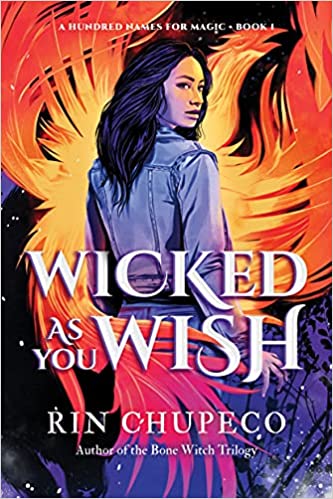
Wicked As You Wish by Rin Chupeco

A young woman with long wavy dark hair, dressed in a denim jacket, looks backward over her shoulder. A bright yellow and orange phoenix is rising behind her against the night sky, and its tail wraps around her.

By Sahana C.

Consider this: every fairy tale you’ve ever heard is at least a little bit true. The Kingdom of Avalon is full of castles and magic, Alice really did travel all through Wonderland, and most of all – magic? Definitely real.  

But at the exact same time, Rin Chupeco manages to surprise readers with twists on each story. Avalon is frozen (literally and metaphorically!) outside of time, Alice was a warrior, and all that magic has rules and regulations in ways that seem to make sense when you look around at the modern world.  

The book opens in the Royal States, a monarchical version of the U.S., where everything is almost exactly the same as reality with the exceptions of a king and quite a bit more magic. The story even involves governmental agencies, with ICE taking on a prominent (and punny!) role throughout the course of the plot. 

The hero here is a young girl named Tala. She comes from an incredibly powerful legacy, with her family hailing from both the Philippines and Avalon. Her entire lineage is made up of magic, despite being convinced that she lives in the most boring town in the entire Royal States, and she’s been told that she’s fairly powerful, too. She’s hesitant to believe it, though, considering her powers are exclusively centered on disrupting magic.  

Her life changes in a big way when her family is called to protect the Crown Prince of Avalon, Alexei, who is the sole survivor of the royal family and has been in hiding for his whole life. Alexei’s dream is to revive his home country and take back his homeland by breaking the curse of the Ice Queen. In the meantime, though, he and Tala become fast friends, and he manages to enjoy a little bit of a normal high school, being sheltered by the Makiling clan, Tala’s super powerful family.  

When the Firebird, the symbol of Avalonian royalty, finally arrives, Tala and Alexei are thrown into a whirlwind adventure, accompanied by the children of Avalon’s best and brightest heroes. All of them have something to prove and they don’t always get along, but they do come together to save a country they’ve all loved and longed for from afar.  

You see, this whole book is a thinly veiled analogy for the immigrant experience and various facets therein. Tala’s whole family is Filipino, and she’s never been to the Philippines but longs to know more about her culture. Alexei had to leave Avalon as a child, forced out by war. The rest of the group that accompanies Tala and Alexei on their adventure also have varying levels of connection to Avalon: some have fond memories of childhood there, others have most of their family members stuck behind the border.  

Chupeco makes it clear, through Tala, that regardless of how connected to country she is, she can still fully claim her heritage. Tala is told by trusted adults time and time again that she belongs, and Chupeco makes it even more explicit when she writes, “Just because you’ve never been to the Philippines doesn’t mean that their rivers don’t course through your blood. It doesn’t mean you don’t have their mountains in your eyes. It’s not where we are, it’s who we are. You’ll always be both a Makiling and a Warnock, and always a Filipina. Never forget that.” 

I will say that some of the worldbuilding was a touch heavy-handed, and I had to go back and forth on the rules of magic and power in this universe Chupeco creates. Those moments could have benefited from a bit less, but they did not take away from the heart present in every chapter. First and foremost, this is a story about family, ones that are forged by blood and those that are found through friendship. For readers who are interested in YA fantasy, with an incredibly diverse and vibrant cast of characters who talk about the immigrant experience and recognize just how important food is as a bonding tool, this is the book for you.  

Wicked As You Wish is available in print and as an eBook from Libby/OverDrive.

Sahana is an Instructor and Research Specialist at the Savage Branch. She enjoys adding books to her “want to read” list despite having a mountain of books waiting for her already.

Help with Your Hobbies

A yellow cover features a photo of a bright scarlet tanager, with its black wings. The title is in dark red lettering above the photograph.

by Emily B.

May is Older Americans Month and is the perfect time to start a new hobby with a little help from HCLS! Check out these great resources you can access for free with your library card.

Looking to get artsy? We’ve got some great DVD series to help you start. Craftsy offers hands-on lessons in creative mediums such as knitting, watercolors, crochet, and sewing. Interested in painting? Follow along with Bob Ross as he guides you every step of the way toward creating your own masterpiece in his art video series.

Interested in building a family tree and learning about your family’s history? Check out, via our online research tools, Ancestry Library Edition (only available in library branches), HeritageQuest, and MyHeritage Library Edition for access to billions of records from all around the world – including census records, immigration records, and beyond!

Budding photographers can head over to LinkedIn Learning for comprehensive video tutorials on topics like mobile photography, taking portraits, photo composition, photo editing, and more! Simply login with your library card and pin number to begin.

Take a hike! Check out Hike Maryland: A Guide to the Scenic Trails of the Free State for some scenic walks to take as the weather warms. See any birds on your hike? Check out Birds of Maryland, Delaware, and Washington, D.C. to learn more about the birds you encounter.

Expand your linguistic horizons and study a new language. For those who prefer to learn in quick, fun, daily lessons, Mango is a great option. Just download the free mobile app, select the language you want to learn, and start learning! For more immersive learning, Rosetta Stone offers structured lessons in reading, writing, speaking, and listening.

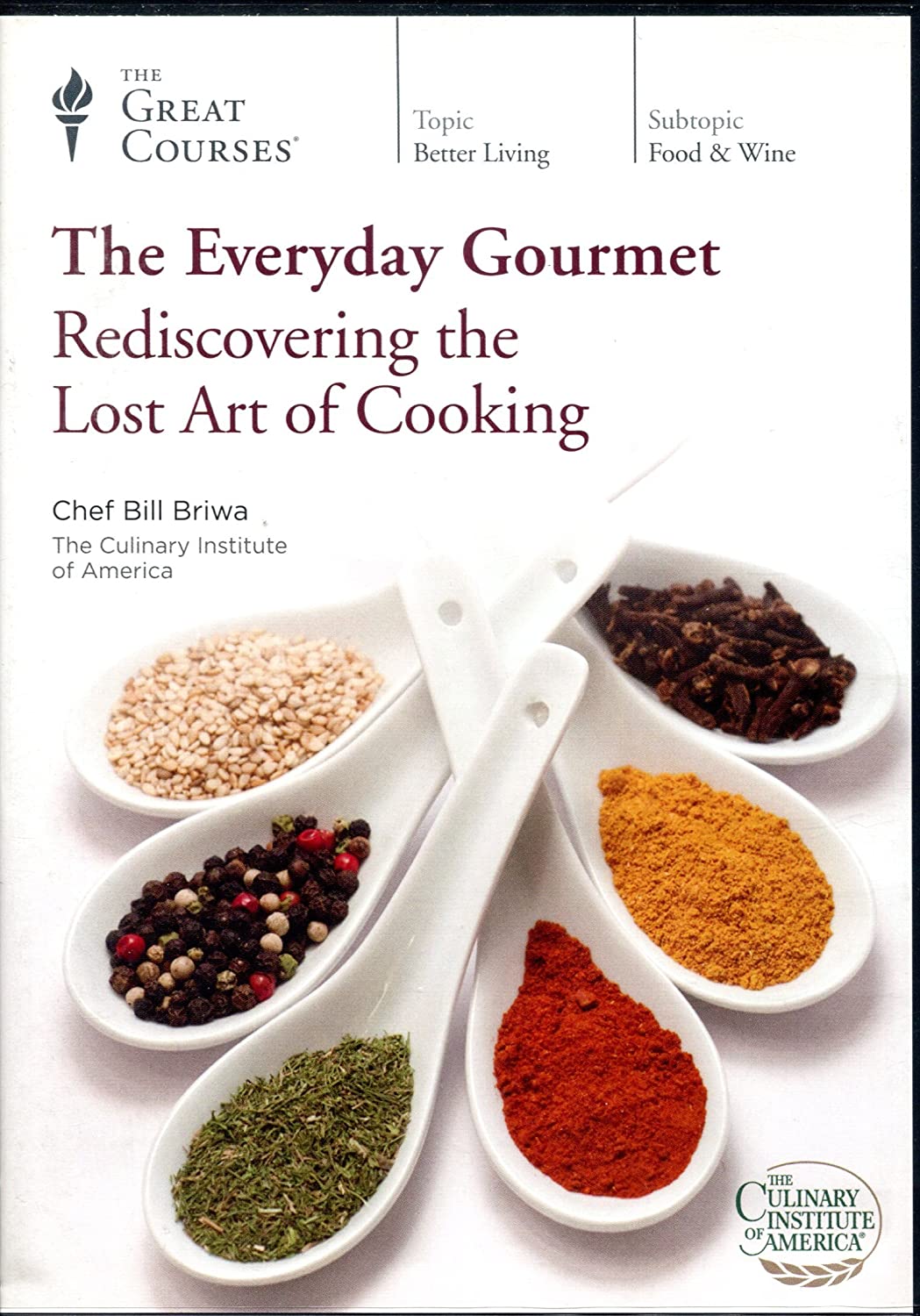
A white cover features white flat soup spoons, each filled with a different color spice.

Hoping to introduce some new recipes into your repertoire? Check out the Great Courses’ Everyday Gourmet DVD series. With courses on outdoor cooking, Mediterranean cooking, and cooking with vegetables, there’s something for every palate!

Emily is an Instructor & Research Specialist at the Central Branch. She enjoys reading, listening to music, and re-watching old seasons of Survivor.

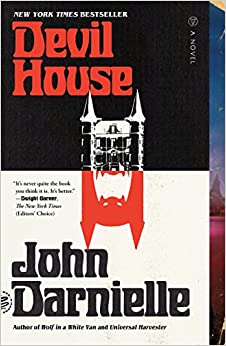
Devil House

The cover of the book shows an old house with two turrets silhouetted in black and white against a black background. Beneath it, against a white background, is a red outlined reflection of the house's shape, illustrated to resemble a vampire bat. The red and black lettering is in a Gothic style and gives the cover a retro, pulpy feel.

It’s changed since you were here, or else it hasn’t
It was special, it was deadly
It was ours and then it wasn’t

– The Mountain Goats

By Ben H.

An entertaining book full of mystery, empathy, and suspense, Devil House is also a thoughtful examination of authorial responsibility. John Darnielle excels at building meaning by layering stories. As the frontman of The Mountain Goats, he’s a storytelling genius. He’s magical and efficient. He’s an all-time great songwriter.

Speaking of authorial responsibility, I should state upfront that I think Darnielle is a better songwriter than he is novelist. Devil House would have benefited from heavy editing. That being said, I like the book and I consider my responsibility as the author of this review now satisfied.

Devil House is the story of true crime writer Gage Chandler. Chandler fictionalizes true stories for money, the job of all novelists, really, but he isn’t Thomas Wolfe writing about Asheville. Chandler writes the new Hulu documentary about a mother who poisoned her kids or a couple who killed boarders and buried them under the hyacinths. Chandler writes books that are adapted for the small screen and become the must watch shows of the week. He approaches the gruesome devil house murders of Evelyn Gates (the greedy landlord) and Marc Buckler (the sleezy real estate mogul wannabe) the same way he approached previous cases, but things get complicated.

The titular house is the center of the novel and serves as a cipher for all the characters. Chandler, Buckler, Gates, Seth, Alex, and Derrick all revolve around its foundations in one way or another. It’s Chandler’s next project; it’s work. Buckler and Gates see it as an asset or potential asset. High school students Derrick, Seth, and Alex use the abandoned house as a hideout. They make it a castle. It’s a safe place to sleep at night. Many of the highlights of the book occur when Chandler describes the boys and their relationship with the house.

Chandler’s methods are extreme. He’s the Daniel Day Lewis of true crime writers. Joaquin Phoenix ain’t got nothing on Gage Chandler. He lives where the crimes were committed (he literally moves into the building known as devil house). He holds items held by those involved as if they were talismans. He haunts eBay looking for paraphernalia tangentially connected to the case. He becomes the victims. He becomes the murderer. Chandler recreates lives based on evidence left behind. He imagines conversations and relationships based on the contents of a junk drawer. He establishes character and personality based on notebooks full of doodles. He gives his characters depth. He uses empathy to create details and narratives for his characters; but has he cold-heartedly monetized empathy?

While living in devil house, an old case that involves the murder of two students by their high school teacher, which Chandler turned into the book The White Witch of Morro Bay, comes back to haunt him. He receives a devastating letter from someone questioning his depiction of a certain character. Chandler prides himself on being fair to his characters, but how can you be fair to someone’s son when to you they are just a character you have partially fleshed out? His resolve shaken, he questions his methods and his career.

For those thinking that what this book sounds like it needs is a medieval section in middle English, you’re in luck! For me, this strange interlude emphasized the depth of the world-building that Derrick, Seth, and Alex were doing. It’s like I always say, “whan that Aprille with his shoures soote, / The droghte of March hath perced to the roote.” I also always say that if you can cut the section in middle English from the book you wrote in 2022, you should.

As in Wolf in White Van, Darnielle moves back and forth in time, weaving patterns and stacking stories. The payoff is well worth it. I reread the reveal a couple of times because it was so satisfying. The obvious takeaway for me was a critique of true crime books, shows, and movies. Devil House also offers a commentary on how society treats its vulnerable members. Whatever meanings you find inside Devil House, I think you’ll enjoy exploring most of its pages.

Harbor me when I’m hungry
Harbor me when I’m hunted

– The Mountain Goats

Ben Hamilton works at Project Literacy, Howard County Library’s adult basic education initiative, based at HCLS Central Branch. He loves reading, writing, walking, and talking (all the basics).

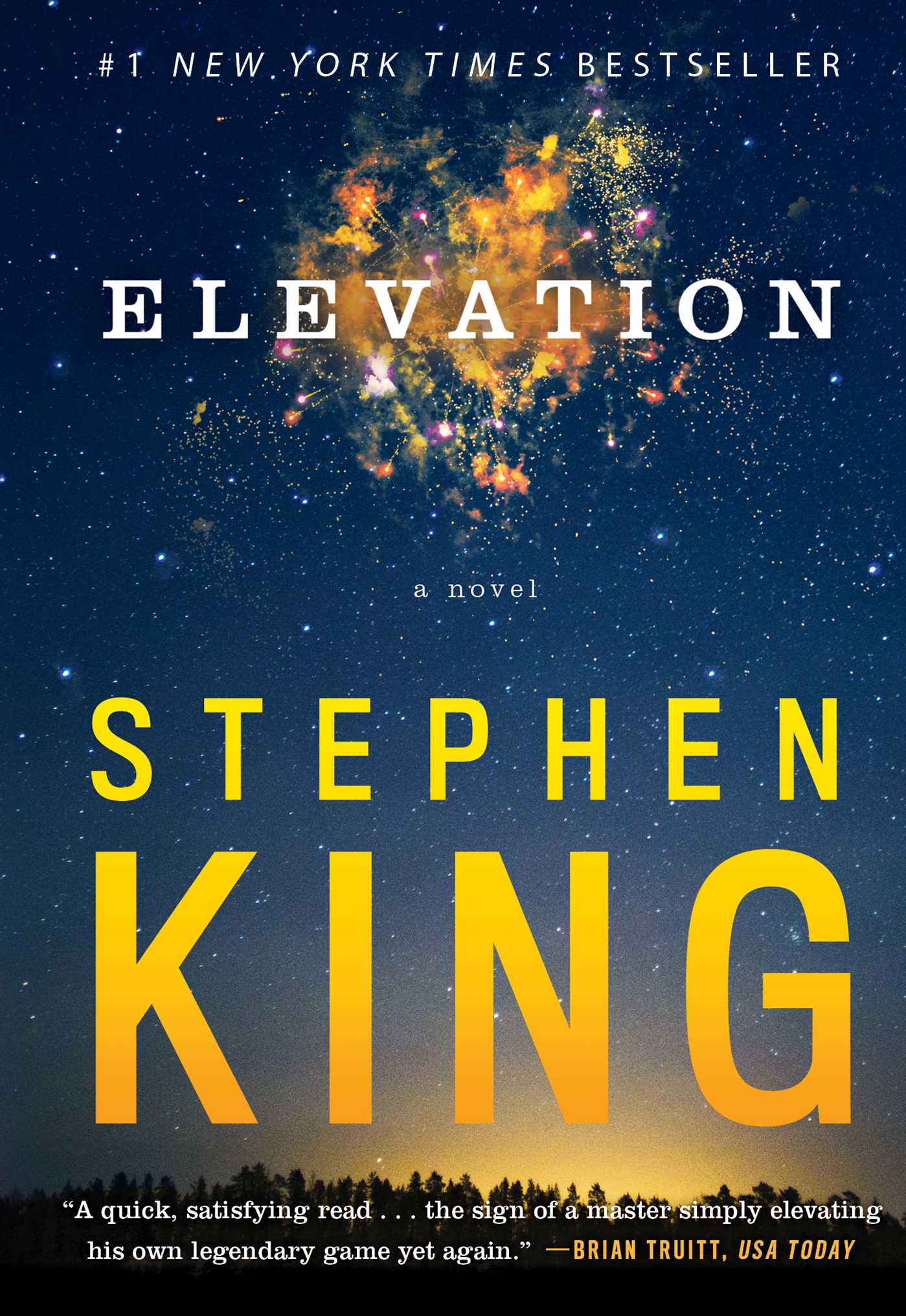
Elevation by Stephen King

A deep night sky shows a sort of explosion, the tree line at the bottm is also illuminated.

By Gabriela P.

Short on time? So is Scott Carey, the main character of Stephen King’s novella, Elevation. Forty-two years old and in relatively good health despite a disposition towards being heavy-set, Scott discovers he is afflicted with a strange condition where he continuously loses weight but not mass. Eventually, he comes to understand that, soon, he will literally be leaving the physical Earth as his weight plummets. With a divorce in his recent past, a too-large house, and a complacently settled routine in the town of Castle Rock, it takes two new neighbors moving in down the street to spur the unfolding of a moralistic but heartwarming comedy.

Scott’s two new neighbors are women. In his small town, same-sex relationships are at best tolerated…but same-sex marriage becomes a root for tension, gossip, and outright hostility. Scott himself bears no ill-will towards Deirdre and Myra, except a slight annoyance with their dog’s preferences for his lawn. When he confronts the two, he is received coldly, a result of a necessary guard the two have had to put up in the face of prejudice.

Unlike the plot development one might expect from a Stephen King story, Elevation does not dive into the wild undoing of a man and a town, but instead comedically highlights one man’s gradual, though admittedly somewhat naive, social enlightenment. While Scott Carey literally begins to leave the ground, he is also able to figuratively rise above prejudice. To really tug at the heartstrings, readers should consider the irony of strengthening bonds and belonging with an inevitable end.

Also available as eBook, eAudiobook on Overdrive and CloudLibrary, on CD, and in large print.

Gabriela is a customer service specialist at the Miller Branch. She loves long walks, reading with her dog, and a good cup of coffee.

Reading Human Rights

You’re invited! Reading Human Rights is a monthly book discussion hosted by the Howard County Office of Human Rights & Equity and Howard County Library System. We read books that promote cultural awareness, diversity, and equity.
Tuesdays at 6:30 pm in person at the Miller Branch

The title appears in large, all caps with fire illustrating the letters. The author's name appears below in cool blue.

May 24: Minor Feelings by Cathy Park Hong
Register at bit.ly/minorfeelingshcls

Poet and essayist Cathy Park Hong fearlessly and provocatively blends memoir, cultural criticism, and history to expose fresh truths about racialized consciousness in America. Part memoir and part cultural criticism, this collection is vulnerable, humorous, and provocative—and its relentless and riveting pursuit of vital questions around family and friendship, art and politics, identity and individuality, will change the way you think about our world.

Available as a book, eBook, and eAudiobook.

A stark cover with a faded map has the title in red shadowed letters and a small gold star.

Jun 23: On Juneteenth by Annette Gordon-Reed
Register at bit.ly/juneteenthdiscuss

The essential, sweeping story of Juneteenth’s integral importance to American history, the book is told by a Pulitzer Prize–winning historian and Texas native. Combining personal anecdotes with poignant facts gleaned from the annals of American history, Gordon-Reed shows how, from the earliest presence of Black people in Texas to the day in Galveston on June 19, 1865, when Major General Gordon Granger announced the end of legalized slavery in the state, African-Americans played an integral role in the Texas story.

Available as a book, eBook, and eAudiobook.

Everyone in This Room Will Someday Be Dead by Emily Austin

A pale yellow cover features bunnies in many poses and many colors, with the title in a quirky script.

By Sahana C.

This book is cathartic. It feels like therapy, except things get way worse, more cringey, and infinitely harder to handle before the payoff hits, and all of the suffering of the previous two-thirds of the book ease into something manageable and even likable.  

I will not lie – I judged this book by its cover. There was something about the whimsical nature of the rabbits juxtaposed with the bold cursive proclaiming “everyone in this room will someday be dead” that struck me. What room? The very room I was in? I looked around the adult fiction section of the Savage Branch surreptitiously to see who was nearby. I went back up to the front desk, still holding onto the book, and thinking, “Yeah, actually, that’s true.”  

Dear Reader, obviously. This is not a new concept, that everyone, one day, dies. But sometimes, a book like this will bring this into perspective, throw a new light on something you know deep down but don’t consider very often. Emily Austin’s debut novel has moments I’m sure she would categorize as semi-autobiographical (I threw the “semi” in there for her sake, as the main character, Gilda, is truly a disaster), especially since there are moments in the book that I felt were semi-autobiographical and was alarmed at how close Gilda had gotten to my reality.  

Emily Austin was not referring to the Savage Branch when she was referencing her room. She was talking about every room Gilda, a noted hypochondriac, ever walked into. Gilda is a twenty-something lesbian and atheist, well known in the emergency room at her local hospital to the point that the janitorial staff know her by name. When we first meet her, she has just been in a car accident and broken her arm, a more physically obvious issue than the anxiety that normally brought her in for a check-up. In an attempt to get her anxiety under control, Gilda follows a flyer for free therapy to a Catholic church, where she meets Father Jeff and accidentally gets a job instead of therapy.  

From there, Gilda searches for a missing cat, deals with her younger sibling’s deteriorating mental health, tries to keep her old friends, tries to pretend like she’s Catholic, well-meaningly catfishes an old woman, and tries to solve a murder mystery that might not have involved murder, actually, all while trying to stay afloat.  

I read this on a long plane ride, which perhaps compounded the feeling of claustrophobia as Gilda kept tangling herself further and further in her web of lies. It meant that as I was reading an especially cringey section and closed the book for a moment, I couldn’t get up and go for a long walk, like I normally do. I was confined to the middle seat, stuck between two people who were fast asleep and were completely unaware of my distress, and, much like Gilda, all I could do in that moment was keep going. Keep reading and hope that somehow, something was going to get better.

Thank goodness it did, because otherwise, also like Gilda, I probably would have had a nervous breakdown. This book is wholly about the existential dread that comes with being an adult and looking around to realize your general existence is not exactly what you thought it’d be, then figuring out how to cope with that anyway. 

I would like to make it very clear that I do, indeed, like this book. I want everyone to read it, despite how difficult it can be. I’ve been recommending it to everyone, describing it as “anxious queer fiction” and asking friends, “Have you ever felt completely directionless and stuck? Well. Gilda will make you feel better. Because she had it worse.” I think if we all take a moment to reflect, the way Gilda does, on the way things are going, we might not always like what we see, but at least we know that we’re not alone in our discontent.

(And if you really want to feel like you’ve got a community, look at the Goodreads reviews for this book here.)

Everyone in This Room Will Someday Be Dead is available in print and eBook

Sahana is an Instructor and Research Specialist at the Savage Branch. She enjoys adding books to her “want to read” list despite having a mountain of books waiting for her already.

The Solidarity Dividend

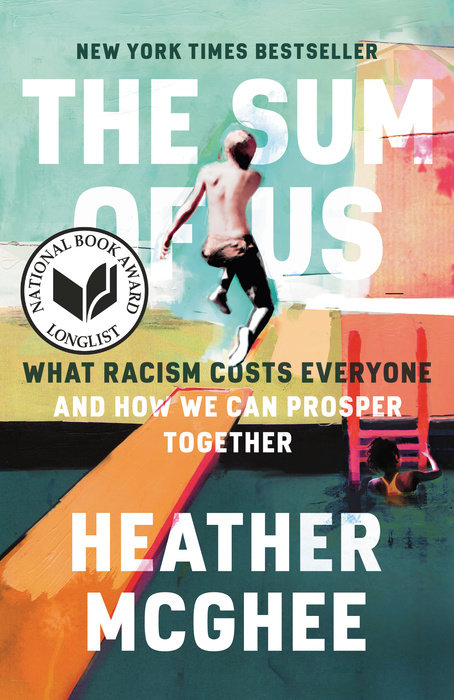
The Sum of Us by Heather McGhee: A cover full of color blocks resolves as a diving board into swimming pool with a white boy jumping off the end and a black girl climbing the ladder.

“I’m a white male, and I am prejudiced.” In August 2016 on C-SPAN’s Washington Journal, public policy expert Heather McGhee, answered the challenge presented by Garry, a caller from North Carolina. He asked, ”What can I do to change, you know, to be a better American?” The video went viral due to McGhee’s reasoned, compassionate response. Thanking the caller for being honest while acknowledging we all have prejudices, McGhee proceeded to offer advice including, “In order to be a demos that is united across lines of race and class and gender and age, we have to foster relationships. We have to get to know who one another actually is.” When McGhee’s book, The Sum of Us, was published, I was curious to learn more from her. After reading it, I especially appreciate McGhee’s insight into how the mentality of “us and them” was built and how we can break it down. 

The Sum of Us: What Racism Costs Everyone and How We Can Prosper Together describes how all ethnic and class groups suffer when racism influences government policy. McGhee researched the roots of economic disparity in the United States and explored causes and solutions from a perspective of unity rather than division. She argues that many problems with wage distribution, education, health care, housing, and environmental policy arise from the concept of a zero-sum game. When citizens perceive one racial group’s gain as another group’s loss, we cannot work for a common good. She documents how everyone loses out when racial hierarchy guides legislation. When public pools are filled with cement to circumvent enforcement of desegregation legislation, all the kids whose parents can’t afford private pools can’t go swimming. Using the concept of the public pool as a central metaphor, McGhee deconstructs how the US reached today’s level of political division and how American society can move forward, allowing all races, ethnicities, and classes to thrive. 

Of course, the idea of “what helps you, hurts me,“ goes beyond kids not being able to cool down in a pool in the summertime. The Sum of Us carefully traces trade union busting, healthcare access gaps, rising costs of public colleges, and the sub-prime mortgage crisis back to racial profiling. The resulting wage stagnation, benefit cuts, student debt, and foreclosures affected all racial groups.  

McGhee’s empathy raises The Sum of Us to a higher level than some other books I’ve read on similar topics. For example, as a self-proclaimed data nerd, she clearly explains the economics of the 2007-2010 financial crisis but then goes beyond the numbers to show, “what was risky wasn’t the borrower; it was the loan.” I gained understanding not only of the economics of the crisis, but the societal toll. Although predatory loan practices were initially targeted at low-income Blacks, later, the loans were pitched to everyone, regardless of their credit status. Many borrowers were eligible for prime mortgages but were manipulated to accept sub-prime mortgages because of the financial bonanza for the lender. McGhee presents this as yet another situation where racism eventually hurt everyone. 

McGhee has coined the phrase “Solidarity Dividend” for the benefits arising from communities collaborating across the racial divide. From minimum wage increases to investment in affordable housing development to improvement in air and water quality, the Solidarity Dividend boosts the economy while enhancing quality of life. “Getting white support to address those different levels of need, and to acknowledge the racism that caused these differences, is never easy – particularly when the zero-sum mental model turns every concession into a threat of loss,” McGhee writes. The Sum of Us demands to be read both for the well-researched documentation of the past and the message for our future.  

By the way, Heather and Garry, a disabled Navy veteran, built a friendship. Garry continues to work on understanding racism and realigning his own thinking. 

Cherise Tasker is an Adult Instructor and Research Specialist at the Central Branch. When not immersed in literary fiction, Cherise can be found singing along to musical theater soundtracks.