April is National Poetry Month

Black and white drawing of two children peering over the edge of a crumbling sidewalk edge, with the title beneath. A dog has fallen partway through behind them.

by Kristen B.

April is National Poetry Month. We need at least that long to appreciate all the wonderful poets and poems that enrich our lives. Poetry allows us the see the world in new ways. The rhythms and allusions of poetry open views or thoughts that ordinary prose simply cannot elicit through standard structures. Whether recounting lengthy epics like the Iliad or appreciating life’s little joyous moments with Mary Oliver, poetry’s language can transport us.

Do you have any favorites? Do any memorized pieces live in your mind? I first read Dylan Thomas‘ “Do Not Go Gentle Into That Good Night” the year my father was diagnosed with cancer. “Rage, rage, against the dying of the light” has been with me ever since. In less fraught circumstances, my sister memorized Shel Silverstein‘s “Sick” when she was in elementary school – it’s still fun to recall its whimsical truth as adults. I know quite a few people who can recite all the nonsensical words of the heroic “Jabberwocky,” from Lewis Carroll’s classic story, Through the Looking Glass – famously performed by the Muppets, in case you haven’t seen it.

We invite you to celebrate a month of poetry. Whether you borrow a volume or anthology of poetry, or attend a class, we hope that you take a moment or two to enjoy some wonderful words. And, on April 27 – official Poem in Your Pocket Day – you can keep handy an old favorite or a new, original composition to share throughout the day.

Creating from Wounds: A Generative Workshop
Adults. Register.
The power of poems is that they allow us to create from disaster, making something out of the brokenness to process and cope. In this workshop, Meg Eden shares tools that she has used in writing her latest poetry collection. Compose using interactive prompts, then receive resources to continue with your writing.
Sat, Apr 15
12:30 – 1:30 pm
Savage Branch

Poets Corner
Ages 6-11, 45 minutes. Ticketed; free tickets available 15 minutes before class starts.
There’s a poem in your head just shouting to come out! Discover the tools poets use to create verses that sparkle and shine. Read, write, and have fun sharing poems!
Sat, Apr 22
2 – 2:45 pm
Elkridge Branch

Playful Poetry
Ages 6-9, 45 minutes. Ticketed; free tickets available 15 minutes before class starts.
April is National Poetry Month – celebrate by joining us to hear and share fun poems from a variety of creators. Participants are welcome to bring a poem they love to share with the group. Maybe you will even be inspired to compose a poem of your own!
Thu, Apr 27
5 – 5:45 pm
Elkridge Branch

Kristen B. is a devoted bookworm lucky enough to work as the graphic designer for HCLS. She likes to read, stitch, dance, and watch baseball in season (but not all at the same time).
The Bright Ages

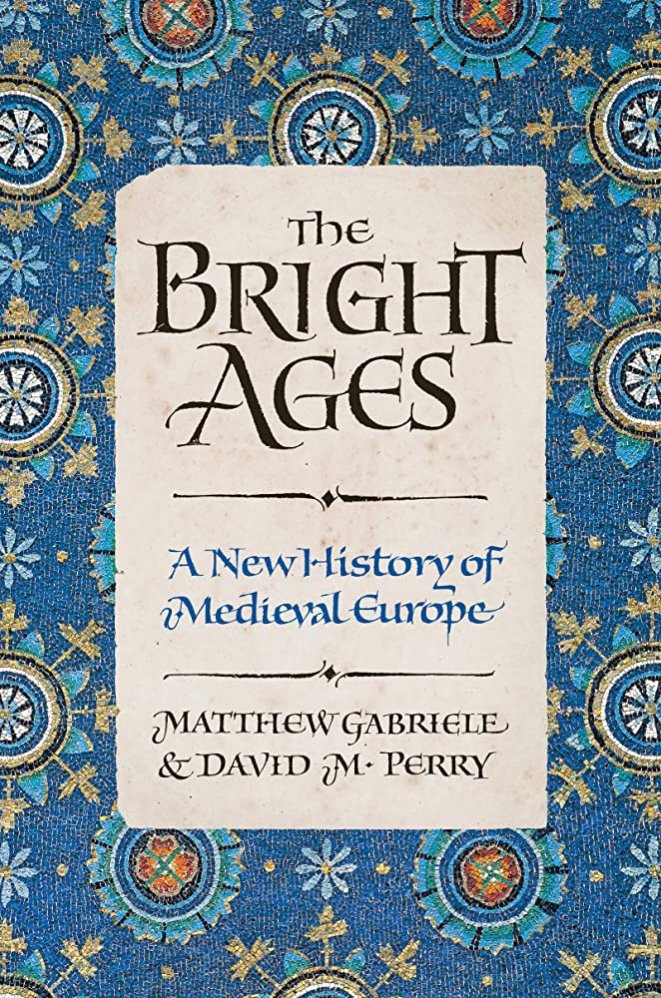
A blue brocade fabric surrounds a parchment-looking rectangle that has title and author in a calligraphic typeface.

by Tony B.

The Bright Ages by Matthew Gabriele and David M. Perry tries to shed some metaphorical light into the historical era many have been taught to call “The Dark Ages.” Characterizing early medieval Europe as “Dark” is mostly a reference to the fall of Rome and the end of Pax Romana. The authors challenge that notion, as the Eastern Roman empire in Constantinople was still, at least to its inhabitants, Roman. This particular argument of The Bright Ages is its most well delivered, but from there, things get iffy.

So why Bright over Dark? It is really easy to consign the messier parts of European history – between Enlightenment highs and the idealized Classical – to a lesser status. Instead, by delving more intimately into Medieval lives, you can find the light of stained glass cathedrals, golden relics, and deep acts of charity, but also the hotter fires of politics, rebellion, and warfare. The goal should aim to examine both for a more nuanced, holistic view of an era.

However, The Bright Ages tends to be a bit cherry-picked for the particularly bright or positive aspects of Medieval society. While it is wonderful that examples delineate traditionally marginalized people showing agency and influence, they tend to be the exceptions that prove the rule and not indicative of a broader norm. The author’s favorite example, the remarkable life of Galla Placidia, was just that, remarkable, and not indicative of all medieval women’s sense of agency. This tendency for forced historiography pervades The Bright Ages, though the overall idea of challenging “The Dark Ages” is valid.

One of the book’s main positive points is that it challenges readers to rethink some of the knowledge we take for granted about Europe’s Medieval period. For instance, the early Medieval world was a lot more connected than many assume. As the authors point out, an elephant from the Congo Basin made its way to the court of Charlemagne in Aachen, Germany, as a gift from the Abbasid Caliph in Baghdad to the newly crowned Emperor of the Holy Roman Empire. However, the authors tend to skip over the bad that comes with the good, like the taking of war slaves or the horrors of the Crusades.

While it toes the line between academic and popular historical writing, the book did itself no favors by omitting notes and sources. Overall, The Bright Ages posits an interesting idea and is one of many voices challenging “The Dark Ages,” but it can be a bit incongruous and sparse on evidence.

Tony is a Customer Service Specialist at Elkridge Branch. He has a degree in history and a perpetual interest in Medieval Europe.

The Future Belongs to Everyone: Introducing the New Lakefront Library

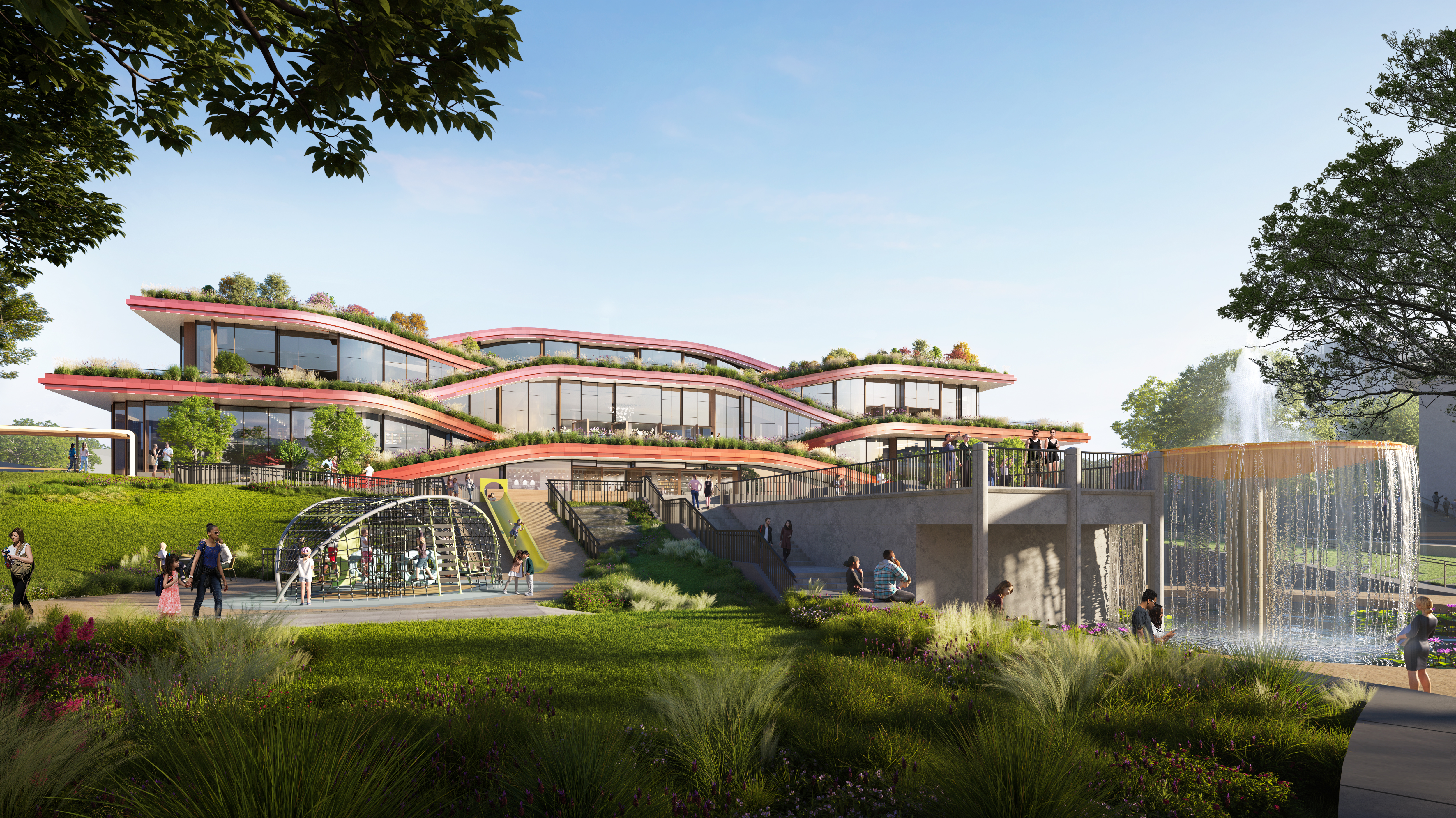
Architectural rendering of a concept for a new multi-level library on Columbia's Lakefront, placed between the fountain and playground.

On Thursday, March 30, 2023, Howard County Executive Calvin Ball was joined by Governor Wes Moore and President and CEO of HCLS Tonya Aikens to unveil plans for a reimagined and transformative library in downtown Columbia. The project will be coupled with expanded mixed-income housing opportunities for the growing community.

The 100,000 square-foot structure will foster creativity, learning, and civic engagement. It will be the first, innovative library of its kind in the region. Designs unveiled were created by Heatherwick Studio, an internationally recognized firm. 

We invite your input and ideas to shape Howard County Library System’s next Strategic Plan, which will guide the future of HCLS, including the new Lakefront Library.  

Your voice matters.
Come together with other residents who are passionate about public education and enhancing library facilities, programs, and services. Please take the online survey or attend one of these:

Listening sessions facilitated by Due East Partners.: 


Thank you for helping us thoughtfully plan how we can work together to better address the evolving aspirations of our Howard County community.

Why is the new Lakefront Library needed now?
The existing branch is undersized to serve the current population, is further constrained by the addition of new housing units, and is slated for demolition as part of the Downtown Columbia plan. More information is available on the HCLS website.

  • When was the Central Branch most recently renovated and how much was spent?
    The Central Branch first opened in 1981 and was renovated in 2000–2001. Minor interior alterations were completed in 2016 at a cost of $1.8M. Due to the pending development, renovations were minimal and addressed structural, end-of-life, interim fixes and enhancements to address customer needs (e.g., new paint, new carpet), and transformed space formerly used by administrative staff into public space.
  • How long has this new Lakefront Library been planned?
    Howard County’s Downtown Columbia Plan (adopted in 2010 and updated in 2018) recommended that a new Central branch be built in Columbia’s new Downtown. In 2019, HCLS engaged G4 Architecture, Research, and Planning, Inc. to update its Master Plan, which calls for a new 100,000 SF downtown Columbia Branch to meet the increased number of new residents and visitors and to meet the Maryland State minimum library guidelines of one SF per capita.
  • Why is a 100,000 SF library needed?
    The current Central Branch is not large enough to accommodate existing customers. At completion of the redevelopment plans, downtown Columbia will feature 1.25 million SF of retail space, 4.3 million SF office/conference space, 640 hotel rooms, and 6,244 market-rate and affordable housing units. These new residential units will expand Howard County’s population by a minimum of 15 percent. In addition, the Central Branch serves the entire county through its Project Literacy program, Art Education Collection, Equity Resource Center, Business and Foundation Center, and Health Collection.
  • What is the proposed timeline for this project?
    FY24: Begin design
    FY25: Continue design, and begin permits and pre-construction services
    FY26: Start construction
    FY27: Complete construction
  • What is the cost for the new branch?
    The estimated cost is $143M.
  • What is the cost for additional staffing?
    There is no additional staffing cost. Existing Central Branch staff will be relocated to the Lakefront Library.