
by Lenae R.
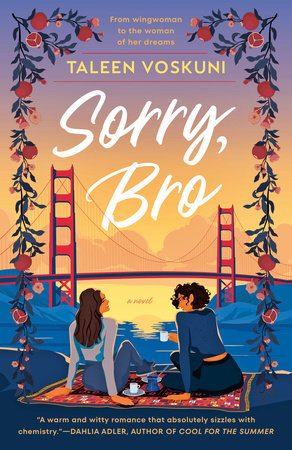
I always find it fun to read books set in familiar places. It’s delightful to recognize street names and to have memories evoked by local scents and flavors. The cover of Sorry, Bro seemingly promised me these with its Golden Gate Bridge set against a golden sunset (be still, my born-and-raised Californian heart!), a frame of pomegranate-laden vines, and a description hinting at the revelations uncovered by its Armenian protagonist, Nareh. My family lived overseas in the Caucasus region for several years, and its mention tripped a longing for the culture and people we fell in love with there. I was sold.
To be clear, Sorry, Bro isn’t a cultural saga, per se. Its cover teases, “From wingwoman to the woman of her dreams,” and I was all-in for the juiciness of a friendship-turned-romance. It opens hilariously in a German restaurant, where we are introduced quickly to Nareh’s main predicaments: the anxiety that carries her through her days; a boyfriend, Trevor, who is equal parts outrageous and dull; and the pressure she manages as an only child who lost her father several years earlier.
Trevor departs to Europe for a business trip before the second chapter, creating space for Nareh to process whether she wants to continue their relationship. She spontaneously decides to do this by committing to attend “Explore Armenia,” a month of events dedicated to celebrating Armenian history and culture. Nareh’s mother hopes she will meet a promising Armenian man to marry, and Nareh is hungry – for an out from Trevor and the satisfaction of making her mother proud.
It’s a rom-com premise that, certainly, seems formulaic in many ways. What sets Sorry, Bro apart is how it poignantly, often painfully, brings us along for Nareh’s reckoning with her bisexuality (she isn’t out to her family or community) and her Armenian roots. As a first-generation Filipino on my mother’s side, so many of Nareh’s reactions resonated with me: the comfort and thrill of language, food, and references to the homeland tinged with the shame and awkwardness of a child raised in the diaspora. How does one settle into, own, and embrace a culture they seemingly move in and out of? Tagging along with Nareh as she considers this question proved endearing and thought-provoking.
Nareh’s closeted sexuality is entwined with this journey of self-discovery and identity. Her attraction to women is something she hasn’t felt comfortable sharing as she imagines how it will impact the acceptance she has from her loved ones. So many in the queer community can empathize with her struggle. Her deepening connection with Erebuni, the wingwoman from the cover, challenges the evasions that have kept her safe but stifled.
Rest assured that Nareh’s journey is as fun as it is stirring. Author Taleen Voskuni writes deliciously, balancing sincerity and sarcasm with thoughtfulness. Nareh’s chemistry with Erebuni crackles on every page. You’ll be cheering for her throughout and Googling Armenian eateries by the last page.
Lenae is an instructor for the HiTech summer program. Besides reading, her great loves are spending time with her family, watching Star Wars shows, and visiting new coffee and bookshops (Charm City Books in Baltimore is her favorite)!
 CHAPTER CHATS