
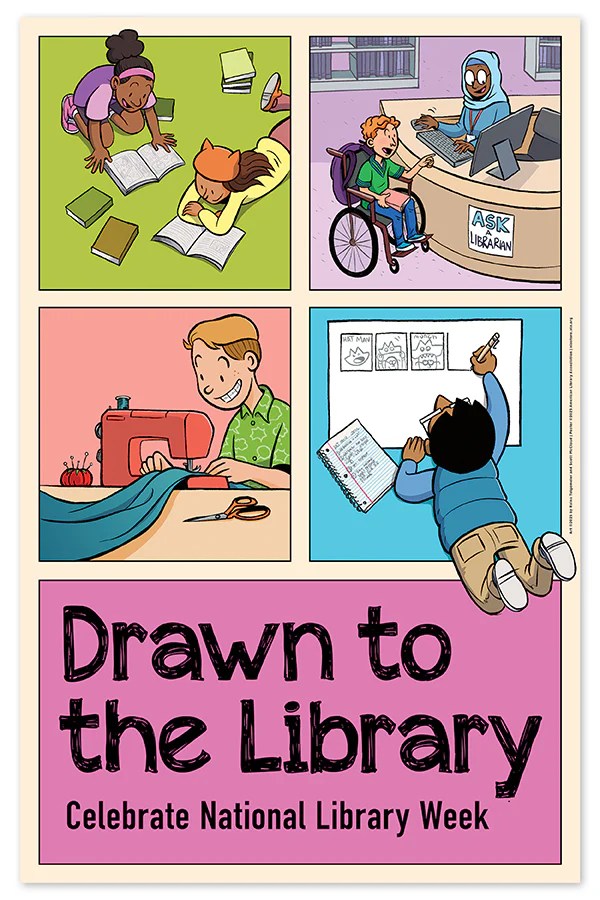
by Emily B.
There seems to be a common misconception that graphic novels don’t count as “real reading.” This could not be much further from the truth! Reading takes on many forms beyond the printed word, each format with its own appeal. Everyone connects with stories and information in unique ways. No matter the format, reading counts, as long as you’re engaged with the material.
I find that nay-sayers tend to focus on how graphic novels differ from traditional books, rather than considering the unique elements that make graphic novels so engaging. The combination of text and illustrations might make reading more approachable to hesitant readers. Not only can the illustrations help bring the story to life, but they also can aid readers in interpreting and understanding the narrative. Literary devices like symbolism, flashbacks, and foreshadowing are enhanced with the added visual component.
Legendary comic artist Will Eisner introduced the term “sequential art” to describe comics in his 1985 book Comics and Sequential Art, giving a name to an art form that has existed for many thousands of years. Though graphic novels have experienced a recent surge in popularity, they are rooted in ancient tradition. Some early examples of sequential art include Egyptian hieroglyphs, the Trajan Column in Rome, and Maya script.
Graphic novels really offer something for everyone, from fictional stories to memoirs and depictions of real-life experiences. Interested in giving graphic novels a try? Here are just a few classics to start you on your journey:

Art Spiegelman’s The Complete Maus – This book is the first and, so far, only graphic novel to win the Pulitzer Prize. Spiegelman tells the story of his father, a Holocaust survivor, in his years leading up to World War II, his survival and liberation from a Nazi concentration camp, and his life in the years that follow. Maus is heralded as a unique blend of memoir, history, and biography in a sleek graphic novel package.
Marjane Satrapi’s Persepolis and Persepolis II – In two volumes, Satrapi recounts her childhood in Iran amidst the Islamic Revolution and her adult years in Austria. Her graphic novel memoirs were adapted into an Oscar-nominated animated film of the same title.
John Lewis’ March I-III – Late civil rights activist and politician John Lewis, at the suggestion of his aide Andrew Aydin, tells the story of the Civil Rights Movement from his perspective. The two compiled Lewis’ anecdotes, experiences, and stories, and artist Nate Powell helped bring the important story to life on page.
Emily is an Instructor & Research Specialist at HCLS Central Branch. When she’s not reading, she enjoys puzzling, listening to music, and re-watching old seasons of Survivor.
 CHAPTER CHATS