
Musical Mondays

A black and white photo of the author, wearing glasses and a big hat, from the middle of his nose up sits under the title, where the word "song" in multi-colored stripes.

by Tony B.

2nd Mondays, 6 – 7 pm
HCLS Miller Branch
Registration encouraged.

Music has been an integral part of my life, and I consider it almost like a second language full of nuance and strange etymology. From cello and bass lessons in middle and high school, exploring other strings and voice in college, to finding a new prog band, music has always been a mainstay for me. Making a habit of falling down musical “rabbit holes” exposes me to all kinds of new musical vocab, including some really inventive genre bends and blends. Fun stuff like modern metal mixed with Japanese instrumentation , or EDM with classical samples. Much like how books can transport you to another place and time and travel abroad can expose you to more of humanity, I think that a widely cast net of musical experiences can benefit the listener in similar ways. 

The universal nature of music is one of the many facets that we will explore in Musical Mondays, HCLS’ new music-centric book club. If you’ve ever had a song give you goosebumps, wondered how music affects the brain, or thought about expanding your own musical vocabulary, then come to Musical Mondays! Whether you are a professional musician, avid car singer, or just enraptured by music like so many of us are, I can’t wait to hear your experiences. Bring song recommendations as well! 

Musical Mondays meets the second Monday of each month, from 6-7 pm at HCLS Miller Branch. We will read both nonfiction and fiction titles, the first of which is How to Write One Song by Jeff Tweedy. Tweedy is best known as the lead singer/songwriter of Wilco and has written several books about music and the creative process. You can pick up copies of the book at the branch.

Sep 8: How to Write One Song by Jeff Tweedy, lead singer and songwriter of hit band Wilco
Oct 13: The Violin Conspiracy by Brendan Slocumb
Nov 10: Anatomy of a Song by Marc Myers

Tony is an Instructor and Research Specialist at HCLS Miller Branch. He has a degree in history, started playing cello in third grade, and enjoys reading science fiction and fantasy.
Silk Road Reads

by Tony B. 

I admit this is a fairly niche set of titles, especially given my past with archaeology, but it is interesting to see how Central and Western Asia can fascinate far Eastern writers as much as it does the Western reader. These manga series all share a common thread of being set in real or fantasy versions of places like Turkmenistan or the various Persian dynasties. The stories may be different, but they all have a cultural or at least aesthetic backdrop of a mythical Silk Road-esque past. 

Manga cover shows a high desert landscape in the background, with a young woman striding off the cover. She's dressed in traditional steppe garp in red and black, with a creamy while underskirt and embroidered boots.

The Bride’s Story by Kaoru Mori
No, not the cult classic movie, but rather a brilliant manga series set in mid 19th century central Asia (think modern day –Stans). The detail that Mori puts into her work is staggering, and she placed specific emphasis on the rich textile traditions of the area. Bold patterns and intricate needlework serve not only as part of the plot revolving around a nontraditional marriage, but as a luxurious backdrop for rather complex characters. Colonialism and foreign power threaten to upend traditional life constantly, and Mori places her characters firmly between the Russian and British factions, during the time period of The Great Game of shadow diplomacy and proxy wars during the 1850s. This series does not stick to one genre, with elements of slice-of-life, coming of age tales, romance, history, and ethnography. No matter the topic or conflict, The Bride’s Story is gorgeously illustrated and historically sound. 

A light bright manga cover in creams, greys, and pale purples shows a figure in a cloak looking to the left, with a hawk on their shoulder.

Heroic Legend of Arslan by Hiromu Arakawa
From the mangaka of Fullmetal Alchemist, this series takes place in a mythical and magical version of ancient Persia. This series utilizes a lot of place names and proper names that are real aspects of several eras of the Persian Empire. Places like Ecbatana and Fars, and people named Daryun and Andragoras, transport the reader into a different, ancient world. Following a young prince who is navigating the trials and tribulations of sudden leadership, the reader watches his coming of age as a compassionate leader in a land accustomed to war. FMA readers will find this series visually familiar, but with enough change to keep it interesting. 

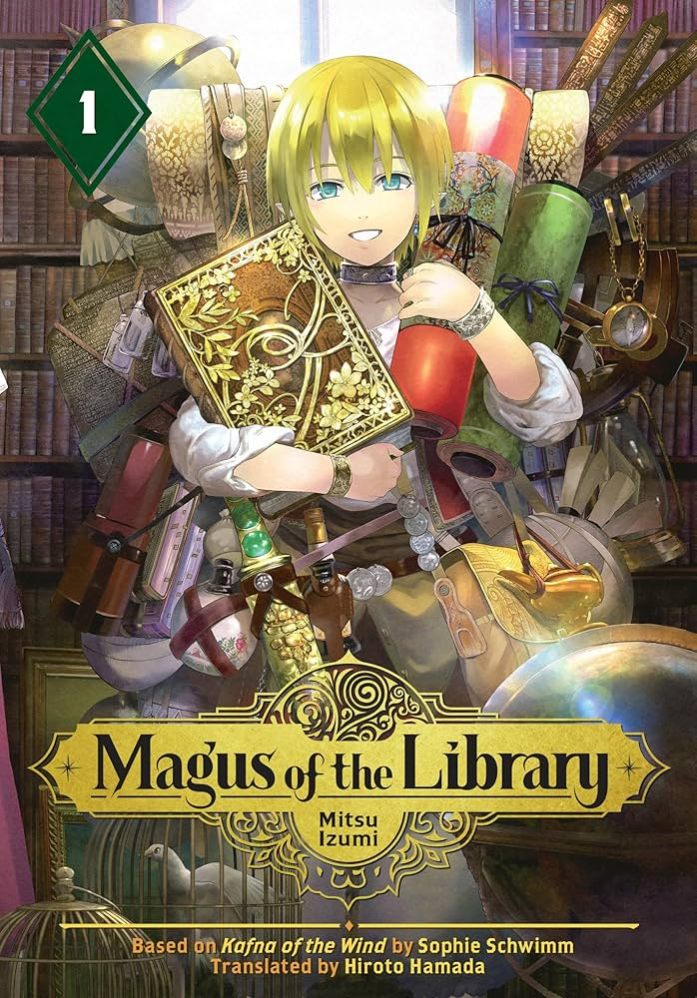
A bright and busy manga cover shows a young person in a wing chair with a library behind, clutching a wide assort of items including a bottle and a book.

Magus of the Library by Mitsu Izumi
Another story rich in detail and set in an alternative Western Asia, this manga leans less on history and more on magic. This was a bit of an indulgent read as a librarian, as most of the characters simply gush about their love of books and passions for various aspects of librarianship and reading. It also does not hurt that the fantasy society in question treats their magical librarians like super-humans. The series revels in diversity of characters, both real and fantasy, drawing from multiple historic inspirations for the factions complete with rivalry and culture shock. 

Tony is an Instructor and Research Specialist at HCLS Miller Branch. He has a degree in history and a renewed interest in science fiction and fantasy.

Reading Nostalgia

The book cover depicts a dragon with its tongue extended, encircling a medallion that depicts a ship with all its sails unfurled on the open sea.

by Tony B.

In January, I resolved to try and check Goodreads at least once a day and to write something about most of the books I read. The pandemic was detrimental to my reading habits, and I needed to give my once-voracious appetite for reading a jolt. As far as new year’s resolutions go, this year has been the most successful by far. When I started my resolution by re-reading a novel I enjoyed in high school, I unintentionally kick-started a year of reading nostalgia. This was either literature that I was forced into by the English curriculum or put into my hands by family and librarians. Reading these fondly remembered books reinforced not only that re-reading books is perfectly fine, but also that it can lead to new understandings. 

The book cover depicts a white dragon with tongue extended, encircling a medallion that depicts a pagoda.

My last book of 2023, Fourth Wing by Rebecca Yarros, was a peer-pressure read, and throughout the story I kept thinking, “Wow, these dragon types really remind me of Naomi Novik’s Temeraire series.” I realized I hadn’t read them since high school, so I listened to the first Temeraire novel, His Majesty’s Dragon. (Side note: Simon Vance is an incredible narrator!) I remember being impressed as a teen by the military and historical aspects of introducing a dragon air corps to the Napoleonic wars, but as an adult I have a significantly more nuanced appreciation of the social, political, and ultimately societal ramifications of adding aviators to the early 19th century. The entire series is an adventure spanning multiple continents and countries, seeing the world through both human and dragon eyes. While it can devolve into a bit of Carmen Sandiego world-hopping, the installments always come back to the big picture and are a joy to experience. 

The book cover depicts a magician and apprentice, both carrying staffs; one is bent and aiming the staff, with a circle of light resembling a blazing sun at the point.

The other series I have revisited from my teenage years was the Riftwar Saga by Raymond E. Feist. Starting with Magician: Apprentice and Magician: Master, these first works of Feist’s are paragons of sword-and-sorcery high fantasy. Inspired by his own Dungeons and Dragons campaigns in college, Feist writes fast action while maintaining vivid storytelling and comprehensive worldbuilding. It is easy to see how many other fantasy authors point to Feist’s work as early inspiration, because the Riftwar Saga titles are hard to put down. These were some of my favorite books as a teen, though as an adult I can spot the D&D influence and sword & sorcery archetypes much more readily. D&D-inspired content is in the limelight, and I can’t recommend these fun classics enough. 

Re-reading these series as an adult was a reflective experience and made me think about how much of our literary experience is informed by our lived experience. I encourage you to re-read a book from your not-so-recent past and see what new nuances you can find. I am looking forward to continuing this trend, possibly either with Barbara Kingsolver’s The Poisonwood Bible, which was assigned reading in high school, or Tad Williams’ The Dragonbone Chair for more epic fantasy.  

Tony is an Instructor and Research Specialist at HCLS Miller Branch. He has a degree in history and a renewed interest in science fiction and fantasy.

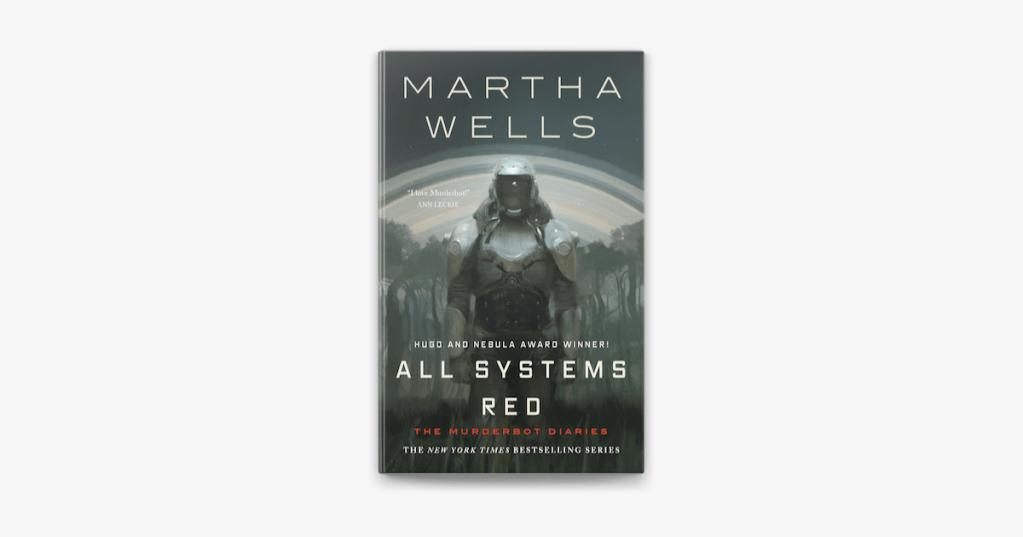
The Murderbot Diaries by Martha Wells

The cover has a grey palette, showing a space-armored figure with a closed helmet with a lit arch behind them.

by Tony B.

Ever wondered what an intelligent security robot would do without a functioning governor module? Murder? Watch Netflix? Save innocent lives? Contemplate sentience?

The Murderbot Diaries, a series by Martha Wells, explores answers to all these questions. Free of their governor module, the eponymous Murderbot leads us through their adventures with corporate warfare, angry megafauna, the (mostly) human experience, and the need for a nice quiet spot to watch interstellar tele-novellas. The first four novellas operate as a one long story arc, even with each book being a complete story, about why Murderbot has named themself in such a way and the repercussions from that particular episode. Along the way, Wells introduces Dr. Mensah and her family, who become important, along with ART – another high functioning artificial intelligence.

Originally a normal Security Unit (SecUnit for short) deployed by The Company, a security bond corporation, Murderbot hacks and destroys their controlling governor module which normally would zap the brain of any SecUnit displaying less-than-utterly-obedient behavior. Now free to do whatever they want, MurderBot inexplicably keeps working for the corporation but with newfound access to the wider net of media with which to distract themselves. 

The Murderbot Diaries are full of dry wit and snarky observations of the human condition, notably that humans tend to put themselves in a lot of unknowing danger. Compound that with galactic dangers and MurderBot ends up as one very busy SecUnit. The series now has six installments (four novellas and two novels) that follow Murderbot and a recurring cast of characters.

MurderBot’s interaction with risk-averse humans is one of the driving issues, beginning in All Systems Red. To MurderBot, the clash between how humanity is portrayed through their favorite space soap operas and how humans actually behave is a constant dissonance which leads to a healthy distrust of the human condition. Hence their thoughts along the lines of, “freedom to be treated like a real human? No thanks.”

Seeing sci-fi action through the lens of a non-human thought process is interesting, where priorities are generally “protect the weak humans from whatever stupid situation they find themselves” and less “be the hero.” SecUnit often ends up being a hero in the end despite themself and equally isn’t sure how to feel about it. MurderBot experiences emotion rather strongly at times but codes, to some degree, as being on the autism spectrum. They have a difficult time expressing those emotions and processing others’ emotional states, as well as the confusion at not always being able to control emotions that well up within them.

As a series, I give it a 9/10. Obvious tropes are usually immediately made fun of a la “oh that’s what the space soaps would do.” MurderBot also reminds me heavily of the 2015 movie CHAPPiE, about a robot who gains independence, but who is perhaps more impressionable in relation to humans than MurderBot ever is.

The Murderbot Diaries, a Hugo and Nebula award-winning series, consists of the following books, available from HCLS in these formats:

The seventh book, System Collapse, is due to be published in November 2023.

Tony is a Customer Service Specialist at HCLS Elkridge Branch. He has a degree in history and a renewed interest in science fiction.

The Bright Ages

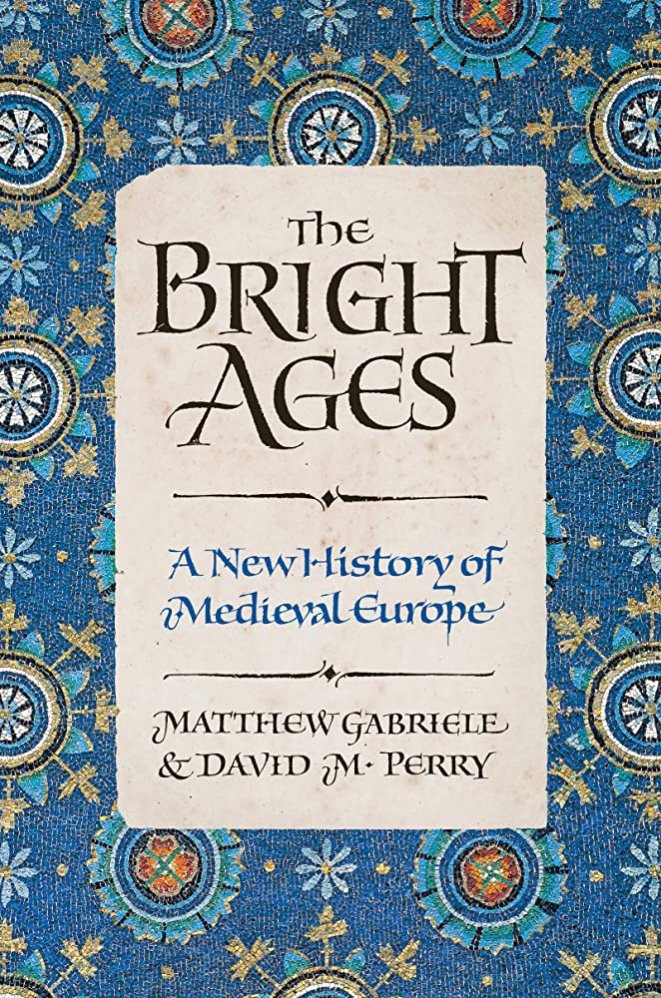
A blue brocade fabric surrounds a parchment-looking rectangle that has title and author in a calligraphic typeface.

by Tony B.

The Bright Ages by Matthew Gabriele and David M. Perry tries to shed some metaphorical light into the historical era many have been taught to call “The Dark Ages.” Characterizing early medieval Europe as “Dark” is mostly a reference to the fall of Rome and the end of Pax Romana. The authors challenge that notion, as the Eastern Roman empire in Constantinople was still, at least to its inhabitants, Roman. This particular argument of The Bright Ages is its most well delivered, but from there, things get iffy.

So why Bright over Dark? It is really easy to consign the messier parts of European history – between Enlightenment highs and the idealized Classical – to a lesser status. Instead, by delving more intimately into Medieval lives, you can find the light of stained glass cathedrals, golden relics, and deep acts of charity, but also the hotter fires of politics, rebellion, and warfare. The goal should aim to examine both for a more nuanced, holistic view of an era.

However, The Bright Ages tends to be a bit cherry-picked for the particularly bright or positive aspects of Medieval society. While it is wonderful that examples delineate traditionally marginalized people showing agency and influence, they tend to be the exceptions that prove the rule and not indicative of a broader norm. The author’s favorite example, the remarkable life of Galla Placidia, was just that, remarkable, and not indicative of all medieval women’s sense of agency. This tendency for forced historiography pervades The Bright Ages, though the overall idea of challenging “The Dark Ages” is valid.

One of the book’s main positive points is that it challenges readers to rethink some of the knowledge we take for granted about Europe’s Medieval period. For instance, the early Medieval world was a lot more connected than many assume. As the authors point out, an elephant from the Congo Basin made its way to the court of Charlemagne in Aachen, Germany, as a gift from the Abbasid Caliph in Baghdad to the newly crowned Emperor of the Holy Roman Empire. However, the authors tend to skip over the bad that comes with the good, like the taking of war slaves or the horrors of the Crusades.

While it toes the line between academic and popular historical writing, the book did itself no favors by omitting notes and sources. Overall, The Bright Ages posits an interesting idea and is one of many voices challenging “The Dark Ages,” but it can be a bit incongruous and sparse on evidence.

Tony is a Customer Service Specialist at Elkridge Branch. He has a degree in history and a perpetual interest in Medieval Europe.

Master of the Game: Henry Kissinger and the Art of Middle East Diplomacy by Martin Indyk

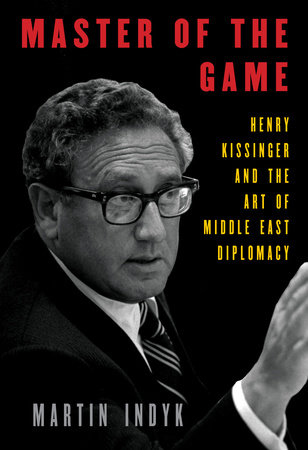
Below title in red block letters, the cover shows a black and white photo of a young Henry Kissinger gesturing off the page. His suit blends into the black background.

by Tony B.

Foreign policy is rightfully in the collective conscious right now. Martin Indyk’s newest work Master of the Game: Henry Kissinger and the Art of Middle East Diplomac takes an insider’s look into the mind and methods of one of the godfathers of foreign policy, Henry Kissinger. The book serves as an academic and personal review of Henry Kissinger’s diplomatic expertise in the Middle East, specifically his work in the peace negotiations from the Yom Kippur War forward. Indyk’s analysis is that Kissinger’s performance was brilliant for his vision, strategy, and understanding of history. While Kissinger was by no means flawless, his understanding of the delicate balances of power, willingness to take risks, and Machiavellian understanding of his own influence made him the master of the game.

Master of the Game is richly detailed, with sources pulled from American, Arab, and Israeli sources, as well as eight personal interviews with Kissinger himself. I was struck by how Indyk captured a lot of Kissinger’s personal style of dealing with foreign counterparts and patterns of thought from those interviews. For example, Kissinger said that he missed Golda Meir’s stubbornness once Yitzhak Rabin’s government was sworn in. In this regard, the book provides highly desirable insight into Kissinger’s diplomatic thinking.

The author is an accomplished Middle Eastern statesman in his own right, both as special assistant to President Clinton and envoy to President Obama for the Israeli-Palestinian negotiations from 2013-2014. In serving in these diplomatic circles, Indyk has met, worked, and formed a relationship with his subject. These combined experiences make for a unique and well-informed assessment of Henry Kissinger’s diplomatic triumphs. Master of the Game deftly incorporates personal reflection and academic research of Henry Kissinger’s diplomatic efforts. Plentiful, factual citation meets anecdote and lived experiences to bring a personal understanding to Kissinger’s Realpolitik.

Tony is a Customer Service Specialist at HCLS Elkridge Branch. He is a history student at UMGC and enjoys not quite finishing books and falling down Wikipedia rabbit holes.