Popeye the Movie: Nostalgia for Spinach and Silliness

A can of spinach advertises the movie Popeye, starring Robin Williams.

by Alex P.

You may dimly remember that there was a Popeye live action movie in the eighties starring Robin Williams. You may have seen the box on our shelves and been amused by the cover or just remembering that it exists. The movie, like the character it adapted, seems banished to somewhere deep in our cultural unconscious, a quaint memory.  

Popeye feels like a movie destined not to work. When Paramount and Disney sought to adapt the 1930s cartoon sailor for a 1980s crowd, they chose Robert Altman to direct, who was primarily known for edgy, subversive Hollywood films like M*A*S*H* and The Last Goodbye. Not only that, but they asked for him to make a musical film, and not only that, but pop musician Harry Nilsson was hired to write the songs. This seems like a series of missteps out of which no normal film could emerge, but thankfully, Robert Altman was a director who thrived on unusual circumstances.  

Truly, though, the casting is kismet. Robin Williams stars in only his second-ever feature film, fresh with success playing Mork in Happy Days and Mork & Mindy. Here he dons huge prosthetic forearms and mugs constantly while performing a passable Popeye impression. Shelley Duvall was practically destined to play the gangly and shrill Olive Oyl and brings a physicality almost as good as Williams’.

The real star is the town the crew built in Malta (it still stands today!) on the side of a cliff in a small bay. The ramshackle town combined with constant slapstick gags give the town an energy that really embodies the cartoons. Altman’s style is notable for having almost constant comic dialogue in all of his films (it can only be described as “muttering”), and I found that it actually did end up resembling the cartoons. There are many direct references to visual gags from the cartoons that work surprisingly well in live-action – my favorite image is when Bluto shoves Shelley Duvall into a large deck-level pipe in a raft, and only her head is visible, the rest of her body impossibly disappears below the surface as she floats along.

The songs are by far the weakest part of the film. Each one is horribly underdeveloped, the lyrics comprise of phrases like “I’m Mean” or “He’s Large” or “Blow Me Down” and little else, except for muttering. The reason for this is that Altman chose, unlike most musical films, to record the singing on-set, so the vocals are always indistinct and seem to trail off amid the choreography and gags. 

Nobody seemed to know what to make of Popeye on its release. It was modestly successful at the box office but not the big success that executives were expecting, and it left critics flummoxed, which was enough to tank director Robert Altman’s career for the next decade. I was charmed by it. I am personally a huge fan of Altman’s films and found it to be a great vehicle for his unique energy. It also a particular joy to watch the cartoon violence that ensues with Bluto and Popeye, smashing through walls and destroying furniture and eating spinach. 

Popeye is available on to borrow on DVD and stream on Kanopy for free with your library card. 

Alex Pyryt is an IT Systems Support Specialist at the Administrative Branch of the Howard County Library System. 

Kick Your Music Streaming Subscription With Freegal and CDs

Freegal music logo shows the words in lowercase with three red lines arching above.

by Alex P.

Want a free alternative to your paid streaming subscription? The library has you covered. With your card, you can stream unlimited music from Freegal, which has more than 20 million ad-free songs. Not only do you get tons of classic albums and artists, but Freegal also features many cool and creative playlists to fit your activities and vibes. There’s an app, too, so you can blast your favorite artist in the car or hit the gym with an energetic playlist. I found playlists like “Hits from the Wasteland,” which has music from the Fallout game series, and “Metal Morning Workout,” in case you want to lift weights to Judas Priest and Ozzy Osbourne.

Included is Sony Music’s vast catalog, which includes Beyoncé, Pink Floyd, Ray Charles, OutKast, Leonard Cohen, and Oasis. I was surprised to find how much of my regular listening I could have been doing for free all along with my library card.

Sly and the Family Stone is included in Freegal, so to mourn Sly Stone’s recent passing, now is a good time to revisit his pioneering funky R&B work. And if you enjoyed A Complete Unknown, last year’s Bob Dylan biopic starring Timothée Chalamet, Bob Dylan is featured in Freegal as well, so you can explore his folk and rock eras from the film as well as his many sides that lie beyond in his later studio albums and live recordings.

Don’t forget about our CDs, either. Your car or computer may have a built-in CD player that lets you take home and explore a plethora of tunes whenever you visit the library. Revisit 2024 phenomena like Charli XCX’s brat or Kendrick Lamar’s GNX or discover new releases like Franz Ferdinand’s The Human Fear and Tate McRae’s So Close To What, free of charge, offline, and with no ads.

Alex Pyryt is an IT Systems Support Specialist at the Administrative Branch of the Howard County Library System.

Born Standing Up by Steve Martin

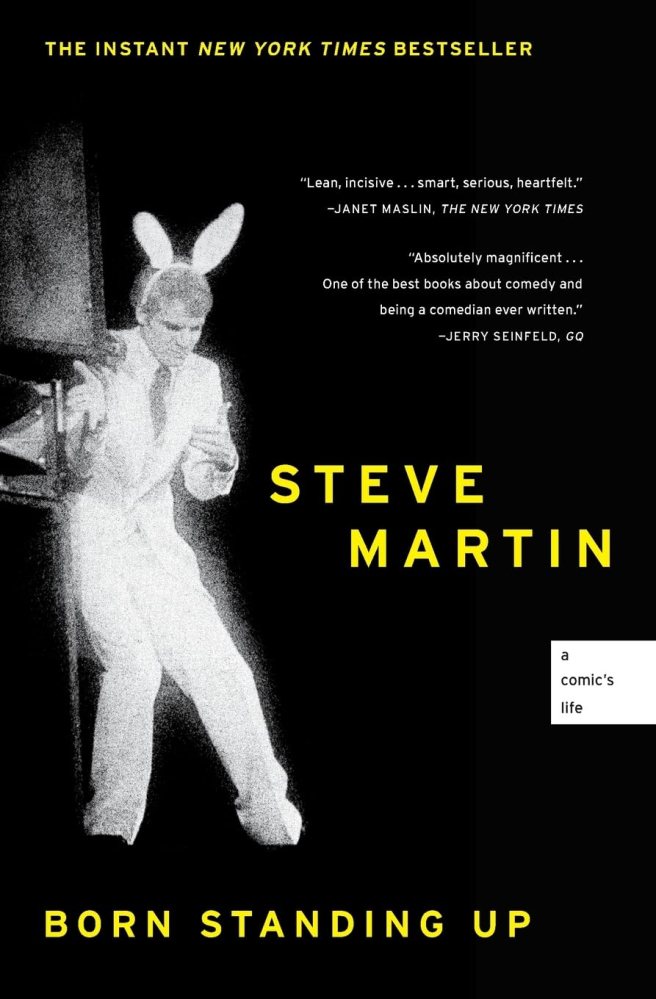
The photograph shows comedian and author Steve Martin wearing a white suit, a tie, and rabbit ears while on stage.

By Alex P.

Steve Martin is best known as an accomplished Hollywood actor, recognized as the star of classic comedies like Father of the Bride, Three Amigos, and Cheaper By The Dozen, but some folks may remember his brief time as a standup entertainer. In fact, Martin achieved national stardom through his standup work, released four comedy albums (Let’s Get Small and A Wild and Crazy Guy sold millions of copies), and established national catchphrases, such as, “well excuuuuse me”. His acting career only began after he burned out from that stardom, and Martin seeks to revisit those beginnings in his new memoir.

Born Standing Up focuses on the early life and career of the Hollywood multi-hyphenate. He comes of age in California; his first jobs included selling guidebooks at Disneyland and performing in a comedy troupe at Knott’s Berry Farm. His surreal sense of humor got him a position as a writer for the Smothers Brothers Comedy Hour, which kept him afloat while his “experimental” standup comedy struggled in California clubs and on late-night TV appearances. Against the blunt advice of his agent (“stick to writing”), he quit writing to take his performances on the road. 

Steve Martin’s standup comedy was weird, conceptual, nonsensical, and almost completely unique. There were props, he was a master juggler, and he played the banjo. He was a consummate entertainer, but his work was intellectual too; his friend Rick Moranis termed it “anti-comedy.” He had a theory behind his performances: “What if there were no punch lines? What if there were no indicators? What if I created tension and never released it?… What would the audience do with all that tension?… if I kept denying them the formality of a punch line, the audience would eventually pick their own place to laugh, essentially out of desperation.”

Some typical Martin one-liners:  

  • “I’m so depressed today. I just found out this ‘death thing’ applies to me.” 
  • “Here’s something you don’t often see:” [spreads mouth open with fingers, and leaps into the air while screaming] 
  • “I think communication is so firsbern.” 

The driving force of Martin’s life during this time seems to be either deep dissatisfaction or reckless ambition, as he constantly abandons his own comfort to try his hand at success. Martin seems more motivated by the idea of mastering his craft than by fame and fortune. He taped his shows on cheap cassette recorders so he could listen back and master his timing, obsessing over how to make audiences “get” his weird material better. He found the uncharted territory of playing those clubs exciting as he refined his craft, but the constant work was met with lukewarm results. It clearly took a toll on him,“ When I think of moments of elation I have experienced over some of my successes, I am astounded at the number of times they have been accompanied by elation’s hellish opposite.” 

He finally broke through and his inventiveness was widely recognized, but he lost the thrill of winning over those tough, small audiences. He now performed in arenas to crowds who were eager to recite his catchphrases and punchlines at him. “The nuances of stand-up still thrilled me, but nuance was difficult when you were a white dot in a basketball arena. This was no longer an experiment; I felt a huge responsibility not to let people down… I dabbled with changes, introducing a small addition or mutation here or there, but they were swallowed up by the echoing, cavernous venues.” Stardom made him terribly lonely and deeply exhausted. He was determined to use his stardom to try to find success while he could, and he pitched a tentative screenplay for The Jerk to Paramount. Carl Reiner signed on to direct, the film became a smash hit, and the rest is history.  

This obsession with self-improvement, artistic satisfaction, mastery, and success seems to stem from family issues: Martin is clearly haunted by his parents. His father, who physically disciplined Martin, sometimes indiscriminately, could barely acknowledge his son’s fame and success and would only do so disparagingly. His mother was clearly happy that her son became a star, but her compliments took an oddly backhanded form: “Oh, my friends went to the movies last weekend, and they couldn’t get in anywhere so they went to see yours, and they loved it!” The book ends with the deaths of each of his parents, with him at their sides, attempting to bring closure to the trauma and understand why they shaped each other the way they did. 

When you’re reading a comedian’s memoir, you usually expect an entertaining, light read with some poignant biographical vignettes to add a little gravitas. Born Standing Up reverses the ratio of jokes to earnestness. Not only does Martin impart a tremendous amount of wisdom and pain from his life experiences, he offers some of the most profound and thoughtful writing I’ve read in a long time. Martin reserves the jokes for either explaining the details of his standup material or making light of awkward life situations he found himself in, and I never really minded.

Born Standing Up is available in print or as an audiobook read by the author. 

Alex Pyryt is a DIY Instructor & Research Specialist at HCLS Elkridge Branch. 

Springtime at the DIY Center

Elkridge DIY Center: stacks of ladders and a wheel barrow stacked against a white wall, with a blue tile floor.
DIY Elkridge Branch

by Alex P.

Beautiful spring weather and fair temperatures are here, making this the perfect time to tackle the outdoor work that it’s been too cold to attempt.

As you ready your garden for vegetable crops, or get your lawn in shape, you may have to clear some debris. You can get it done with a variety of rakes that the HCLS Elkridge Branch’s DIY Collection has for different lawn areas and applications, or perhaps with one of our leaf blowers. We also have tree limb saws, pruners, and pole saws to help prune errant limbs on the variety of trees you may have around your lawn, so you can keep your area safe and keep your trees healthy.

One necessary but demanding task you may wish to tackle is clearing your gutters. The DIY Collection has a variety of ladders that can help you get the job done. We have various step ladders, such as the multi-position ladder, that are suitable for single story homes, and 20- or 24-foot extension ladders for two-story homes. From there, you can access your gutters with ease, so clear, flush, and adjust away! Check our catalog or come to Elkridge Branch for a list of our ladders and the average vertical reach you can expect while using them.

Car maintenance is also easier to do now that it’s warmer. Make sure you have enough engine oil and check your tire treads to see if they’re worn. If you need an oil change or are replacing a tire, the DIY Collection has an automotive jack and stands kit so you can lift your car safely for easy access. While your car is up, you can check your brake pads to see if they need replacing too. You can use our socket set, breaker bar, and torque wrench to get tires on and off your vehicle.

DIY is your place to tackle spring cleaning, planting veggies in your garden, and so much more. Borrow the tools mentioned above and stay tuned for exciting new additions to our collection soon.

Community Plant Swap
Sat, May 10 | 2 – 3:30 pm
HCLS Central Branch
For adults.
Calling all plant lovers and the plant-curious! Join us for the second HCLS live plant swap. Have an abundance of healthy seedlings, cuttings, bare-root or potted plants? Bring them to the Take-a-Plant area so they can find a new home. Bring a box or other container(s) to gather and take home new plant friends.

A woman wearing a blue shirt walks toward the camera, with a toaster under one arm and a broken lamp in the other.

Repair Cafe at the Library
Sat, Jun 14 | 1 – 4 pm
HCLS Elkridge Branch
Instead of throwing away broken items, bring them to a Repair Cafe where volunteers will do their best to give them a new life. If you are interested in how things work, or have a favorite item that needs repair, join us to see what’s possible. Clothing, jewelry, small electrical appliances, toys, furniture. (No smart phones or computers, or gas powered devices.) Volunteers evaluate and fix as many items as they can and offer their expertise for things too large or not possible to bring in.

Alex Pyryt is a DIY Instructor & Research Specialist at HCLS Elkridge Branch.  

Hundreds of Beavers

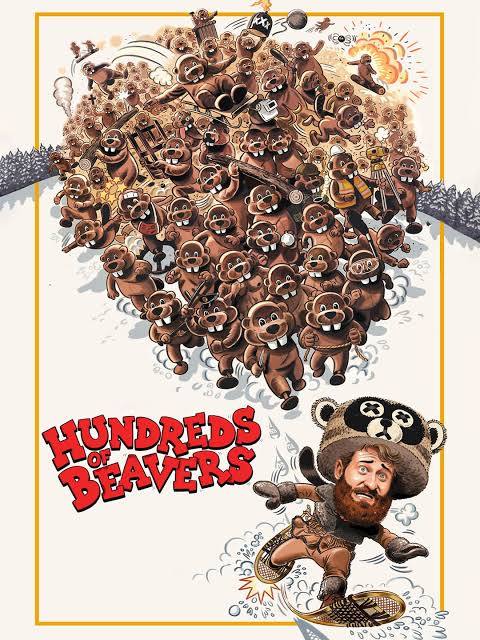
In a style reminiscent of National Lampoon or other madcap movies, the illustration shows a man dressed in a beaver costume fleeing a crowd of beavers. Text appears in red hand-drawn blocky letters.

by Alex P.

When Hundreds of Beavers got released to streaming services last year, it became one of the biggest success stories and most beloved films of the year, and for good reason. As a black-and-white slapstick comedy, awash in practical effects and Adobe After Effects 2D animation, completely devoid of dialogue and produced with only $150,000, it feels remarkably out of place in a cinema landscape dominated by CGI and character-driven dramas. But that very out-of-placeness is what makes its inventive qualities all the more precious. I feel that the poster, which IndieWire called one of the best of 2024, captures this perfectly. Its hand-drawn caricatures and bold red lettering are a direct throwback to the absurd comedies like It’s a Mad, Mad, Mad, Mad World and those by National Lampoon from the 60s and 70s, which make up just some of the film’s many influences. 

The influences are even wider than Hollywood comedies. The first act is a perfect translation of Looney Tunes cartoons to live-action film, before heavily incorporating video game logic in the second act. I particularly like how directly it translates the video game mechanics of survival games like Minecraft or Terraria into film action. We’ve seen a lot of video games adapted into films in the past decade, but they seem to flatten how the games work into standard Hollywood action. Seeing a movie that literally functions and presents itself like a video game as a framework for its action and plot is a bold innovation. Similarly fusing old and new influences, the slapstick feels equal parts Charlie Chaplin and early YouTube sketch comedy. 

Co-writer Ryland Tews stars as Jean Kayak, a 19th century applejack salesman turned fur trapper. The film’s action completely centers around his efforts to trap and kill cute critters (played by people in mascot suits) for sustenance and to trade their pelts for goods. The rigid logic about the tactics to trap each animal (beavers always fall for turds lacquered in castor oil, rabbits will go for anything that resembles a carrot) sets up most of the action as Jean discovers the logic of his world and his trade the hard way. The film’s best quality is the virtuosity with which it immerses you in recurring gags and wild internal logic that feel as well-scripted as a classical symphony. Again, thanks to the heavy use of video game logic, gags that would be throwaways in other movies recur again and again only to culminate in centerpieces where Jean uses everything he’s learned to set up giant, hilarious Rube Goldberg machines. 

In our age of digital proliferation, you’d think independent film would have flourished to a much greater extent than it has. Nearly everyone has a camera and powerful editing software sitting in their pockets. Instead, though, modern film has felt more suffocated than ever, as big studios insulate themselves from big risks by trying fewer crazy ideas and releasing fewer movies. In this era, then, it’s comforting and much needed to see a film made with no money whatsoever that looks amazing and oozes more creativity than most blockbusters and made more than six times its money back solely by word of mouth.  

You can watch Hundreds of Beavers on Kanopy with your library card and PIN. 

Alex Pyryt is a DIY Instructor & Research Specialist at HCLS Elkridge Branch.  

The Addams Family by Barry Sonnenfeld 

The image shows the Addams Family assembled before a full moon under a dark sky, in front of their home.

by Alex P.

The ooky, spooky Addams Family has charmed America for almost a hundred years in countless forms and adaptations, from Charles Addams’s original New Yorker comics to Tim Burton’s new TV series on Wednesday Addams. The 1991 film, though, has always struck me as the adaptation that captured the demented energy of the original comics the best. It’s the kind of delightful culmination of talent and influences that is truly lightning in a bottle.

The film is the directorial debut of Barry Sonnenfeld, but you’d never be able to tell from its bold camerawork, blocking, and mise-en-scène. (It must have helped that he was director of photography for the Coen Brothers’ first three films.) Before I saw the film, I assumed it must have come from the dynamic duo of director Tim Burton and Danny Elfman, but Sonnenfeld both channels their era-defining aesthetic influences and adds a faster pace and kookiness that are all his own. Every set in the film is so full of detail that the Addams mansion becomes its own character. The impossible layouts and mountains of cobweb and clutter allow it to feel like a live-action cartoon. 

Gomez’s brother, Fester, returns to the Addams Family after having suddenly disappeared decades earlier in the Bermuda Triangle. But Fester is not Fester: the reunion is a scheme cooked up by Addams’s lawyer as a way to repay loan shark Abigail Craven. Craven’s adopted son Gordon resembles Fester remarkably, so he’s sent into the mansion during a séance to access the eccentric family’s vast riches. The bulk of the action follows Fester as Gomez wants to reminisce about growing up together, while Fester tries his hardest to keep up with the Addams’ odd and morbid customs. 

Those customs are perfectly presented in the spirit of Charles Addams’s one-panel comics. The Addams Family lives a macabre mirror image of the traditional American household, captured in this earnest and glorious interpretation. The film has aged perfectly, thanks to the simplicity of the characters and costuming, the labyrinthine sets, and the practical effects for, for example, the disembodied hand, Thing. The cast is also a once-in-a-lifetime assemblage. The late Raul Julia leads as Gomez Addams, and his chemistry with Morticia (Anjelica Hudson) is indelible. The momentum of the film is carried by the glee the pair shares in the perverse and morbid, and Julia in particular thrills with expressive and kinetic energy. Christopher Lloyd is cast against body type as Fester Addams, and though his role is peripheral, the seven-foot-tall Carel Struycken plays a perfect Lurch.

The influence Charles Addams’s characters have had on American culture is monumental; it’s arguable that he created goth culture. Accordingly, every generation has had several adaptations competing to be their favorite. For me, though, Sonnenfeld’s celebration of these characters is the one that defines them and transcends its era. 

The Addams Family is available on DVD and for streaming through Kanopy

Alex Pyryt is a DIY Instructor & Research Specialist at HCLS Elkridge Branch. 

The Killing by Stanley Kubrick

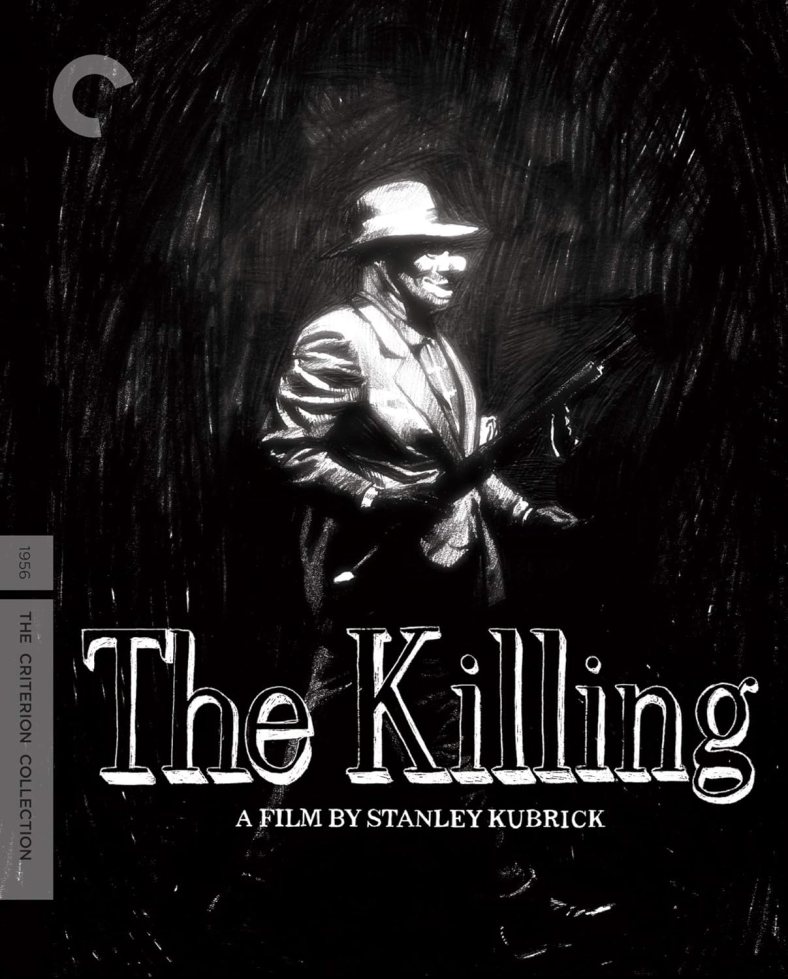
The image depicts a man with a bulbous clown-like nose, wearing a hat and carrying a club. He is portrayed against a dark background.

by Alex P.

I’ve always been drawn to crime films, from Fritz Lang’s “M” to classic film noir to Martin Scorsese’s extensive gangster film output, with their allure of hidden underworlds of organized crime and the handsome rewards it brings at the risk of it all falling apart at any moment. Whether you identify with the criminal masterminds or with the police detectives hot on their trails, it’s a strain of cinema that’s had appeal since the inception of film itself and 1903’s The Great Train Robbery.  

One sub-genre of crime that’s stuck with me is the heist film. There’s something exquisitely thrilling about watching a heist carried out from the planning stage to the execution where it all goes so right or so wrong; think Baby Driver and The Bad Guys for popular recent examples. 

Director Stanley Kubrick’s shadow still looms large over the art of film, but some people may not know one of his earlier films, The Killing, a 1956 heist noir that gave Kubrick his first critical success. Many know the 1968 ensemble comedy Dr. Strangelove, his last black and white film before the monolithic 2001: A Space Odyssey. Fewer know of Lolita (yes, that Lolita), Spartacus, or Paths of Glory, but I suspect the most obscure are his first three films. Fear and Desire and Killer’s Kiss are independent, exploratory films where Kubrick was finding his footing; these were followed by The Killing, starring the elusive Sterling Hayden, which was a real home run.  

The Asphalt Jungle was a foundational heist films, and it seems clear that Kubrick wanted to emulate it a few years later with The Killing. Kubrick plucks Sterling Hayden from The Asphalt Jungle’s all-star cast to play Johnny Clay, the mastermind behind a heist at a horse-racing track. Clay remains a mysterious and dominating figure, and much of the story is dedicated to the setup of the heist and the ensemble of his hired co-conspirators. More of the tension comes from a psycho-sexual rift between George, the racetrack cashier, and his wife Sherry, who overhears the plot and schemes to take George’s money and run. This sub-plot strikes me as The Killing’s weakest aspect, as it is far too maudlin and the sets are cheap, complete with a fake parrot. The rest of the cast, though, comprise a thrilling ensemble of characters, each of whom plays a perfectly compartmentalized part.  

Johnny Clay, as played by Hayden, is a complete enigma. Just out of prison, he immediately starts moving on the heist. He conducts himself with an affect so cool and calculating that it strikes the viewer as sociopathic. My favorite participant in his heist is Maurice, played by Georgian wrestler Kola Kwariani. He’s a highly intelligent, thoughtful, soft-spoken man who works in a chess club, and it is tragic to watch Clay pay him to get drunk and start a fight, reducing a smart and sensitive man to hired muscle. Every participant is meticulously positioned to play a separate part in his scheme while remaining unable to implicate him if they fail. It’s so well-planned, and the execution is mesmerizing and unforgettable, but so are the inevitable snags along the way.  

When comparing The Killing to The Asphalt Jungle, I’ve found that the inherent moral ambiguity makes Kubrick’s heist film memorable, as the start of a theme that continued throughout his career. In The Asphalt Jungle, the charming and likeable criminals are served their just desserts, complete with a speech by the police to an eager press pool that feels straight out of a public service announcement. While in The Killing, the brief but poetic comeuppance that comes to the Clay at the film’s end comes instead from a cruel and simple twist of fate. Instead of seeking answers from the morals and standards and the laws of his era, Kubrick looked to bad luck and the randomness of the universe. 

Like many overlooked greats, The Killing can be found on Kanopy using your library card. Though I mostly use it for hidden gems that can’t seem to find their home in more commercial environments (take, for example, The Hudsucker Proxy), it still has recent blockbuster hits, as well as classic documentaries and more. 

Alex Pyryt is a DIY Instructor & Research Specialist at Howard County Library System Elkridge Branch. 

The Hudsucker Proxy, available on Kanopy

A man in dress pants and suspenders, with his tie flying over his shoulder, smiles through a red hula hoop on the marquee poster for The Hudsucker Proxy.

by Alex P.

I went to the theaters the other day to see Francis Ford Coppola’s Megalopolis, a kaleidoscopic, stylish mess of a film, which is polarizing and exciting moviegoers and critics and making very, very little money. This latter fact is a constant reminder as I look back at my favorite films; most of them were bold statements, so bold that the cold logic of the marketplace left their makers in the red. Megalopolis also prominently features the Chrysler Building and 40s art deco, as well as 40s Hollywood (old cars, suspenders, city hall meetings, scaffolding) as one of the central visual themes. This left me remembering one of the most stylish box office bombs in cinema history: The Hudsucker Proxy by Joel and Ethan Coen (who, immediately after this film, went on to make Fargo, The Big Lebowski, and O Brother, Where Art Thou?, in that order!) 

The Hudsucker Proxy is a bold love letter to the art deco, brutalism, and bauhaus styles that dominated the New York skyline and business suites of the 30s and 40s, the Cary Grant screwball comedies of the era (think Bringing Up Baby), as well as the sentimental Jimmy Stewart blockbusters like It’s A Wonderful Life. It stars Tim Robbins as a clueless, well-meaning businessman from Muncie, Indiana, Jennifer Jason Leigh as a fast-talking newspaper reporter (giving a very Katharine Hepburn performance), and a cranky Paul Newman as a high-ranking executive of Hudsucker Industries.

After the untimely demise of Hudsucker’s founder and CEO, Newman concocts a scheme to elevate the clueless Robbins from the company’s mailroom (featuring one of the coolest sets I’ve ever seen, replete with steam, pneumatic tubes and a constant confetti of mail) to CEO; he aims to recruit the dumbest person he can find to the position in order to lower the company’s stock to the point where he can buy a majority stake and take it over himself. As is the case with the best of the Coen brothers’ films, there are endless twists and turns and a brilliant supporting cast. Bill Cobbs plays the omnipotent caretaker of the Hudsucker Industries clocktower, Jim True (“Prez” from The Wire) plays an overactive elevator operator, and Steve Buscemi plays a beatnik bartender.

It’s also a rare feel-good film from the Coens. Right after making the endlessly nihilistic Miller’s Crossing and Barton Fink, this film has a sentimental tone truly reminiscent of Frank Capra’s best films. A lot of the action takes place on Christmas, and some of the most memorable shots of the film feature a stylized miniature set of the New York City skyline awash in snow, truly bringing back memories of It’s a Wonderful Life.

The amount of style on display gives the appearance, action and direction of the film the feel of a live-action cartoon; while always keeping a grounded feel, there’s a speed to it and a constant stream of gags and emphatic camera movements that deliver class and hilarity. The Hudsucker Proxy is such a gem in the Coens’ catalog; they were given their largest amount of money to work with to date and comes at just the right time in their career for them to utilize the budget in order to execute a wild, unique vision replete with symbolism, gags, and profundity.

One of the most puzzling but profound aspects of the film is the constant motif of the circle (yes, the shape): A large aspect of the plot comes from the dramatic irony of Tim Robbins’s character hedging his career on Hudsucker Industries by introducing the hula hoop to the market, an invention that his handlers deem as doomed to failure, but is instantly recognizable to us as an icon of 50s consumerism. He also veers into contemplating the concept of karma, specifically samsara and the wheel of existence. The circle imagery is constantly present but never seems to resolve, but it impresses nonetheless. The film was a marketing failure, not an artistic one. 

After hearing the story of the film and its position as a rare dud in a huge stream of heavy hitters in the Coen brothers’ filmography, I was determined to find a copy, only to come up empty handed until I found it on Kanopy using my HCLS library card. Kanopy is a great resource for finding everything from box office hits to independent films, but I’ve found that it’s a great resource for films that don’t seem to fit in among the rest. If you’ve never tried Kanopy, you might be surprised to find the weird little films you’ve been searching far and wide for staring you right in the face. 

The Hudsucker Proxy is available to stream on Kanopy. 

Alex P. works in the Customer Service department in the Savage Branch of the Howard County Library System. 

Joyland by Stephen King

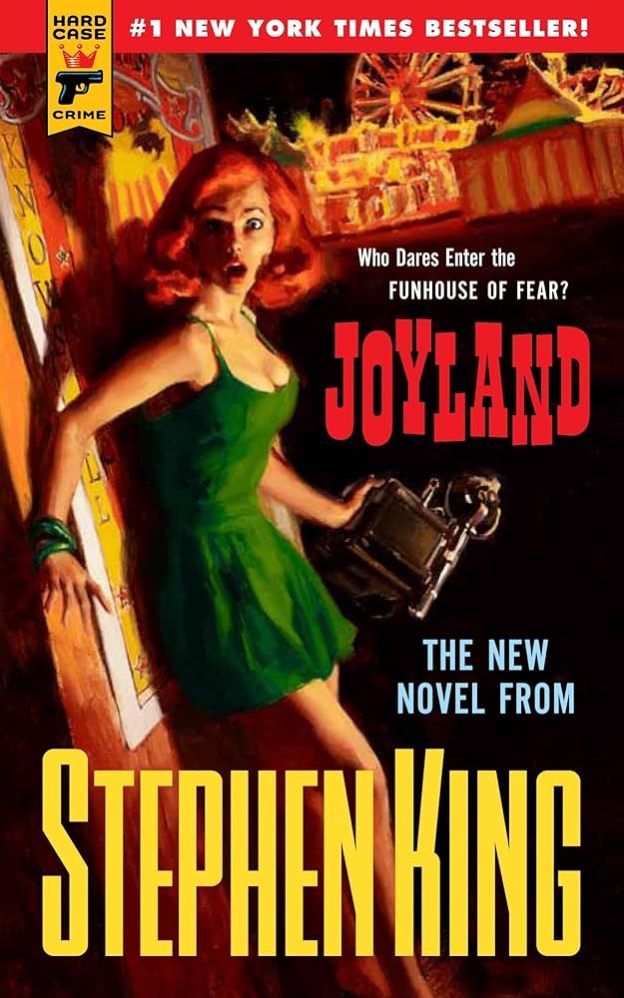
In the vein of old pulp covers, a red-haired woman (maybe a doll?) in a short green dress holds an old-fashioned square camera. She looks startled, and there's a carnival above and behind her.

Stephen King is an author whose work, while distinctive in style and subjects, spans many genres. This is proven, in some ways, by the breadth of Stephen King movie adaptations. Many know his work through classic Hollywood horror films like The Shining and Misery, but fewer know that non-horror classics like The Green Mile and The Shawshank Redemption have their origins in his work. Even fewer know of his forays into fantasy (The Dark Tower, The Eyes of the Dragon) or science fiction (The Tommyknockers, Running Man).  

One particular stylistic foray of King’s was his trilogy for Hard Case Crime, a publishing label that focuses on a style of detective novels known as hard-boiled fiction. This extends to the cover art for their releases, which all pay homage to pulpy paperbacks of the 1940s and 50s. King has written three books for the imprint: The Colorado Kid (2005), Joyland (2013), and Later (2021).  

The middle of these, Joyland, less resembles the detective noir fiction of the 40s by Raymond Chandler and Mickey Spillane than it is more akin to King’s classic coming of age story The Body (later adapted into the Hollywood hit Stand by Me). The book’s adult narrator, Devin Jones, recalls his summer job at Joyland carnival in North Carolina from his high school years. He describes it as a popular, dingy, and dubious little fairground that’s ideal for students who want to make a little money on their summer break. Devin, though, seems to be a natural at carny work, rising to the top of the ranks and becoming buddy-buddy with the management. After becoming somewhat of a local hero with a particularly good performance in a blistering hot mascot suit, he elects to take a break from school to work full-time at the carnival, much to the dismay of his parents. 

Again, the tone is far less Maltese Falcon and more sentimental and sweet, a nostalgic ode to the growing pains and new experiences that are expected from a carnival summer job in a beach town. Much of the book provides a nuts-and-bolts look at how carnys work, down to their slang and the way they work the rides, games, booths, and stands. Eventually, an murder mystery emerges (and a connection to one of King’s other novels, as introduced by a fortune teller), but it’s overwhelmingly clear that King’s heart lies elsewhere; It’s one of his sweeter novels, aching with nostalgia and an overwhelming amount of heart. I found it best experienced through its audiobook, a great performance by actor Michael Kelly, best known for his work in the show House of Cards.  

Joyland by Stephen King is available in print and e-book, e-audiobook and book on CD.

Alex Pyryt works in the Customer Service department in the Savage Branch of the Howard County Library System.