

by Ben H.
Though we do not wholly believe it yet, the interior life is a real life, and the intangible dreams of people have a tangible effect on the world.
James Baldwin
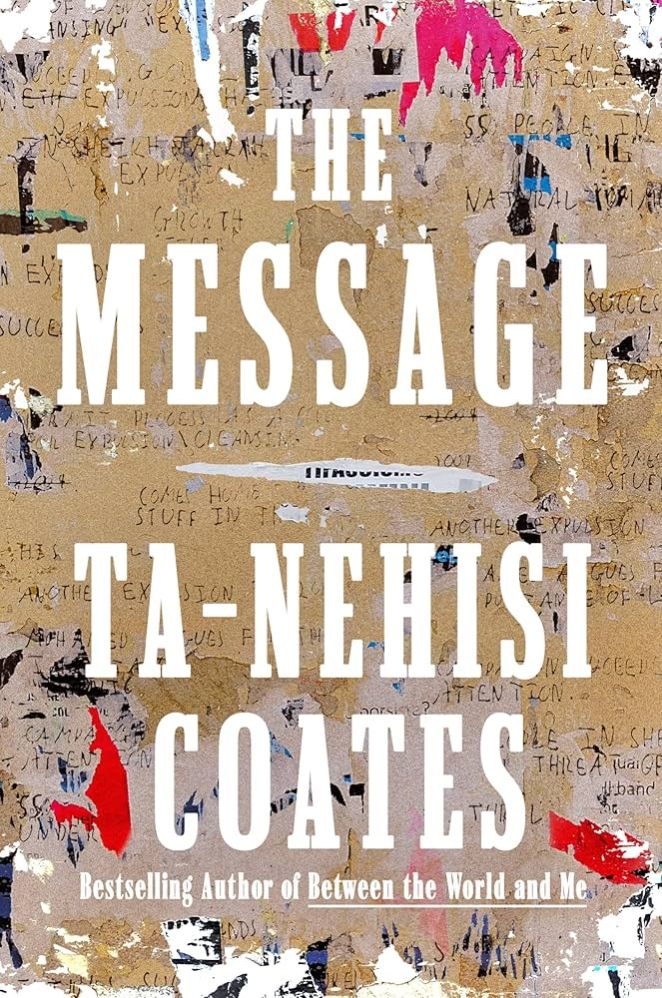
Ta-Nehisi Coates opens The Message with the above quote, and it’s a great frame for his book. Coates, the esteemed public intellectual from Baltimore and author of many excellent works such as Between the World and Me and We Were Eight Years in Power, explores three places in The Message: Senegal, South Carolina, and Palestine. Returning to the Baldwin quote for context enriched and expanded my understanding of the book.
Coates first takes us to Senegal, “I had indeed come home, and ghosts had come back with me.” He processes his own history, constantly referencing his parents, and the history of slavery and the slave trade. Coates intermingles the unbearably heavy and the humorous in the same way those things blur together in real life. He visits the “Door of No Return” and eats a delicious meal by the ocean. He stays at a luxurious hotel and thinks about, “blood in the bricks and ghosts in the attic.” He regrets the fancy hotel. The juxtaposition of heavy and humorous stretches back to his childhood and the “inheritance of the mass rape that shadows all those DNA jokes” he and his friends would make. Though we come from different backgrounds, I find Coates constantly relatable.
After Senegal, he moves us to South Carolina. He’s flying to South Carolina to support Mary Wood. Wood, a high school English teacher, assigned Between the World and Me to her class but was ordered to stop teaching the book. What is censorship and the uproar about Critical Race Theory other than an attempt to control the intangible inner life of people to keep it from having a tangible effect on the world? Coates writes, “the arts tell us what is possible and what is not, because, among other things, they tell us who is human and who is not.” As a librarian, this chapter dealing with representation in the arts, censorship, and education felt written for me.
After South Carolina, he visits East Jerusalem and the West Bank. Coates opens in Yad Vashem with the Book of Names. The Book of Names is a project to collect the names of all the Jews murdered in the Holocaust and display them. It’s overwhelming. Coates considers genocides and how the efforts to remember them, memorialize them, or recognize the horror of them can result in a second tragedy where the murdered men, women, and children are “reduced to a gruel of misery.” Coates is devastated by the holocaust memorial and crushed by the suffering of Palestinians.
Coates sees Palestinians living, at best, in a Jim Crow state. He can’t unsee this connection to his own country, life, and history. In the Jim Crow South, there was a privileged group with full rights and a disadvantaged group with partial rights. In East Jerusalem and the West Bank, he sees a privileged group with full rights and a disadvantaged group with partial rights. He drives on roads with his Israeli guides that he can’t drive on with his Palestinian guides. As he travels with Palestinians, he feels the “glare of racism,” and he sees soldiers with the “sun glinting off their shades like Georgia sheriffs.” His narrative is compelling; his argument is strong. I think his assessment of the situation is accurate.
What ties Coates’s journeys together? What connects Senegal and South Carolina and the West Bank? Let’s return to Baldwin’s quote and assume that Coates included it for a reason. All three situations reflect the tangible effect of the interior life of people. The interior lives of his mother and father had a tangible effect on him as a child and he expands on this in Senegal, constantly wondering what his father was thinking or how he thought about things. The high school in South Carolina wanted to ban his book for fear of the tangible effects that would result from the change in interior lives. The heartbreaking suffering and misery in Gaza is the horrendous tangible effect of generations of interior lives.
I appreciate Coates’ approach. He’s not a sophist. This isn’t an empty academic argument or intellectual exercise. He calls his books his children. He puts his whole self into his writing. His whole being is in his work. If you’ve seen his interviews or headlines about his book, but haven’t had time to read it, I think it’s worth the time.
Ben loves his job at HCLS Project Literacy. When he’s not at work, you might find him walking around Lake Kittamaqundi (on his break), playing pretend with his daughter Annika, reading, peeling garlic, weeding his tiny lawn (Canada Thistle, leave me be!), eating chocolate, or listening to baseball games on the radio.








 CHAPTER CHATS