The Cartoonists Club by Raina Telgemeier & Scott McCloud

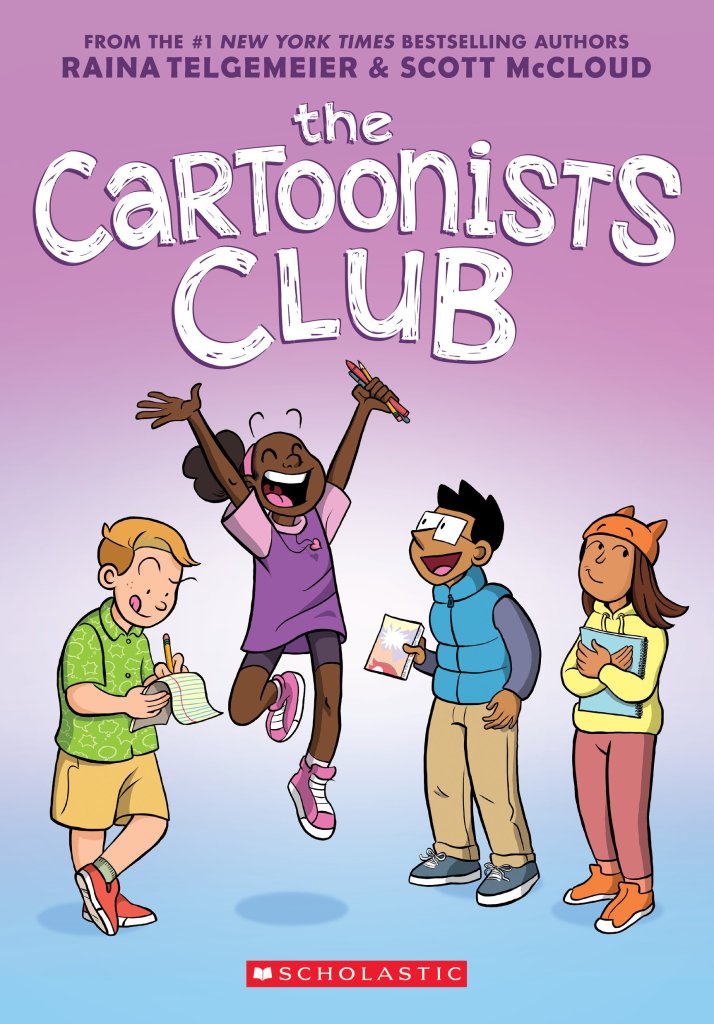
The book cover depicts four middle-grade students holding sketchbooks, pencils, notepads, and other drawing implements; one is jumping into the air excitedly, one is watching with a big smile on his face, one is looking to the side wistfully, and one is concentrating on writing or sketching on a lined piece of notepaper.

By Holly L.

Back in 2020, during the lockdown days of the pandemic, I logged on to a Zoom featuring cartoonist Raina Telgemeier with my then-second grader. As huge fans of Raina’s work, and having read, re-read, and read again, Smile, Sisters, Drama, Ghosts, Guts, and the first four Baby-Sitter’s Club books, the two of us were super excited to hop online with our favorite graphic novelist. Raina was just as friendly and charming as we imagined, with a level of nervousness that seemed exactly appropriate for an introverted artist.

There was some book talk, a Q&A, and, to our delight, a live sketching session. Black marker in hand, she drew several images, but the one that stands out in my mind is of a cover mock-up, rendered in the style of Smile, Sisters, and Guts. It was a big, round sourdough loaf captioned with the title Bread. Raina said that she, like many others during the pandemic, had gotten elbow-deep into making sourdough, so it seemed an appropriate theme for a new book. Because this explanation came across as a bit tongue-in-cheek, we didn’t necessarily expect to see news of an upcoming book in the months that followed. But still, my daughter and I both hoped that we had actually been let in on a secret that afternoon and that Bread would someday make it into print. Months turned into years with no publication news, about Bread or any other Raina book. That is, until June 2024, when Scholastic’s Graphix announced the 2025 publication of The Cartoonists Club by Raina and Scott McCloud. 

Comic fans will recognize Scott as the author of Understanding Comics, widely considered an essential guide to comics as an art form and one of Raina’s all-time favorite books. From Raina’s website

When I was 16, I read Understanding Comics by Scott McCloud, a ‘comic book about comic books.’ It immediately cemented my desire to be a cartoonist–as well as gave me a shape and vocabulary for the scope, philosophy, iconography, and downright magic of comics storytelling. That was a pivotal moment for me, and I speak with a LOT of young readers who have been looking for a similarly pivotal book for them. The Cartoonists Club is the result of almost 5 years of working together with Scott himself, to create what we hope is that book!

The Cartoonists Club follows four young, diverse characters who form friendships through their love of comics. Makayla, Howard, Lynda, and Art are middle school students encouraged by Ms. Fatima, their school media specialist, to form a club centered on their passion for reading and making comics. Makayla has so many ideas but has a hard time turning them into a story. Howard’s passion is drawing, but he is often short on ideas. Lynda fills page after page in her sketchbook but is her own harshest critic.  Art is a maker who just loves to be creative and has enough enthusiasm for the whole group. By featuring characters with different approaches to creativity, the authors establish an inclusive space in the pages of the book where there is no one “right way” to be an artist. In the “Behind the Scenes” section that follows the story, Raina remarks that each of the characters represents different traits possessed by the two authors. 

As the characters learn various techniques of the comic craft, the reader becomes acquainted with what Ms. Fatima calls “The Magic of Comics.” The club members hone their own trademark styles, making individual comics while working as a team in preparation for what will–hopefully–be their big debut at the local mini-con, where they’ve applied to set up a table. The Cartoonists Club is an inspiring and illuminating story of friendship and self-expression that graphic novel and comics fans will enjoy. In addition to the story, the book also features a fun “Behind the Scenes” section, including “A Chat with Raina and Scott,” a Q&A addressing questions (such as “how do you get better?” and “what advice do you have for aspiring comics?”), a comics glossary, a list of Comics Jobs, How We Made This Book, and Resources and Suggested Reading. Although I’m still holding out hope that Bread will someday make it into print, I thoroughly enjoyed this collaborative and entertaining read about the art of comics.

The Cartoonists Club by Raina Telgemeier is available in print and e-book.

Holly is an Instructor & Research Specialist at HCLS Miller Branch. She enjoys reading widely, knitting sporadically, and baking as often as she gets the chance.

The Harder I Fight The More I Love You by Neko Case

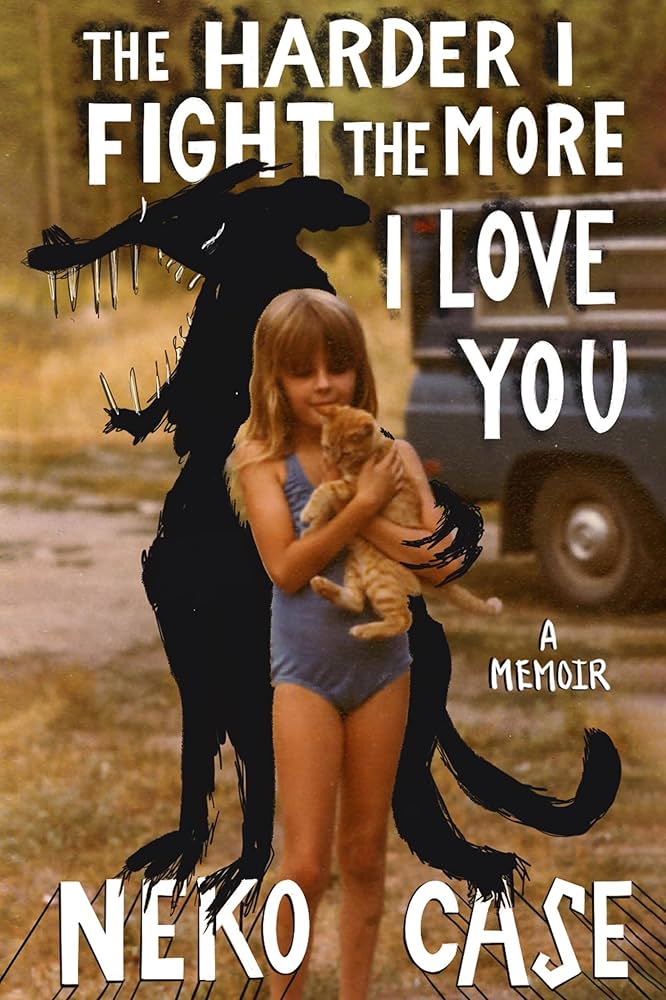
A young girl stands in a run-down yard, wearing a bathing suite and holding an orange kitten. Appearing immediately behind her is a rough sketch of a big black dog with sharp teeth.

By Holly L.

“I had actually DONE IT. I had made horses appear!!!” Neko Case recalls a defining moment described as “a bit of magic” from her childhood. Neglected by young parents who left her home alone from a too-early age, she was constantly hungry for food and companionship. One day, while desperately yearning for a horse, she makes not one but two horses appear before her eyes, a visualization she describes as “a real arrival to a real place.” In drawing these beasts from her imagination, Case establishes a sense of self and a creative identity that proves comforting.

She says that today, at age 52, she, “can still see the horses clear as day.” An early scene from Case’s new memoir, The Harder I Fight The More I Love You, it is one of many pictures drawn from memory that illustrates a fierce bond with nature and longing for connection in a world in which she felt unwanted. Today, she is a critically praised Grammy-nominated artist and has recently been welcomed back to the Grand Ole Opry after being banned in 2001 after taking her shirt off (playing an outdoor festival on a sweltering day, she found herself delirious and stripped down to her bra to avoid heatstroke).

I discovered Neko Case in 2005 when my friend Amanda tipped me off to her. Encouraging me to give her a listen, she said the name of Case’s third album like a command: Blacklisted. So I listened. The opening song Things That Scare Me hooked me from the start with its dark country twang and noir vibes (Case mentions the recently departed David Lynch as a strong influence). By the second song, “Deep Red Bells,” the saturated images of her haunted world gave me chills and had me fully converted: 

The red bells beckon you to ride
A handprint on the driver’s side
It looks a lot like engine oil and tastes like being poor and small
And Popsicles in the summer

Case details her traumatic childhood, starting out poor and small outside Bellingham in Northwestern Washington State. She recalls communing with the velvety-tracked ferns outside the trailer she shared with her mom and dad as she lay on the ground to “pet the soft dots” for hours. Throughout the book, she speaks reverently of animals and nature as wondrous beings, benign and free of ill-intent, unlike the adults in her life. Looking back on a short stint in her early childhood when the family lived near Cocoa Beach, FL when her dad was in the Air Force, Case recalls encounters with crabs, “little magicians of harmless danger, their black eyes atop long stalks like cartoon exclamation points.” This kind of vivid imagery, familiar to fans of her music, injects her prose with sound and color, conjuring up a sort of real-life fairy tale. 

Things get dark in Case’s story when, as a second grader, her Dad abruptly informs her that her mother is dead. His story is that her mother has been “very sick” recently, which is news to Case, who recalls only a few doctor’s visits, nothing that seemed serious. Stunned with disbelief, she gets on with life as kids do, only to be told by her father a little more than a year later that her mother is actually alive and has been living in Hawaii to receive treatment for her illness. The explanation is that her mother left so that the family wouldn’t have to see her suffer. Case is so elated to have her mother back that she doesn’t really question the story until years later, and the family never speaks about it.

From these turbulent beginnings outside Bellingham, Case crisscrosses the state as she splits time between her parents, who have divorced. Whether with her mom or dad, she is left alone for hours at a time, an only child who finds connection to the music that she hears on the radio: Buffy Sainte-Marie, the Go-Go’s, and Blondie are among those whose records she listens to in her school’s library when the other kids are playing at recess. Music becomes Case’s comfort and escape. Putting on headphones and pressing play on her “lavender off-brand, gas-station Walkman” helps her drown out the noise of a menacing world occupied by depressed, neglectful parents and the ever-present threat of the Green River Killer, whose murders dominate the local news. When she leaves Washington to attend a fine arts college in Vancouver, BC, she starts playing drums in a punk band called Maow. Feeling comfortable behind the drum kit, she’s reluctant to sing and one day asks her bandmates which one of them should sing a song when one shoots back “YOU sing it!” And so she does. The rest is history.

Although she had loved to sing all her life, it took her a long time to consider herself a capital S singer. Throughout a 30+ year career spanning solo and collaborative albums with such bands as power pop dynamos The New Pornographers, Case has taken ownership of her voice—which ranges from a soaring clarion call to a soft, breathy lilt and is always uniquely her own. I tore through this page-turner of a memoir, enthralled by Case’s heartbreaking story told in her trademark voice. Case’s sense of humor and nuanced perspective help the reader process some of the darker elements of her past, which includes severe neglect and sexual abuse. Ultimately, this is an affirming tale about survival and the transformative power of art. I came away from the book with an enhanced appreciation for the strength underpinning Case’s voice, eagerly anticipating her future projects, which include a forthcoming album later this year as well as a musical adaptation of the 1991 film Thelma and Louise.

The Harder I Fight The More I Love You is available in print, e-book, and e-audiobook. Neko Case also publishes a Substack newsletter called Entering the Lung.

Holly is an Instructor & Research Specialist at HCLS Miller Branch. She enjoys reading widely, knitting sporadically, and baking as often as she gets the chance.
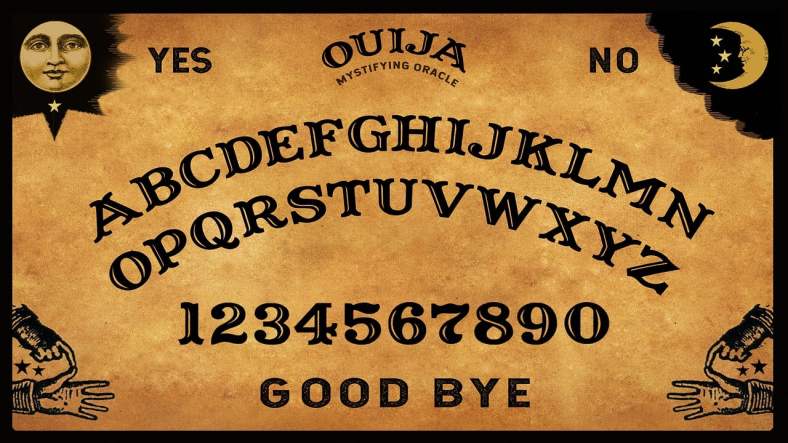
Mediums, Magicians, and the Ouija Board

Ouija Board with a curved alphabet, numbers 1 through 0, a moon and yes in the upper right corner, and a moon and no in the upper left.

Thu, Oct 10 | 6:30 – 7:30 pm   
HCLS Online  
For adults. Register here to receive the link 

Join us for a journey into Charm City’s Spiritualist past.  

Julie Saylor, of Enoch Pratt Free Library’s Maryland Department, explore the roles of mediums, magicians, and the Ouija Board in early 20th century Baltimore through the lens of Spiritualism. A religious movement that gained popularity in 19th century America, Spiritualism offered its followers hope that they could communicate with their deceased loved ones. These exchanges occurred through ritual seances, the dearly departed speaking through a person called a medium. The Spiritualists were active in Baltimore Society, many aligning themselves with progressive causes such as abolition, feminism, prison reform, and labor reform. 

Working in opposition to the Spiritualists were magicians, who viewed Spiritualists as charlatans who took advantage of impressionable mourners. Seeking to protect the integrity of their craft, Baltimore magicians founded a magic club called The Demons Club, which had ties to such prominent magicians of the day as Harry Kellar, Howard Thurston, and Harry Houdini.  

While the magicians were working to debunk the Spiritualists and spirit mediums, local manufacturers picked up on a surging interest in “spirit boards.” With origins in Northern Ohio, the spirit board, a small wooden board with letters, numbers, and a pointer, was devised as a tool to facilitate communication between the living and the dead. Find out how Baltimore businessmen created and patented the famous Ouija Board, which continues to enjoy popularity to this day. 

Presented in partnership with the Maryland State Library Resource Center. 

Sigh, Gone by Phuc Tran

The book cover shows a school picture of the author as a child, against a gray background. He is wearing a white shirt with a collar beneath a peach sweater.

By Holly L.

When I first glimpsed the cover of Phuc Tran’s powerful 2020 memoir, Sigh, Gone, I chuckled at the title. Sigh Gone—hahaha, I get it! As in Saigon. As in Vietnam, the country Tran fled with his family as a little boy in the mid-70s. The unsubtle title perfectly suits the story of, “a misfit’s memoir of great books, punk rock, and the fight to fit in.” In his debut book, Tran tells a compelling coming-of-age story of a book-obsessed punk in small-town Pennsylvania. His case for the transformative power of books struck a chord with me, as a library worker. As an Asian American who also came up in 1980s America, I empathized with Tran’s struggle to fit into a society that was relentlessly calling his American-ness into question.   

Each of the book’s sections is titled with a famous work of literature, the prologue being Oscar Wilde’s The Picture of Dorian Grey. The opener is a scene from Carlisle Senior High School in Carlisle, Pennsylvania, a small town in the Susquehanna Valley. Tran is sizing up the new kid, Hoàng Nguyễn, whose arrival marks Phuc’s demotion as the (meaning only) Vietnamese kid at his school. “@#$% that kid,” he thinks. Rather than seeing Hoàng as a potential comrade, Tran regards him as “a fun-house mirror’s rippling reflection of me…I was filled with loathing.” By this time, as an eleventh-grade Asian kid who had finally achieved “insider status”—acceptance among his punk crew and being better read than any of his classmates—Tran saw Hoàng as only a distorted picture of who he might have been had he not assimilated so well.

The story begins in earnest in 1978 with Tran’s earliest memory. He’s in the eat-in kitchen of his family’s first apartment in the United States, having fled Vietnam three years earlier. While his mother prepares dinner and his father tries to make sense of some bills with his limited grasp of English, Tran asks his dad, “Ba, what’s my name?” The question arises from playground encounter when another kid asked Tran his name and he didn’t know how to reply. Among all the nicknames and endearments he was labeled with by his family, he didn’t know which name to give. Young Tran felt he needed a name, an English name, that would make sense to his playmates. After a minute of consideration, Tran’s dad decided that the actual Vietnamese pronunciation of his name (which sounds more like Fuhp, with a rising tone at the end) would be too confusing to Americans, and he settled on Phuc (sounds like Fook, rhymes with Luke), which Tran adopts, referring to it as an alter ego.

Tran’s story takes us from childhood through adolescence with identity being a central theme. As he forms friendships and battles racist bullies, Tran struggles to define who he is, along with where he and his family fit in a mostly white working-class town. He expresses an ambivalence about his community, “(as refugees) random strangers had saved us. And random strangers were cruel to us, too.” Violence is another thread running through the memoir, inflicted upon Tran by school bullies and members of his own family.

He finds refuge and a means of self-fortification through books (first comics then Western classics) and later, music, specifically punk rock and its rebellious, non-conformist subculture. Tran’s scuffed Doc Martens and rotation of band T-shirts represent an identity of his choosing, not one imposed upon him by society. As Tran’s reinvention into honor-roll skate punk becomes complete, we see a growing alienation from his family, whose notions of success and assimilation don’t align with his own. One exception being Tran’s second-hand store hauls, approved of by his thrift-conscious father.

Some reviewers criticized Tran’s memoir as lacking in nuance and maturity, but I loved how he channeled the voice of his teenage self in all its egocentric, pained, misunderstood glory. In the best scenes I felt like I was right there, hanging out with his crew, cheering them on when they successfully fled the cops on their skateboards during their annual “Running of the Pigs.” By the end of the book, I felt a kind of pride in this self-made young man, considering how far he had gone, what he had endured, and who he had become. I almost wished for another few chapters detailing the adventures that awaited Tran beyond graduation. But that was the end of the story, at least until he writes another memoir. Sigh, gone. 

Sigh, Gone is available from HCLS in print and also in e-audiobook and e-book formats.

Holly Learmouth is an Instructor & Research Specialist at HCLS Miller Branch. She enjoys reading widely, knitting sporadically, and baking as often as she gets the chance.

Exercise Your Brain with BrainHQ

The logo shows the regions of the brain in three colors - orange, yellow, and pale green.

By Holly L.

Is your daily Wordle not enough of a challenge these days? If you’re looking for a fun new way to engage your brain this summer, consider BrainHQ.

One of the many free online resources we provide, BrainHQ is brain-training program developed by international neuroscientists. Led by Michael Merzenich, co-inventor of the cochlear implant, this team has translated 30 years of brain research into a personal gym for your mind. The program works by helping to rewire the brain by taking advantage of its plasticity, or ability to change through learning and experience.

The 29 exercises focus on attention, brain speed, memory, people skills, navigation, and intelligence. A personalized trainer feature allows you to choose which cognitive areas you want to focus on, using an algorithm to measure your performance and adapting each exercise to your optimum level. Each BrainHQ level can be completed in five minutes, so you can “work out” in small chunks or longer sessions, to fit into your schedule. A BrainHQ app also allows you to play on your mobile device.

In case you’re wondering about the science behind the program, BrainHQ provides links to published studies demonstrating its proven benefits. One study documented that BrainHQ training in combination with physical exercise improved episodic memory—the memory for specific events in life, such as a first day of school or a special party.

BrainHQ might also help improve quality of life, as with improved focus, memory, and brain processing, people are able to stay healthier, with greater feelings of happiness and control.

I flexed my mental muscles today with a few rounds of a fun memory exercise called “Eye for Detail.” It focuses on brain speed and working memory, which is the brain’s ability to store small amounts of information in the short term for recall at a later time. In this exercise, three butterflies briefly appear on the screen, two of which are matching. It was up to me to remember the location of the matching butterflies for several turns. With a few misses and several hits, the butterflies flashed more quickly on and off the screen as I improved my accuracy, making the exercise feel continually challenging. After a few rounds, I earned enough stars to win a badge and a tiny dose of brain fatigue. 

If you are interested in boosting your mental mojo by giving BrainHQ a try, click here to create your free account. You can use it directly on the site or download the mobile app.

Holly is an Instructor and Research Specialist at the Miller Branch. She enjoys knitting, preferably with a strong cup of tea and Downton Abbey in the queue.

Relax and Align with the Healing Flame Collective

Members of the Healing Flame Collective posing with their instruments.

By Holly L.

Do you want to give meditation and mindfulness practice a try, but don’t know where to begin your journey? 

Join us on Saturday, March 18 from 1-3 pm at HCLS Miller Branch for an afternoon of informal meditation and mindfulness in an open setting brought to you by The Healing Flame Collective.  

Founded by musical team Janice Buerkli (known in her community as “Janice B.”) and Maurice Carroll, The Healing Flame Collective is a group of musicians, sound healers, and energy workers united by the common cause of healing. According to Janice B., “the concept and purpose of the group is to help as many people as possible with the combined healing power of music, meditation, energy work, and vibrations in a live experience.”   

Attendees of the free session on March 18 experience guided meditation and breath work, sound healing vibrations, and a mini seated Reiki session. For those new to Reiki, it is a Japanese technique for stress reduction and relaxation that promotes healing. Reiki is based on the idea that “life force energy” flows through us and causes us to be alive. If one’s “life force energy” is low or blocked, then we are more likely to get sick or feel stressed. Sound Healing also works with energy and uses a variety of singing bowls, tools, and instruments in specific frequencies and vibrations designed to promote healing. Benefits of Reiki and Sound Healing include a reduction in stress, anxiety, and depression, alleviation of physical and emotional pain, an increase in gamma brain waves which aids in cognitive function, and increased relaxation. Participants should feel encouraged to participate at their own comfort level and have the opportunity to ask questions. All who attend should emerge from the session feeling more relaxed and aligned. Janice B. describes the event as, “a great opportunity to try out these healing modalities without committing to the time and cost of a full in-person session.”

Learn more about the Healing Flame Collective at www.thehealingflamecollective.com  

Holly is an Instructor and Research Specialist at the Miller Branch. She enjoys knitting, preferably with a strong cup of tea and Downton Abbey in the queue.

Cozy up to some new cookbooks

A wooden cutting board holds chopped green herbs, a stainless steel knife, and a small metal bowl with grated cheese. Nested colanders sit next to the board.

by Holly L

With temperatures falling outside, there is no better time to get cozy inside with some comfort food cooking. If you’re looking for inspiration, consider one of these new or new-to-our-collection cookbooks to liven up your repertoire.

In Tasty Total Comfort: Cozy Recipes with a Modern Touch, the minds behind the food site Tasty.co present a whimsical collection of comfort food from around the world. With 75 easy-to-follow recipes, this vibrantly photographed cookbook has you covered from breakfast to midnight snacks and all the little (or not so little) meals in between. The tone is approachable and playful (tater tot casserole on the cover) and, in addition to providing the reader with such tempting recipes as Korean Hot Dogs, Fried Chicken Adobo, and Spumoni Sundae Brownies, it gives reassurance that cooking, like eating, should be fun.

With Natural Flava, brothers Craig and Shaun McAnuff showcase the vibrant vegan Ital cuisine of Jamaica’s Rastafarians. According to the publisher’s website, “Ital means clean, natural, and unprocessed as much as possible. Rastafari is an expression of unity with all things, and the Ital diet reflects that through a sense of peace and togetherness with the natural world.”
Although Caribbean cuisine may be famous for meat-centric dishes such as jerk chicken, the region is abundant with fresh fruits and vegetables such as plantains, yams, jackfruit, and guava that lend themselves to many tasty plant-based recipes. From coconut pancakes with warm blueberries to potato and chickpea curry with roti, the McAnuff brothers share a bounty of quick and delicious recipes that highlight the rich culture of their Jamaican heritage.

For me, nothing says comfort food like dumplings. And I think Top Chef alum Lee Anne Wong, author of the cheekily-titled Dumplings All Day Wong, might agree. Like a proper dumpling, this 2014 cookbook is stuffed with tasty goodness, featuring recipes for such tempting bites as Kimchi Mandu and Miso Short Rib Dumplings. Wong begins the book by covering the basics, in this case, dumpling wrappers, and provides suggestions for both store-bought and homemade. From there, she describes various dumpling folds and offers several recipes for each dumpling type as determined by fold/shape. Now that you’ve read the word “dumpling” eight times, don’t you want to try to make and eat your own? With Chef Lee Anne at your side, you can’t go wrong, (but you might go Wong)!

In the follow-up to his acclaimed 2020 celebration of Mexican-American cooking, Chicano Eats, Edwin Castillo shows us his sweeter side. In Chicano Bakes, southern California-based Castillo shares recipes that featured in his childhood in Orange County: pan dulce, tres leches cake, and panque de nuez (sweet pecan loaf), as well as creative twists on Mexican classics such as red velvet chocoflan. Through the 80 recipes and vivid color photos featured in this book, Castillo opens a window onto the delicious, vibrant world of his life, family, and Mexican-American culture.

Whatever region of the world or section of the Dewey Decimal system your appetite takes you to, come browse our cookbook collection for a read that’s sure to bring you warm, delicious comfort.

Holly is an Instructor and Research Specialist at the Miller Branch. She enjoys knitting, preferably with a strong cup of tea and Downton Abbey in the queue.

Cover image by Roy Stephen from Pixabay.

Stress Free Steam

A black and white photo of a paper snowflake in a window, overlooking benches, trees, and garden beds in the Enchanted Garden of the Miller Branch at HCLS.


Feeling stressed?  Relieve some of that tension and join us for Stress Free STEAM. In this low-key, hands-on monthly series, commune with other adults while exploring various topics in Science, Technology, Engineering, Arts, and Math.

Each class session focuses on a different subject and features an engaging and creative hands-on project. Among other inventive projects, previous creative customer favorites have included miniature cabinets of curiosity, Japanese Gyotaku fish prints, and Fibonacci spiral paper sunflowers.

On Thursday, January 5 we will examine the science of snowflakes. Learn why no two snowflakes are alike, among other fascinating facts, before making a unique paper snowflake.

All abilities welcome. Beginners and the non-crafty are encouraged to come. Materials provided.

Stress Free Steam for Adults meets at the Miller Branch on the first Thursday of the month. Register here.

Holly is an Instructor and Research Specialist at the Miller Branch. She enjoys knitting, preferably with a strong cup of tea and Downton Abbey in the queue.

ELEVATE your relationship!

You see to feet, one in a chunky boot and one in a black sneaker, crossed toward each other with a deck be

by Holly L.

UPDATE: SERIES CANCELED – MAY BE RESCHEDULED.

Are you looking to take your relationship to the next level? Or searching for a new twist on date night?

You can hone your skills for maintaining a stable marriage or committed partnership through upcoming classes using material from ELEVATE. Developed in collaboration with colleagues at the University of Georgia and at Auburn University, the program blends practical skills with an understanding of the physiology of human interaction to enhance healthy adult relationships.

Join us at Miller Branch on three Tuesdays, October 4, 11 and 18 from 6:30 – 8 pm, to participate in these free sessions, presented in partnership with the University of Maryland Extension. Registration required.

The Elevate logo has a green heart that contains an upward pointing arrow above the

The two core components of ELEVATE are (1) practical strategies and tools and (2) the inclusion of mindfulness practice activities that help couples manage intense emotions by learning to regulate their heart-brain response to stressful triggers. Couples leave equipped with tools to communicate (and argue) more effectively, resolve conflict, and strengthen their relationship.

University of Maryland Family and Consumer Sciences Specialist Dr. Alexander Chan leads this inclusive and LGBTQ+ friendly class. This series is designed primarily for couples who are currently in a committed relationship. Individuals may attend without a partner, but couples attending together receive the most benefit.

Holly is an Instructor and Research Specialist at the Miller Branch. She enjoys knitting, preferably with a strong cup of tea and Downton Abbey in the queue.

Cartoons and Memoirs with Alison Bechdel

by Holly L.

If you don’t think you know Alison Bechdel, cartoonist extraordinaire whose 2006 graphic novel Fun Home was adapted as a Broadway musical, you may have heard of the Bechdel test. The Bechdel test, a tool for evaluating the depiction of women in film (though the test can be applied to literature as well), has its origins in The Rule, a 1985 strip of her long-running comic Dykes to Watch Out For. In response to being asked to go see a movie, a character explains her “rule” about movies having to meet three requirements: 1) it has to have at least two women in it who 2) talk to each other about 3) something besides a man. Bechdel has expressed surprise at the cultural influence of something that came about when she was out of ideas for her strip and heard her friend Liz Wallace mention her own version of the “rule.”

“The only movie my friend could go see was Alien, because the two women talk to each other about the monster. But somehow young feminist film students found this old cartoon and resurrected it in the Internet era and now it’s this weird thing. People actually use it to analyze films to see whether or not they pass that test. Still … surprisingly few films actually pass it.”

Bechdel got her start as a professional comic artist in June 1983 when WomaNews, a New York-based feminist newspaper, published her first strip. Her single panel art evolved into multi-panel strips and she was later picked up by several national alternative and gay weekly papers. Dykes to Watch Out For (DTWOF) chronicled the everyday lives and misadventures of lesbians in a mid-size American city. Bechdel referred to it as “half op-ed column and half endless serialized Victorian novel.”

Bechdel, who identifies as a lesbian since coming out at age 19, may be best known for her graphic novel memoirs that explore sexuality, identity, and familial relationships. Fun Home: A Family Tragicomic was published two years before DTWOF ended its run in 2008. This richly-detailed, poignant, and humorous autobiography delves into Bechdel’s past as the daughter of Bruce Bechdel, a closeted gay funeral home director.

A green tinted illustration show a table with a black and white family portrait. Title appears in yellow lettering

The details of the author’s youth are as carefully rendered as the family’s gothic revival house was painstakingly restored by her father, an aesthete who, “treated his furniture like children, and his children like furniture.” Bechdel compares her late father to F. Scott Fitzgerald, an author he revered, and the entire novel is peppered with literary allusions, which is fitting considering both her mother and father were teachers and voracious readers.

As Bechdel reflects on her relationship with her late father, I was moved by her ability to render him with sympathy despite his many flaws as a parent. I’ve heard some refer to Fun Home as a “gateway” graphic novel, as its themes of family and identity and its tender, comic narrative have a universal appeal, making it accessible to readers who may be new to the form.

Are You My Mother?: a Comic Drama was published in 2012 and was the first full length work of Bechdel’s that I read. Pregnant with my first child at the time, I was especially drawn to this fascinating portrait of Bechdel’s complicated relationship with her mother. A formidable figure, Bechdel’s mother kept her daughter at a distance, and stopped touching or kissing her good-night at the age of seven.

The red tinted cover includes a vanity handheld mirror, a lipstick tube, bed, and a black and white photograph. The title appears

A frustrated artist stuck in a deeply unhappy marriage, Helen Bechdel might be what English pediatrician and psychoanalyst D.W. Winnicott called a “good enough mother”- a mother who, in her imperfection, gives her child space to grow and develop independently of her. Bechdel spends quite a bit of ink on Winnicott and his object-relations theory, and on psychoanalytic therapy, where Bechdel has spent many hours over the years. In addition to examining her intense relationship with her mother, she also chronicles her romantic relationships with women over the years as a self-confessed “serial monogamist.”

I think that many readers will sympathize, as I did, with Bechdel’s simultaneous desire to please her mother while also trying to establish her own creative identity. A scene that I found especially touching involved Bechdel’s mother taking dictation from a young Bechdel, as she narrated the events of her day: a mother-daughter diary collaboration as well as a foreshadowing of the years of therapy to come in Bechdel’s future.

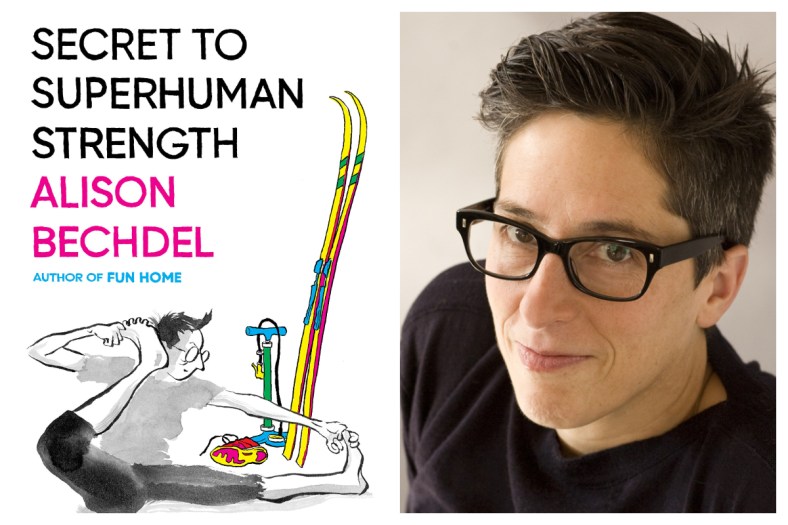
Bechdel’s most recent graphic memoir, The Secret to Superhuman Strength, came out in 2021 and focuses on the author’s lifelong obsession with working out.

Illustration of a person doing silly stretches with a bike pump and skis behind them.

Starting with a childhood preoccupation with the Charles Atlas bodybuilding ads she saw in her comic books, Bechdel became fixated on exercise as a means of quieting her anxious brain and controlling, and even transcending, her physical form. Although I was a bit skeptical when I first heard the subject of the book, any misgivings were laid to rest as I quickly became absorbed by the narrative, following Bechdel on a diverse tour that visits Jack Kerouac and the Beats, the Romantic poets, and Transcendentalist thinkers, along with figures from Bechdel’s life.

On this journey, Bechdel uses exercise to explore bigger subjects, digging at the question of why we exercise, which can be extended to why we do anything. Organized by decade, this is a book of substance and plenty of style, with Bechdel’s trademark precise drawings enlivened by her partner artist Holly Rae Taylor’s brushstrokes of vivid color. As much as I loved her previous two memoirs, they dealt with pretty heavy subjects, and The Secret to Superhuman Strength, while just as thoughtfully crafted as any of her other works, is a bit lighter, making it a perfect candidate for a great summer read.

Holly is an Instructor and Research Specialist at the Miller Branch. She enjoys knitting, preferably with a strong cup of tea and Downton Abbey in the queue.