Welcome to the Year of the Tiger! The Lunar New Year is the most important social and economic holiday for billions of people around the world. Tied to the lunar-solar Chinese calendar, the holiday was originally observed as a time to honor household and heavenly deities and ancestors. Today, Lunar New Year brings friends and family together for feasting and festivities in China, Korea, Vietnam, Japan, Mongolia, and other countries all over the world.
This website, recommended by our presenters, offers a helpful guide where you can discover more about everything from food and drink to clothing and decorations for Lunar New Year celebrations. In addition, we have an assortment of books and other materials available at HCLS to help families learn and celebrate.
In recognition of this significant holiday, HCLS is celebrating with an online class, Learn About the Lunar New Year Celebration, in partnership with Howard County Chinese School. A panel of middle and high school students and parents share the histories and traditions of the Lunar New Year celebration in a variety of Asian American Pacific Islander sub-communities. Join us on Saturday, Feb 5 for a combination of short presentations, Q&A, and interactive educational games with prizes.
Additional upcoming children’s classes with Lunar New Year-themed sessions include:
In Fifteen Hundred Miles from the Sun, Julián Luna is determined to make the most of his senior year of high school. He has plans on how he’ll make that happen: spending as much time as possible with his best friends, playing soccer, graduating, getting into UCLA, and, oh – making sure no one finds out that he’s gay. Especially not his father. But despite this secret he’s keeping, he manages to make the most of things, spending time with his tight-knit friend group. Until, of course, one day, just scrolling through Twitter, he sees pictures of a boy. Immediately, there’s a connection, and when they start texting and speaking more, Julián finds himself falling for the boy, Mat. The issue, then? Well, other than the fact that Julián isn’t out, he’s also in Corpus Christi, Texas, and Mat lives in Los Angeles. Despite the distance, the two boys start learning about each other, falling for each other, and hoping for a future together. But time, distance, and unplanned coming-outs get in the way.
Garza Villa is honest about hardship from the start of the book, even writing in the dedication ““To all the queer brown boys still waiting for their chance to bloom. Quisieron enterrarnos, pero no sabían que éramos semillas.” They want to bury us, but they don’t know that we are seeds. That thread flows through the novel, including candid conversations about machismo in Latinx culture, religion’s intersection with homophobia, and conversations about bullying. And yet, despite the list of trigger warnings at the top of this review, the novel is intentionally not centering trauma in Julián’s life. Every moment of pain is followed by immediate love, support, and care. Garza Villa takes pains to ensure that joy is the central theme around which the rest of the story is built; of course Julián faces hardship, but he is never truly alone in how he responds to those traumatic moments. The idea presented in the dedication, “we are seeds”, is exactly how Julián responds to all the hardships in his life. He was buried deep, and with careful nurture, love, and support from his family and friends, he manages to bloom into something beautiful and loving, breaking the cycle of abuse.
This book was wonderfully illustrative. I lost myself in Julián’s friend group, found myself falling in love with Mat along with Julián, and waiting with bated breath for college acceptance letters. But most significantly, I was swept up in a celebration of culture, cuisine, friendship, and queer joy. There is real heart here; Garza Villa paints an honest picture of the ways falling in love and doing long distance just as easily as he manages to bring to life all of the different characters that make up Julián’s friend group, who each are so vivacious and full of life without becoming caricatures.
This book is perfect for any teens looking to find themselves, or adults who know that the blooming never stops. That if we are seeds, we will continue to grow, season after season.
Sahana is an Instructor and Research Specialist at the Savage Branch. She enjoys adding books to her “want to read” list despite having a mountain of books waiting for her already.
American Dirt’s story begins with Lydia’s family joyously gathering to celebrate her niece’s quinceanera. The day quickly becomes the beginning of a nightmare when the party is suddenly interrupted by a group of men with no regard for human life launching a violent attack. Lydia and her son, Luca, make it out only through luck. She realizes the attack was planned in vengeance against her journalist husband, who had recently exposed the identity of an infamous drug cartel’s leader. She realizes the leader was a frequent patron of her bookstore, one that she had considered a kindred spirit and even a friend because of his love of books. It is then that Lydia realizes the race is on to save both of their lives. Without time to bury her relatives or even cry, they leave their home in Acapulco. With this begins a story of cat and mouse as Lydia and her son set off on a dangerous mission to find refuge in the United States, following in the footsteps of many Central American immigrants before them.
When mention of American Dirt came up in conversation, several of my colleagues asked me, being Latina, of my opinion of it after it was received with controversial reviews. I was hesitant to pick it up only because of my familiarity with the tragic history of Central American immigrants to the United States, and I knew how emotionally taxing the subject could be. Looking back, I am glad I decided to read it, if only to be able to speak on its shortcomings. I have to say that I feel that, while detailed and evocative, the story came up short in its representations of immigrants and was especially off the mark when it came to cartels. The cartel leader is romanticized, being painted as a man of poetry and philosophy, with a deeply rich life. In reality, cartels are dysfunctional and dehumanizing organizations full of fear. They certainly have no mysterious allure to them.
In regards to our protagonist, Lydia, her background as a highly educated woman of the middle class does not align with the decisions that she made in the story. The danger that she put her and her son in was unnecessary and a poor decision. She leads them along one of the dangerous paths to the United States border, one usually only followed by the most desperate and poor immigrants as a final resort. Unlike so many of the people who would have taken that path, Lydia had options. She was comfortably middle class, with a college education, connections, and resources available to her. As such, I have to say that her story is not very realistic. Instead, I would have liked to read more about her companions on the journey, who truly represent the people who would have had to adopt such dangerous measures. These people holding on to hope, fleeing for the safety of themselves and for the survival of their loved ones, truly represent bravery. The end of Lydia’s story, though conclusive, left me frustrated. Her complacent satisfaction with her new job in the United States left a bitter taste in my mouth, speaking as a Central American immigrant myself.
If you choose to dive into American Dirt, I would take its legitimacy and credibility with a grain of salt. Let’s not forget it’s fiction. If you are interested in a nonfiction book that explores the topic with more nuance and depth, I highly recommend Enrique’s Journey by journalist Sonia Nazario, her account of a young Honduran boy’s perilous quest to reunite with his mother in the United States. Nazario based the book on her Los Angeles Times series of articles, also called Enrique’s Journey, which won the Pulitzer Prize for feature writing in 2003.
Half Sick of Shadows caught me with its premise. Billed as a feminist version of Arthurian legend, I really wasn’t sure what to expect. King Arthur, the Round Table, and all of the many stories of knights and chivalry are…really not known for their peak feminist content. In fact, the two major women within Arthurian legend, Guinevere and Morgana, both end up being villains and betraying Arthur when he needs them most. But Sebastian lets the reader into a world where, it’s true, there are places that Guinevere and Morgana, and even Lancelot, could betray steadfast Arthur, but she makes sure the origins of the myth are clear. To do that, she introduces Elaine, a minor character in Arthurian lore who plays the leading role in one of Alfred Lord Tennyson’s famous poem, “The Lady of Shalott.”
Tennyson’s Lady and Sebastian’s Elaine couldn’t be more different in terms of temperament, abilities, and importance, but elements of the poem are woven tightly into the narrative; the Lady falls for Lancelot at first sight, she has some sort of prophetic power, and she believes, deeply, that she is cursed. See, the Lady of Shalott can only see the world through the mirror above her as she weaves. Tennyson opens the poem with great detail about the beauty of the world outside only to tell us that the Lady never sees it. She sits with her back to the window, but cannot escape the draw of the world outside, and as it finds its way into her weaving, she glances at the mirror to ensure accuracy. In fact, in one of the most poignant stanzas of the poem,
Sebastian’s version of the Lady of Shalott, Elaine, is an oracle haunted by a tower in Camelot, just the same, but this Elaine takes control of her future. She is taught to understand her seeing by the Lady of the Lake, she lives among the Fae, and most importantly, she is the last addition to a group of children who grow up in Avalon, balancing between the Fae and the Human worlds. That group of children? Lancelot, Guinevere, Morgana, and Arthur himself. By setting up these friendships so firmly, Sebastian makes the thought of future betrayal gut-wrenching. Because the reader gets to follow her growth, it makes Elaine’s role as oracle and Arthur’s top advisor even more important. And this is the beauty of Sebastian’s story-crafting: Elaine, the fair damsel with no real grit, becomes Arthur’s top advisor and the most important woman in this world. Guinevere is bold and brash and deeply in love with Arthur, but could never be disloyal. And Morgana is the fiercest protector Arthur has on his side, her magic at his service, no matter the personal cost.
Half Sick of Shadows by Laura Sebastian is well worth a read for those who appreciate historical fantasy, Arthurian myth, and coming-of-age stories, all in one. It is available in print and eBook format.
Sahana is an Instructor and Research Specialist at the Savage Branch. She enjoys adding books to her “want to read” list despite having a mountain of books waiting for her already.
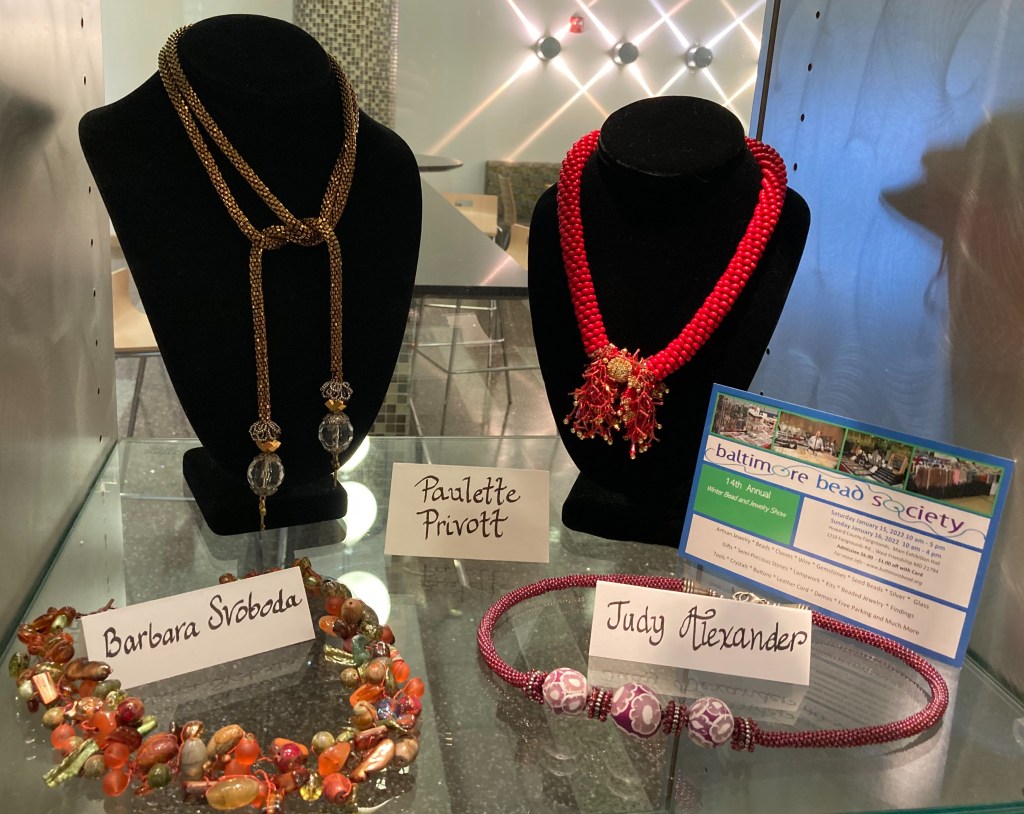
The Baltimore Bead Society display at the Miller Branch.
HCLS Miller Branch is delighted to partner with the Baltimore Bead Society (BBS) to exhibit beautiful displays of innovative jewelry designed and created by BBS members! Please visit the Miller Branch through mid-January and view the glass cases in the meeting room hallway to examine and explore the unique handiwork of these gifted local artisans.
The Baltimore Bead Society is a nonprofit group of enthusiastswho love jewelry, and especially love making all kinds of jewelry. Having been around for more than 28 years, the group has experienced amazing growth in membership as more people develop a desire and passion for making jewelry, even with the advent of more mass-produced jewelry. The BBS provides many educational opportunities, including programs, workshops, networking, outreach for individuals who need a healing peace in their lives, and classes for those wanting to learn traditional and new techniques.
The Baltimore Bead Society presents its 14th Winter Bead and Jewelry Show on January 15-16, 2022 at the Howard County Fairgrounds. You can visit on Saturday from 10 am – 5 pm and Sunday from 10 am – 4 pm. Experts offer a wide assortment of classes each day, from how to make your own jewelry to advanced techniques, with pop-up demos featured concurrently during the entire show. Jewelry makers and crafters will also find an extensive selection of supplies from many of the top vendors.
And if you are a jeweler, artist, crafter, or enthusiast for all things creative and lovely, please check out this list of related jewelry-making books and other resources available from Howard County Library System. HCLS also has a wide variety of DIY and crafting classes to help you get in touch with your creative side!
Illustration by Rebekka Dunlap, from the short story “The Tree in the Back Yard” by Michelle Yoon
By Susan Thornton Hobby
Climate change is scary, and cli-fi short stories are here to help.
“Right here, right now is where we draw the line. The world is waking up. And change is coming whether you like it or not.” – Swedish climate activist Greta Thunberg, age 18
Change is coming, both in the climate, and with luck, in human behavior. Reading about climate change is frightening, and sometimes shuts people down. But as many climate activists have explained, there is hope.
Environmental and animal activist Jane Goodall said it well: “I do have reasons for hope: our clever brains, the resilience of nature, the indomitable human spirit, and above all, the commitment of young people when they’re empowered to take action.”
But reading alarmist nonfiction doesn’t always reach the heart. Story, however, seems to sneak through our defenses and climb straight into our souls. Climate fiction, a genre of literature sometimes shortened to “cli-fi,” pioneered with J. G. Ballard’s novels of climate change (especially the 1962 classic The Drowned World) and Frank Herbert’s 1965 novel Dune (see the review).
Since March 2019, HoCoPoLitSo recording secretary Susan Thornton Hobby and climate educator Julie Dunlap have led a climate fiction book club at Howard County Library System. Attendees are interested in literature that explores the facts and mysteries of Earth’s changing climate, and we have read and discussed eight incredible novels to date.
We’re mixing things up in January, and have chosen to read the award winners of a climate fiction short story contest sponsored by Grist Magazine’s Fix Solutions Lab. Organizers of the contest, Imagine 2200: Climate Fiction for Future Ancestors, urged writers to envision the next 180 years of equitable climate progress.
Sponsored by the National Resources Defense Council, the contest is “an uprising of imagination,” as Fix describes it. The winning stories, a dozen pieces of short fiction by authors including Black, Indigenous, disabled, and queer authors, conjure hope, anger, frustration, joy, and contemplation about the future of our planet in the impending climate crisis.
“Whether built on abundance or adaptation, reform or a new understanding of survival, these stories provide flickers of hope, even joy, and serve as a springboard for exploring how fiction can help create a better reality,” writes Tory Stephens, who works at Fix and spearheaded the contest. Join us in reading and discussing these stories on Thursday, Jan. 6, from 7 to 8 pm, at HCLS Miller Branch. Register here. The stories, and a terrific glossary of cli-fi terms, including afrofuturism (looking at you Octavia Butler), solar punk, and ecotopia, are available here.
Susan Thornton Hobby is the HoCoPoLitSo recording secretary as well as co-leader of the Inconvenient Book Club at HCLS Miller Branch.
Fans of Jordan Peele’s Get Out, this book is for you. Romance author Alyssa Cole’s first venture into the thriller genre comes to us with a bang, a gentrification thriller that talks about all of the ways a neighborhood disappearing can truly be insidious.
When No One is Watching follows Sydney, a Black woman recently returned to the Brooklyn neighborhood where she grew up, and Theo, a White man, who has also recently moved into the neighborhood with his extremely wealthy (and pretty catty) girlfriend/ex/it’s-complicated, Kim. Neighborhood shops disappear and turn into national chains, but it isn’t until Sydney hears about neighbors moving suddenly that she starts to think something unusual might be going on. She teams up with Theo to work on an accurate tour of the neighborhood, but is unsure if he’s trustworthy or part of the problem.
Cole does a wonderful job marrying the two perspectives, Sydney’s and Theo’s, into a cohesive narrative, in a time and situation where their points of view appear to be polar opposites. When we are reading from Sydney’s point of view, it is nerve-wracking and jarring, a new problem around every corner. When we are seeing the world from Theo’s eyes, it is us trying desperately to understand problems that don’t hurt us the way that they hurt other people.
This novel approaches gentrification with a firm and education-based stance. There are some moments where it feels like Cole is trying to make sure that her readers are walking away armed with facts, not just the thrill factor. Admittedly, that can feel a little distracting when there is the next big bad problem only pages away, but waiting with the characters and following the pace that Cole sets up is well worth it for the explosive finale.
The influence of Get Outis clear as well, and fans of the movie will notice the pacing of the book matching closely to the movie. No matter how similar the two seem, however, the ending is still something that will catch readers by surprise, keeping you hooked to every page.
It is an easy, captivating read for people who want the conventions of a thriller while also feeling like they are learning something. New York Times bestselling author Alafair Burke wrote, “From the first page of When No One Is Watching, I felt like I was right there in the gentrifying Brooklyn neighborhood, filled with sharply etched characters and dialogue that zings. Then bam! I was knocked over by the momentum of an intense psychological thriller that doesn’t let go until the final page. This is a terrific read.”
Sahana is an Instructor and Research Specialist at the Savage Branch. She enjoys adding books to her “want to read” list despite having a mountain of books waiting for her already.
Scythe is the first installment in Neal Shusterman’s YA trilogy. The novel is set in a fictional near-future dystopian society where immortality is the default. An all-seeing and almost all-powerful AI system has everything figured out; there is no starvation, poverty, pain, or sickness. Of course, along with age-resetting tech, this means no death. However, in order to control the risk of overpopulation, the position of “Scythe” was created. With no AI interference permitted, “Scythes” are chosen individuals responsible for death-dealing, or “gleaning”. But is it truly in the interest of the greater good? After all, we’re all only human.
The novel follows Citra Terranova and Rowan Damisch, two teenage apprentices who find themselves grappling with being in the Scythedom, their position being one with the highest honor, and the highest burden. Within the system, politics, morality, and reasoning stand at odds. It’s not so simple as right or wrong, good or evil. Citra and Rowan may be protagonists, but are they heroes?
Admittedly, the novel’s macabre plot may be off-putting at first, but Shusterman boldly handles its darker themes with delicacy, and fills the story with endearing moments of humor and vulnerability. Readers are given the opportunity to bond with characters as they learn their strengths and faults, all while following the novel’s underlying question; what life is without death, and what gives us meaning.
Scythe is a fantastic novel with plenty to discuss. Never a dull moment, its real world parallels make it a great read for older YA readers and adults alike.
Photograph of Marley Dias courtesy of the American Library Association.
By Julie F.
Howard County Library System is proud to have so many devoted customers who love our library and all of our books, music, movies, online resources, classes, and events. But we have good news for anyone in your orbit who is not familiar with all the exciting things the library does: September is Library Card Sign-up Month! Share with your friends, families, neighbors, and colleagues that they, too, can make the most of all that an HCLS library card has to offer.
A new library card empowers learners and readers through the three pillars of HCLS: self-directed education, research assistance and instruction, and instructive and enlightening experiences. HCLS’ mission is to deliver high-quality public education for all, and much of that is delivered through your library card: whether Books, Movies & Music from our outstanding collection or Online Resources that provide free, self-directed education at your fingertips, your library card is a passport to all of our helpful virtual services. Whether you’re looking for Consumer Reports online or hoping to help your child prepare for SAT or AP exams, you can access all of these with a library card number and PIN. The possibilities are unlimited!
As the American Library Association notes, “Marley Dias, author, executive producer, and founder of #1000BlackGirlBooks, is joining the American Library Association and libraries nationwide in promoting the power of a library card this September. As honorary chair, Dias wants to remind the public that signing up for a library card provides access to technology, multimedia content and educational programming that transforms lives and strengthens communities. ‘A library card provides opportunity for discovery and access to a rich and diverse world. It empowers you to make change and experience new stories.'”
Julie is an instructor and research specialist at HCLS Miller Branch who finds her work as co-editor of Chapter Chats very rewarding. She loves gardening, birds, books, all kinds of music, and the great outdoors.
London native and Brighton resident Elly Griffiths has had a phenomenal (and very busy!) career since publishing the first Ruth Galloway mystery, The Crossing Places, in 2009. The author of three children’s books, the Stephens and Mephisto historical mystery series, and the Harbinder Kaur mystery series, she is the winner of the 2020 Edgar Allan Poe award for Best Novel for the first Kaur mystery, The Stranger Diaries. She also won the Dagger in the Library award from the Crime Writers’ Association, which is a prize for a body of work by a crime writer that users of libraries particularly admire.
Although all of her work is acclaimed, the Ruth Galloway novels are especially beloved by her devoted readers. Ruth is a forensic archaeologist who teaches at the University of North Norfolk, where her best friend, Shona, is married to the head of Ruth’s department. Over the span of thirteen novels, Ruth nurtures a passion for the work that consumes her academic life but also spills over into her personal life and a second job as an adjunct to the North Norfolk police constabulary. Like many police officers, DCI Harry Nelson is haunted by the one case he couldn’t solve – that of a missing five-year-old, who was taken from her parents’ home ten years ago and is now missing, presumed dead. When bones are discovered on the beach near Ruth’s home, DCI Nelson calls on Ruth to help the police date and identify them. An Iron Age discovery ensues, another child goes missing, and Ruth finds herself pulled into a case that has ramifications both past and present. The Crossing Places is an excellent start to a series where following the quirky, familiar characters we learn to love doesn’t overshadow the intensity of the mystery; Griffiths is skilled at developing both character AND plot.
Through the course of the series, Ruth has chilling adventure after adventure: she carbon-dates bones found on the site of an old children’s home in the process of being demolished; she attends the scene of the discovery of a downed World War II plane which presumably has the skeleton of the pilot intact; and a jaunt to Italy at the request of a fellow archaeologist needing help with his own most recent discovery results in a kind of working holiday. As the books progress, her relationship with DCI Nelson, both professional and personal, goes through a series of ups and downs that has the reader rooting for both the cranky but decent old-school DCI and the strong-willed, independent archaeologist.
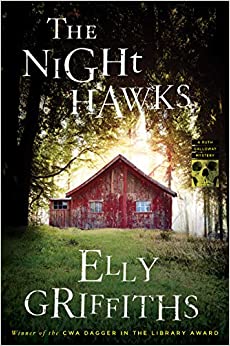
The most recent novel, The Night Hawks, has the titular group of treasure hunters combing the beach in North Norfolk when they come across a body – and a cache of Bronze Age weapons, which is of real interest to Ruth and a new university colleague. DCI Nelson speculates that the body, which is not from antiquity, might be that of an asylum seeker who washed overboard in a storm, but the death is quickly linked to a murder-suicide at a nearby house, Black Dog Farm. The name ties into local legend about a huge, spectral black dog who haunts the area, adding an element of the paranormal to an already complicated mystery.
Both The Crossing Places and The Night Hawks are worthy additions to a compelling series, but I can recommend every entry – I’ve read and enjoyed every story involving DCI Nelson and his team, and Ruth and her colleagues, for well over a decade now. I’m still looking forward to more suspenseful mysteries from them – in a recent interview, Elly Griffiths said she is hard at work on the fourteenth Ruth Galloway novel, The Locked Room. Fans of Louise Penny, Ann Cleeves, and other writers of character-driven police procedurals will find much to enjoy and admire about this suspenseful series.
Julie is an instructor and research specialist at HCLS Miller Branch who finds her work as co-editor of Chapter Chats very rewarding. She loves gardening, birds, books, all kinds of music, and the great outdoors.





 CHAPTER CHATS