Tails and Tales: Summer Reading at HCLS

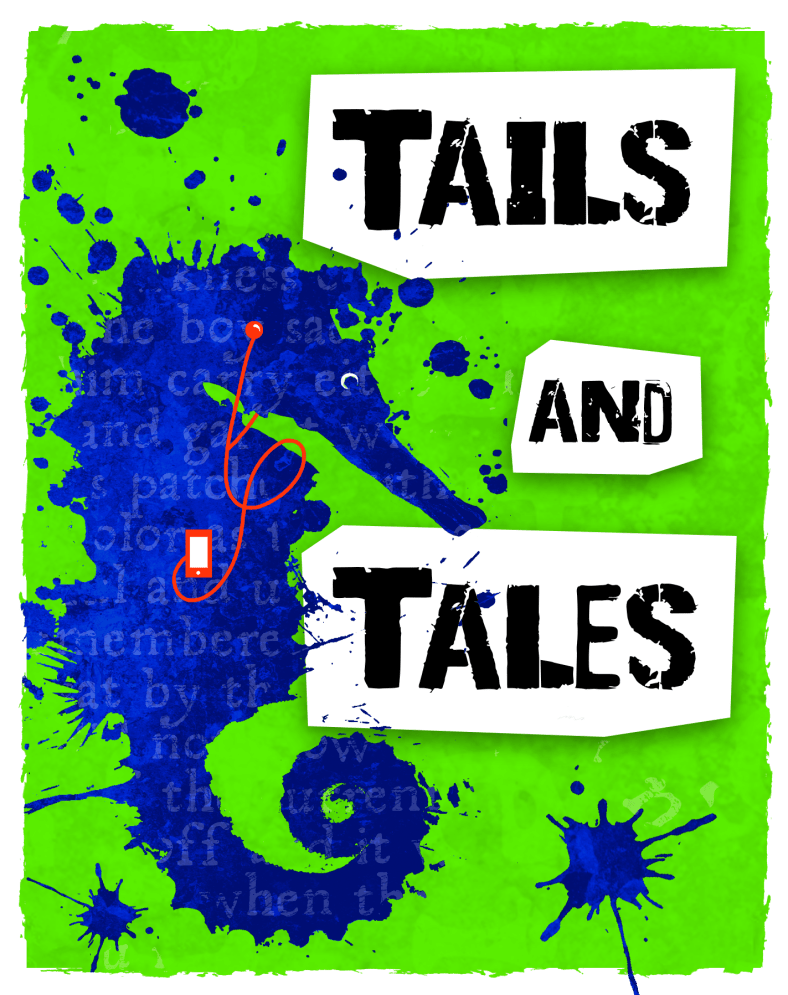
A green and blue chameleon rests on a red book. The yellow banner reads: Tailes and Tales.

Howard County Library System invites you to participate in Summer Reading 2021: Tails & Tales! It keeps your family motivated to read all summer as you accomplish Missions each week. Summer Reading began June 1, and it runs through August 23.

Track your reading and play fun educational mini-games as you complete missions full of activities. Discover HCLS eResources along the way. Earn ten points to receive a free book! Earn points by either logging your books online or in a paper reading log, and then visit any HCLS branch between August 2 – 31 to pick up your book. Limit one book per reader, while supplies last. 

Choose between two versions: one for birth to age 10 and the other for ages 11-17. More information and book lists available at hclibrary.org/summer.

You can set up accounts at hcls.readsquared.com to track your progress, or you can download and print the paper version (in multiple languages this year). Each Monday, a new Mission is available online. You can enjoy the tasks listed or you can Imagine Your Own 20-minute Reading Activity by reading any way you like: Read or listen to an eBook;  a book you can hold in your hand; a chapter; a comic or graphic novel; or read a poem.

When you reach a total of 10 points, you have officially completed Summer Reading and may visit any HCLS Branch to pick up your book prize. (While supplies last; limit 1 book per reader).  What happens after you earn 10 points? Keep on reading! Continue reading, logging books, and completing mission activities.  

HCLS ADULT SUMMER READING CHALLENGE 2021 

A book lies open in grass with a pair of reading glasses resting on top. The frames are blue and the arms are multi

Give yourself some time to read, relax and learn this summer with our Adult Summer Reading Challenge. We encourage you to read in whatever format you like best: audiobooks, eBooks, graphic novels, and hold-in-your-hands books! As above, you can either track your progress online, or you can download and print a paper version.

Earn two points for each book you log. Earn a total of ten points to be automatically entered into the end of summer prize drawing! Create your own summer reading challenges or use our list of suggestions. Details at hclibrary.org/summer

Found Family in Speculative Fiction

By Kristen B.

There’s an old saying that while you can’t choose your family, it’s lucky that you can choose your friends. Some of my favorite stories include found family, where the characters forge tight bonds that go beyond simple friendship into family feeling. These are often the books that live on my comfort reads shelf. It’s also one of the oldest tropes in existence: the band of brothers (or maybe just the band) who live and die for each other. If it can’t actually save the world, friendship can at least make it a better place.

This mostly brown cover features a planet in the background and a chunky spaceship in the front. The title appears in shaded block letters which gradually increase in size.

The Long Way to a Small, Angry Planet by Becky Chambers (also available as an eBook and an eAudiobook from Libby/OverDrive)

This is the book I hand to people who tell me they don’t really like science fiction, but want to try something new. If you ever enjoyed the show Firefly, this novel will feel familiar. Set on an older, slightly beat-up spaceship, the crew represents a wide range of galactic species who pull together as a team, a ragtag group of political and social misfits. The fairly minimal plot focuses on the need to push a new wormhole/jump, which means that one ship has to take the slow voyage to anchor the jump points. It may sound tedious but it’s never boring with all that time to get to know the quirky crew of the Wayfarer. Two of my favorites are the pacifist chef who comes from a species that essentially committed self-genocide through endless war, and Lovey (short for Lovelace), who is the ship’s AI. While not so heavy on forward action, The Long Way to a Small, Angry Planet provides an interconnected set of character studies that leaves you feeling more than a little warm and fuzzy.

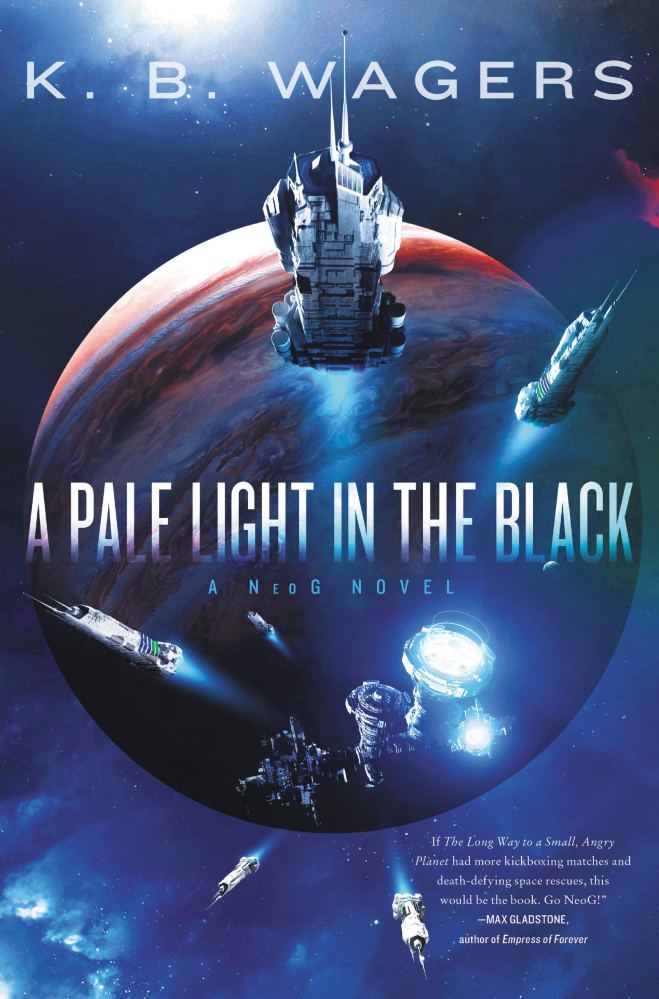
A blue cover with an image of Jupiter in the background features a flotilla of different spaceships framing the title across the middle of the image.

A Pale Light in the Black by K. B. Wagers

Some of the most enduring found family stories tell about military outfits whose bonds are stronger than blood – kinda like the A-Team. Meet Max and Jenks, officers (commissioned and non-com, respectively) on the NEO-G ship Zuma’s Ghost. A sort of space-based Coast Guard, NEO-G (Near-Earth Orbital Guard) Interceptor teams run counter-smuggling interdiction operations and rescue missions. Max has recently joined Zuma’s Ghost, after Jenks’ brother is promoted off the ship. Part of the story revolves around Max and Jenks finding a good working relationship during various military actions. Part of the story concerns the Boarding Games annual competition, which happens among teams from all military service branches and which Zuma’s Ghost just missed winning the previous year. Jenks is the all-time champion cage fighter, and Max, navigator extraordinaire, is still discovering what skills she contributes to the team. Underlying all this surface fun, something more sinister lurks that threatens Max, Jenks, and all of Earth. This book rolls with a ton of space opera fun, hitting all the beats you expect and some you don’t. It’s also one of the most inclusive set of characters ever thrown together to save the solar system!

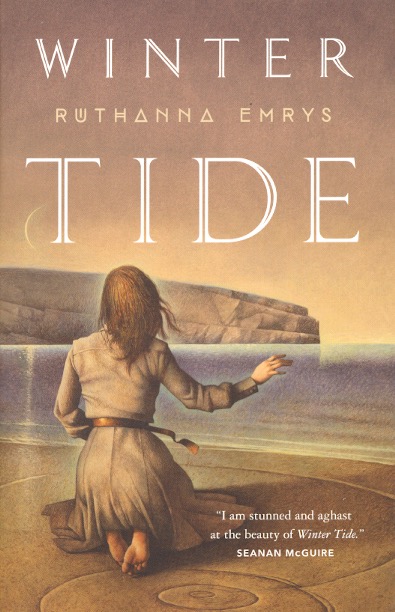
A woman kneels upon a beach gesturing with her right hand toward a flat sea, with symbols traced on the sand beneath her. The palette is muted beiges and blues.

Winter Tide by Ruthanne Emrys (also available as an eBook from Libby/OverDrive)

I must admit to avoiding this title for longer than I should have given its association with the Lovecraft mythos. Lovecraft’s opinions and bigotry have not stood the test of time well, and I was a little apprehensive about diving into the deeps with a Cthulu-inspired novel. How wrong I was! Emrys reconstructs the Lovecraftian milieu into a family saga that demands empathy for the Other. Set in Innsmouth along the shore of the Atlantic Ocean, down the road from Miskatonic University (home to lots of unhelpful white men), Aphra Marsh and her brother Caleb look to reclaim their heritage that was stolen when the government interred her people away from the sea in the desert. The Innsmouth community comes from People of the Water (as opposed to Air or Earth), who eventually leave dry land and evolve to live as Deep Ones in the sea. Aphra needs to find trusted friends and colleagues to re-establish a home at Innsmouth before developers demolish what little remains and to reclaim her people’s heritage from the dim reaches of the university’s library. This quiet, personal novel focuses on staying true to yourself and trusting others who travel the path with you – even if one of them happens to be an FBI agent.

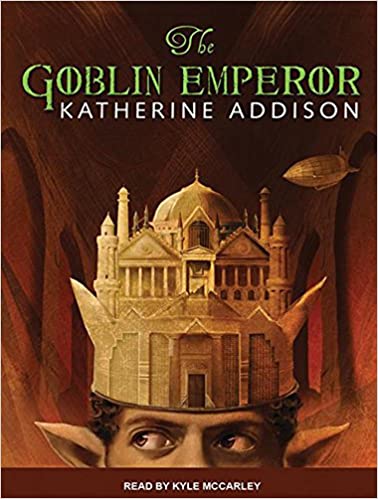
A face with long ears peeks over the bottom of the cover wearing a crown shaped liked a palace.

The Goblin Emperor by Katherine Addison (also available as an eAudiobook from Libby/OverDrive)

Do you love pauper to prince stories? Heroes that go from the kitchen or the farm to the throne? Me too! Half-elf, half-goblin Maya grew up in almost total isolation after the death of his mother, living in a remote marshy estate with an equally outcast, abusive tutor. His father, the Emperor of Elfland, had come to regret his political marriage, exiling Maya and his mother from court. This book opens with Maya receiving news that he is the only remaining legitimate heir after his father and older brothers are killed in a terrible accident. Promising himself to be true to his mother’s precepts of kindness and generosity, Maya tries to maneuver in an imperial court for which he has no frame of reference or requisite education. He makes his way tentatively toward a previously unimaginable royal future, grounded in the adamant idea that he will not continue the cycle of abuse levied against him. Along the way and despite assassination attempts, he finds kindred spirits – helpful councilors, his maternal grandfather (who rules the goblin empire), long-lost aunts and sisters, and devoted bodyguards – to ease the burden of royal privilege and deference. I love this book to pieces, and it only improves with re-reading. The language can be a little dense at first, but stick with it and you will be greatly rewarded with a story of courtly politics and the power of kindness.

Kristen B. is a devoted bookworm lucky enough to work as the graphic designer for HCLS. She likes to read, stitch, and take walks in the park.

Dr. Erika Lee: The Making of Asian America

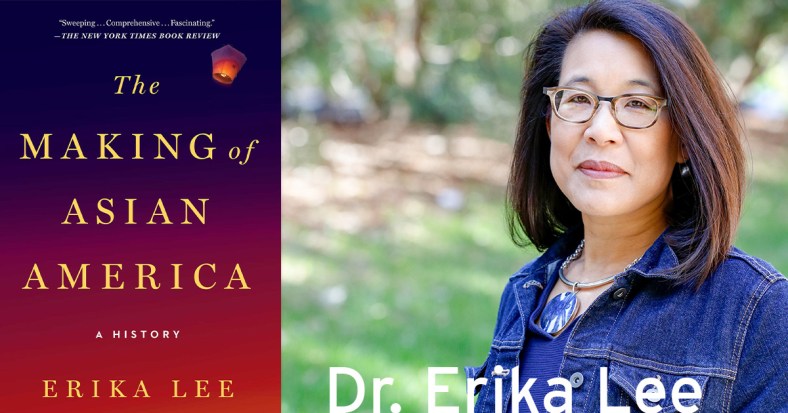
On the left, the cover of Dr. Lee's book: The color shades from deep blue to bright red with lettering in gold. A paper lantern floats in the top right corner. On the right: A photo of Dr. Lee wearing a denim jacket and large blue necklace, her hair is shoulder length and she wears glasses. A sunny green yard is out of focus behind her.

Monumental. . . . Lee handles her scholarly materials with grace, never overwhelming the reader with too many facts or incidents. She tells an American story familiar to anyone who has read Walt Whitman, seeking to capture America in all its diversity and difference, while at the same time pleading for America to realize its democratic potential. . . . Powerful Asian American stories . . . are inspiring, and Lee herself does them justice in a book that is long overdue.” ― LA Times

On Wednesday, May 26 at 7 pm, Dr. Erika Lee discusses her acclaimed book The Making of Asian-AmericaIn the past fifty years, Asian Americans have helped change the face of America and are now the fastest-growing group in the United States. As award-winning historian Erika Lee also reminds us, Asian Americans also have deep roots in the country. The Making of Asian America tells the little-known history of Asian Americans and their role in American life, from their first arrival to the present-day.

An epic history of global journeys and new beginnings, this book shows how generations of Asian immigrants and their American-born descendants have made and remade Asian American life in the United States: sailors who came on the first trans-Pacific ships in the 1500s; indentured “coolies” who worked alongside African slaves in the Caribbean; and Chinese, Japanese, Filipino, Korean, and South Asian immigrants who were recruited to work in the United States only to face massive racial discrimination, Asian exclusion laws, and, for Japanese Americans, incarceration during World War II. During the past fifty years, a new Asian America has emerged out of community activism and the arrival of new immigrants and refugees. No longer a “despised minority,” Asian Americans are now held up as America’s “model minorities” in ways that reveal the complicated role that race still plays in the United States.

Copies of The Making of Asian America are available to borrow (also as an eAudiobook) from HCLS or to purchase from Books with a Past. 

A stunning achievement, The Making of Asian America establishes the centrality of Asians to American history, and poses alternatives to US national and immigration histories. Asians, this remarkable text reveals, transformed the face of America, and they locate the US firmly within a hemispheric and global order.” ― Gary Y. Okihiro, Professor of International and Public Affairs, Columbia University

ABOUT DR. ERIKA LEE One of the nation’s leading immigration and Asian American historians, Erika Lee teaches American history at the University of Minnesota, where she is a Regents Professor, a Distinguished McKnight University Professor, the Rudolph J. Vecoli Chair in Immigration History, and the Director of the Immigration History Research Center. The granddaughter of Chinese immigrants, Lee grew up in the San Francisco Bay Area, attended Tufts University, and received her Ph.D. from the University of California, Berkeley. She was recently elected into the American Academy of Arts & Sciences, testified before Congress during its historic hearings on discrimination and violence against Asian Americans, was awarded an Andrew Carnegie Fellowship, and named Vice President of the Organization of American Historians.

Citizen Science and Summer Fun

The photograph shows two orange, white, and black monarch butterflies gathering nectar from a stalk of lavender sage.
Photo by Robert Thiemann on Unsplash.

by Jean B.

Last spring, as a COVID lockdown project, I expanded my backyard garden and planted some milkweed to attract monarch butterflies.  I was rewarded with not only bright orange-yellow flowers throughout the summer, but dozens of striped monarch caterpillars in August and then, the ultimate treasure:  one glittering pale-green chrysalis, from which I watched a monarch emerge one late September day.  Observing this life cycle drama unfold in my backyard was absolutely a pandemic highlight!

As you may know, habitats for monarch butterflies are declining rapidly, threatening their ability to make the incredible migration from Canada to Central Mexico that species survival requires. But there are tangible ways individuals can help monarchs. It can be a wonderful family activity to learn about, observe, and take action to help monarch populations, with help from some fantastic children’s books available at HCLS. Become citizen scientists!  It’s fun, it gets everyone outdoors together, and it’s rewarding. 

First, check out Winged Wonders: Solving the Monarch Migration Mystery. In this book, Meeg Pincus explores how the monarchs’ amazing migration journey was uncovered through the actions of not only scientists, teachers, and explorers but also thousands of volunteers, who helped tag and observe the butterflies to figure out where they went. When the mystery finally was solved, whose achievement was it? As this book joyfully replies, the discovery belonged to “all of them – the scientists, the citizen scientists, the regular folks along the way.”  Learning about that remarkable effort, it’s easier to appreciate how each of us can play a part in helping solve the problems facing monarchs and other struggling species.  

Now we need some specifics to get to work. Check out Citizen Scientists: Be a Part of Scientific Discovery from Your Own Backyard by Loree Griffin Burns, with photographs by Ellen Harasimowicz. This beautiful, family-friendly book guides kids and their grownups through four seasonal projects: tagging monarch butterflies in the fall, counting backyard birds in the winter, frog watching (and listening!) in the spring, and photographing ladybugs in the summer. Each section contains a visually-rich full spread with practical information for “when you go,” including a checklist of equipment, close-up photos of the creature to be observed, and a quick quiz to learn some useful facts.  Links to organizations that collect citizen scientist information are provided, too. It’s every curious and naturally-observant kid’s dream to count, name, and dig around outside to find interesting creatures, right? This book gives just the right blend of guidance and inspiration to harness that excitement to a great purpose.

While you’re outside looking for monarchs, you’re bound to see all kinds of other butterflies, caterpillars, and insects you’ll want to learn more about. Capturing the beauty and wonder of butterflies, the nonfiction picture book A Butterfly is Patient by Dianna Hutts Aston, with spectacular artwork by Sylvia Long, is my favorite guide. It contains fascinating information presented with gloriously colorful and detailed illustrations. It’s available as an eBook from CloudLibrary, too. (And since this summer will be full of cicadas, check out A Beetle is Shy, by the same duo, to boost your beetle appreciation.)

Finally, if you embark on this journey of discovery, be sure to stop in at the HCLS Enchanted Garden located at the Miller Branch, a certified Monarch Way Station. Through the HCLS website and classes, the Enchanted Garden offers more resources to support citizen scientists and monarch watchers.   

Make HCLS your partner as you encourage the budding naturalists in your family this year and maybe you’ll get to see a brand new monarch stretch its wings, too!

Jean B. is a Children’s Instructor and Research Specialist at the Central Branch and loves reading books for all ages when she isn’t enjoying the outdoors.

Valentine by Elizabeth Wetmore

The book cover depicts a dust storm across a dry landscape of orange dirt,  with oil rigs and a solitary tree in the distance and purple stormclouds in the sky above.

by Aimee Z.

Content warning for book: sexual assault

1976, Odessa, Texas. The wild oil boom brings equally wild young transients from as far away as Arkansas and the Carolinas. These “roughnecks” work and play hard, drinking all night at the local cantina. When Gloria, a rebellious fifteen-year-old Mexican girl, accepts a truck ride from such a blue-eyed stranger who calls her “Valentine,” she doesn’t expect to be raped, beaten, and left for dead on the dusty Texas range.

She surely doesn’t expect to awake at dawn, shoeless, black-eyed, her spleen ruptured, ribs and jaw busted, watching her rapist sleep off his drunk in the cab of his old truck. But she does. Stealthily, Gloria wills herself over sagebrush and shale, to what first seems a mirage – a farmhouse. 

Gloria bangs on the door and a child answers followed by one of the most gloriously grounded characters in recent fiction, the very pregnant Mary Rose. Gloria is in the worst shape Mary Rose has ever seen. She sees something else, too – way out on that dusty red road, a sky blue truck is racing toward her. 

Mary Rose yanks Gloria inside, shushes her little girl, and waddles out to the front porch to meet Gloria’s sweet-talking rapist with her rancher husband’s Winchester .22.  He’s intent, too, in getting back “his little Mexican gal.”

I found the prose taut and gorgeously written by first-time novelist Wetmore, whose affection for Texas is only surpassed by her fierce and pragmatic women — Mary Rose, Corrine, Gloria, and more. You’ll love them for their pushback, for their ‘Me Too” attitude against the structural racism and ingrained misogyny that defined West Texas oil boomtowns in the 70’s.

Elizabeth Wetmore’s Valentine is also available in eBook and eAudiobook format from Libby/OverDrive. 

Aimee Z. is part of the adult research staff at HCLS East Columbia Branch. She lives on a lake with her two labs, Dixie and Belle, who enthusiastically approved the content of this review in exchange for a peanut butter and jelly biscuit.

Chernobyl on Page and Screen

By Kristen B.

It’s not exactly a cheerful topic – the most devastating nuclear accident ever to have happened. However, the story of what went wrong is riveting and amazingly complex. More than 30 years ago, on April 26, 1986 at 1:23:58 am, one of the nuclear reactors at the Chernobyl site suffered a massive explosion and containment failure, which led to fallout poisoning in large areas of Ukraine and Belarus. At the time, the Soviet government was more concerned with containing the political and international ramifications than protecting its citizenry. I have to admit that until recently I hadn’t thought much about Chernobyl other than as an unfortunate incident that happened during my teenage years.

A member of the book discussion group that I moderate, Books on Tap, advocated for reading oral histories and books in translation, particularly this one. She argues (and I agree) that it’s a marvelous way to gain insight and perspective from other cultures and points of view. Voices of Chernobyl: The Oral History of a Nuclear Disaster presents the ultimate expression of telling stories “in their own voices.” Svetlana Alexievich, who won the Nobel Prize in Literature, wrote it 10 years after the nuclear accident, and it was more recently translated in 2014. The book presents the written account of her interviews with a wide cross-section of people who lived through the catastrophe and the subsequent years. A surprising number of people returned to their homes or fled to the “open” country as other Soviet Socialist Republics disintegrated into ethnic warfare. They often refer to Chernobyl as “war,” being their only other frame of reference to so many people dying and the subsequent governmental propaganda. Although it can feel a bit repetitive, that sheer recounting from so many different people – teachers, party loyalists, army conscripts, wives, and mothers – drives homes the devastating, ordinary reality of living on top of nuclear fallout.

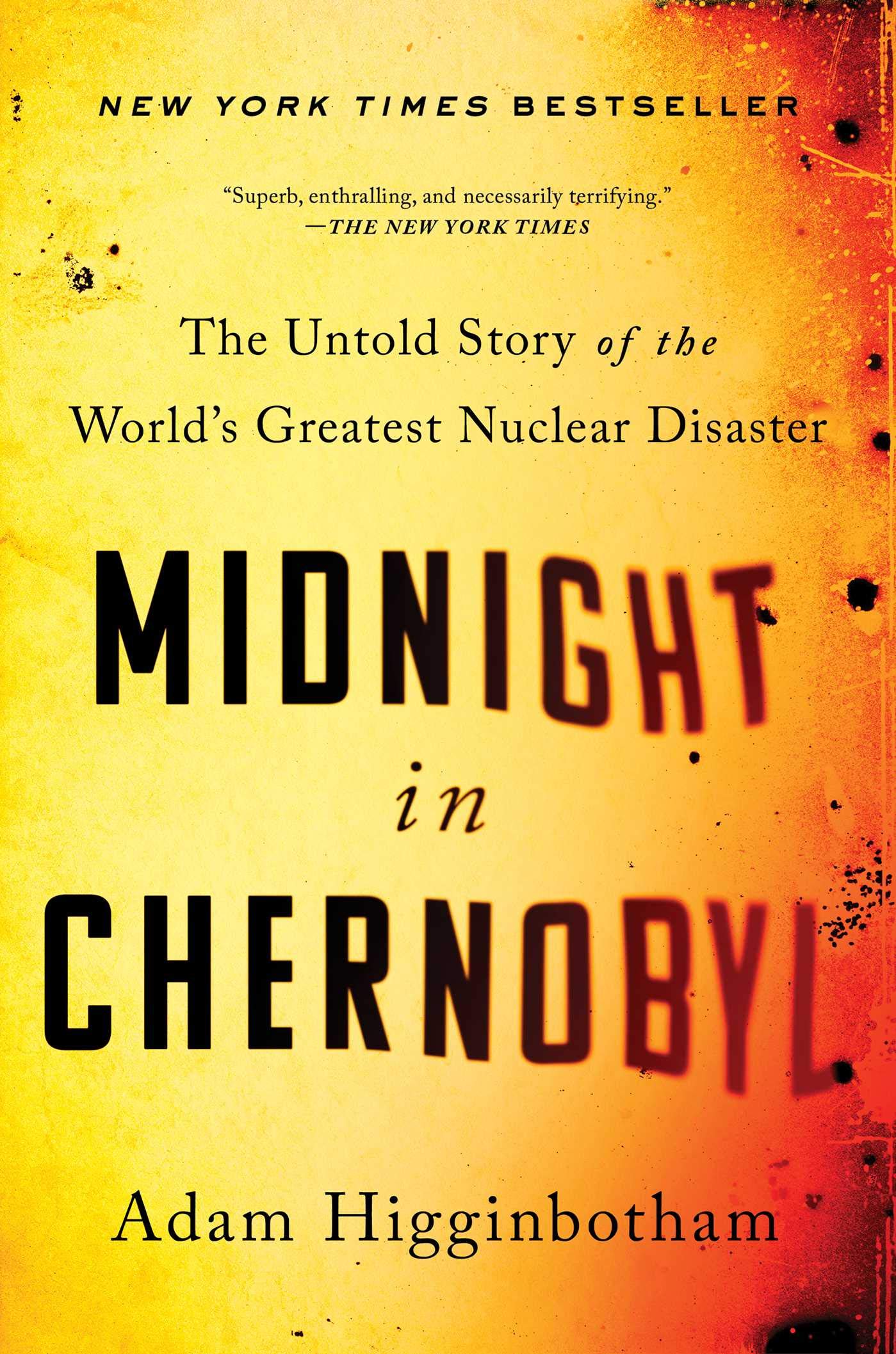
Midnight in Chernobyl by Adam Higginbotham (also an eBook and eAudiobook) offers another side of the story, one rich in politics and science. Where the previous title provides a direct line to individuals, this book takes a much larger overview of the history of Chernobyl – literally starting with the creation of the plant and its company town along a marshy stretch of wilderness. The perfidy of the Soviet institution’s need for results and optics, above any adherence to safety and good practice, was something I had forgotten since the fall of the USSR. The Chernobyl disaster was nonetheless a direct result of the political reality during that time… and in fact contributed to the fall of the communist regime. This book draws on interviews and recently declassified archives to bring the disaster and the people who lived through it to life. Although there’s a short holds list for the book, it’s worth the wait.

HBO aired a five hour, five episode Chernobyl miniseries in 2019 that combined the source material from these two books into an excellent show about what happened during the explosion and in the two years after, available to borrow as DVDs. You can’t turn away from the real-life drama unfolding on the screen, not even knowing the basic outlines of the story. All sources, books and screen, point to the complete cognitive dissonance of dealing with an accident that was largely deemed to be impossible. The show is immensely well-written and well-acted, pulling you in almost despite yourself. Content warning: The middle episode contains some particularly hard scenes of “cleaning up” wildlife and abandoned pets. Here, too, the faces and the voices give a human accounting to an unimaginable tragedy.

The area will not fully return to “safe” for millennia, barring any further contamination. I feel like this was an important moment in time, and only now can we begin to appreciate its history. I also hope it will give us some optimism about human resilience and the ability to solve big problems… because one thing has been made perfectly clear: it could have been so much worse.

Kristen B. is a devoted bookworm lucky enough to work as the graphic designer for HCLS. She likes to read, cook, and take walks in the park.

The House in the Cerulean Sea by T.J. Klune

An illustration shows a raggedy spit of land above a blue sea, with a red house with lots of windows at its very edge. Windswept trees and a blue and pink sunset sky frame the house.

by Sarah C.

Have you ever read a book that feels like a warm hug? Not just certain scenes either, like the entire story overall, start to finish, feels…happy. Comforting. Wholesome. And despite containing a large variety of themes, concepts and emotions, highs and lows, and a bit of magic, the book still manages to wrap itself around you like a soft, well-loved quilt?

Me neither…until now! To be fair, my preferences are usually hard-hitting realistic teen fiction with some fantasy and sci-fi thrown into the mix, and I tend to avoid gentler, softer stories. Maybe that is why this particular book was so surprisingly engaging for me. Regardless, let me tell you about this charming modern fairy tale of a novel that I had the absolute pleasure of reading.

The House in the Cerulean Sea by T.J. Klune (also available in eBook and eAudiobook format from Libby/OverDrive) was recommended by a colleague who is always on point with their choices, so I assumed I’d enjoy it, but was not prepared to fall in love like I did. Utterly and completely head over heels in love. After staying up late on a weeknight to finish this page turner, I then re-read it slowly over the weekend to savor it…then demanded my friends, my book club, my social media groups, my co-workers, and my family read it. Then I bought it, AND I requested it again from the library because at this point there was a decent waiting list but my copy was almost overdue. I proceeded to suffer greatly waiting for the copy I bought to arrive, so I began reading it yet again, together with my 11-year-old in the evening..and so on and so forth.

Perhaps you might like to hear about the actual book at some point, as opposed to my swooning?

Right, well this is the story of a group of misfit children with different special abilities and backgrounds, and the “normal” adults who play certain roles in their lives. Some try to raise and protect them, some try to control and contain them, while others fear and scorn them. Our main character, Linus Baker, is confused by them but curious and good-hearted, and throughout the book learns to see them for who they truly are and love them more for it. A lonely, rule following caseworker for the Department In Charge Of Magical Youth, Linus lives a dull and dreary life, until he is given a mysterious assignment to investigate the “dangerous” children being cared for at the Marsyas Island Orphanage and identify their threat levels. Without much information to go on, Linus embarks upon what becomes a life-changing adventure, filled with unexpected beauty and memorable characters. There might also be a sassy and insufferable pet cat, which is an added bonus.

Themes include found family, celebrating differences, facing bias and prejudice in ourselves and others, accepting help and love, and recognizing true bravery and learning that it’s never too late to start over or discover something new, with many parallels to today’s world. Darkness lurks around corners in Cerulean Sea as well as our own lives, and the author skillfully acknowledges this, lest the story become too unrealistic.  

As I finish this book for the third time, I am left with a renewed sense of hope for the future. I invite you to fall in love as I did with this intergenerational “must read” for 2021.

While you will have to request the title because it’s so popular right now, the wait will be worth the while!

Sarah is the Teens’ Instructor and Research Specialist at the Savage Branch, where she can be found geeking out over new graphic novels, spotting rainbows and drinking day-old coffee.

Crooked Letter, Crooked Letter by Tom Franklin

The book cover shows two boys running in silhouette against a dark foreground and blue sky with clouds, between two leafy trees.

by Aimee Z.

In a small, forgotten Mississippi town, a vicious crime and a missing girl are like déjà vu for hapless farmer and hermit, Larry Ott. Decades before, the man the whole town still calls ‘Scary Larry,’ took local girl Cindy Walker on his first and only date. The girl never came home, and her body was never found.

Blame fell on Larry Ott, and he became a pariah to everyone, including his parents. But the one person Larry could not bear to lose was his best friend from childhood, Silas Jones. Silas “32” Jones, a black man, once dirt poor, worked hard over the years to earn the respectability he covets as the town’s lawman.

Now another girl – a politician’s daughter – has gone missing. Once more, the town is certain Larry did it. The last thing Silas needs is anything to do with Larry Ott – until he responds to the 911 call: Larry Ott’s been shot by an intruder and is now in intensive care. It doesn’t look good.

Silas’s struggle to do the right thing is what makes this book a small gem. Readers will settle in to assume that this is another insignificant southern town, bristling with economic despair and racism, but they’ll be wrong. Sure, Franklin creates an oppressive atmosphere where heat and kudzu vines flourish, and neighbors get back at neighbors with the occasional cottonmouth snake in the mailbox. Urban legends, racism, ignorance, child abuse, and the small-town need for a whipping boy abound. We need a hero, and refreshingly, Franklin has given that role to Silas.

At the same time, any connection to Larry Ott could put Silas back on that precipice of racism. But as he investigates and pursues the perpetrator, unearthing the bones of an old crime, Silas’s conflicted emotions press to a breaking point. Will he admit to the complicated part he once played in the harrowing life he shared with Larry Ott? If only he could forget turning his back on Larry when Larry needed him most.

Part thriller, part literary fiction, Crooked Letter, Crooked Letter is still a book I want to press into everyone’s hands. I think it should also be part of the high school curriculum. An eloquent and tender story, it will shape any reader’s collective consciousness regarding race and what it means to be a friend. 

Crooked Letter, Crooked Letter is also available from HCLS as an ebook from Libby/Overdrive, and in audiobook format on CD.

Aimee Z. is part of the adult research staff at HCLS East Columbia Branch. She lives on a lake with her two labs, Dixie and Belle, who enthusiastically approved the content of this review in exchange for a peanut butter and jelly biscuit.

Maybe He Just Likes You by Barbara Dee

The book cover depicts a girl in black silhouette, against a white background with various objects in black and shades of teal, including trumpets, musical notes, a basketball, acorns, seashells, and leaves.

by Carmen J.

I remember this phrase being said to me after I told a friend a boy was being mean to me in middle school. Maybe He Just Likes You. Because that didn’t make sense when I was in middle school, and it wouldn’t make sense today in modern day America. It’s the title of a timely and very thought-provoking book by Barbara Dee. This book was required reading for a work training, and I can’t say I would have stumbled upon it otherwise. I’m glad for the happy accident.

The story follows Mila Brennan, a seventh grader, as she navigates unwanted attention and advances in the forms of a guilt-tripped hug of a fellow male classmate, invasions of personal space on the bus, and not-so-innocent sweater petting. When the perpetrators are her friends and include a star student athlete and first-seat orchestra player, the line between only joking and tween-age Me Too becomes increasingly blurred. It is difficult for Mila to know what is right and what is completely wrong.

Maybe He Just Likes You offers a good and well-written story with characters you’d find as next-door neighbors. The better story is how it brings to light an important conversation to have with our young people regarding consent and what constitutes wanted and unwanted physical advances, as well as how these distinctions can vary so much from person to person, male to female. For example: I have a friend who would rather swallow garbage than have anyone hug her at any time. By contrast, I can’t wait until the pandemic is over so I may start the next bear-hugging movement. (Who’s with me? It’s OK, if you’re not with me).

There is extensive gender pressure for young men to act a certain way toward the opposite sex as early as middle school, maybe late elementary school, as if school cafeterias are the new singles bars. It’s my hope that more conversations are had about de-normalizing this behavior. Pump the breaks, guys and girls. There’s plenty of time for all of this after your childhood has developed. Please. Or better yet? Let’s keep our hands to ourselves. 

Maybe He Just Likes You is also available from HCLS in eBook and eAudiobook format from Libby/OverDrive.

Carmen J. is a teen instructor at HCLS East Columbia. Among her favorite things are great books, all things 80s, shamelessly watching The Bachelor, gardening, and drinking anything that tastes like coffee.

Author event with Kekla Magoon

Photo of author Kekla Magoon, who has a wide smile, rectangular glasses, and short hair with lots of curls. She's wearing a deep V-neck in a black and white print, pictured with a green yard behind her.

One of this year’s Battle of the Books titles is The Season of Styx Malone by Kekla Magoon. The author is visiting virtually on April 14 for a 30-minute live Q&A! You may type your questions in advance within registration or hold them for the event.

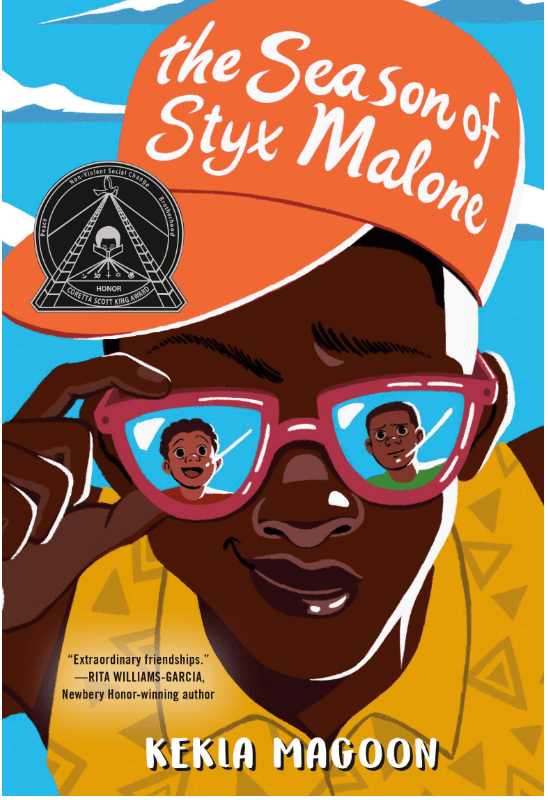
The Season of Styx Malone tells the funny, poignant story about one amazing summer in small-town Indiana, when Caleb and Bobby Gene make friends with the slightly older, way cooler Styx Malone. Let’s be clear: Styx Malone is definitely too cool for school! He knows things… like about elevator trading, where you can essentially make something out of nothing. These boys are going to make a bag of fireworks (obtained by temporarily trading their baby sister) into a green moped. All these brothers want is to see the big city of Indianapolis, but their (maybe overly) protective father wants them to stay close to home in Sutton. The desire for adventure wars against the need for safety throughout the family’s interactions.

The boys follow foster child Styx into one “interesting” choice after another, hoping to achieve their dream of having independent mobility via the green moped, affectionately nicknamed Grasshopper. When things take a turn for the worse, everyone has to reconsider what a happy ending will look like. As Caleb and Bobby Gene lobby for adopting Styx, it turns out that adults can sometimes make good things happen. It’s a delightful book full of good humor from the point of view of three bored friends longing for more from summer than watering holes and doing chores (Mom was not happy about the baby sister trading).

Kekla Magoon is the author of many novels and nonfiction books for young readers, including The Season of Styx MaloneThe Rock and the RiverHow It Went Down, and the Robyn Hoodlum Adventure series

She has received the Margaret A. Edwards Award, the Boston Globe-Horn Book Award, the John Steptoe New Talent Award, three Coretta Scott King Honors, the Walter Award Honor, an NAACP Image Award, and been longlisted for the National Book Award. 

Kekla conducts school and library visits nationwide and serves on the Writers’ Council for the National Writing Project. She holds a B.A. from Northwestern University and an M.F.A. in Writing from Vermont College of Fine Arts, where she now serves as faculty. Visit her online at keklamagoon.com.

Cover art has an illustration of a Black teenager in a slightly off-center ball cap, adjusting his mirrored sunglasses. In the glasses, you can see two other Black kids. The title of the book appear in script on the orange hat.

The book is also available as an ebook, on CD, and as an eAudiobook.