Howard County Library System wishes you all the best during the holiday season. Thank you for reading our new blog, which we began in May. We hope you’ve enjoyed the reviews and maybe discovered a new electronic resource or two.
We published nearly 95 posts this year; here were some of the most-read posts of 2020:
Bypass the News Paywall Jessica listed the many newspapers that HCLS subscribes to … so you don’t have to!
Smiling woman holding a motivational message from the Longest Table event.
by Katie DiSalvo-Thronson
Learn about what’s local!
This fall we designed and launched a new series of programs to educate customers about local diversity, equity, and inclusion issues, and connect participants to organizations taking action on those topics.
Why? Our mission to provide high-quality education for all must include education about our own community! As local news coverage has decreased, it is especially imperative to create conversations and presentations where our shared experience as Howard County residents is discussed and analyzed. We hope you come learn with us, and that our programming helps you contribute to our community.
Look forward to events on the county council’s Racial Equity Taskforce and more.
Learn about your neighbors!
In strategic planning events held with over 500 residents in 2019 and early 2020, HCLS staff heard loud and clear that people are interested in ways to learn about each other. People said they want opportunities to bridge what can feel like racial, cultural, and political divides in the country and build more community. At the excellent 2020 virtual Longest Table, participants voiced this request again.
Howard County is asking HCLS to make spaces for people to connect with and learn from each other. Look ahead to more programming in 2021 with small group discussion, especially on diversity, equity, and inclusion topics.
Additionally, HCLS will be launching a story collection effort on racial equity issues. We have two goals. First, we hope to build community – that sharing and listening to stories will increase our understanding of each other, provide recognition of diverse experiences, and spur new relationships. Second, we seek impact. We will use our stories to understand local diversity, equity, and inclusion efforts more precisely. We will publicly share stories and community-led analysis of these stories to help inform local decision-making. We can’t wait to start this process with you.
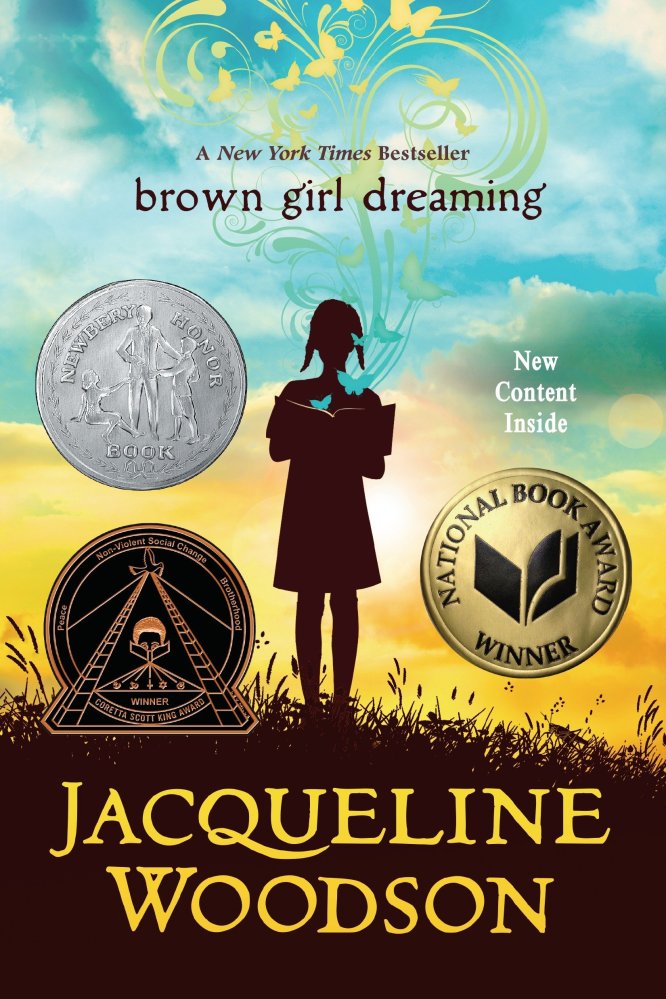
Brown Girl Dreaming may be one of the most beautifully poignant books I’ve ever had the privilege to read. This autobiographical text told in verse relates Woodson’s childhood memories of both Brooklyn, NY and her grandparents’ home in rural South Carolina. I loved the glow of fireflies appearing in the summer dusk, and my heart ached with the understanding that her brother had been lead poisoned by paint in an old tenement. This lovely volume brings us the complete open-hearted bewilderment of a child learning about her world. Dirt driveways and city asphalt combine into a mesmerizing memoir that, while it might be labelled for teens and children, brings truth to all its readers (also available as an eBook and eAudiobook). Woodson received a 2020 MacArthur Fellows Grant.
Woodson continues the coming-of-age theme in her novel, Another Brooklyn. In some ways, I read this as the grown-up version of Brown Girl Dreaming even though its more novel and less memoir. August is returning to Brooklyn for a funeral, and as she travels she can’t help but remember her childhood – the lives of the four fast friends growing up in the 1970s in Brooklyn. The storytelling is still lyrical, if not exactly in verse. The vignettes of the girls’ lives gave me both the feeling of being a young teen again, with all those emotions and upsets, as well as a glimpse of the bigger, national picture that was unfolding around them. Like in the previous book, you get the family nostalgia for an unkind South as well as the hard edges of the northern city. The author does not pull any punches as the girls get older, the problems get thornier, and the solutions ever more doubtful. (also available as an eAudiobook).
These are dreaming books, a little beautiful and a little disturbing, with a haze of remembering to them. But they carry truth, and truth can be hard to hear. Both of these books live on my keeper shelves, and I revisit them periodically. I hope you love them, too.
Kristen B. has worked for HCLS for more than 15 years, and currently hosts the Books on Tap discussion group at Hysteria Brewing Company. She loves reading, Orioles baseball, and baking.
HCLS and InLACE, the Initiative for Latin American Community Engagement, are partnering to offer Remembrance Trees, a community memorial for the Covid-19 pandemic from Dec 9 – 21, and Remembering Together, a virtual event on Monday, Dec 21, 6 – 7 pm. These efforts look to honor those loved ones who have passed and those who are struggling near and far due to the Covid-19 pandemic — and to help us remember that while we might be distanced, we’re deeply connected and can support each other.
Patricia Silva of InLACE approached the library and asked if HCLS wanted to collaborate on this important, meaningful idea during what will be a challenging holiday season for many. HCLS’s Katie DiSalvo-Thronson spoke with her about the inspiration and hopes for these projects. For more information about Remembrance Trees and Remembering Together, visit hclibrary.org/remembrance.
How did you get the idea for this effort?
I first was thinking about this because so many people were dying and how much despair they must have felt and how lonely people have been. When you hear that the families couldn’t say their goodbyes, that bonds were lost… We need to honor them.
I haven’t lost anyone, but when I hear people talking about their friends, sons and daughters being sick or dying that makes me sad and makes me want to reach out with information or emotional support and it makes me want to honor those lives.
Our losses are not reflected only in death, but people losing their jobs, not being able to have food in the house, or facing mental health difficulties. This pandemic affects your hope. What I want to honor also encompasses people who are living with those struggles and uncertainty.
What do you want to remember during this memorial and event?
I think that every life counts and no one should endure this alone. Solidarity.
For you, what does “community” mean in this moment?
Well, it’s a tricky one, because community is something that is immediate around you – but when you become a citizen of the world the notion of community just gets bigger, broader. I live in Howard County, but what happens in my native country of Brazil also affects me.
The other day I was walking through my neighborhood and I saw a lawn sign that said “together and apart.” I think that the same time that social distance makes us physically distant from each other, it could give us a sense of connectivity. We can support each other in ways that are less physical and concrete because what we do and don’t do impacts other people’s lives. If we do social distance, that will impact the curve and fewer people will get sick. The beauty of it in my view is that applies to everything. If we reach out to family and friends to support them, that can save lives, that can help someone. We are in this together. That’s true!
Who should participate in this memorial and event?
Oh my gosh! This is open to everyone who wants to express their solidarity, and in any sense grieve and mourn and remember.
Patricia Silva is InLACE’s Co-Founder and President and a community advocate.
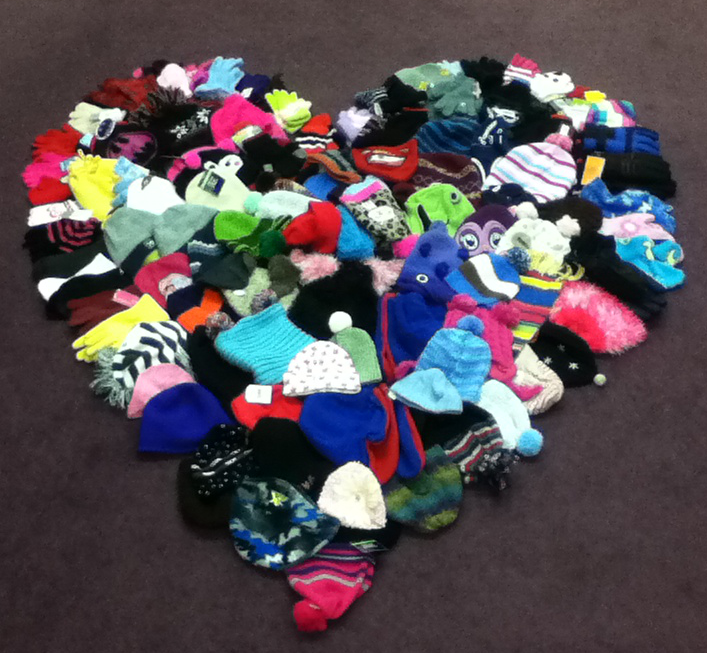
I am constantly amazed by our community. If an opportunity to give is presented, the response is often overwhelming. We take good care of each other, and it makes me proud to live and work in Howard County. Every year, generous people donate almost 1,000 pieces of cold weather gear via the Library. I know you will receive many requests for donations … it’s that time of year … but maybe in 2020 we need to do just a little bit extra.
Once again, we are asking for donations of new child-sized mittens, gloves, hats, and scarves. You can purchase them, or we accept handmade items. Even though we are still constrained to contactless pickup, our lobbies are open and boxes are in place to accept donations at any of our six branches throughout December. Donations will be given to the Community Action Council of Howard County for Head Start children and families.
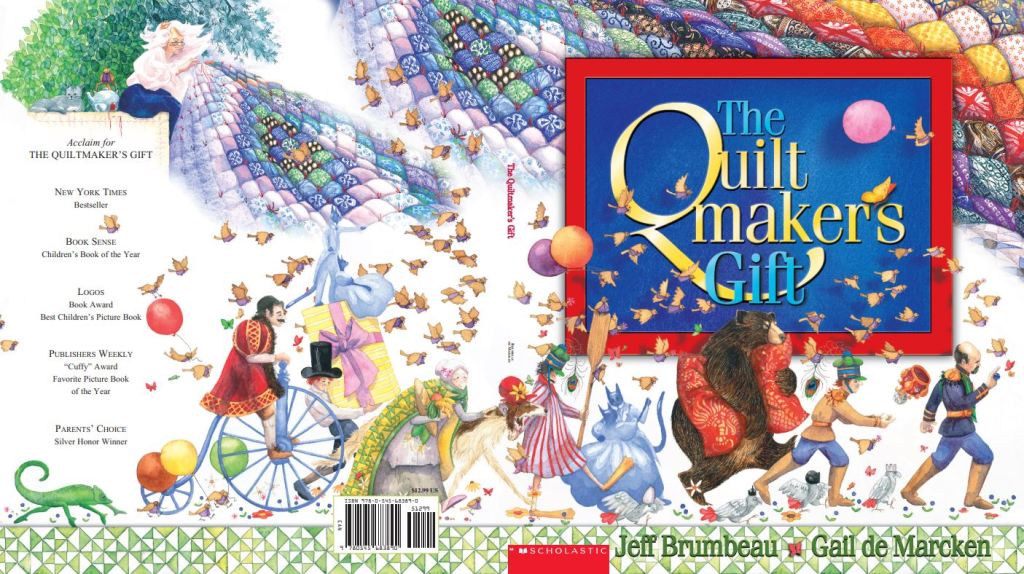
If you are interested in a book that celebrates giving: One of my favorite books that I read to my kids when they were small, and that I still regularly gift to young relatives, is The Quiltmaker’s Giftby Jeff Brumbeau. This colorful, lively tale explains the joy of giving, even more than receiving. The richly detailed illustrations provide examples of different quilting patterns. There’s so much to enjoy!
Thank you for all you do for our community!
Kristen B. is a devoted bookworm lucky enough to work as the graphic designer for HCLS. She likes to spend winter reading, baking, and waiting for baseball to return.
Taking standardized tests, choosing the right college, and planning for a career can be stressful and overwhelming, especially when so much is uncertain. You can control your preparation and research, though, ensuring the best possible outcome. Preparing thoroughly helps to eliminate anxiety and build confidence in your test performance and decision making. Testing & Education Reference Center from Gale is an incredible online tool that’s rich in content, offering standardized test and entrance exam preparation, in-depth undergraduate and graduate program research, tuition and scholarship assistance, and valuable career information. It helps everyone from students to seasoned professionals embark on new paths.
Testing & Education Reference Center provides the information, tools, and materials needed to achieve all your career and education goals, including:
Full-length, Timed Practice Exams Gain an advantage with practice exams that simulate the actual test-taking experience for AP tests, ACT, SAT, PSAT, GMAT, GRE, LSAT, MCAT, GED and HiSET, TOEFL, U.S. Citizenship, military exams, and more. Diagnostic pre-tests help you determine where you stand and how much preparation you need before taking an exam.
Intuitive School Searching Easily search for private secondary schools, vocational/technical schools, boarding schools, military schools, special needs schools, or accredited colleges and universities to find the perfect fit. Quick results deliver information on school location, tuition, academics, admission requirements, campus life, among other aspects.
College Funding Tools Financial aid tools, such as the Undergraduate Scholarship Search, Financial Aid Award Analyzer, College Savings Calculator, and Tuition Cost Finder provide data to help you plan, budget, and identify resources.
Career Development Access rich career development tools including a Career Assessment, the Resume Builder, and the Virtual Careers Library to help in every part of the career planning process. Map your career interests and aptitudes to job categories and industries that fit your personality. Delve into a list of occupations suited to your interests and learn about the skills involved, salaries, and more.
Get job search guidance, as well as resume, interviewing and networking advice for your career stage, whether you’re just starting out, looking to change careers, or transitioning from the military.
Prepare and study for professional certification exams, such as accounting, cosmetology, firefighter, postal worker, real estate, and more.
Testing & Education Reference Center is available for free courtesy of Howard County Library System. Watch this quick video to get an overview of how it works, and then click here to log in with your library card number and PIN. Please note that you must create an account with your email address and a password, which is necessary to save resumes, career assessment scores, and practice test progress.
No matter your academic or professional goals, Testing & Education Reference Center can help you reach them, and HCLS is cheering you on every step of the way!
Kim M. works in the Materials Management Department at the Administrative Branch. She’s currently reading Eleanor Oliphant is Completely Fine by Gail Honeyman and watching The Queen’s Gambit on Netflix.
Are you heading into some holiday conversations you already dread? Or wishing you could talk to someone about a position they hold that you deeply disagree with, but feel unsure how to do it?
When you think about someone who voted differently than you in the last election, are you wondering, “can I even talk to them?”
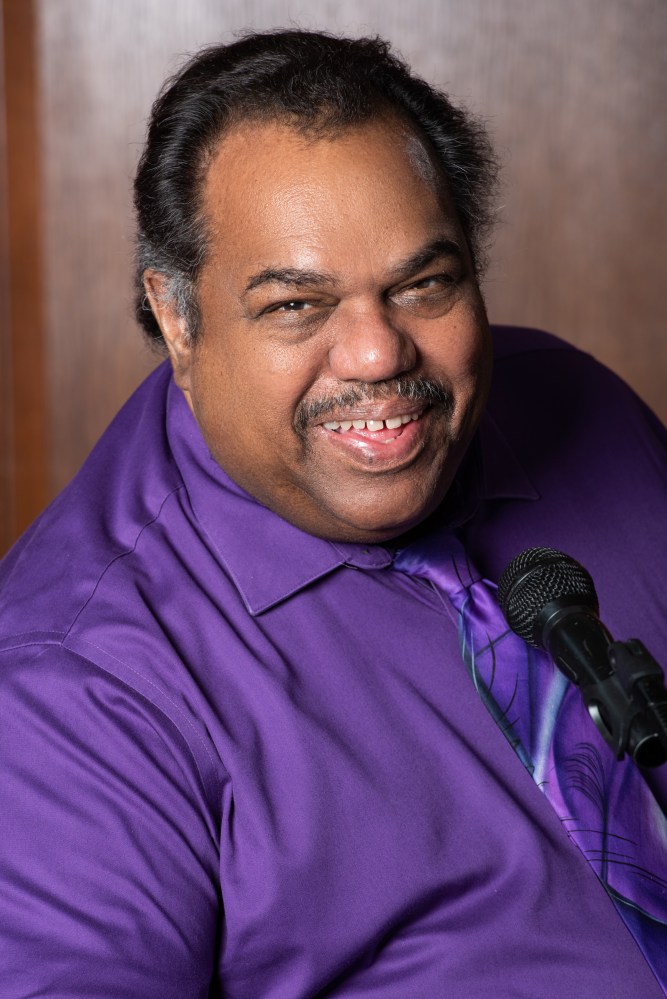
Last month, Howard County Library System held The Longest (Virtual) Table with Daryl Davis, an exceptional man with a lot to say about having hard conversations. Davis is an internationally celebrated blues musician who has also led more than 200 KKK members to leave the organization through personal relationships and dialogue. He is motivated, as a Black man, by the question: “How can you hate me if you don’t even know me?”
At the Longest Table, Davis shared parts of his amazing story, reflections on recent events, and ideas on how to talk someone out of hate. His experiences can help us see that people – even those holding extremely problematic positions – are capable of change. His ideas can help us connect with people whose beliefs feel impossibly different than our own.
So what does Daryl Davis suggest? Here are some of his top points, paraphrased:
Remember we all want the same five things. People want to be loved, to be respected, to be heard, to be treated fairly, and they want the same things for their families that you want for yours.
Give respect and get respect. Ask questions. Listen. “While you are actively seeking information from someone else, you are passively teaching them about yourself at the same time.” On social media, find a positive way to respond. The way you listen and respond will help people listen and respond to you.
Plant seeds as you engage in a long game. Give someone something to think about that troubles their world view. Then, engage again: “You must come back and water the seed – that’s the key.”
Lower their walls and keep them down. If you listen respectfully first, they will feel the need to listen to you next. “Defend yourself but don’t attack them,” and “keep your emotions in check.”
Davis’s approach demands intensive time and skill as well as self-control, and it may not be one we can all use all the time. His focus is not everyone’s: some people think it is more important to change policies and systems than to convert individual racists. However, we can all honor and appreciate that he has dedicated decades of his life to “putting a dent in racism,” along with his courage and selflessness in following this path.
Like good music, Davis’ messages resonate well and widely. How could your ‘impossible conversations’ change by remembering shared humanity, showing respect, and teaching others with the example of how you live? Watch/listen to Daryl Davis in his own words today!
Katie is the Community Education and Engagement Manager for HCLS. She loves people, the big questions, the woods, and chocolate.
Sherlock Holmes is a perennial favorite. So many movies and TV shows have delved into Sir Arthur Conan Doyle’s series of short stories and novellas, from House M.D. to Benedict Cumberbatch on the BBC to Robert Downey, Jr’s movies, that the character has entered the common sphere. You really don’t have to explain him and his particular attention to detail.
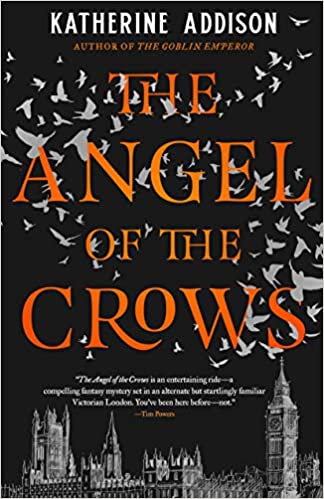
Katherine Addison’s new novel,The Angel of the Crows, combines Victorian England, the Sherlock Holmes stories, and Jack the Ripper with a supernatural, steampunk milieu that includes angels, Fallen angels, vampires, werewolves, and hellhounds. Angels operate a little differently here: they are only thinking, rational beings with names when they have a habitation. Without a location (usually a public building) to guard, an angel is Nameless and belongs to the collective hive-mind. In the worst case, when an angel loses its habitation, the trauma can cause it to Fall (capital letter necessary) … which can have an impact like a bomb.
You need to know this to understand our intrepid detectives, Crow and Dr. J. H. Doyle. Crow names itself Angel of London but is really managing to hold onto a name and an identity by sheer force of will. The angel is a maniac for helping the local police solve murders and other crimes (and obsesses over the daily papers to this end). Dr. Doyle has returned home from the war in Afghanistan, where an unexpected attack by Fallen angels left behind an interesting assortment of wounds and complications. The two social misfits become unexpected, but oddly compatible, flatmates.
These two get themselves into – and out of – all sorts of predicaments. The structure of the book is fantastic, with the overarching story of solving the Jack the Ripper/Whitechapel murders carrying throughout. The novel, however, divides into several, shorter parts which work as discrete, individual detective stories about missing persons, foreign treasure, and other mundane mysteries – most of which are direct pastiches of Sir Arthur Conan Doyle’s originals. The smaller adventures allow the individual characters to come to life and steal into your heart a little bit at a time. Both Crow and Doyle are wrestling the world for their right to live as they choose – and you root for them as well as their superior sleuthing.
While by no means a strict Sherlock equivalency, the book recognizes and honors its source material. I hope you enjoy it as much as I have. It may, indeed, spur you to reacquaint yourself with the originals, too.
Kristen B. has worked for HCLS for more than 15 years, and currently hosts the Books on Tap discussion group at Hysteria Brewing Company. She loves reading, Orioles baseball, and baking.
The first (and only) song I’ve ever heard to rhyme both Trump and Clinton into the same chorus was sung to me during the 2016 election – by a five-year-old in my son’s Kindergarten class.
In 2020, election talk is even more ubiquitous. Grownups aren’t the only ones figuring out voting. Many children are hearing about the election and wondering what it all means. Some may be asking their questions, while others may be unsure where to start. It’s never too early to welcome young ones into the voting process and help them understand how important it is. We may be shocked to find what they’ve heard already – and what critical gaps likely are in their understanding.
Children can understand the value of having a say, and we all know they put a lot of stock in fairness. Such basics of democracy are very accessible. Even preschoolers can use a simple form of voting to make a group decision. Pizza or sushi for dinner? Ride scooters to the park or walk? We grownups can give our little future voters lots of practice with making a choice, counting up votes, and making peace with the outcomes. Of course, the story of American democracy doesn’t end with the idea of one person, one vote, but it is a great way to start talking about it. Reading books about voting can further spark children’s interest and open up fun, informative, invaluable conversations. Encourage your kids to ask questions, then find answers together.
The President of the Jungle by André Rodrigues, et al.is a playful introduction to voting as a fair way to decide things as a group. In the story, the animals are not too happy with Lion, King of the Jungle, and they want a change. Key election concepts are explained with clever illustrations and a glossary. It’s great for big-picture questions about what’s fair and what makes a good leader. Bonus, it’s also great for character voices if you like that kind of outlet.
Vote for Our Future!, by Margaret McNamara shows the many ways kids can get involved during election season, even before they are voting on their own. The story follows an elementary class learning and doing all they can about voting as their school becomes a polling place. Vibrant drawing of people in action let kids make observations and ask logistical questions.
Voting is an important way that families act on their values and help determine what it’s like to grow up in this country. Children of all ages are paying attention. Will they see just how valuable each vote is?
Foradditional books, DVDs, and eResourcesabout voting for children and adults, check out the collection curated by our HCLS team here.
Emily is a Children’s Instructor & Research Specialist at HCLS Elkridge Branch.. Her family voted on how to celebrate their ballot drop-off this year. “I Voted” S’mores won in a landslide over the “I Vote” Rootbeer Float, and “I Voted” stickers.
A monarch butterfly flexes its wings in the Enchanted Garden at HCLS Miller Branch.
by Ann H.
Now is a great time to harvest and plant milkweed to support the dwindling monarch population. Milkweed is the host plant of the monarch butterfly. It is where monarch butterflies lay their eggs, and when the eggs hatch the tiny monarch larvae (caterpillars) start chomping away on their one and only food – milkweed leaves. Monarchs cannot complete their life cycle without milkweed. Common milkweed, Swamp milkweed, and Butterfly Weed are all native to Maryland and suitable for the butterflies as they journey through our state. The Enchanted Garden showcases vivid orange Butterfly Weed and, especially this year, an abundance of Common Milkweed. The latter one spreads easily. During the garden closure it found its way to our compost bins, the pathways, and between the rocks lining our stream!
Milkweed seeds are easy and fun to harvest. In the fall, fat pods dry on the plants and burst open to reveal hundreds of seeds in a single pod. Each seed is attached to silky fluff also called coma. That silky fluff allows the seed to float through the air with the hope of landing in fertile soil. You can pull the seeds from the fluff or put an open seed pod in a bag with some pennies for weight, close the bag and shake. The seeds will come loose from the fluff.
Collect and plant seeds now so the seeds get the winter chill or cold stratification they need to germinate in the spring. If you want to wait, put them in a bag in the freezer for a month and they’ll be ready for planting come spring.
Would you like to plant some milkweed? I am happy to share the many common milkweed pods I harvested from the Enchanted Garden. I’ll place a container of pods in front of the Enchanted Garden Gate on days I’m in the garden (see times below) and for as long as the supply lasts. Bring a small bag and take a couple pods home. Every seed planted has the potential to support our monarchs!
WHEN: Monday, Tuesday & Wednesday October 19, 20, 21 & 26, 27, 28 9:30 am – 12:30 pm
You can find additional information about Monarchs in our HCLS collection.
Ann is a Master Gardener and the Enchanted Garden Coordinator at the HCLS Miller Branch, where she has worked for eight years. You can find her smiling in the garden and sharing her passion for plants, nature, and our community.














 CHAPTER CHATS