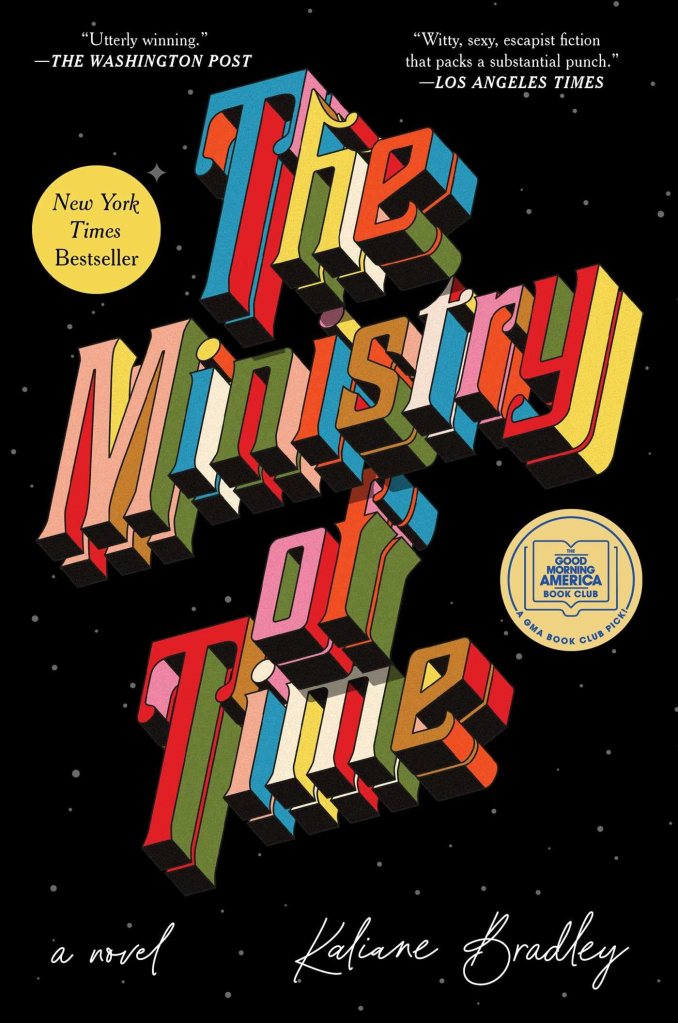
The Ministry of Time by Kaliane Bradley

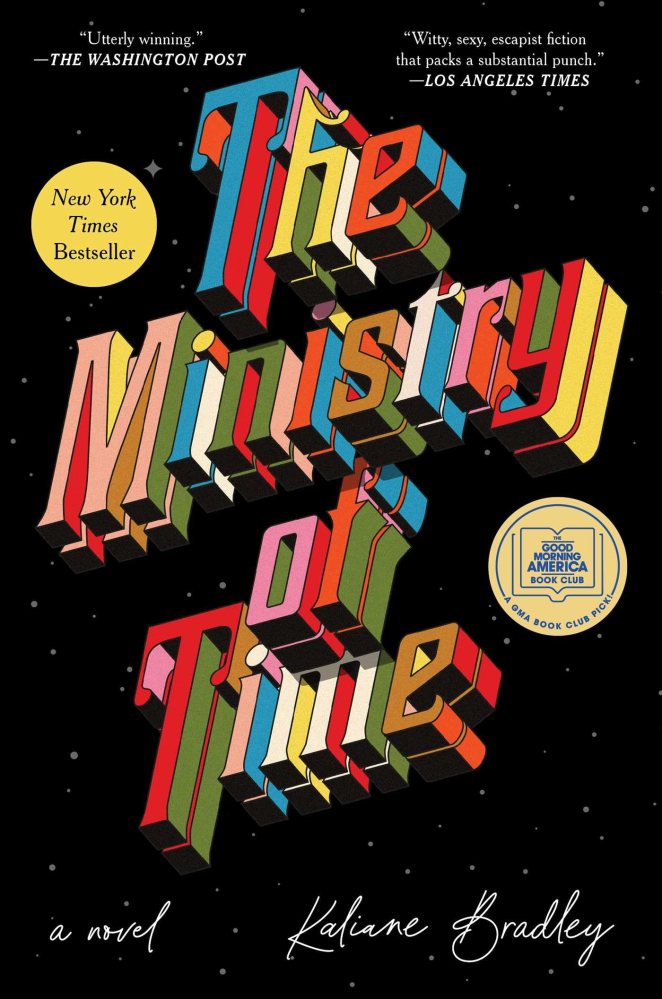
Brightly colored, large italicized lettering appears doubled on a black cover. Stickers added for New York Times best seller and the Good Morning America Book Club.

by Kristen B.

As the story begins, the main character is finishing a series of rather hush-hush job interviews. When she learns she got the new position, she hears the words, “We have time travel.” Welcome to The Ministry of Time by Kaliane Bradley, which plays with the notion that sometime in the future, we figure out how to travel in time.

It’s one of the biggest question about time travel: Can we improve the present – avert some disaster – by changing the past? This story seems a little different, more scientific at the start – wondering if it’s even possible for humans to exist outside of their own time. The Ministry devises an experiment where they “rescue” certain individuals known to have died in tragic or terrible ways: a doomed trip to discover the Northwest Passage, a plague house in the 1600s, the trenches of WWI, and other such horrible histories. Those individuals feel more like they’ve been kidnapped than rescued.

The book’s narrator, who gets that job with the Ministry (but never a name), is assigned to be a bridge between Graham Gore, officer of the Royal Navy in the early nineteenth century, and her time period in near future London. She insists on referring to him as being Victorian, but his time was actually just before Victoria’s reign began. The first third of the book delights in Gore’s observations of modern life and conveniences. But clearly, something is amiss in the Ministry. The main character just can’t quite figure it out but strange happenings keep occuring, like her handler being assassinated at a public event and certain time travelers being invisible to scanners. Other things don’t add up either, although it becomes clear there are warring factions within the Ministry. No one is quite sure who to trust.

Graham and our narrator spend almost all their time together: learning modern skills like riding a bike (which eventually improves to a motorcycle), touring museums, and going to pubs with other time traveler/bridge pairs. One session admiring a Turner exhibit at the Tate is particularly insightful. Graham becomes good friends with two other people out of time, one of whom is my favorite character. Maggie was left to die in a plague house, but she comes to embrace London’s club scene and dating apps where she can be openly gay. These friendships prove to be crucial not only to the characters’ well-being, but to the ultimate resolution of the story.

On top of the fascinating premise, the author has a gorgeous way with words. One character is described as, “Despite being out of uniform, he looked oddly formal, as if he was as the sole person in serif font.” I don’t want to spoil the surprise of this excellent debut. What ensues in the second half of the book is a complete mash-up of time travel, spy thriller, and romance into a beautifully written novel about the dangers of colonialism. Bradley really does tell you everything you need to know in the first chapter, only I didn’t realize it until I re-read it after the devastatingly bonkers ending. This is a book I’ll think about often and already have plans to re-read.

You can borrow the book in print or large print now, but there’s a bit of wait for the e-book and e-audiobook versions.

Kristen B. is a devoted bookworm lucky enough to work as the graphic designer for HCLS. She likes to read, stitch, dance, and watch baseball (but not all at the same time).
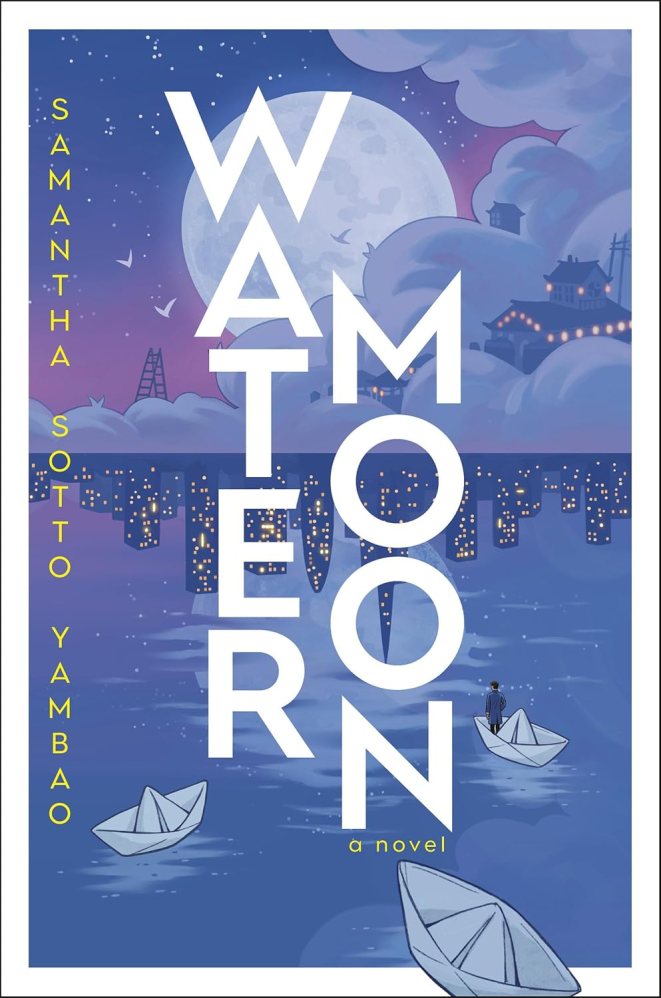
Water Moon by Samantha Sotto Yambao

The book cover shows a city skyline reflected in water in the moonlight, with several small boats approaching, one with a passenger facing the shore.

by Kristen B.

Sometimes, a quirky book comes into your life at just the right time. Water Moon was that book for me recently, during a high-stress time. It’s a delightful, cozy sort of fantasy set in a Japanese-inspired mythology, and it feels like an anime show that could air on a Saturday morning.

As the story opens, Ishikawa Hana is ready to take the reins of her family’s pawnshop when her father retires. It’s an unusual shop; only people who need it can find it, sitting tucked next to a popular ramen restaurant. The shop allows people to bargain away their greatest regrets. Kei is a nuclear physicist who is in Japan to work on the Super-K conductor looking for neutrinos. He’s in Tokyo for ramen – and hoping for a little wish fulfillment. Kei stumbles into the pawnshop and finds Hana standing amid ransacked wreckage.

Hana’s father has disappeared, on the run from mysterious figures who collect the regrets that are bargained away every month. The Shiikuin have no mercy for those who stray outside their roles. Hana’s father, Ishikawa Toshio, seems to have stolen one of the regrets, which take the shape of brightly-colored birds, and fled. When Kei wanders in looking for ramen, he immediately offers Hana all the help he can.

Hana then introduces Kei to the world on the other side of the puddle, where magic has its own rules that run counter to everything Kei thinks he knows. The two adventure through dreamlike sequences in a rather episodic manner, which made me think it would be a great animated show. They visit Hana’s grandmother’s tea house, explore the floating Night Market, and experience falling through a paper door and being folded like origami, among other memorable vignettes. All the while, Hana and Kei try to stay one step ahead of the cruel monsters on their trail.

While they are running and solving puzzles, Hana constantly tells Kei that things are not what they seem. The two have an instant connection and spend the course of the story falling in love while being sure they can’t be together. Hana is engaged to a childhood friend, and Kei is from our world, not hers. But, the story wonders, what is the price of happiness? What duty do we owe to how things are “supposed to be?” How do you set aside expectations so you can truly live your most authentic life?

All these weighty questions are wrapped up in spare, lovely prose and a fast-moving plot. You keep reading to find out how they escape the next pickle, always looking for Hana’s missing parents – and the answer to how you get to be with the one you love. Things might not be as they seem, but the resolution is wonderfully, romantically satisfying.

Water Moon is available from HCLS in print and as an e-book and e-audiobook on Libby.

Kristen B. is a devoted bookworm lucky enough to work as the graphic designer for HCLS. She likes to read, stitch, dance, and watch baseball (but not all at the same time).

The Violin Conspiracy by Brendan Slocumb

You see the face of a Black man peering through the f-hole on a violin.

by Kristen B.

One of the reasons I love to read is to gain new perspectives on what it’s like to live an entirely different life. The Violin Conspiracy by Brendan Slocumb offered just that in a smooth, beautifully written package. While the framework of the story is the mystery of who stole a valuable violin, the book is all about living your dreams and working hard to realize them. It almost doesn’t matter “who did it,” as long as the violin is returned. That’s what kept me reading – does Ray get his precious violin back?

Imagine being a violin prodigy. But here’s the rub: no one recognizes or supports you as such because of the color of your skin and your socio-economic status. Rayquan McMillian was born in rural North Carolina and seemed destined to leave high school early to get a job so he could help his mom pay the bills. His true love in life was playing with the high school orchestra and in a local gig group for weddings and such. He brought in enough money to placate his mom.

Now, imagine finding out your grandfather’s dusty old violin moldering in the attic is actually a Stradivarius. Ray’s Grandma Nora was his fiercest defender (and my favorite character), who loved him wholeheartedly and supported his love of music. She encouraged him to look for his grandfather’s violin in the piles of family detritus in the attic. Eventually, he found it, fought to have it minimally restored at a local shop, and had an instrument to call his own.

When auditioning for the local honors orchestra, Ray got the opportunity of a lifetime when he was discovered by a strings professor from a local college. When offered a full scholarship, he seized the opportunity and never looked back. When it was time to start auditioning, his mentor encouraged him to find a new violin. He then got a call that changed his life: Did he know what he had? He had no idea that he owned a $10 million piece of musical history.

All of this combines into a wonderful, heart-warming story of one person’s determination to be true to his talents and to live in the world of music. Ray had few illusions about his chances to succeed, but he rose to perform at the most prestigious places within classical music: Carnegie Hall, the Chicago Symphony Orchestra, and the Tchaikovsky Competition. You read about the hours and hours of practice, learning technique and struggling to gain mastery over fantastically difficult music, and through it all, how much Ray loves the various pieces and connects to the music. The writing through these passages is lovely and lyrical.

The book opens with Ray discovering the theft of his violin, then gives you his story until it all catches up at the Tchaikovsky Competition. Ray, his girlfriend Nicole, and his college mentor travel together. As Ray heads to the most important performance of his life, he has to worry about insurance policies, lawsuits from two different sets of relatives, and whether he’ll get his beloved instrument back so he can play the way his grandmother dreamed he would. The book navigates family expectations, professional politics, and international intrigue all through the point of view of a good kid who just wants to play music for people. I rooted for Ray through the entire book!

The author’s website has a Spotify playlist, which I discovered after reading. It brought new levels to understanding how difficult some of the music selections truly are. Slocumb is a professional musician and clearly is writing what he knows – not just the world of being a professional musician, but how much more difficult it is to be a Black professional musician with racism and condescension at every turn.

The Violin Conspiracy by Brendan Slocumb is available in print, large print, and e-audiobook.

Kristen B. is a devoted bookworm lucky enough to work as the graphic designer for HCLS. She likes to read, stitch, dance, and watch baseball (but not all at the same time).

Branch Raffles & Birthday Bash

Celebrating 85 surrounds a set of candles with dark blue text that says Evening in the Stacks, Howard County Library System. Plus a neon lit sneaker, advertising the event as a sneaker ball.

BRANCH RAFFLES Branch raffle tickets are available online or at every branch. The last day to purchase raffle tickets is Feb 21. Winners will be drawn by February 26 and notified by email and/or phone. Nearly 80 businesses donate items for this raffle. Please make sure to thank those that you see on the prize lists by giving them your business! Raffle tickets are $5 each, and you can win any of these prizes: 

  • Grand Prize: Disney Vacation Club 4 Night Stay 
  • Two tickets to Evening in the Stacks on Feb 22 (in branch sales only)  
  • Six branch community baskets with donations from area businesses
  • Family fun package filled with tickets and gift cards to local attractions

Purchase tickets or become a sponsor at hclibrary.org/stacks. Did you know that Friends & Foundation of HCLS raises more than $100,000 each year to support the library’s educational initiatives? Evening in the Stacks is an important winter fundraiser that helps them reach that goal. When you make a $500 or more donation to the Friends, you receive two tickets to the party! 

EVENING IN THE STACKS: BIRTHDAY BASH Party at our sneaker ball in your snazziest outfit and your coolest kicks. Live in the spotlight during a live sneaker contest before our guest DJ gets the dance floor jumping. Enjoy a gourmet meal by Rouge Catering, sip signature drinks by The Wine Bin and Sobar, and endless birthday entertainment.  

How much are tickets? Tickets are $125 if purchased by January 31.Beginning February 1, tickets are $150 or two for $285. Purchase tickets or become a sponsor at hclibrary.org/stacks.

This year’s gala fundraiser benefits the vital work HCLS does to help prepare young children  
for kindergarten.

THANKS TO THE SPONSORS

Platinum 
Friends & Foundation of HCLS   
Gold 
The Common Kitchen at Clarksville Commons 
Howard Hughes Corporation 
Ron and Ellen Flynn Giles 
Hoenes Family Foundation   
Photo Booth 
Grimm + Parker Architects   
Silver 
Howard County Economic Development Authority 
Ronald and Cynthia Gula Charitable Fund   
Bronze 
Ayers Saint Gross 
Columbia Association 
Connection 
COPT Defense Properties   
Media 
Columbia Inspired 
FunFitnessFamily   
In-Kind 
Brown & Associates, Inc. 
Rouge Catering 
The Wine Bin 

Shakespeare: The Man Who Pays the Rent by Judi Dench

A light blue cover with a small watercolor illustration of a tree above text that reads: Judi Dench. Then, Shakespeare in a big script above copperplate type: The Man Who Pays the Rent.

by Kristen B.

If you have ever wanted an in-depth, behind the scenes look at Dame Judi Dench’s formative years with the Royal Shakespeare Company, have I got a book for you! If you haven’t but have a fondness for the Bard, you still want to get your hands on this book. And if you simply love to listen in on two friends trading stories from their past and arguing over details, this one is for you, too – it’s that much fun!

Dame Judi Dench and her good friend Brendan O’Hea engage in a series of conversations in Shakespeare: The Man Who Pays the Rent, during which they discuss Shakespeare and acting, and – in all honesty – just dish about various productions. You can almost hear the teacups in the background. It’s fascinating to eavesdrop on them quarreling about interpretation or reminiscing about pranks and misdeeds. They cover some of the best-known plays, such as Twelfth Night, Macbeth, and Romeo and Juliet, but they also spend time with Coriolanus, The Merry Wives of Windsor, and The Winter’s Tale. I was simply amazed by how much of each play Judi Dench can apparently recite from memory – entire sequences, from multiple parts.

I assume the physical book is lovely, but the audiobook is pure gold. Barbara Flynn provides Dame Judi’s voice, and you would think that you’re listening to a younger version of the great actress (which you essentially are). She talks about her favorite parts, her views for the motivation of various characters, how Shakespeare manipulates the audience, and more details about stagecraft. She also tells stories about being mostly naked and painted green, sharing rooms, and having a ton of fun with other (now revered) fellow actors.

As she says, ““Everything you have felt or are yet to feel is all in there in his plays: oppression, ambition, loneliness, remorse, everything….Shakespeare has examined every single emotion….His writing has the capacity to make us feel less alone.” This book helped me remember exactly that! I laughed, I learned, and I was gloriously entertained.

Shakespeare: The Man Who Pays the Rent by Judi Dench and Brendan O’Hea is available in print, e-book, and e-audiobook.

Kristen B. is a devoted bookworm lucky enough to work as the graphic designer for HCLS. She likes to read, stitch, dance, and watch baseball (but not all at the same time).

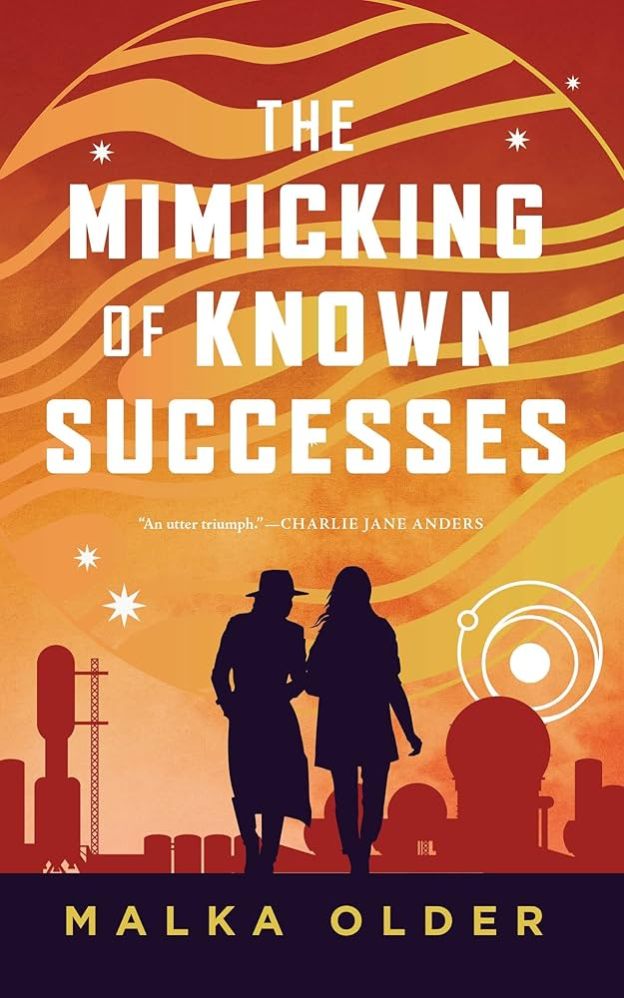
Mossa and Pleiti series by Malka Older

by Kristen B.

The first two books in a series by Malka Older take place about 500 years in the future. Humanity no longer lives on Earth, a planet we have rendered uninhabitable. Instead, we colonized Jupiter – known as Giant – and some of its moons. A series of platforms and railways encircle the big gas planet, on which farms, businesses, and Valdegeld University exist (or in some cases, subsist). There are three major schools at the university: Classics, Modern, and Speculative. Classics studies literature, history, biology, and more from our planet of origin, trying to figure out how the pieces of well-balanced biospheres (ones not continually in crisis) operate. Modern looks at the issues facing the populace where they are now. Speculative also looks to return to Earth, among other goals, but not (necessarily) to restore it to its former glory. University-level research appears to be the biggest enterprise and employer, upon which the survival of the species relies. It’s rather a pointed observation, given the modern American penchant to argue with experts and deny scientific advancement.

I pieced together most of this synopsis from the information around the edges of Older’s first two short novels in a mystery series that is planned to run for at least five books. Pleiti is tenured faculty at Valdegeld, with a specialty in classic literature. Mostly, she researches how the various elements of biospheres worked together by reading books published when those animals lived on Earth. Mossa is an Investigator, the equivalent of a police detective, who spends most of her time searching for lost people. The two were lovers in their past, who, as the series begins, perhaps look to rekindle their romance.

The two installments to date are a lovely combination of science fiction, college politics, and detective mystery. Pleiti and Mossa are enigmatic people, but you find yourself wanting to know more about them as individuals and a couple.

The Mimicking of Known Successes: A man from the university takes a railcar to a remote platform, then promptly disappears. Mossa is pretty sure that he didn’t jump to his death into the planet, and she ends up at Pleiti’s campus asking questions and looking for help. University politics and personalities mix badly with personal ambitions to see Earth restored. Favorite pieces include atmoscarves, the sheer quantity of scones and tea consumed, and the existence of the mauzooleum where “ancient” breeds of animals are carefully bred and studied. I had to make an effort to keep reading through a fairly slow set-up and was rewarded with an exciting, and rather unexpected, conclusion.

The Imposition of Unnecessary Obstacles: I enjoyed this one more, when I could enjoy the mystery without working to understand the world-building. Mossa and Pleiti once again join forces to solve a case involving missing persons – and a subsequent murder – that requires them to do a fair amount of traveling, including to the moon Io and the far side of Giant. Gourmet snacks once again play a not-inconsiderable role as our valiant pair completes some quality sleuthing. There’s also the mention of an opera named Murderbot, which was a high-quality tidbit. I gobbled up this book over a weekend and appreciated the slightly faster pacing and tighter timeline.

A third installment is scheduled to be published in June, The Potency of Ungovernable Impulses, and I’m already looking forward to it.

Kristen B. is a devoted bookworm lucky enough to work as the graphic designer for HCLS. She likes to read, stitch, dance, and watch baseball (but not all at the same time).

Night of the Living Rez by Morgan Talty

by Kristen B.

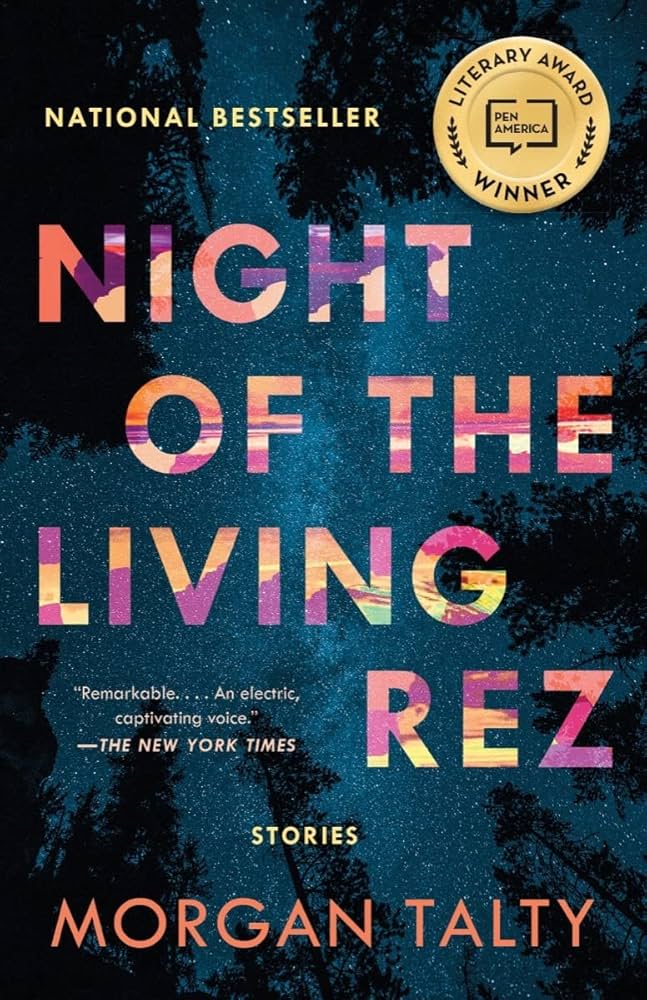
My book discussion group (Books on Tap) recently discussed Night of the Living Rez by Morgan Talty. I try to choose books that reflect the time of year, as well as to prioritize authentic voices. This book worked for November because Morgan Talty is a Native American author, and his book collects a series of inter-connected short stories about David and his family and friends on the Penobscot reservation in Maine.

In all honesty, the book is as bleak as any other work that deals with generational trauma and chronic poverty. However, it is laced with gorgeous prose, mostly in scenes describing the local woods and river. Talty has a sense of the poetic that shines through even the most difficult situations – including the description of a car crash that perfectly captures the halting, photo-flash moments of impact and aftermath. Surprisingly, along with the spare dismay of the stories, Talty also offers a pitch-black sense of humor. The sheer absurdity of teenage boys and their antics relieves the otherwise unrelenting sense of nowhere to go and nothing to do that permeates this book. Sometimes it’s true: you have to laugh instead of cry.

Eleven of the twelve chapters are tightly told from young David’s point of view – and his almost complete lack of understanding of what’s happening with the grownups in his life. His relationship to his grandmother is the foundational relationship of the book, as it was for his life. That special love grounds the stories and makes them real, in ways that the cigarettes, drugs, and drinking couldn’t. The love and the bad decisions weave so intimately that the inevitable heartbreak registers as simply, devastatingly true. The tight narrative focus is a fascinating authorial choice, but not until the last section do all the pieces truly come together in any sort of coherent way. It’s worth getting there with adult David, with compassion and forgiveness for the bone-headed youth that he was.

I’m not sure this review is going to convince you to pick up this book, but you should! I was heartened by reactions of the folks in my book club. They found value in the language, the author’s choices of what to share, in the universality of the stories, and in the need to laugh in the face of despair. Night of the Living Rez is a stellar beginning for a new author. I will eventually read Talty’s new novel, Fire Exit, but I need to continue to sit with this volume first.

Night of the Living Rez by Morgan Talty is available in print, e-book, and e-audiobook.

Kristen B. is a devoted bookworm lucky enough to work as the graphic designer for HCLS. She likes to read, stitch, dance, and watch baseball (but not all at the same time).

Ink Blood Sister Scribe by Emma Torzs

A deep purple background shows a plant and fountain pen, with the four words of the title interlaced in light yellow.

by Kristen B.

There seems to be a trend these days that recognizes the inherent magic of books. I mean, what’s more magical than a book? A bound set of white paper pages, set with solid black type that absolutely transports you via your imagination. Maybe you’re sleuthing for clues to solve a crime? Maybe you’ve stepped through the back of a wardrobe into a snowy woods? (still waiting for this to happen, honestly) Maybe you’re falling in love with your worst enemy from high school? So many books, so little time!

Ink Blood Sister Scribe by Emma Torzs takes the magic of books one step further, giving us spell books and the scribes who write them. It’s an entirely enthralling concept in a debut novel that reads as part family saga and part thriller, with a bit of romance thrown in to keep things fun. The three alternating POV main characters are desperately trying to figure out what’s going on in their world, and I enjoyed putting together the pieces with them.

The book opens with Esther loving her life and falling in love at the scientific station in Antarctica. She moves every year, trying to stay hidden from the people who killed her mother. Only this time, she likes the work and she has a girlfriend, and she’s literally at the far end of the earth. What could go wrong? Then, a new batch of researchers arrives and bad things start to happen, like people disappearing on the ice fields. She notices that mirror magic seems to have found its way into the dormitories. Esther knows about magic but is immune to it. She flees, terrified by an attempt on her life and anonymous notes that reach her through a mirror at the station.

Joanna, Ester’s half sister, lives a completely home-bound life in New England, as compared to Esther’s constant movement. She has an obsessive routine that protects the books her father collected throughout his life, books that led to her parents’ divorce and an almost complete estrangement with her mother. Joanna can perform the spells in their family’s magical library to maintain the protective wards on the estate. Before events get underway, Joanna found her father dead in the front yard, bleeding from one finger into one of the spell books. Her personality and life seem as opposite from Esther’s as possible, but the sisters miss each other terribly.

Nicholas is the poor, little, rich kid that no one feels terribly sorry for – until you do. He seemingly has an enchanted life of parties, limos, bodyguards, and a huge family estate in the English countryside. Nick is one of the last known living Scribes, a person who can write spells. There’s a catch, though – a scribe has to use their own blood as the ink. It turns out that Nick’s guardian and mentor is not (surprise surprise) an entirely ethical person, despite family ties. Uncle Richard has some fairly classic failings. When Nick runs away with his grumpy bodyguard Collins, they meet Esther on her way out from Antarctica. This coincidence has been carefully engineered – but I don’t want to give away more than that. Also, Collins is one of the best side characters ever, along with Nicholas’ dog Sir Kiwi.

From there on, it’s a flat out race to save the three protagonists, foil nefarious plans, and make magic accessible again. I don’t want to spoil any of many plot twists and turns, some of which are well telegraphed and others are more surprising. The interlocking story lines take a while to resolve, but I loved every word of discovering hidden libraries, teasing out the meaning of long-lost spells, and unraveling family secrets. The conclusion is satisfying, if a little rushed after the prolonged setup. I would love to read more about these characters in the future.

Ink Blood Sister Scribe by Emma Torzs is available in print, e-book, and e-audiobook.

Kristen B. is a devoted bookworm lucky enough to work as the graphic designer for HCLS. She likes to read, stitch, dance, and watch baseball (but not all at the same time).

Groundskeeping by Lee Cole

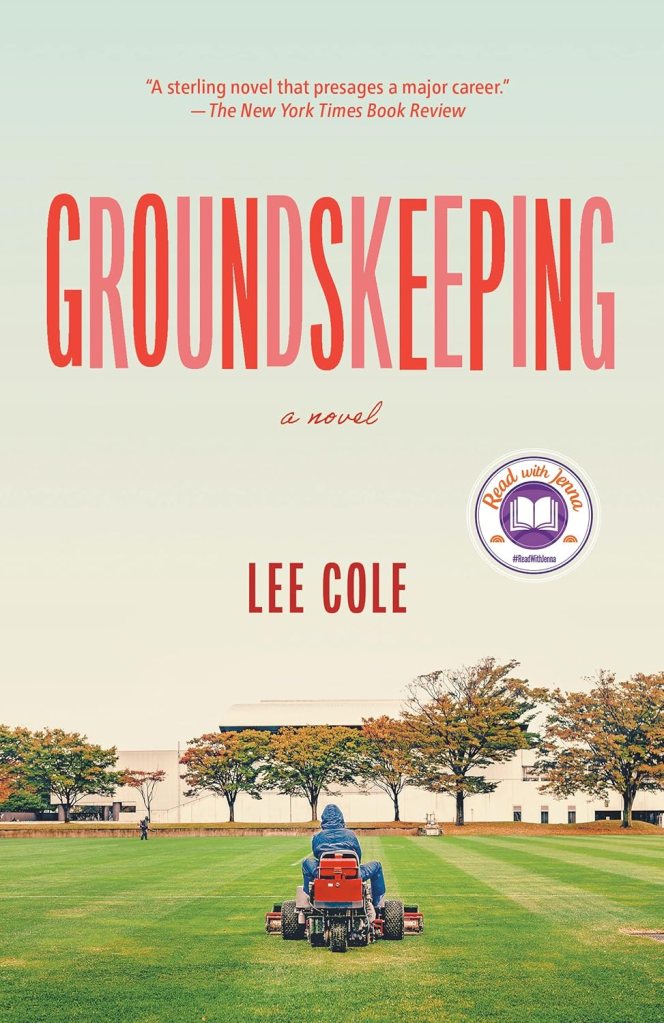
The book cover shows someone in blue jeans and a blue hoodie riding a red lawn mower across a vast expanse of lawn towards trees and a large building. The rider's back is to the viewer as if moving in the opposite direction.

by Kristen B.

Books on Tap (an HCLS book discussion group) recently discussed Groundskeeping, seemingly an ideal title for book clubs: well written, timely, and with just enough spaces in the story to poke at. This debut novel by Lee Cole takes place at small liberal arts college in western Kentucky in 2016. The heart of the story revolves around a coming-of-age journey for Owen Callahan, a rather fatalistic young man with dreams of becoming a writer. After he graduated from a local state college, Owen ended up in Colorado, living out of his car, working odd jobs, and doing drugs. In the manner of a prodigal son, he swallowed his pride at age 28 and moved home into his grandfather’s basement. When we meet him, he has taken a job on the groundskeeping crew at the local college, which pays for creative writing classes.

As the book opens, Owen is lurking in the corner at a friend’s party as the new semester begins. He strikes up a conversation with an attractive young woman, who claims to come from a country that no longer exists. Alma provides the other half of the story’s equation, as the child of Bosnian Muslims who fled to the States when Yugoslavia fell apart. She grew up in northern Virginia, an Ivy League-educated over-achiever who became a published author fairly quickly. She has won a year-long fellowship at Ashby College, where she’s teaching workshops and polishing a volume of poetry.

The attraction that begins at the party blossoms into a true romance, with all the requisite drama and confusion. Owen and Alma are an “opposites attract” couple in almost every sense. He’s wholly from Kentucky and wants nothing more than to make his way out into the world, both physically and professionally. She has all the advantages-economic status, education, literary success, and a path forward, but her family’s history is rooted in trauma and tragedy. Given these fundamental differences, Owen and Alma have the capacity to both hurt and heal each other to staggering degrees.

A wide variety of supporting characters make the spaces and situations believable. Owen’s family sheds light on the disaffected rural Americans who became Trump supporters in the pivotal 2016 election. His uncle rages against opportunities lost while addicted to pain killers. His co-workers at the college provide another set of perspectives, and Alma’s family demonstrates how immigration (in something close to a refugee situation) can be a mixed blessing.

Cole’s language offers a constant recursive flow of Owen learning how to write and how to love, as he journals about the details of his days and discusses writing assignments. Combined with the richness of the characters, this is a more discuss-able book than is immediately apparent. In many ways, the setting is the third main character of the book. The hills, rivers, flea markets, bars, towns, and even the jargon and accents of western Kentucky give the novel a veritable grounding – a ground to keep, indeed.

Groundskeeping by Lee Cole is available in print, e-book, and e-audiobook.

Kristen B. is a devoted bookworm lucky enough to work as the graphic designer for HCLS. She likes to read, stitch, dance, and watch baseball (but not all at the same time).
Favorite Movies Starring Frances McDormand

Frances McDormand in the movie Fargo, in a bomber style winter hat, sitting at the wheel of a car, looking side-eye to the right.
from Fargo

by Kristen B.

I love going to the movies, sitting in the dark with a tub of popcorn, having a communal moment with a bunch of strangers I will never talk to. I also enjoy watching at home, via DVD or a streaming service, with a big bowl of popcorn (a theme!). My viewing tastes are almost as eclectic as my reading ones: artsy emotional films that wring your heart, thrillers full of car chases and gun fights, animation that leaves a hopeful smile on your face, book adaptations, and grand fantasy epics. Tell me a compelling story, and I am a happy human.

I will see ANYTHING in which Frances McDormand has a role, of any sort or size. She can probably lay claim to most of those film genres listed above. She is a marvelous character actor, disappearing into whatever persona she chooses to inhabit – from a French nun to a pregnant police officer to a mother grieving her missing daughter. I cannot say I’ve seen everything she’s been in because, holy moly, that woman has an immense body of work – including being the voice of God in the Good Omens series. But here’s a quick look at some favorites:

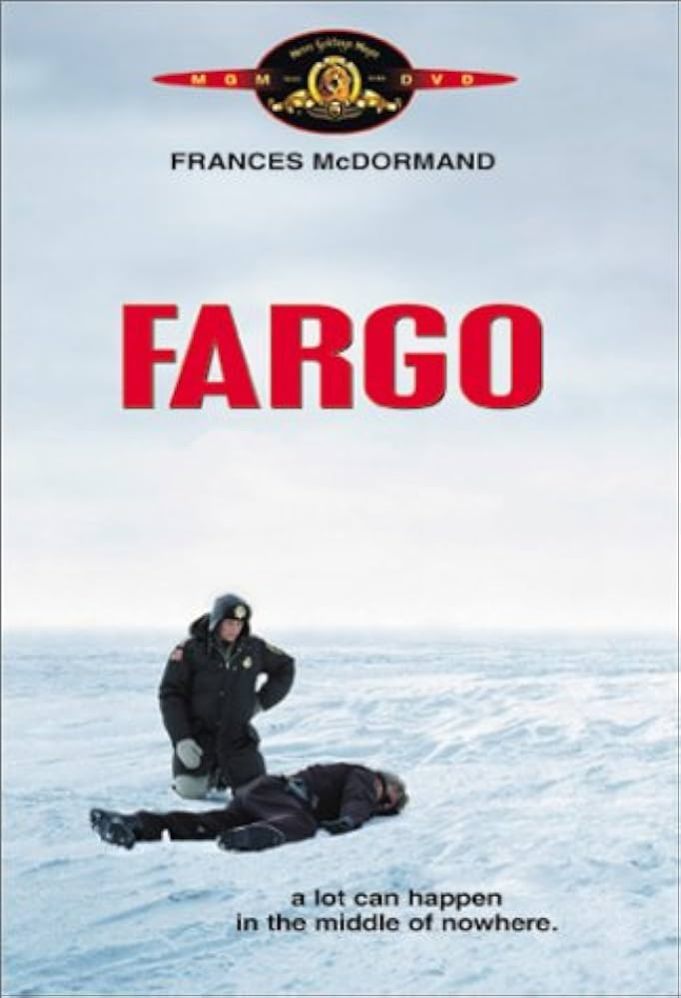
A police officer bundled in winter gear kneels in snow next to a face-down dead body. The scene is white sky over a field of snow. The title appears in red and teaser reads,"a lot can happen in the middle of nowhere."

The Coen Brothers movies defy categorization, and she’s a favorite of theirs, understandable given that she’s married to Joel Coen. Two movies immediately come to mind:

Fargo: Where she plays Margie, the whip-smart local police detective who is investigating what appears to be a random murder. The movie spools into a convoluted tangle of a tale that puts lie to the adage that truth is stranger than fiction. While there might be some real life behind this movie, it’s mostly fiction.

Burn After Reading: The Russians? This movie immediately entered my family’s lexicon of jokes and silly sayings. It might have the most DC vibe of all the Coen Brothers’ movies, and so be a little more relatable to those of us who live in the DMV. A mysterious cache of what appears to be important information pulls gym rats (McDormand and Brad Pitt), the CIA, and a plethora of cameo roles into a darkly funny send-up of the world of international espionage and politics.

Emotional Wringer

McDormand won the Oscar for Best Actress for her role in Three Billboards Outside Ebbing, Missouri. She plays a distraught and deeply angry mother who rents three roadside billboards to draw attention to her daughter’s unsolved rape and murder. She is, quite literally, willing to burn down her life and the town to get answers.

Artsy, Feel-good

A pristine blue sky above summer green tree provide a photo backdrop to a group of people in the bottom third, most of home are dressed in uniforms remiscent of Scouts.

Of all of Wes Anderson’s perfectly composed films, Moonrise Kingdom is probably my favorite. The setting of summer camp on a New England island pairs deliciously with the young lovers Sam and Suzy (as deeply romantic as only 12-year-olds can be), who run away looking for the perfect place to live in harmony. McDormand plays Suzy’s mom, among the many, many stars who inhabit this odd corner of the world. This movie has everything: local theater, police, scouts, dancing on the beach, a lighthouse in a hurricane, and Ed Norton wearing knee socks.

Fun and Funny

Miss Pettigrew Lives for a Day, which co-stars two other favorite actors, Amy Adams and Ciaran Hinds, is one of those movies that I will always be willing to watch. In London on the eve of World War II, McDormand plays the strict governess who has become a social secretary to a wealthy, beautiful socialite involved with three men. Romance and shenanigans ensue for the entire cast. (based on a book)

Children’s Story

In an old house in Paris that was covered in vines, lived twelve little girls in two straight lines, the youngest of whom was Madeline.

If you aren’t familiar with Ludwig Bemelmans lovely, rhyming series of stories for children, you might want to start there. Miss Clavel runs the French Catholic boarding school, where Madeline is the fiercest and funniest of orphans destined to steal hearts everywhere. McDormand plays the straight-faced and exasperated nun in a film that runs rampant through the major tourist attractions of Paris. It’s a lot of fun for children and their grownups, each of whom can identify perfectly with their generation’s main character.

Kristen B. is a devoted bookworm lucky enough to work as the graphic designer for HCLS. She likes to read, stitch, dance, and watch baseball (but not all at the same time).