
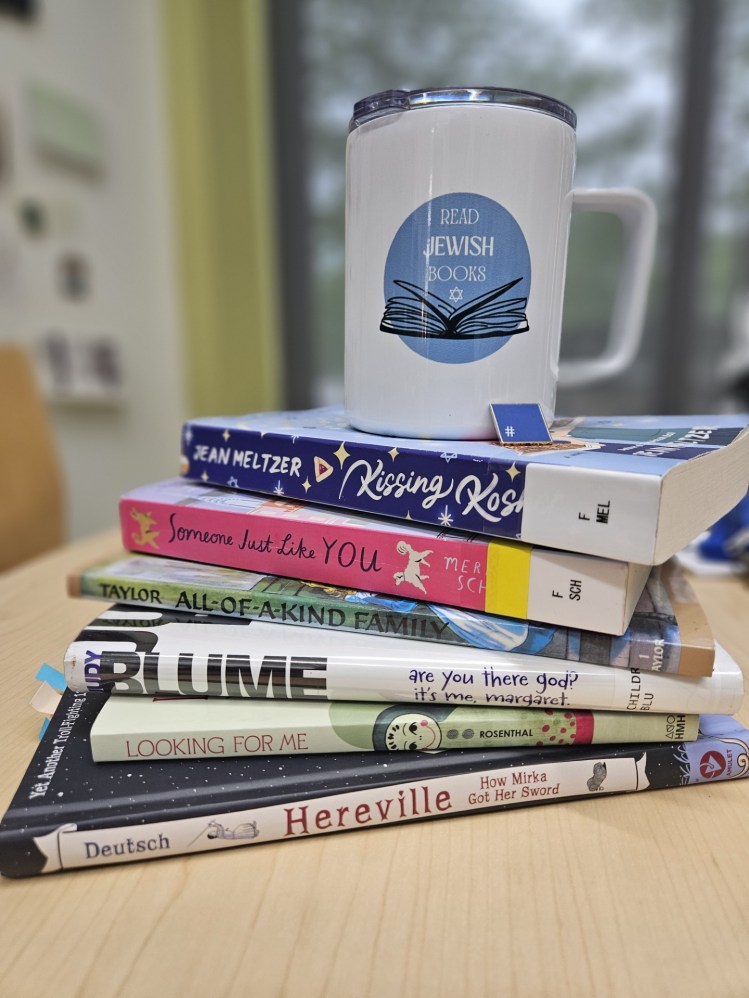

by Stacey F.
“They enjoy finding books that are not about Jews in the Holocaust or other hard times, but focus instead on characters who are like themselves and about families that sound like their own.”
– Judy Blume
While trying to frame how I was going to write this post, I found a 2015 article in Hadassah Magazine, where Judy Blume was interviewed. When I was younger and even more so now as an adult, this quote really resonates with me. As pointed out in the article, “…the unassuming way Blume presents the Jewish identities of many of her characters is a welcome surprise for Jewish readers, many of whom articulate their appreciation to Blume.”
Randallstown in the 70s and 80s, when and where I grew up, was a very Jewish area. An avid reader, I made frequent visits to the Randallstown library, grabbing handfuls of books. These books provided windows to other cultures where I could see what life was like for other people. What I didn’t find so much were books that were mirrors, about people like me.
Older now and as a librarian, I realized that when most people think about Jewish literature, they think about Holocaust books. Book lists and displays about Jewish literature always seem to highlight Holocaust books as being representative of Jewish literature. We are directed to remember (זכור). To never forget. These books are important, moving, and usually show triumph over oppressors. Powerful literature. However, it is essential to realize, not only for those reading Jewish books as windows but also for those reading them as mirrors, that there is so much more to Jewish literature.
I now purposefully search for Jewish Joy in books. Again, ordinary people who happen to be Jewish, living their lives, finding humor, and most importantly their happily ever after. We need mirrors!
The incomparable Judy Blume had a more modern, secular take on Jewish life. In Are You There G-D, It’s Me Margaret, I saw someone Jewish living their regular life. Being Jewish was important, but so were the other things that went on in middle school. When I read Starring Sally J. Freedman as Herself, I certainly didn’t know that I would one day share her last name.

Sydney Taylor’s All-of-a-Kind Family was actually one of the first books that I read where the main characters were Jewish. Even though the story took place starting in 1912, the books about an observant family living in New York City still resonated with me: the holidays they celebrated, the food that they ate, the Yiddish words used. One of their favorite activities was their weekly trip to the library! For the first time, parts of my life were reflected in the pages, and I wanted to be a part of their story. This series was so important to me that I read the books aloud to my daughter; I was able to experience Jewish Joy once again as she could see her life mirrored in the pages. Sydney Taylor’s body of work, including All-of-a-Kind Family, inspired the Sydney Taylor Book Award presented annually to outstanding books for children and teens that authentically portray the Jewish experience.
A number of recent romance authors embody Jewish Joy. Some examples are Stacey Agdern, Sara Goodman Confino, Felicia Grossman, Jean Meltzer, Meredith Schorr, and Rachel Lynn Solomon, to name a few. Characters in these books are living their lives. Some are observant Jews, while others are more culturally Jewish. With her Once Upon the East End series, Felicia Grossman even offers a peek at what being Jewish was like in Victorian England.
These days, you can also find many more children’s books that not only serve as a mirror for young Jewish readers, but as windows for others unfamiliar with Jewish culture. When the American Girl books featured Rebecca Rubin, it was a very big deal for my daughter. They were published in 2009, when my daughter was nine – the same age as Rebecca! Who was an American Girl! And a Doll! And she’s Jewish! Interestingly, she is from the same era as All-of-a-Kind Family.
A graphic novel series from 2010 remains a favorite, which begins with Hereville: How Mirka Got Her Sword. While I love the story, I think my favorite part of the book is the tagline on the cover, “Yet Another Troll-Fighting 11-Year-Old Orthodox Jewish Girl”. Because there are so many of them out there.
A modern picture book classic is Patricia Polacco’s The Keeping Quilt, a fictionalized memoir of how a very special quilt is passed down through her family from generation to generation, serving as tablecloths, chuppahs, and blankets for babies. She has updated several editions to include how her children have used and cherished the family’s keeping quilt.
A story written in free verse, Looking for Me by Betsy Rosenthal drew me in because it talks about Jewish life in depression-era Baltimore, which was where my parents grew up, even though they would have been a little younger.

I love the diversity found in books with Jewish characters. There is a trend with books where the characters are of mixed heritage: Jewish plus something else, a window and a mirror. Some good examples include My Basmati Bat Mitzvah by Paula J. Freedman about a young woman who is East Indian and Jewish, as well as Not Your All-American Girl by Madelyn Rosenberg & Wendy Wan-Long Shang, featuring a Chinese and Jewish main character.
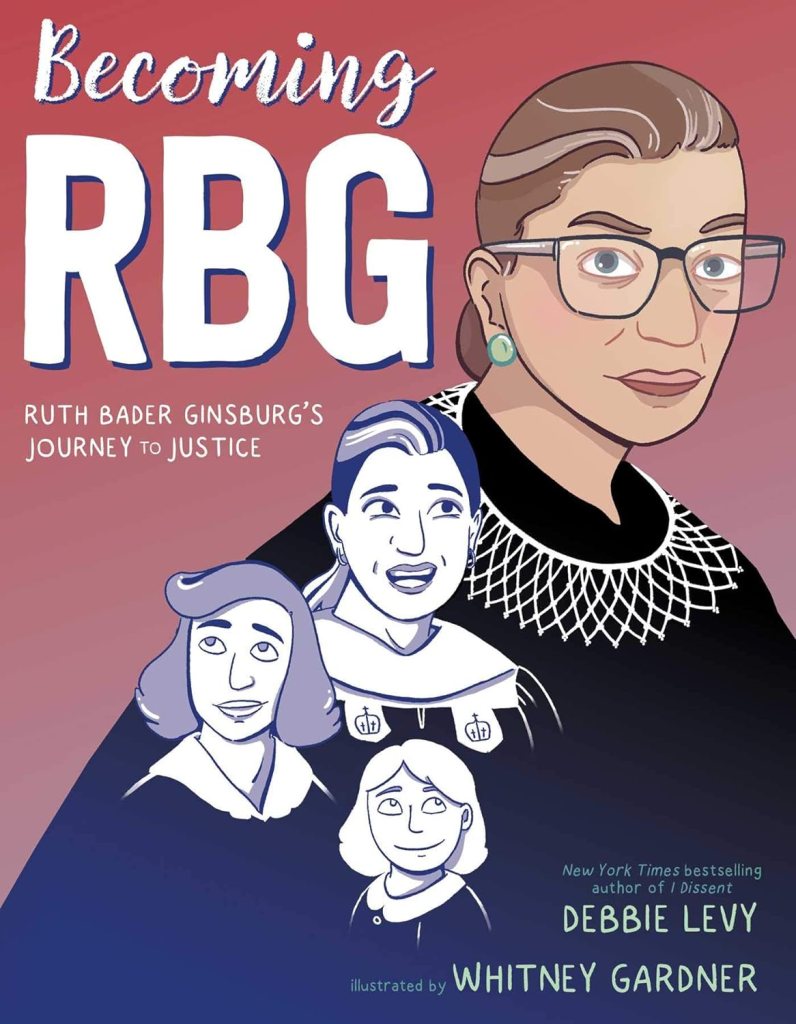
Finally, I need to include books about one of my favorite American Jewish women, Ruth Bader Ginsburg. RBG overcame obstacles to fight for what she believed in. You can start with:
Becoming RBG: Ruth Bader Ginsburg’s Journey to Justice by Debbie Levy
Notorious RBG: The Life and Times of Ruth Bader Ginsburg by Irin Carmon & Shana Knizhnik
For more titles for Jewish American Heritage Month, here are some great selections:
for children and teens
References:
Musleah, Rahel. “Judy Blume.” Hadassah Magazine, 21 Oct. 2015, http://www.hadassahmagazine.org/2015/10/21/judy-blume/. Accessed 1 May 2024.
“Sydney Taylor Book Award.” Association of Jewish Libraries, jewishlibraries.org/sydney_taylor_book_award/. Accessed 1 May 2024.
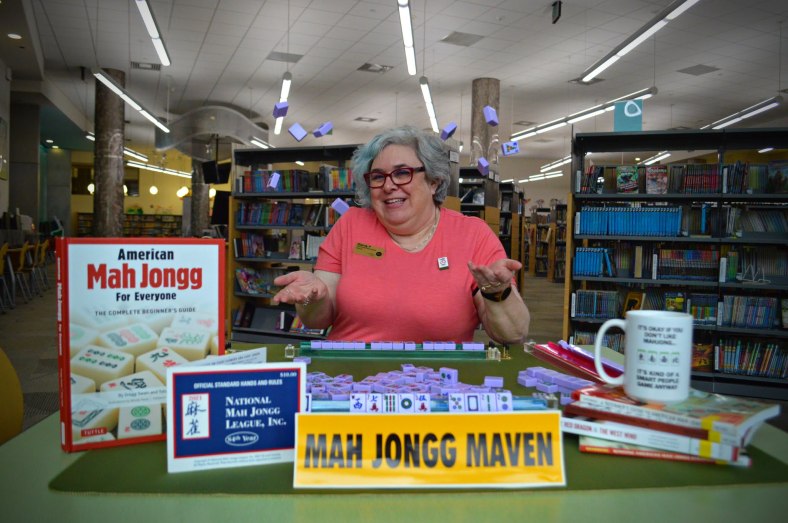
Stacey F. is the Children’s Instruction & Research Supervisor at the Miller Branch. She has been at HCLS since 2004 (this time). Her hobbies include reading romances, playing/teaching mah jongg, and starting sentences with, “It’s funny because….”


 CHAPTER CHATS