Sorry, Bro by Taleen Voskuni

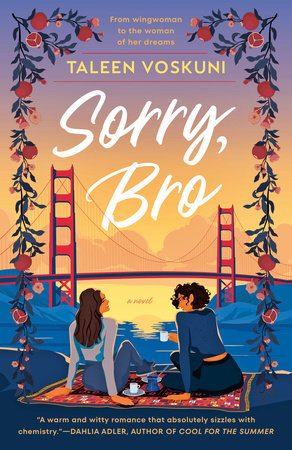
An illustrated cover shows a from-behind veiw of two women on a blanket looking a sunset and the Gold Gate Bridge. Flowering vines frame the cover. The title is in white scrpt above the bridge.

by Lenae R.

I always find it fun to read books set in familiar places. It’s delightful to recognize street names and to have memories evoked by local scents and flavors. The cover of Sorry, Bro seemingly promised me these with its Golden Gate Bridge set against a golden sunset (be still, my born-and-raised Californian heart!), a frame of pomegranate-laden vines, and a description hinting at the revelations uncovered by its Armenian protagonist, Nareh. My family lived overseas in the Caucasus region for several years, and its mention tripped a longing for the culture and people we fell in love with there. I was sold.

To be clear, Sorry, Bro isn’t a cultural saga, per se. Its cover teases, “From wingwoman to the woman of her dreams,” and I was all-in for the juiciness of a friendship-turned-romance. It opens hilariously in a German restaurant, where we are introduced quickly to Nareh’s main predicaments: the anxiety that carries her through her days; a boyfriend, Trevor, who is equal parts outrageous and dull; and the pressure she manages as an only child who lost her father several years earlier.

Trevor departs to Europe for a business trip before the second chapter, creating space for Nareh to process whether she wants to continue their relationship. She spontaneously decides to do this by committing to attend “Explore Armenia,” a month of events dedicated to celebrating Armenian history and culture. Nareh’s mother hopes she will meet a promising Armenian man to marry, and Nareh is hungry – for an out from Trevor and the satisfaction of making her mother proud.

It’s a rom-com premise that, certainly, seems formulaic in many ways. What sets Sorry, Bro apart is how it poignantly, often painfully, brings us along for Nareh’s reckoning with her bisexuality (she isn’t out to her family or community) and her Armenian roots. As a first-generation Filipino on my mother’s side, so many of Nareh’s reactions resonated with me: the comfort and thrill of language, food, and references to the homeland tinged with the shame and awkwardness of a child raised in the diaspora. How does one settle into, own, and embrace a culture they seemingly move in and out of? Tagging along with Nareh as she considers this question proved endearing and thought-provoking.

Nareh’s closeted sexuality is entwined with this journey of self-discovery and identity. Her attraction to women is something she hasn’t felt comfortable sharing as she imagines how it will impact the acceptance she has from her loved ones. So many in the queer community can empathize with her struggle. Her deepening connection with Erebuni, the wingwoman from the cover, challenges the evasions that have kept her safe but stifled.

Rest assured that Nareh’s journey is as fun as it is stirring. Author Taleen Voskuni writes deliciously, balancing sincerity and sarcasm with thoughtfulness. Nareh’s chemistry with Erebuni crackles on every page. You’ll be cheering for her throughout and Googling Armenian eateries by the last page.

Lenae is an instructor for the HiTech summer program. Besides reading, her great loves are spending time with her family, watching Star Wars shows, and visiting new coffee and bookshops (Charm City Books in Baltimore is her favorite)!

Summer Reading Adventures: Friendship Stories

By Eliana H.

Some of you may have already collected your finisher prizes for our Summer Reading Adventure. If you have, congratulations! Great job reading and completing activities. It’s not too late to visit one of our branches to collect your prize if you haven’t. They are available through Thursday, August 31, as long as supplies last. If you’re still working on finishing those last few reads, I have a highlight for you from each of our elementary lists. This time, I’m focusing on friendship stories. 

Grades K-1: 

Amy Wu and the Warm Welcome by Kat Zhang (also available as an e-book)

The cover depicts an array of children and a white kitten, holding a gold and white banner with the book's title written in fuschia.

This book offers a beautiful beginning, showing ways to say “welcome” from around the world even before the title page. Amy is excited to see a new student join her class, but he doesn’t talk at all during the school day, even when she tries very hard to make him feel welcome. When she sees him light up and talk away to his little sister – in Chinese – she’s surprised to see how different he is! Amy thinks hard and comes up with an idea of another way to make him feel welcome. Check the book out to see if Amy succeeds, and be sure to explore the craft idea and note from the author.

Grades 2-3: 

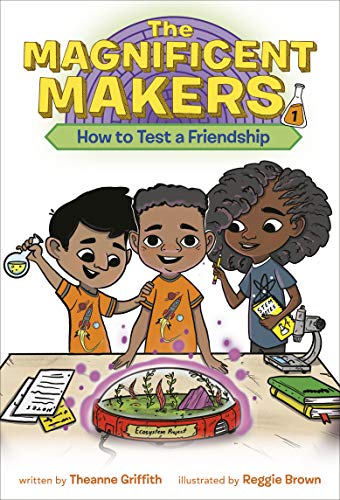
How to Test a Friendship by Theanne Griffith

The book cover shows three students working on a science project involving a miniature ecosystem under a dome, with books and a microscope on a table in front of them. One of them holds an Erlenmeyer flask and another holds a pencil and a booklet that says "STEM notes." All three are wearing t-shirts with science motifs - two have rockets, planets, and stars, and the third has a diagram of an atom.

How to Test a Friendship, the first title in the series Magnificent Makers, introduces readers to third graders Pablo and Violet, best friends who are looking forward to being in the same class and studying science, their favorite subject. When new student Deepak appears and starts making friends with Violet, Pablo is not very excited. But the three suddenly find themselves transported to the Maker Maze when they solve a riddle in science class. They must complete challenges to return to their world, but they will only finish in time if they work together. Can Pablo set aside his hard feelings toward Deepak so that they make it home in time? Do they know enough to solve the puzzles? If your young scientist is feeling inspired, be sure to take a look the STEM activities in the back to try at home! 

Grades 4-5: 

The Witchlings by Claribel A. Ortega 

The cover depicts three of the witchlings - one with a worried expression who is wringing her hands, one with a smug expression with arms crossed, and one wide-eyed, facing forward. There are buildings with peaked roofs and turrets in the background, and the eyes of the Nightbeast are superimposed over the starry night sky.

Readers who enjoy fantasy will love The Witchlings, offering another unique view of magic and the world by the author of Ghost Squad. It’s the night of the Black Moon Ceremony, when Witchlings are placed in their covens, and twelve-year-old Seven Salazar knows exactly where she wants to be: House Hyacinth, with her best friend Poppy. Instead, Seven’s worst nightmare comes true. She’s named a Spare, one of the three witches left over at the end of the ceremony, along with Thorn, who is new to town, and Valley, Seven’s long-time enemy. Spares are stripped of their magic and treated poorly, but Seven invokes the rarely used Clause of the Impossible Task. If she and the other Spares can accomplish the Impossible Task, they will complete their circle and become a true coven. When they learn they need to find and defeat the dreaded Nightbeast, Seven and her coven wonder what they’ve gotten themselves into. Little do they know, Seven, Thorn, and Valley will uncover even darker and more mysterious things lurking in their town of Ravenskill. They need to work together and learn to trust each other if they have any chance of success. Check out The Witchlings to discover whether they manage the impossible and overcome their own pasts and fears, as well as the dark powers working against them.

Be part of HCLS’ Summer Reading Adventures.

Eliana is a Children’s Research Specialist and Instructor at HCLS Elkridge Branch. She loves reading, even if she’s slow at it, and especially enjoys helping people find books that make them light up. She also loves being outside and spending time with friends and family (when it’s safe).

Legendborn by Tracy Deonn

A Black woman with natural hair holds her arms apart in front her her with red glowing around the top and a blue around the bottom, against a dark background.

King Arthur isn’t dead. The Round Table yet survives.  

Only… it looks a little different. In the place of mail and armor, you have sixteen-year-olds with unbelievable strength and speed. Merlin’s around too, but he’s a college student and “Merlin” is merely a title. And somehow, wonder of all wonders, the seat of all this ancient power is in Chapel Hill, NC.

That’s not the only fantastical thing, though, in Legendborn by Tracy Deonn. There are centuries of lore, of demons and Shadowborn, all hiding under a thinly veiled surface of messy college kid drama. They surround the Onceborn (read: all of us), who live blissfully ignorant lives, worrying about normal things, like getting busted going off campus or figuring out who is headed to the party tonight.  

And Bree, our protagonist, doesn’t know about any of the secrets of the Round Table when she applies to the University of North Carolina’s Early College program with her best friend Alice. She doesn’t expect to be caught up in an Arthurian world of magic and lore, and she definitely doesn’t expect that applying to go to the same school her mother attended would cause so much personal tragedy. Still reeling from the trauma of losing her mother, trying to establish some sense of normalcy, and looking for the truth about the suspicious circumstances of her mother’s death, Bree throws herself headlong into this Arthurian world, making friends and enemies along the way.  

Cool, right? It’s everything I want from my YA novels, hearkening back to the good ole days of 2014, when the trilogy ruled the YA realm with works like Divergent or Matched. But now, we get far more in-depth lore, speaking more candidly (and less stereotypically) about mental health, and a whole lot more diversity of character. Bree’s experience at UNC is profoundly shaped by being Black. It’s a reality that so many BIPOC students face that has only recently been put to pen, and a reality that author Tracy Deonn knows intimately, having gone to UNC herself.  

The coolest part is one I won’t spoil for you, but there is a very fun other magic in this book too, so if you like King Arthur and his knights, but it’s not enough to sway you, there’s a whole lot more to the magic of this world, and Bree discovers all of the secrets and implications in due course.  

It’s a brick of a book, but it flies by. The themes in this book of being Black, the unquestioned queerness among her friends and peers, and the honest discussions of grief and the trauma that results make for a real and grounded force within this novel that is otherwise so perfectly fantastical. I can’t wait to get my hands on the second one. In this series – here’s hoping for a trilogy.  

You can get Legendborn by Tracy Deonn in print, audiobook, eBook, and eAudiobook.  

Apocalypse and Heartbreak: Atmospheric Tales of Horror

Deep red slats of wood with title set in single word lines, emphasizeing Cabin, End, World.

by Angie E.

Good horror scares me, but great horror breaks my heart and mind, seeping into me and playing in my head like a found footage trope.  I find solace in horror somehow, and I know I’m not alone because others feel this way, too, even if they are quiet about it (“Why do anxious people love scary movies?”).

The first horror fiction I ever read was The Mist by Stephen King (e-book on Libby), which first appeared in a 1980 anthology called Dark Forces (an outstanding collection of stories I cannot recommend enough). It is hard to come by these days, but you can check interlibrary loan. Director Frank Darabont took The Mist and gave it an unimaginable, twisty, emotionally devastating ending – hence the heartbreak.

The Cabin at the End of the World by Paul Tremblay evokes similar feelings of heartache, and, like The Mist, captures themes such as faith and trust and how both can be warped by strangers we have the fortune (or misfortune) to meet under trying circumstances. Do we take a chance on others, or ourselves, or possibly a mash-up of both? A contributor to the website Bloody Disgusting sums up what could easily be said about both Tremblay’s and King’s novels, saying that a complete lack of faith can be just as insane as a fanatical sense of faith.

The novel invites readers into the lives of Eric and Andrew, a couple vacationing at a remote cabin with their young daughter Wen. Tremblay’s sensitive storytelling allows us to witness their love and vulnerability, amplifying the impact of the anguish that unfolds. Their journey takes an unexpected turn when a group of mysterious strangers appear at their door, whose mission (they say) is to save the world from an impending apocalypse. Their ominous beliefs shatter the tranquility of the cabin, leaving the family trapped and frightened. 

The strangers demand an impossible choice: sacrifice one of their own to stop the apocalypse. As fear and uncertainty overcome them, the bond between Eric, Andrew, and Wen deepens, revealing the strength of their love and the resilience of the human spirit. You’ll find yourself empathizing with the family’s plight, feeling their fear, and grappling with the moral dilemmas they face. 

Ultimately, The Cabin at the End of the World is not just a horror story; it’s an exploration of family ties, sacrifice, and the will to protect those we love. Like The Mist, The Cabin at the End of the World has a haunting film based on it: Knock at the Cabin. Both novel and film create an air of mystery and seclusion, but they do so subtly, evoking different atmospheres. 

Knock at the Cabin may appear superficial, but it carries a sense of abruptness, brevity, and vagueness distinct from Tremblay’s novel. The former hints at the story’s initiation and leaves us questioning, “Who’s there?” The Cabin at the End of the World explicitly suggests apocalyptic themes. Both titles succeed in unique ways, captivating the audience with their enigmatic allure. 

I could go on about both Tremblay and King, but I won’t. If you also seek out heartbreak in your reading, though, consider the following: 

  1. Frankenstein by Mary Shelley: Published in 1818, this classic Gothic horror novel tells the tragic story of Victor Frankenstein and his creation. The creature’s isolation, rejection, and search for acceptance evoke profound empathy from readers. 
  1. Dracula by Bram Stoker: From 1897, the epistolary novel delves into themes of loss, love, and the consequences of immortality. The tragic fate of some characters, such as Lucy Westenra, leaves a lasting impact on readers. 
  1. The Road by Cormac McCarthy: This post-apocalyptic novel from 2006 depicts the journey of a father and his young son through an ashen landscape. The bleakness and desolation of their surroundings combined with the father’s love and determination to protect his son create an emotionally compelling narrative. 
  1. Beloved by Toni Morrison: While not typically thought of as a horror novel, the 1987 Pulitzer Prize-winning work incorporates ghostly, supernatural elements. Set in the aftermath of slavery, the book explores the haunting effects of past trauma, loss, and the desperate longing for freedom. 

These masterpieces blend elements of horror with deep emotional resonance, leaving readers with a poignant sense of heartbreak and empathy for the characters’ experiences. 

Angie is an Instructor & Research Specialist at Central Branch and is a co-facilitator for Reads of Acceptance, HCLS’ first LGBTQ-focused book club. Her ideal day is reading in her cozy armchair, with her cat Henry next to her.

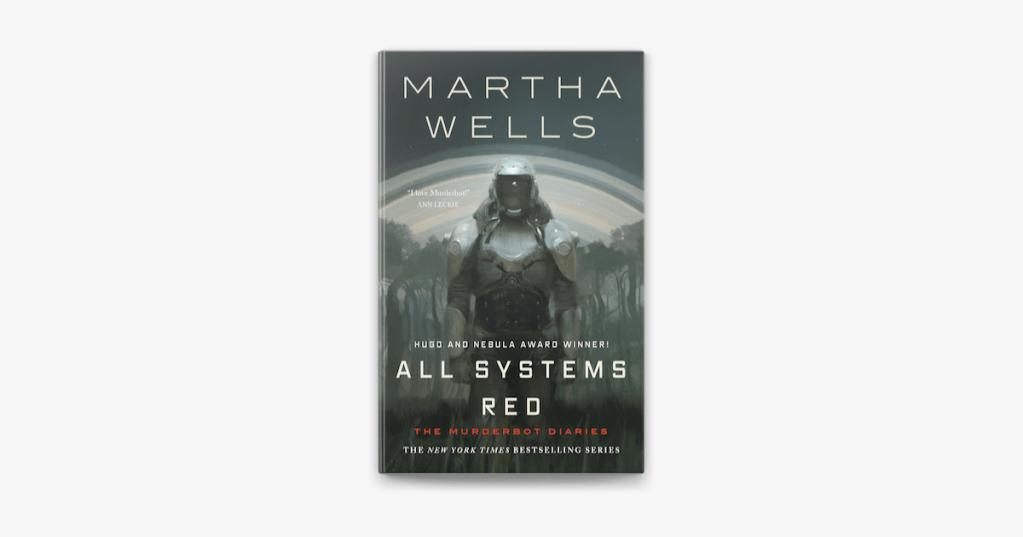
The Murderbot Diaries by Martha Wells

The cover has a grey palette, showing a space-armored figure with a closed helmet with a lit arch behind them.

by Tony B.

Ever wondered what an intelligent security robot would do without a functioning governor module? Murder? Watch Netflix? Save innocent lives? Contemplate sentience?

The Murderbot Diaries, a series by Martha Wells, explores answers to all these questions. Free of their governor module, the eponymous Murderbot leads us through their adventures with corporate warfare, angry megafauna, the (mostly) human experience, and the need for a nice quiet spot to watch interstellar tele-novellas. The first four novellas operate as a one long story arc, even with each book being a complete story, about why Murderbot has named themself in such a way and the repercussions from that particular episode. Along the way, Wells introduces Dr. Mensah and her family, who become important, along with ART – another high functioning artificial intelligence.

Originally a normal Security Unit (SecUnit for short) deployed by The Company, a security bond corporation, Murderbot hacks and destroys their controlling governor module which normally would zap the brain of any SecUnit displaying less-than-utterly-obedient behavior. Now free to do whatever they want, MurderBot inexplicably keeps working for the corporation but with newfound access to the wider net of media with which to distract themselves. 

The Murderbot Diaries are full of dry wit and snarky observations of the human condition, notably that humans tend to put themselves in a lot of unknowing danger. Compound that with galactic dangers and MurderBot ends up as one very busy SecUnit. The series now has six installments (four novellas and two novels) that follow Murderbot and a recurring cast of characters.

MurderBot’s interaction with risk-averse humans is one of the driving issues, beginning in All Systems Red. To MurderBot, the clash between how humanity is portrayed through their favorite space soap operas and how humans actually behave is a constant dissonance which leads to a healthy distrust of the human condition. Hence their thoughts along the lines of, “freedom to be treated like a real human? No thanks.”

Seeing sci-fi action through the lens of a non-human thought process is interesting, where priorities are generally “protect the weak humans from whatever stupid situation they find themselves” and less “be the hero.” SecUnit often ends up being a hero in the end despite themself and equally isn’t sure how to feel about it. MurderBot experiences emotion rather strongly at times but codes, to some degree, as being on the autism spectrum. They have a difficult time expressing those emotions and processing others’ emotional states, as well as the confusion at not always being able to control emotions that well up within them.

As a series, I give it a 9/10. Obvious tropes are usually immediately made fun of a la “oh that’s what the space soaps would do.” MurderBot also reminds me heavily of the 2015 movie CHAPPiE, about a robot who gains independence, but who is perhaps more impressionable in relation to humans than MurderBot ever is.

The Murderbot Diaries, a Hugo and Nebula award-winning series, consists of the following books, available from HCLS in these formats:

The seventh book, System Collapse, is due to be published in November 2023.

Tony is a Customer Service Specialist at HCLS Elkridge Branch. He has a degree in history and a renewed interest in science fiction.

How to Keep House While Drowning by KC Davis

by Eliana H.

I read – actually, listened toHow to Keep House While Drowning after a good friend shared repeatedly and enthusiastically how valuable it was to her. It’s pretty short, and I figured it was worth a look at least. Let me now tell YOU that it is certainly worth picking up. There is a line on page 6 that says, “If you are crying (or wincing internally) right now, this book is for you.” I will freely admit here that I was crying at that point, and this book was for me. 

If you have ever found yourself having a hard time keeping up with everything you feel like you should be doing, this book is for you, too. Everyone struggles sometimes. Our society puts ever-increasing demands on all of us, but it doesn’t necessarily provide the support needed to meet those expectations. For many of us, there are times where even basic tasks can feel overwhelming, especially if we struggle with ADHD, depression, or other challenges to executive functioning. 

Author KC Davis is a licensed professional therapist, and she is so gentle with readers of this book. Chapters are short, main points are highlighted, and a shortcut journey through the book is offered for those who do not have the capacity to go through the whole thing. But most of all, judgment is completely removed. Every situation Davis describes is explained as a legitimate challenge or obstacle, and she explicitly tells us early on that she does not think laziness exists. What a novel, generous concept! It should not be such an amazing thing to offer everyone grace and compassion when they are struggling, but Davis does so ably and authentically. 

The primary tenet guiding this book is this: “You don’t exist to serve your space; your space exists to serve you.” It’s that simple and that groundbreaking. When we can reframe our perspective on the relative value of our time and having a picture-perfect home, we can find space to prioritize what truly needs to get done, in what timeframe, and to what level. Concrete steps are offered to guide you through the process of managing care tasks – the term Davis uses to encompass the everyday business of caring for oneself and one’s belongings. Nothing is set in stone, and throughout the book, readers are encouraged to figure out what works for them. Everyone’s capacities and priorities are different, so no strategy works for all. But helpful suggestions and guidelines can give us a place to start, even when we are struggling. 

Even if you’re telling yourself “I’m not drowning,” it’s worth taking a look at How to Keep House While Drowning. Just a glance at the short appendices may give you some ideas for improving the functionality of your space, and you may find yourself wanting to see more of what the author has to say. You can borrow it in print, audiobook on CD, e-book, or e-audiobook

Eliana is a Children’s Research Specialist and Instructor at HCLS Elkridge Branch. She loves reading, even if she’s slow at it, and especially enjoys helping people find books that make them light up. She also loves being outside and spending time with friends and family (when it’s safe).

Manga Romance: A Tropical Fish Yearns For Snow

Two manga characters stand back-to-back with fish swimming around them.

by Monae R.

This year has seen me reading completely different books than usual. Am I back in middle school, 2011? I was obsessed with Asian culture, anime, and most relevant, manga. This format of Japanese comics was all I read. From action, to slice of life, to romance, I engulfed every book I could get. If I had known that Savage Branch was not the only library I could visit, I would have read a lot more, alas I had no idea. Now that I work in the library system and am aware of the resources, I find myself falling back in love with manga as I read A Tropical Fish Yearns for Snow.

Makato Hagino is a female author from Ehime Prefecture, Japan. This series has nine books and follows characters Konatsu and Koyuki – two girls who bond in a most unlikely place. Konatsu’s father gets a new job overseas and they have to leave Tokyo to stay with her aunt. From the large city to the small seaside town, adjusting is not easy. As if that was not enough, Konatsu, who is not adept or fond of change, must also adapt to a new school surrounded by new people. Eventually she ends up joining a club that drops her straight into the lap of the Introverted and extremely shy Koyuki. The two slowly grow out of their shells and build a friendship that has the potential to be a lifelong bond.

This heartwarming story will hit home for all of us introverted individuals and will give extroverts insight into the quiet thought process of an introvert. This romantic slice of life will keep you wanting more and close the story leaving you with nothing but warmth.

Monae is a Children’s Instructor and Research Specialist at HCLS East Columbia Branch.

Mission Impossible: Summer 

by Cherise T.

It’s August, it’s hot, you need to complete a few more adventures for Summer Reading 2023. Cue the music and jump into Mission: Impossible. Not only can you see the world, but you can watch Tom Cruise do all his own stunts over 25 years of true movie star magic.  

At this point in film history, Tom Cruise embodies Ethan Hunt, heroic Impossible Missions Force (IMF) agent. The seventh installment, Dead Reckoning, is in theaters currently (with part 2 arriving in 2024), and its trailer with Ethan/Tom jumping off a cliff while riding a motorbike is simply heartstopping. Saving the world is assured as long as tech genius Luther, played by Ving Rhames, is by Ethan’s side. Beginning in the third installment, the team is perfected with the addition of field agent Benji, played by Simon Pegg (see also Shaun of the Dead for London electronics salesman battling a zombie apocalypse while maintaining his sense of humor). These three, bolstered by a rotating cast of glamorous spies, defeat the savviest of international criminals. 

Brian De Palma, the great suspense director, kicked off the Mission: Impossible series in 1996. Not-to-be-missed scenes include the exploding fish tank and Ethan suspended upside down by a cable while attempting to infiltrate an impenetrable CIA vault. Cruise later explained he put coins in his shoes to help him balance. 

Mission: Impossible II finds Ethan saving us all from the release of a deadly virus. The rock climbing sequence is incredible. Ethan is pulled out of retirement for Mission: Impossible III which transports viewers to Rome, Shanghai, and Berlin. Directed by J.J. Abrams (Cruise is an Alias fan), the movie includes an explosive scene on the Chesapeake Bay Bridge-Tunnel. 

Ghost Protocol, the fourth in the series, finds Ethan accused of bombing the Kremlin and fighting for his life. Brad Bird bravely ventures beyond his acclaimed animation repertoire, including The Incredibles and Ratatouille, to direct this one. The travelogue encompasses Bangalore, Mumbai, Budapest, Dubai, and Moscow, and Cruise again engages in some impressive climbing, scaling a 1700-foot building. For those prone to hypertension, beware the action sequence in the parking structure. 

The Syndicate is a group of spies gone rogue, and they have nerve gas. Hence, Rogue Nation, get it? Ethan goes to the opera, visits Oxford, hangs suspended from an Airbus, and dives underwater in a long take that has been reported as lasting anywhere from three to six minutes. Cruise trained with a diving instructor to assure he could act as well under the sea as he does on land and in the sky. 

2018 brought the release of Fallout, the sixth installment. The Syndicate has morphed into the Apostles, and Ethan must race to Paris, London, and the Himalayas to retrieve some plutonium. Ethan jumps from a plane, requiring Cruise to do multiple takes skydiving from an aircraft traveling 165 miles per hour at an altitude of 25,000 feet. At one point, production was suspended to allow Cruise to recover from a broken ankle that he suffered performing one of his “easy” stunts jumping between buildings. 

Your mission, if you choose to accept it, is to watch all six. There’s no boredom allowed when you have an HCLS library card. 

Cherise Tasker is an Adult Instructor and Research Specialist at the Central Branch. When not immersed in literary fiction, Cherise can be found singing along to musical theater soundtracks. 

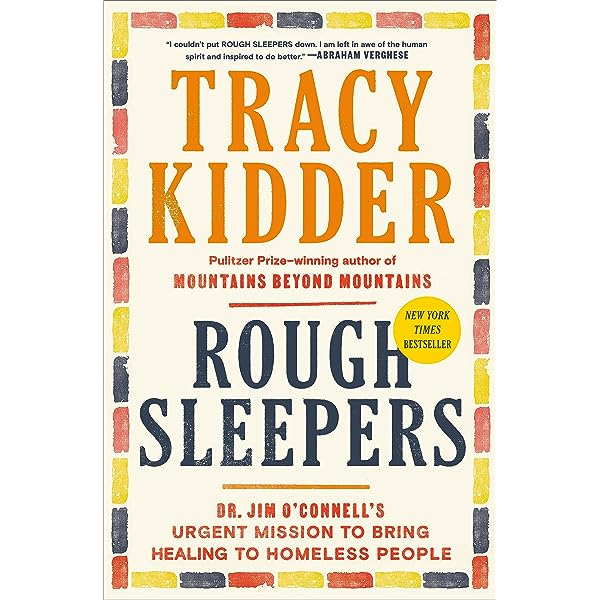
Rough Sleepers by Tracy Kidder 

A colorful border of blue, red, and yellow bricks surrounds the author and title.

by Piyali C.

After graduating from Harvard Medical school and towards the end of his residency, Dr. Jim O’Connell, a brilliant and gifted man, was approached by the Chief of Medicine of Massachusetts General Hospital to help in an organization to provide health care for the homeless population of Boston. “Rough sleepers” is a British term for someone who is homeless and sleeps without adequate shelter or protection. Dr. O’Connell decided to defer a prestigious fellowship at Memorial Sloan Kettering hospital for a year to devote his time to developing the Boston Health Care For The Homeless Program, which, at the time, was primarily run by nurses. He was not convinced this was his life’s calling but he could not refuse his superior’s plea for help.

The first day he walked into the clinic at Pine Street Inn Shelter, he had his stethoscope around his neck. A nurse at the shelter, Barbara McInnis, asked him to put his stethoscope away and instructed him to soak the feet of the patients. While Dr. O’Connell did not understand the significance of the instruction at the time, he did what he was told. As he soaked each individual’s feet for several days, they gradually started opening up to him. The homeless population had an ingrained mistrust of physicians because they had been treated disrespectfully for so long. Once he put away his stethoscope, people slowly started telling him about their other ailments. Dr. O’Connell listened and treated but only if they were willing to be treated. He respected their choice about their own health.  

Thus began Dr. Jim O’Connell’s lifelong journey of providing not only medical care but friendship and respect for the human dignity of the homeless people of Boston, whom he encountered in his long tenure of providing medical care. Pulitzer Prize winning author Tracy Kidder followed Dr. Jim for five years as he rode his Street Team van to seek out individuals who needed medical attention on the streets. If not medical help, he handed out blankets, warm socks, a sandwich, Dunkin Donut gift cards, or hot chocolate. He offered treatment or shelter for a chilly night but always left the choice to the individual whom he was trying to help. He emphasized a style of medicine where the patients came first. The providers and the patients created a ‘circle of friends’. Throughout his career Dr. O’Connell viewed his patients in their totality. He heard their stories. He came to know they were incredibly brave, they were difficult, they were charming, they could be obnoxious under the influence of alcohol or substance abuse, and when the effect wore off, they were kind, clever and funny.  

This is one of those books that changed the way I thought about the homeless population. Each person I see living on the streets has a story. I had stopped seeing them in the true sense of the word. I was desensitized to their presence, often getting annoyed by their panhandling. After reading the book, I was aware of my part in perpetuating the process of robbing a person of dignity by not “seeing” them. 

Rough Sleepers is inspiring, thought provoking, and a beautifully written documentation of the lives of some individuals who have truly hit the rock bottom in life and those who are trying their best to help them and give them the human dignity that everyone deserves. 

Rough Sleepers by Tracy Kidder is available in print, e-book and e-audiobook formats. 

Piyali is an instructor and research specialist at HCLS Miller Branch, where she facilitates Light But Not Fluffy and co-facilitates Global Reads. She keeps the hope alive that someday she will reach the bottom of her to-read list.

Feeling Curious? Take the Curiosity Challenge!

A teen sits in the biography isles reading at the Miller Branch during a summer reading adventures teen after-hours event.

by Emily B.

Have you embarked on your Summer Reading Adventure yet? If not, head to any HCLS branch to begin your Summer Reading Adventure or participate online through ReadSquared. There are Summer Reading games and prizes for all ages. Visit hclibrary.org/summer/ for all the details on this year’s Summer Reading Adventures.

One of the fun challenges this year for all ages is the Curiosity Challenge. To partake in this challenge, simply read a book on any topic you’re curious about. No matter your interests, we can help you find a book to satisfy your curiosities!

Here are some books to spark your curiosity:

Science: With a wide range of science-related topics covered in these books, you’re sure to learn something new and you might even find additional topics to explore!

The Highlights Book of How: Discover the Science of How the World Works by Libby Romero (CHILDRENS 500R)

Science Superstars: 30 Brilliant Women Who Changed the World by Jennifer Calvert (509.2C)

The Science of Science Fiction by Matthew Brenden Wood (TEEN 500W)

What If? 2: Additional Scientific Answers to Absurd Hypothetical Questions by Randall Munroe (500M)

Entertainment: Learn more about the games, movies, and TV shows you love with behind-the-scenes photos and stories and retrospective analyses.

What is Nintendo? by Gina Shaw (CHILDRENS 338.761S)

Star Wars: The Mandalorian Handbook by Matt Jones (CHILDRENS 791.4572J)

Gamer Girls: 25 Women Who Built the Video Game Industry by Mary Kenney, illustrated by Salini Perera (TEEN 794.8092K)

Blood, Sweat, and Pixels: The Triumphant, Turbulent Stories Behind How Video Games Are Made by Jason Schreier (794.8S)

Best. Movie. Year. Ever.: How 1999 Blew Up the Big Screen by Brian Raftery (791.4309R)

History: Learn the incredible story of World War II Resistance leader Virginia Hall. A Maryland-native, Hall’s work with espionage, reconnaissance, and sabotage were instrumental in the eventual defeat of the Axis powers.

Agent Most Wanted: The Never-Before-Told Story of the Most Dangerous Spy of World War II by Sonia Purnell (CHILDRENS B GOILLOT P)

Code Name Badass: The True Story of Virginia Hall by Heather Demetrios (TEEN 940.5486D)

A Woman of No Importance: The Untold Story of the American Spy who Helped Win World War II by Sonia Purnell (940.5486P)

Be part of HCLS’ Summer Reading Adventures.

Emily is an Instructor & Research Specialist at the Central Branch. She enjoys puzzling, reading, listening to music, and re-watching old seasons of Survivor.