Giving Henry James a Second Chance

An Impressionist sort of painting of a public park featuring a woman dressed in black and white who is holding an orange parasol.

by Angie E.

A friend recently told me she recently checked out and watched the 1949 film The Heiress and that she was oddly enthralled and affected by it.

“That’s based on a Henry James novel called Washington Square.” I said excitedly. “You should read it sometime! It’s absolutely heartbreaking.” Her face grew a bit stricken as she said, “Oh, Lord, no! I can’t do that.” She sounded like I had just suggested an unexpected root canal, and I had to wonder if maybe she had had a bad experience with Henry James at some point in her reading life. Maybe I should say a particularly bad experience, as she would not be alone in her feelings on him. Biographer Susan L. Mizruchi writes that a law professor she knew once confided in her, “I never read a James novel that I did not want to hurl across
the room when I finished.”

It is kind of true: Henry James can be off-putting to a lot of readers, especially in his writing style. He appears stuffy and unapproachable in nearly all known pictures of him. You might even wonder: what could he possibly have to say to today’s readers? Despite all this, I unapologetically love Henry James. I named my tuxedo cat after him and have read almost everything he ever wrote. I buy all my favorite titles of his in every imaginable edition, just to see the different ways covers treat his novels and to read yet another introduction (or afterword).

I’m determined to sell someone besides me on Henry James. It’s not that he doesn’t already have his fans (though probably not in the same number as Dickens or Austen), or that I’m the first person to ever hear of or love him. Joseph Conrad, a contemporary of James, once said: “His books stand on my shelves in a place whose accessibility proclaims the habit of frequent communion.” Kim Gordon of Sonic Youth is also a fan of Henry James and well-deserving of a read with her terrific Girl In A Band (reviewed here).

Washington Square remains my favorite of his and is the book I would give to anyone who believes that Henry James is as dry as day-old toast. In her slim biography on Henry James, literary critic Rebecca West writes, “The book so beautifully expresses the woe of all those people to whom nothing ever happens, who are aware of the gay challenge of life but are prevented by something
leaden in their substance from responding. It’s a work of genius and a story of how a plain and stupid girl was jilted by a fortune hunter when he discovered that she would be disinherited by her contemptuous father on her marriage. It has in it a wealth of feeling.” Even critics of James often say that Washington Square is his most accessible title.

I remember when I discovered him back in college, Washington Square touched me profoundly. James could see right through the veneer of proper society and heavy clothing to the heart that beats in anyone who has ever been manipulated or spurned in the name of love…or lack of it. And he had a feel for emotions and social observations that were ahead of their time. Whether it’s the 19th century or the 21st, the power of emotions can bring down even the most staid of persons and are something all people from all times can understand.

But if I can’t sell you on Henry James with any of the above, consider, for a moment, this passage, both lovely and far from uptight, that I have held on to many times in my life: “Don’t melt too much into the universe, but be as solid and dense and fixed as you can. We all live together, and those of us who love and know, live so most. We help each other—even unconsciously,”

Washington Square is available as a book, an audiobook on CD, and as an e-book via Libby.

You can download the selection here, in the public domain and completely free of charge.

Angie is an Instructor & Research Specialist at Central Branch and is a co-facilitator for Reads of Acceptance, HCLS’ first LGBTQ-focused book club. Her ideal day is reading in her cozy armchair, with her cat Henry next to her.

Piracy and Good Manners, or Silliness and Romance

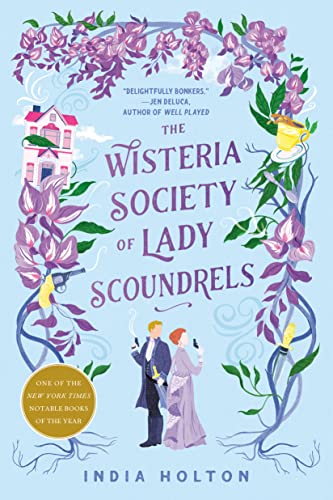
A pale blue background has an illustrated cover with purple wisteria twining up the sides, containing a tea cup and a house among the flowers. They from the title and and a well dressed couple standing back to back with pistols at the ready.

by Kristen B.

Piracy, historically and currently, is really not something that good guys do. However, the Wisteria Society of Lady Scoundrels practices a variation of piratical nonsense that could have stepped out of an Austen novel (or maybe Bronte?). Lady Scoundrels don’t sail ships – they have access to a magic incantation that allows them to fly houses around the British countryside. We’re talking townhouses, manors, abbeys, and many other shapes and sizes of abodes, all the while on the lookout to protect themselves from the Great Peril: freckles.

It’s just silliness. India Holton’s novel recently provided the perfect antidote to real life. I will admit, it took a bit to come to terms with the sheer folly of it all – airborne houses and assassinations as a form of professional advancement, combined with social norms and rivalries straight out of a Regency romance.

Dear Reader, I adored it.

Our heroine, Miss Cecilia Bassingthwaite, wishes for nothing more than to be invited to the Senior Table of the Wisteria Society of Lady Scoundrels. She has every confidence of achieving this signal honor, after all, she has undertaken thievery, successfully piloted a residence, and even been targeted for an assassination. The only concern, though, comes from her antecedents. Her father is entirely the wrong sort of scoundrel, who has committed unfortunate poetry as well as the actual murder of her mother. He believes himself to be the unrecognized, illegitimate son of Branwell Bronte, but he proves himself to be an absolute bastard (pardon my language).

Miss Bassingthwaite’s adventures begin shortly after her estranged father absconds with the entire senior cohort of the Wisteria Society (and their residences) and makes off to the dreaded, dreary Northangerland Abbey. (yes, yes, I know). She is accompanied on her rescue attempt by Ned Lightbourne (a man of many aliases), who comes from a good pirating family that experienced severe setbacks with the loss of their house. The entire scheme goes to perdition in a handbasket once Queen Victoria arrives on the scene (with Windsor Castle). The concluding negotiations left me grinning in appreciation of these ruthlessly practical ladies.

Ned and Cecilia appeal as a power couple with intense, immediate chemistry. Reader: I may have blushed. Their convoluted route to trust and, dare I say it, love, gives the entire story its emotional underpinnings. While it is a romance, Cecilia’s need to settle family affairs and become a Lady Scoundrel drives the plot. That she keeps stumbling over and eventually conspiring with Ned only adds spice to the mix. Her consternation about what to do with the extra complication of figuring out who Ned is – both in reality and in her regard – makes the high stakes at Northangerland Abbey even steeper.

In short, if you are looking for a bit of fluff and fun to read while sipping tea (maybe with a splash glass of sherry) that nonetheless celebrates competent women and the men who love them – you will enjoy The Wisteria Society for Lady Scoundrels, available as an e-book and an e-audiobook. I am looking forward to reading the sequel, The League of Gentlewoman Witches.

Kristen B. is a devoted bookworm lucky enough to work as the graphic designer for HCLS. She likes to read, stitch, dance, and watch baseball in season (but not all at the same time).

Trilogy and Beyond

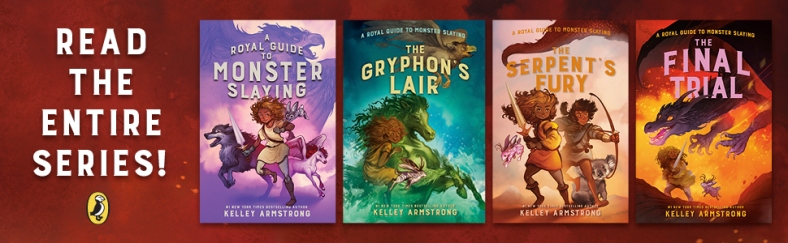
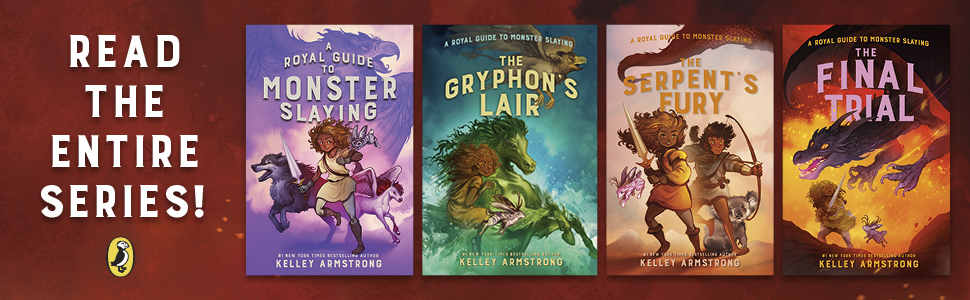
Provided by Penguin Random House: a red background with white type, "Read the Entire Series" then the four covers in the series featuring illustration of the main characters and fantastical creatures.

by Monae R.

Kelley Armstrong, a Canadian writer born in 2001, completed a wonderful children’s series in June 2022. Originally an author for teens and adults, her Royal Guide to Monster Slaying series, illustrated by Xavière Daumarie, comes as a nice refreshment for children. The first book, A Royal Guide to Monster Slaying (followed by sequels The Gryphon’s Lair and The Serpent’s Fury) was a Black Eyed Susan 2021-2022 nominee. Despite its enticing and interactive story, it did not win the award. The series follows the story of a princess and her journey to become the Royal Monster Slayer of her Kingdom.

Rowan, a 13-year-old girl, is adamant to fight alongside her aunt in the battle to understand and drive the monsters of the kingdom back to the mountains. Her journey towards this encompasses loss, friendship, family, and excitement beyond belief. Rowan’s bloodline, that of clan Dacre, gives her a gift many cannot fathom and allows her to find friends in unusual places.

Many see Rowan as a young, incapable princess. Over time, they see the error of their ways as she fights to increase her knowledge and strength. Her journey takes her out of the kingdom and past the mountains, where many have not traveled before, where she encounters rare and extinct monsters and develops relationships with bordering clans.

This series is full of unexpected twists and turns. The characters are silly and relatable and the monsters are fascinating and frightening. As someone who is deeply in love with fantasy stories, I could not put these books down. I placed a hold on the fourth book, The Final Trial, as soon as it was on order here at the library.

I highly recommend this inclusive fantasy quick read.

Monae is a Children’s Instructor and Research Specialist at HCLS East Columbia Branch.

I Kissed Shara Wheeler by Casey McQuiston

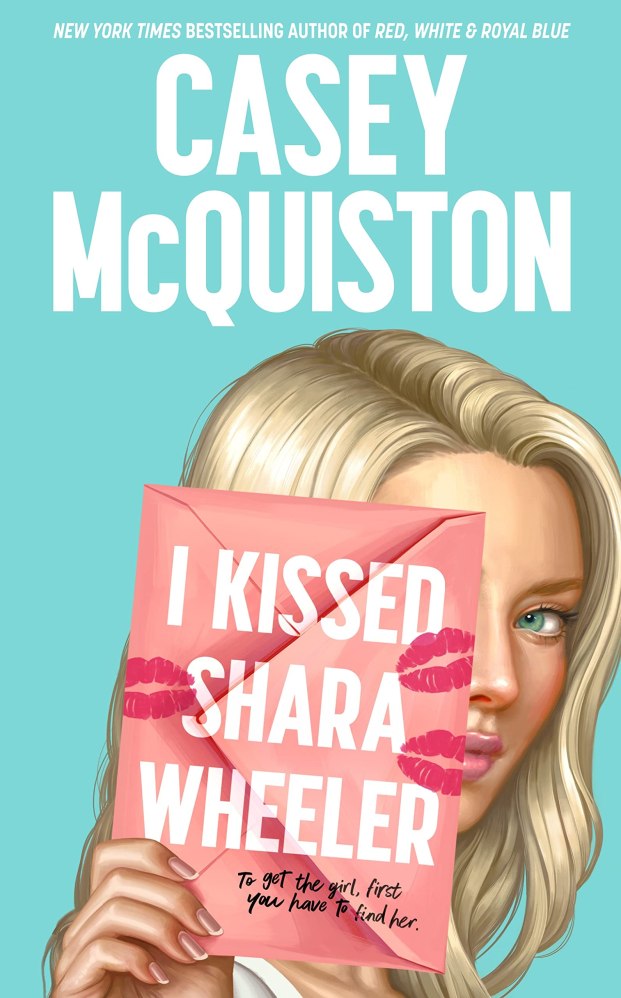
A pale blue background shows a blonde girl holding up a a pink envelope with three red "kisses" around the title. The envelope reads, "To get the girl, first you have to find her."

by Ash B.

I previously shared a review for Casey McQuiston’s One Last Stop, and I’m happy to report that their YA debut, I Kissed Shara Wheeler, is an absolute pleasure to read as well.

A contemporary coming-of-age story with a mystery twist, I didn’t want to put down this temptingly readable book once I was pulled into the story. Popular girl Shara Wheeler has the audacity to pull a disappearing act a month before graduation. Chloe Green, academic rival of Shara and protagonist of the novel, wants nothing more than to bring her back in time to see Chloe win valedictorian – because what’s the point of winning without a worthy competitor?  

For better or worse, Shara left behind a trail of clues designed specifically for the three people she kissed before disappearing – her quarterback boyfriend Smith, the boy-next-door Rory, and quite shockingly, Chloe. Shocking mostly because Shara – little miss perfect, daughter of the principal, and “it girl” of their small Alabama town – is, as far as anyone knows, entirely straight. However, the set-up of the novel makes it pretty clear that this is an enemies-to-lovers type of situation. The rivalry and frustration Chloe feels regarding Shara – really a mask for their magnetic attraction – is high-grade narrative fuel. What made me fall in love with the story, however, is the friendships that Chloe develops with Smith and Rory. 

Chloe, Smith, and Rory come from different tiers of the Willowsgrove High hierarchy. They don’t appear to have anything in common, aside from a connection to Shara. However, the more time they spend together, the more the dynamic shifts, and the more they learn about each other and themselves. By spending time with Smith and Rory, and their respective friend groups, Chloe realizes that the way she’s looked at many of her peers has been flawed. 

When it comes to stories set in high school cliques, I often proverbially roll my eyes, unconvinced that heavy-handed stereotypes of jocks, nerds, goths, prom queens, and such represent the average teen experience. I Kissed Shara Wheeler incorporates student group dynamics in a way that feels realistic and reminds me of my high school experience (Mt. Hebron, Class of 2015, what’s up!). The different social circles are often based on interests and activities – student athletes, band kids, and theater kids. However, each of those kids is nuanced, and the groups can overlap.  

For example, Ace plays on the football team with Smith. He tried out for the school play and snagged the lead, and Chloe’s group of artsy, queer, nerdy friends assumed Ace did it as a joke. However, Ace is a big musical theater fan and always dreamed of being in the school’s productions. He was nervous to audition, let alone star, mainly because he was concerned about being teased by the football crew. There certainly are some rude, insufferable jocks at their school – one in particular displays misogynistic, sexually objectifying behavior towards Chloe. There are also jocks like Ace and Smith, who are kind, who try to shut down the misogyny of their peers, and who have other interests besides sports… but are pigeonholed. It’s very much like Nick (the love interest) in Heartstopper by Alice Oseman

One of my favorite scenes happens at the senior theater party, where we hear Ace confess to Chloe about auditioning and preparing for the school musical. It shifts Chloe’s perspective about Ace, and it opens her mind to what all her other peers might be going through. Also, we get a lovely interaction when Ace and Smith get their makeup done by Chloe’s artsiest friend Ash, who happens to be nonbinary – which results in a conversation about gender that leads Smith to start questioning his gender identity:

“You know… if being a guy feels like something you have to do, like it’s an obligation or something,” Ash says carefully. “Maybe think about that.” 

I’m not going to lie; it’s pretty cool to see a fellow nonbinary Ash reflected in a book I love, especially when the character gets lines like this. I lived for this conversation! 

Overall, this was such a fun, joyous read. McQuiston relied on beloved tropes and archetypes that feel both familiar and fresh, thanks to the way they are subverted. Serious subjects are explored without being insensitive. The dramatic tension quickly propels the narrative forward, but there are also plenty of laughs along the way to keep the reader from feeling too stressed. (Seriously, how is CMQ so seemingly-effortlessly funny in their writing?)  

Perhaps best of all, the queer friendships are exactly what I think many readers will hope for. The ending is satisfying, with the youth banding together and standing up to ‘the system,’ and starting the work of unlearning the harmful messages that they’ve internalized so they can fully accept themselves and each other. If you’re interested in a compelling mystery full of warmth, hilarity, and character growth, check out I Kissed Shara Wheeler by Casey McQuiston in print, e-book, or e-audiobook.

Ash is an Instructor & Research Specialist at Central Branch and is a co-facilitator for Reads of Acceptance, HCLS’ first LGBTQ-focused book club. Their favorite place to read is spread out on a blanket under the shade of the tree. 

National Education Week: Let’s Play

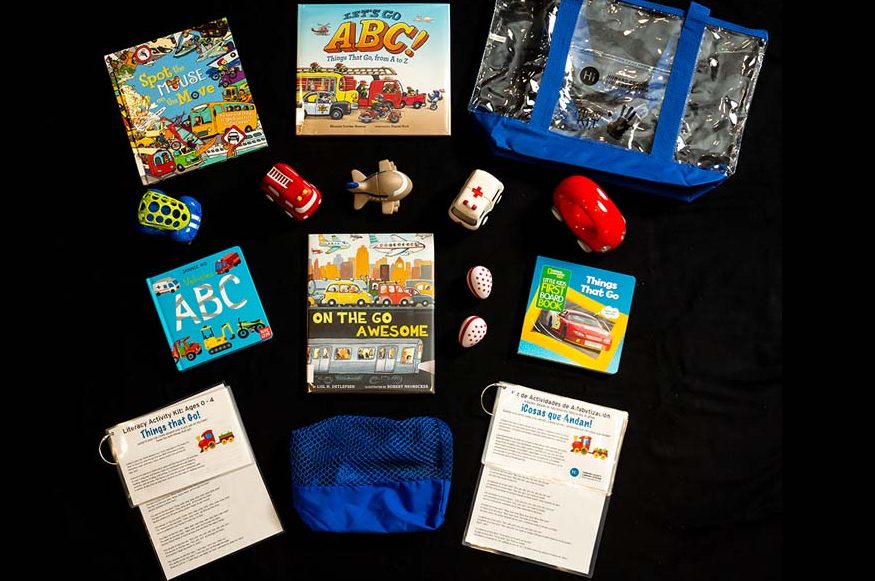
The contents of the On the Go Literacy Activity Kit displayed against black background, including toy vehicles, books, and tip sheets.

by Jean Boone, Central Branch

“When we treat children’s play as seriously as it deserves, we are helping them feel the joy that’s to be found in the creative spirit. It’s the things we play with and the people who help us play that make a great difference in our lives.” said Fred Rogers.

By definition, PLAY is FUN but that doesn’t make it unimportant. For a child’s development, it’s serious business. Play feeds a child’s imagination and creativity, and it helps them explore and discover their capabilities and their world. As it spurs brain development, play becomes a pathway for learning and creates the foundation for literacy and school readiness.

To support children and their families in growing and learning through play, we offer some incredible resources.

The toy collection includes more than 300 wide-ranging, developmentally appropriate and safe items:

  • Does your child love pretend play? Borrow a wooden sandwich-building set or the bilingual (English-Spanish) EnSALADa play set for some imaginative cooking!
  • Is your child always on the move? Take home a parachute, trucks and other vehicles, and push and pull toys for building motor skills.
  • Help your child learn their letters, numbers, shapes and colors with toys like the Counting Carrots Stacker, Rocket Shape Sorter, or Oscar the Grouch stacking cans.
  • Encourage storytelling with a set of puppets like the Three Billy Goats Gruff or Peppa and George Pig, or music-making with My First Piano or the Hedgehog Accordion.
  • Promote problem-solving with all kinds of puzzles, for toddlers to kindergartners.

Literacy Activity Kits combine themed books, toys, games, and hands-on activities that are both educational and entertaining. Created for three distinct age groups, the kits also include a bilingual parent guide with ideas for how to engage your child with these materials.

For 0-4 year olds, kits focus on essential concepts with books, music, and toys:
Numbers and Shapes
Colors and Letters
Bilingual English and Spanish
Things that Go
Barnyard Animals

For 5-7 year olds, kits contain books and problem-solving projects and games:
The Three Little Pigs
The Gingerbread Man
Goldilocks and the 3 Bears
Fun with Words
Dive into Dolphins and Sharks

For 8-10 year olds, kits offer books, worksheets, and games that strengthen literacy skills:
Super Spelling and Wonderful Writing
Stretch Your Storytelling
Pass the Poetry
Focus on Fluency

All of these materials can be borrowed for three weeks, just like a book. Come into your nearest branch and bring home some serious fun!

Jean B. is a Children’s Instructor and Research Specialist at the Central Branch and loves reading books for all ages when she isn’t enjoying the outdoors.

Veterans Recommend Books

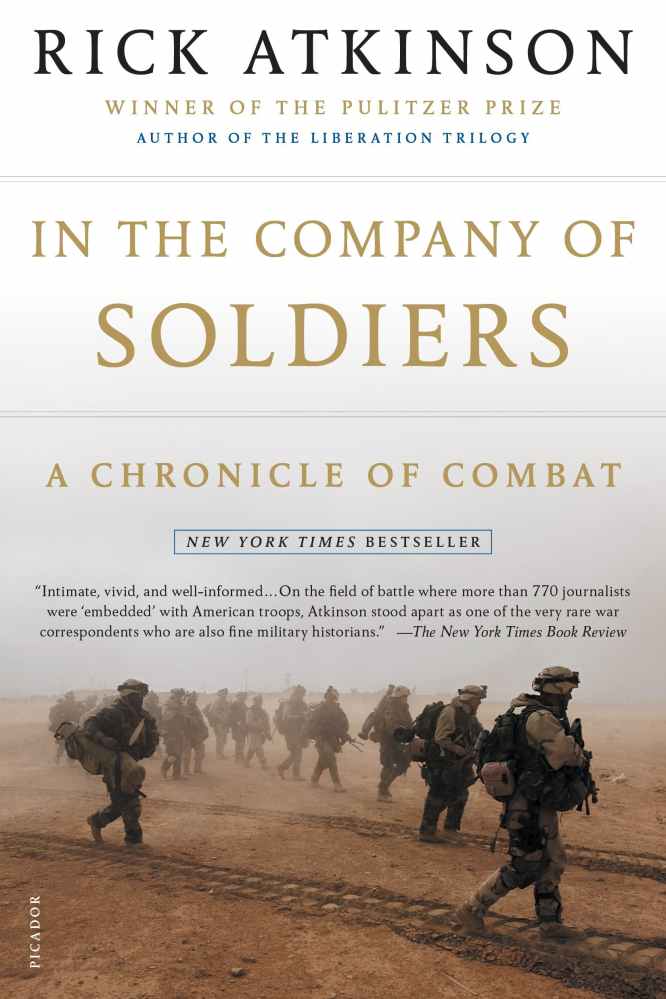
Shows an armed company with their gear walking across a sandy landscape.

by Rohini G.

Veterans, both active and retired military, participated in a recent online book discussion series. During five monthly facilitated sessions, conversations centered on military experiences and a unique set of readings, which included classics, fiction, memoirs, poetry, short stories, articles, and essays. The readings related in some way to military experiences or offered a veteran’s perspective. A new session begins in 2023. The Veterans Book Group is coordinated statewide by Maryland Humanities and is supported in part by the Wawa Foundation.

“If I had to narrow it down to one, it would be The Forgotten 500 by Gregory A. Freeman. The book recounts the details of American airmen shot down in Nazi-occupied Yugoslavia, and the local Serbian farmers who risked their lives to give them refuge. I really enjoyed learning about a relatively lesser-known WWII operation, and I’m always fascinated by the lengths to which humans will go to help one another when faced with desperate circumstances. This book was really good.”  – Dave O.

With the Old Breed: At Peleliu and Okinawa by Eugene B. Sledge is, perhaps, the finest individual memoir of the Pacific War. John Keegan, the noted British military historian, spoke highly of it. Ken Burns used it as a source for his documentary, The War.”
– Eugene O.

In The Company of Soldiers: A Chronicle of Combat by Rick Atkinson was my favorite book of the list we had to read. I like all books that have to deal with soldiers and this was one of the best. This book was well written and contained many individual issues that affect soldiers.” – Ron B.

HCLS joins the wider community in remembering with gratitude the service of our veterans, including the HCLS employees who have served. We are thankful for their patriotism, their willingness to serve and sacrifice for their country in wartime and in peacetime, and their love for and loyalty to our country and its citizens.

Rohini G. is an Adult Curriculum Specialist with Howard County Library System who coordinates the Veterans Book Club.

Falling for Children’s Books

by Eliana H.

I have to admit that fall is my favorite season. Having moved to Maryland from Texas as an adult, I continue to find joy and excitement in the crisp weather and beautiful colors that nature puts on display around these parts. It certainly isn’t the case everywhere! To help you savor the season with young people in your life, or just on your own, here are a few kid-friendly fall reads for you to enjoy.

The book cover depicts a white elephant eating an apple and a white mouse sitting astride another apple next to an overturned bucket of apples. An orange pumpkin is on the ground next to the elephant. The title, "Fall Friends," is on a sign behind them, and the sun is setting behind that with fall leaves on tree branches overhead as well as on the ground surrounding them.

Fall Friends by Mike Curato 

This seasonal installment in the Little Elliot series finds Elliot, an elephant, and his friend Mouse taking a fall vacation away from the city where they live. Escaping the hustle and bustle gives them the chance to slow down, enjoy what nature has to offer in the autumn, and make some new friends. A sweet, simple read that evokes common features that tend to be fall favorites, share this with a little one in your life and have a conversation about your favorite things to do this time of year! 

The cover is a photograph of fall leaves in shades of red, orange, and yellow against the backdrop of a blue sky.

Full of Fall by April Pulley Sayre 

Vibrant, detailed photography of fall sights pop in this appealing picture book, accompanied by simple text that immediately brings to mind real-life experiences. The words are poetic and powerful, perfectly pairing with full-page photos. Younger readers will stay engaged with the short text and can point out familiar sights in the pictures, but older readers can enjoy more in-depth discussions about the images and words chosen. Perhaps you will be inspired to take some photographs and make a personal version of this book. 

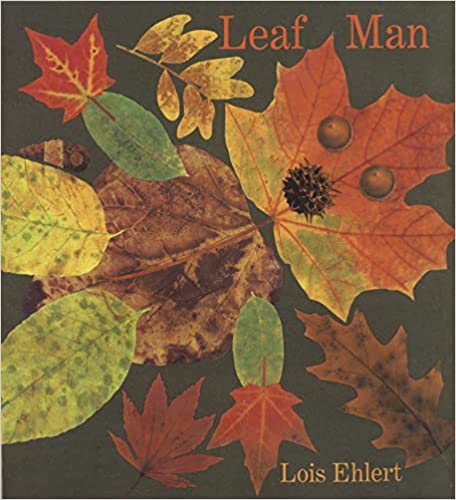
The cover depicts varying types of leaves, acorns, and a seed pod. The leaves are in fall colors of red, orange, yellow, green, and brown.

Leaf Man by Lois Ehlert 

Lois Ehlert is an author/illustrator near and dear to my heart, and Leaf Man is a beautiful example of her work. In the story, the narrator had a man made out of leaves who blew away. The illustrations throughout the book are made from leaves of all shapes, sizes, and colors combined to make everything from chickens to orchards to fish. Although the narrator isn’t quite sure where the leaf man has gone, a repeating phrase reminds readers, “a Leaf Man’s got to go where the wind blows.” After reading this one, you might find yourself joining your little one as you look for a leaf man – or other leaf shapes – while walking outdoors this autumn. 

The cover depicts someone in a yellow raincoat and blue hat and scarf sweeping a clear path through the leaves on the ground with a broom.

Sweep by Louise Greig, illustrated by Júlia Sardà 

Before he knows it, Ed’s bad mood has swept him away. It spirals out to get in the way of everything and everyone around him, and he feels stuck but isn’t sure what to do. Then, something changes, and Ed can see a way out and think about what he might do the next time he finds himself in a bad mood. The autumnal metaphor the illustrations provide make this the perfect time of year to use this title as a starting point to talk about big feelings and what we do with them. 

The title is depicted in leaves, in fall shades of red, orange, green, brown, and yellow, with leaves of similar shades falling and on the ground beneath.

Awesome Autumn by Bruce Goldstone 

In this nonfiction title, Goldstone offers a wealth of information to answer many questions from little ones about the season. Colorful photographs accompany facts about changes in nature and in the human world during fall. For younger readers, you can choose to share only some of the text, but older children may enjoy additional details. Readers of all ages can consider personal connections to what they see in the book. 

The cover depicts two children and a cat tumbling against the backdrop of a fall leaf.

Autumnblings by Douglas Florian 

Word play is another favorite of mine, and this slender volume of poems and paintings offers plenty. In simple, relatable poetry, Florian offers examples of some favorite forms. They may even inspire a budding poet. Even if no one in your house composes verses, point out some of the unique words used and talk about why they are special and why Florian may have chosen them. 

Eliana is a Children’s Research Specialist and Instructor at HCLS Elkridge Branch. She loves reading, even if she’s slow at it, and especially enjoys helping people find books that make them light up. She also loves being outside and spending time with friends and family (when it’s safe).

At the Table Together

by Brandon B.

The book cover is a photograph of a roasted turkey on a white china platter, with silverware in front and garnished with greens.

The Thanksgiving holiday is an opportunity for families to gather at the dinner table, express their love, enjoy each other’s company, and give thanks for what life has to offer. On Thanksgiving Day, people watch the parade in New York, the national dog show, and football games, but the holiday feast is the main event. Many families showcase a variety of food choices from their respective regions or countries.

Some families could decide to have mashed potatoes with their turkey instead of macaroni and cheese. Many people prefer collard greens to green bean casserole, or sweet potato pie over pumpkin pie. Apple, cherry, and blueberry pies might also make an appearance. Even though turkey, ham, and other meats can be served during Thanksgiving, plenty of plant-based or meatless options are now available for vegans and vegetarians. Many pescatarians will have seafood as one of their main entrees for their feast.

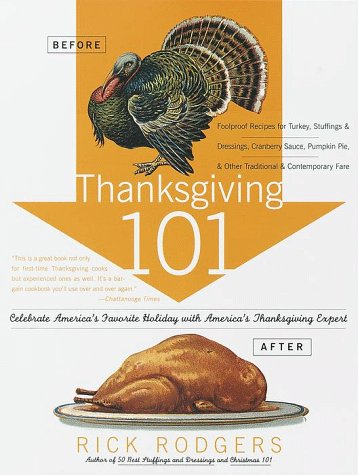
The book cover depicts an illustration of a live male turkey at the top, superimposed above a maize-colored arrow that points to a roasted turkey on a platter at the bottom.

We can help you plan for Turkey Day with a wide variety of cookbooks from our collection. Fine Cooking Thanksgiving Cookbook: Recipes for Turkey and All of the Trimmings, from the editors of Fine Cooking magazine, will help prepare your holiday feast. With Rick Rodgers’ Thanksgiving 101: Celebrate America’s Favorite Holiday with America’s Thanksgiving Expert, you can explore timeless dishes and helpful holiday tips. Preparing for a plant-based meal presents certain challenges; Vegan Holiday Cooking from Candle Cafe offers celebratory menus and recipes from New York’s premier plant-based restaurants.

The book cover depicts a variety of fruits and vegetables, vegan cheese and crackers, and three cocktails on a platter, all resting on a white table.

Being thankful for the time that you spend with your family and friends is vital. Our society has had its recent share of trials and tribulations, especially with the Covid-19 pandemic. We as a nation have a lot to be thankful for. So please, cherish the people you love and the time you have to celebrate together during this holiday season.

Brandon is a Customer Service Specialist at HCLS Central Branch who loves reading, football, and taking nice long walks around his neighborhood.

Freedom in Iran: Stories Teach and Inspire

The book cover depicts a bird in silhouette flying free from an open filigreed cage, in shades of turquoise.

By Maryam S.

It is said: Even if you leave your homeland for good, she will never leave you. Whether recalling friendships that I have cherished for over five decades or when in some life circumstance, suddenly an expression from my homeland, Iran, comes to mind. One unforgettable piece are the stories from my childhood: stories that are deeply rooted in the past yet alive in my memory to this day, which still unify the Iranian people.

One epic story “Zahhak, the Serpent King” was written around 1020 CE by the famous poet Ferdowsi, with all the beauty and purity of the Farsi language. It inspires several questions relevant to the current day, especially: How much can a human soul take to achieve freedom?

In the story, Zahhak, the son of a kind king, rises to power after killing his father. One day, the devil, Ahriman, shows up to the doors of his castle and asks the king if he can cook for him (“Ahriman” means “Satan” or “devil” in Persian). Ahriman’s culinary skills are excellent, and Zahhak asks how he can reward him. The devil’s only wish is that he allow his cook to embrace the king as the sign of humility and gratitude. Although surprised, the king accepts the embrace; Ahriman kisses each of the king’s shoulders and immediately disappears. Once the devil disappears, two black snakes grow from Zahhak’s shoulders that cannot be removed. Learned doctors gather about him, but no one finds a remedy. Then, the devil appears in the form of a wise doctor who recommends feeding each one of the snakes the brain of a young man or a woman everyday. From then on, every day, two young people’s brains are fed to the serpents. Zahhak lives for a very long time, casting a dark cloud of hopelessness and grief over the people and the land. Eventually, a child called Feraydun is born. At age 16, his mother tells him how his father was killed by Zahhak, and how she escaped and hid herself and Feraydun, safe from the king’s assassins. Feraydun decides to gather enough followers to challenge Zahhak’s powerful army.

Meanwhile, Kaveh, a blacksmith who has lost 11 sons to Zahhak, comes to the palace to demand that his last son be freed. First, Zahhak’s guards try to seize the insolent commoner, but a mountain of iron, tall and forbidding, rises up before Kaveh and protects him. As father and son leave, Kaveh hoists his leather apron on a spear as a rallying point and shouts, “Today it was my boy, tomorrow it will be yours.” A crowd of people gather and everywhere they march, joining Feraydun and his followers. Eventually, they defeat the evil king, imprisoning him in a deep, dark cave in Mount Damavand where he will suffer until end of the time. Feraydun returns to the palace and ascends the throne. The whole earth rejoices, and peace and fortune return to the land and to her people again.

So, the story considers what happens to those who swim against the river of power, greed, cruelty, violence, and selfishness. Losses and loneliness can seem insurmountable for those few who choose this path. But what encourages those few heroes whose decisions are unchanged, fighting for freedom until their last breath? Is there anything but faith in freedom for humankind, for their sisters and brothers, for their country, for a better society to pursue a better life? One modern woman’s story can provide some answers.

Bengt Oberger, CC BY-SA 4.0 , via Wikimedia Commons

In 2003, the Nobel Peace Prize was awarded to an Iranian woman, Dr. Shirin Ebadi. She was the first female judge during the secular regime in lran, before the Islamic revolution of 1979. However, according to seventh-century sharia law, after the revolution she could no longer practice as a judge and was forced to work as a family lawyer. In her first book, Iran Awakening, published in 2006, she shares an overview of her upbringing, the history of social and political changes since the revolution, her challenges, and her fight for under-served children and women in the Islamic republic of lran. Although the world recognized her efforts for the well-being of her country, she suffered from the regime’s hostility, espionage, and social harassment, ultimately leaving in exile in 2009.

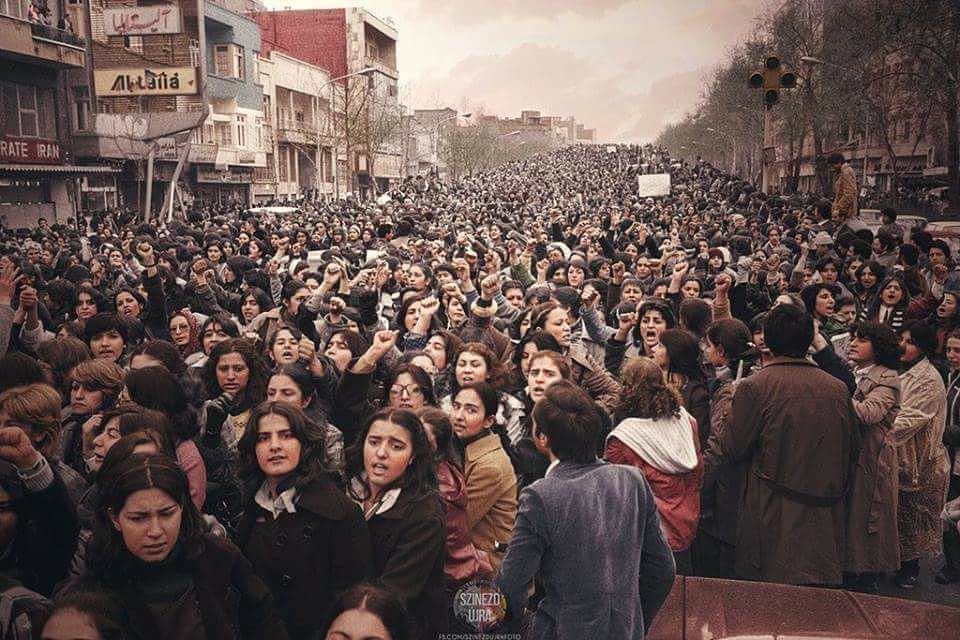
1979 Women’s Day Protest in Iran, public domain image.

Until We Are Free: My Fight for Human Rights in lran is her memoir, published in 2016, of events in lran and the Middle East. Ebadi’s views about the lives of ordinary people in lran encompass a good part of the book: the economic hardship that many Iranian families endure daily, as well as the regime’s zero-tolerance policy for political criticism. She also writes about the women who selflessly assisted her in continuing her work as a human rights lawyer. She worked not only for women, but for men, for those with different religious beliefs, for jailed writers and journalists, and even for those who worked for the regime but didn’t understand how the wrong interpretation of Islamic law and the abuse of Islamic sharia was destroying family structures and the society overall.

Although this book was written a decade after the first one, l still found Ebadi’s words honest. Her description of the events and incidents that she, her family, and her colleagues endured are described in frightening and unsettling details. She repeatedly mentions the security that the Nobel peace prize committee afforded her; legal support from the committee was like an invincible human force against the regime’s hostility and humiliations, so she could continue her legal fight for her clients pro bono. I found her hopes for the freedom of her country unshakable, despite losing most of the valuable possessions that she was attached to, emotionally and physically. Through her words, I found her vulnerability not pretentious but genuine, whether doubting herself or receiving criticisms from her closest family members. She is still an ordinary human with flaws and achievements in her life. But, she is still closer to the reality than a dream for freedom described in the stories of my youth.

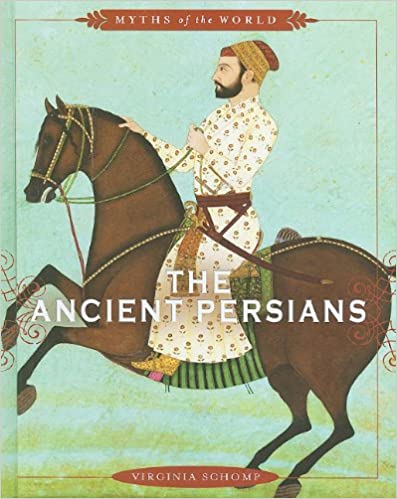
The cover depicts a Persian man astride a horse, with his sword in a scabbard aside as if he is going into battle. The horse's front legs are raised and the rider clutches its mane with one hand and the reins with the other.

The story of Zahhak the Serpent King can be found in Myths of the World: The Ancient Persians, written by Virginia Schomp.

More about Dr. Ebadi can be found in these titles:
The Wonders We Seek: Thirty Incredible Muslims Who Helped Shape the World by Saadia Faruqi and Aneesa Mumtaz; illustrated by Saffa Khan.

Who Did It First?: 50 Politicians, Activists, and Entrepreneurs Who Revolutionized the World by Jay Leslie

Fight Like a Girl: 50 Feminists Who Changed the World by Laura Barcella

Maryam S. is a customer service specialist at HCLS Miller Branch. She loves traveling near and far and loves to cook and bake from new recipes.

DeadEndia & Dead End: Paranormal Park

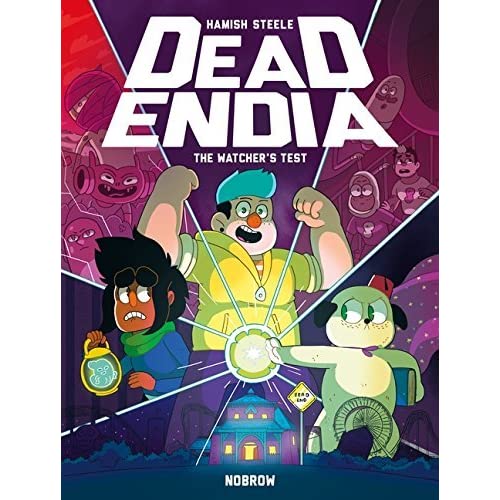
The main characters of DeadEndia: The Watcher's Tesst appear against a segmented background of devilish figures.

by Ash B.

Set in haunted amusement park themed around the life and career of fictional actress-superstar Pauline Phoenix, the world of DeadEndia is full of spooky, supernatural fun. If you’ve got a Netflix account and a kid older than 7, or you’re fan of cartoons with great representation, you’ve probably heard about Dead End: Paranormal Park. The Netflix show was adapted from a graphic novel series called DeadEndia, which you can borrow from the library.

The main characters of Norma, Barney, and Pugsley began as an animated web short for Cartoon Hangover. Creator Hamish Steele used this as inspiration for a new webcomic, which, in turn, became DeadEndia: The Watcher’s Test and DeadEndia: The Broken Halo graphic novels. The third and final book is anticipated to release next year.

I was first introduced to the world through the graphic novels – so, imagine my excitement when one of my favorite reads became an extremely well-adapted animation! The show diverges quite a bit from the graphic novels in some ways, particularly how the main characters meet and the story begins. From there, the first episode of the show lines up pretty closely with the first chapter of DeadEndia: The Watcher’s Test. The demon king is summoned and possesses Barney’s dog, Pugsley, instead of one of the humans as planned; Norma cleverly figures out how to defeat the demon king; Pugsley is left with magical powers, including the ability to talk. The story continues with a balance of paranormal adventures, such as “monster of the week” style demon-fighting episodes/chapters, along with the emotional rollercoasters of personal identity, mental health, romance, and family struggles.

The novels strongly resonated with me because of the way Barney’s transmasculine experiences were included. In both the comics and the show, we find out that he was primarily interested in getting a job so that he could gain independence from his parents. The show allows for more development of Barney’s relationship, though. I think the cast and crew nailed it, with a family that goes through realistic misunderstandings and growing pains, but makes it through the rough patch to fully embrace the LGBTQ+ kid. 

The graphic novels have a special place in my heart for certain heartwarming details. For example, Barney gives Pugsley a copy of The Very Hungry Caterpillar as he learns to read, and Pugsley compares Barney to the titular caterpillar. Pugsley eventually clarifies: “My comparison was due to the fact that we all start off looking and sounding a little different to how we turn out. Some more than others. But that doesn’t change who we are on the inside.” This line, especially in the context of the rest of the chapter (which I won’t spoil here), is so gentle and comforting to a trans reader like me. 

Probably the most notable point of difference between the show and comics is the target audience. The comics are aimed at young adults (ages 14+), with Barney, Norma, and their peers being in their early twenties. When adapted for the small screen, the characters were aged down to be in their teens and the material made suitable for a younger audience. The graphic novels can be enjoyed by teens and adults alike, and you can borrow them in print from HCLS. 

Ash is an Instructor & Research Specialist at Central Branch and is a co-facilitator for Reads of Acceptance, HCLS’ first LGBTQ-focused book club. Their favorite place to read is spread out on a blanket under the shade of the tree.