Do the Right Thing

Movie cover for the Spike Lee movie, showing Danny Aiello as Sal and Spike Lee as Mookie, looking up at the camera.  Mookie is holding a pizza box that says "Sal's Famous Pizzeria" and dressed in a work uniform with the red and green colors of the Italian flag.  Sal is wearing a black patterned shirt, white pants, and white tennis shoes.

by Eric L.

As the weather heats up and tensions in America never seem to ebb, I am reminded of the Spike Lee masterpiece (or “joint’ as he prefers to creatively call them), Do the Right Thing. I am surprised by the number of people I speak with who have not seen this film. I am a fan of Lee; I find him humorous, I like his style and his honesty. I also like how much he likes the New York Knicks, despite the fact that they are a fairly disappointing sports franchise. I’m not really sure why I appreciate his devotion to the Knicks, but perhaps I wish I sat courtside at the Washington Wizards’ games (they’re still my Baltimore Bullets). 

Visually the movie is very well done. The whole film takes place on a hot summer day in Brooklyn, New York in the late 1980s. Having spent much time in a southwest Baltimore small business cluster, it seemed pretty true to life and almost stereotypical. The setting is replete with the animosity, resentment, struggle, and misunderstandings of an American multiracial neighborhood. It’s a contentious place. Moreover, it reminds me of just how hot a city feels on the East Coast in summer and how riots often happen on scorching days. Lee creates and presents this masterfully, and the tensions are palpable. Someone I know that spent time in a similar environment, and is rather conservative-minded, claimed that the movie is “spot on.” I concur.

There is the Italian family who owns the pizza shop (Sal’s) for generations, the Asian family that owns the small corner store, (neither of whom presumably live in the neighborhood), the black and Hispanic residents, the white “gentrifying” guy that just bought the brownstone, etc. The scenes with Danny Aiello, Spike Lee, et al. filmed looking at the camera and enumerating racial epithets are raw, stripped down, and very powerful. By the way, you’ll recognize many great actors in the film, giving great performances.  

One of my favorite scenes, which is famous, involves the character that would be me. A young white man carrying his mountain bike, with longish hair, stubble, and running shoes accidentally steps on a black character’s “brand new white Air Jordans.” Then, a very telling exchange and slick commentary on race relations in the U.S. ensues. Like all great comedic moments, it is also tragic.  

There are several references to athletes and race throughout the film. In fact, Lee dons a Jackie Robinson jersey and wears Air Jordan sneakers himself. What’s more, one subtle detail is also clever – the white “gentrifier,” who accidentally mis-steps on the character’s shoes which he “paid $100 for,” is wearing a Larry Bird Boston Celtics jersey shirt. As a side note, if you’re interested in watching an outstanding documentary, check out Magic and Bird: A Courtship of Rivals. Even if you’re not into basketball or sports in general, it is a compelling story about race in America and the relationship of two kindred spirits. As a blonde kid with floppy hair, Larry Bird was my guy in the NBA for sure; however, he had no interest in being the “white savior” America desired. But I digress.

Lee’s examination of his own beliefs and experiences, neighborhood, and America is real art. I would go so far as to say it’s a must-watch for Americans. In sum, Do the Right Thing is a micro-examination of inner-city race relations and how they can easily boil over in the sweltering heat. After watching this film you may ask yourself, how could they not? 

Eric is a DIY Instructor and Research Specialist at Elkridge Branch. He enjoys reading, films, music, doing nearly anything outside, and people.
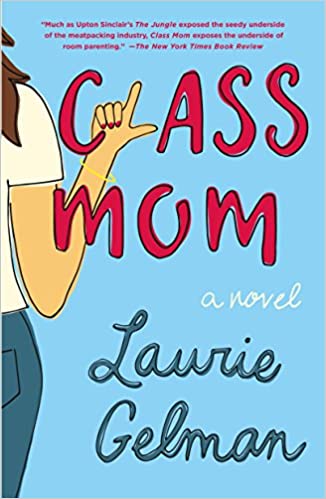
The Class Mom series by Laurie Gelman

The image shows a mom with shoulder-length brunette hair, in a white t-shirt and blue jeans with her back to the viewer. Her right hand is raised and her index finger and thumb form the "l" in the book's title, Class Mom.

By Piyali C.

Most people at their workplaces dream of moving up in the chain. They aspire to be assistant managers, managers, or chiefs of staff, and hopefully rise to the top. I dream of starting new book clubs. I already co-facilitate two book clubs at the library – Global Reads and Strictly Historical Fiction. But if I am allowed and time permits, I dream of starting yet another one that I will name “Light but not Fluffy.’ And Laurie Gelman’s Class Mom along with its sequels will surely feature as some of the chosen titles.  

My love affair with Gelman’s writing started when I discovered Class Mom on the shelves while I was shelving a cart at the library. The jacket looked interesting, so I took it home and read it in two sittings. I met Jennifer Dixon in Class Mom for the first time and fell head over heels in love with her character. In Class Mom, Jennifer Dixon raised two daughters as a single parent before she met Ron, fell in love, married him, and had an adorable baby boy, Max. The story of Class Mom (as the name suggests) revolves around Jen assuming the role of class parent when Max enters kindergarten. Jen is a different kind of class mom than, most likely, you or I have encountered. Her emails to the parents are funny, irreverent, snarky, and raise some eyebrows. Although Jen’s best friend, the PTA president, thinks Jen is perfect for the job, there are many parents who disagree. As we read about Jen’s never-ending commitments to both her child’s school and her own personal life, we wonder how Jen will possibly get everything done. But she does, with an inordinate amount of humor, grace, and – yes – snark.

The cover shows a mom with shoulder-length brown hair, wearing a high-visibility vest and holding a "stop" sign that reads "A Class Mom Novel." She has her back to the viewer and appears to be working as a school crossing guard.

In the sequel, You’ve Been Volunteered, Max is in third grade and Jen has been roped into being the class parent again. But this time she must deal with not only the micromanaging PTA president, but also extremely difficult parents who are not charmed by Jennifer’s management of parental politics or the tone of her emails, which remain tongue in cheek, irreverent, and sassy. Apart from the drama in school, Jen’s personal life goes through some turbulence as well, as she deals with her overworked husband and helps her older daughters navigate adulthood. On top of all that, Jen’s elderly parents may also need some supervision. In this book, yet again, Jen juggles all her responsibilities with humor, empathy, sometimes failure, but mostly humor.

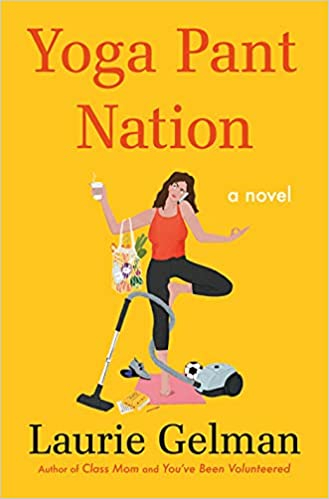
The cover shows a Mom in a yoga pose, with shoes, homework, and sports equipment cluttered around her foot. She holds a coffee cup in one hand, a cell phone to her ear, and a grocery bag strung over her arm, with the hose of a vacuum cleaner wrapped around her standing leg.

Yoga Pant Nation is the third hilarious book in this funny series. Max is in fifth grade, so this is Jen’s last year as a class parent in William Taft Elementary school. This year may be her most challenging one yet as she has been entrusted to raise 10,000 dollars to buy devices for fourth and fifth graders. Jen has no idea how she will raise such immense funds with her team of parent volunteers. She is also aspiring to be a spin instructor as well as caring for her two-year-old granddaughter Maud (yes, 53-year-old Jen is a grandmother now). On top of that, her dynamic parents Ray and Kay seem lethargic and forgetful. Jen wonders if it is time for them to move to an assisted living facility. Read this book to find out if Jen Dixon will finally admit defeat. 

Jennifer Dixon is sure to make you laugh as you read about her life. Laurie Gelman puts just the right blend of insanity, charm, love, and sarcasm in Jennifer Dixon to make her readers fall in love with this high-achieving, super snarky, well-meaning mom. If you were or are a class parent or an active member of the PTA, you will relate to Jen. If you have not participated in any of that, you will look at her life with awe and perhaps thank your lucky stars that you have never had to deal with her challenges. No matter which side you are on, one thing is certain: you will laugh. And we all could use some laughter in our lives.

Class Mom, You’ve Been Volunteered, and Yoga Pant Nation are all available in print, and a fourth book, Smells Like Tween Spirit, is due to be published in August.

Piyali is an instructor and research specialist at the Miller Branch of HCLS, where she co-facilitates both Global Reads and Strictly Historical Fiction and keeps the hope alive that someday she will reach the bottom of her to-read list.

Maid: Hard Work, Low Pay, and a Mother’s Will to Survive by Stephanie Land

The book cover shows a pair of dirty yellow work gloves, lying one on top of the other.

By Kimberly J.

In this autobiography, journalist Stephanie Land details the hardships and trials she endured during her daughter’s first years. Driven into homelessness due in part to an abusive partner, an abusive father, and an absent mother, Land is truly on her own. Her family and friends have nothing to give, leaving her alone to survive. People from all walks of life will relate to her fighting spirit and resiliency.

This story is so compelling because it is so personal. This eye-opening tale gives us a glimpse into the everyday struggle of one woman fighting for a life for herself and her daughter. Reading from her point of view gave me insight into the scorn and derision felt by the working poor. The tension and anxiety Land experienced were palpable as she struggled to balance 15 types of assistance in order to simply survive.

It is a hard and heavy subject – Land works as a maid cleaning houses in order to make ends meet. The contrast of being surrounded by the trappings of the upper middle class while she is struggling to feed herself is heart-rending. This position of servitude leaves her feeling dehumanized and “othered” more often than not. When she encounters the rare client that treats her like a person, she is hungry for even the smallest acts of compassion – a note, a conversation, a smile.

This book raises important questions – How do we treat people who are performing manual labor? How do people experiencing homelessness and/or poverty fit into our society? What makes a home? How can you keep going even when hope feels impossible?

Maid is a New York Times bestseller and has been converted into a Netflix series. It is available in print, ebook, and eaudiobook from HCLS.

Kimberly J is an Instructor and Research Specialist at the HCLS Glenwood Branch. She enjoys reading, photography, creating, crafting, and baking.

Author Works with Michael Twitty

Portrait of Michael W. Twitty, wearing a zip-up hoodie and touching his beard.

Thursday, Aug 11 from 7 – 8 pm at Miller Branch.

Please register to attend. Limited seats.
Register at bit.ly/twittyhcls

In partnership with the Howard County Jewish Federation and Baltimore Jewish Council

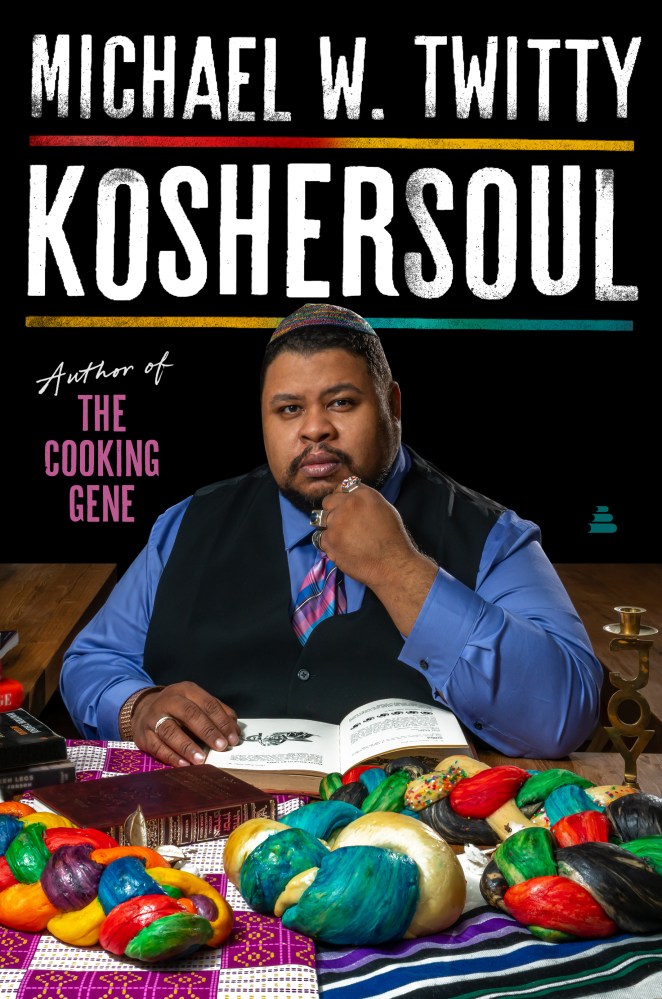
In his new book KosherSoul, Michael Twitty, author of the acclaimed The Cooking Gene (read a review), explores the cultural crossroads of Jewish and African diaspora cuisine and issues of memory, identity, and food.

Twitty examines the creation of African/Jewish global food as a conversation of migrations, a dialogue of diasporas, and the rich background for people who participate in it. At the same time, he shares recipes for Southern culinary touchstones like apple barbecue sauce, watermelon and feta salad, and collard green lasagna, while blending the traditions of his mixed identity into new creations such as Louisiana style latkes and kush. KosherSoul is more than a cookbook, it’s an exploration of selfhood when born at a crossroads of race.

The question is not just who makes the food and who it belongs to, but how food makes the people, reflects the journey, and validates the existence of these marginalized identities. Twitty aims to move beyond the idea of Jews of Color as outliers, but as significant and meaningful cultural creators in both Black and Jewish civilizations.

ABOUT THE AUTHOR

A highly sought-after speaker and consultant, Twitty has appeared on programs with Andrew Zimmern, Henry Louis Gates, Padma Lakshmi, and most recently on Michelle Obama’s Waffles and Mochi.

He is a TED Fellow and was just named as a National Geographic Emerging Explorer. His first MasterClass course, “Tracing Your Roots Through Food,” is now available. Over the past year he has partnered with Atlas Obscura to teach multiple online seminars and was the first guest on a new web series for their food division. Michael will also be a Consulting Producer on a new food competition program coming soon from OWN. He lives in Fredericksburg, Virginia.

Border Less by Namrata Poddar

A bold illustration shoes a woman's back with her hands raised in a dancing posture, while a votex swirls above her with botes and planes.

By Piyali C.

Dia stretches her arm over her head and forms a mudra with her fingers as she answers phones at a call center, Voizone, in Mumbai. Her customer is irritable and rude. However, if she can resolve the call within seventeen seconds, she has a chance at a promotion in Manali. Thus begins the story of a young woman, Dia Mittal, a passionate dancer who is financing her education by working at a call center in Mumbai and taking care of her family. Dia, however, is representative of modern Indian youth who refuses to stay contained within borders, be it geographic or societal. So instead of listening to her mother’s remonstrations about getting married, Dia dreams of a life that has a higher purpose than matrimony. Although dancing is Dia’s passion, she is realistic enough to know she will not make a name by dancing as a junior artist in Bollywood movies.

Dia wants more from life. Her desire to create her own destiny takes her far from home to the United States where she discovers the dichotomy of belonging to more than one country. After many years of living afar, Dia cannot fully belong to India or relate to her family including her widowed mother. While in United States, Dia is unable to assimilate to the culture and people, even her own people – the desis. She exists in a strange limbo. Namrata Poddar proves her expertise as a storyteller by dividing Dia’s journey in two parts – Roots and Routes. We meet young Dia in Roots. She is still vulnerable, slightly unsure of how her journey in life will unfold, but despite the uncertainty we discover her steely determination to embark on that journey. In Routes, we travel with Dia as she meets new people, finds love and a successful career that transcends borders. Through her eyes we read about the experiences and perspectives of the South Asian diaspora in United States. Through her we discover that although many Indian men and women left their country for better opportunities, they brought with them the patriarchy and prejudices that were, perhaps, a part of their lives when they emigrated.  

Poddar intersperses certain chapters within her story with perspectives of narrators other than Dia without really telling us whose voice we are hearing. Each voice is unique and gives us a glimpse of a slice of life, be it on a passenger train in Mumbai or the struggles of an immigrant who came to the US in the 1960s and built a successful life from scratch. As I read those chapters, I felt a little lost but Poddar guides her readers back to Dia’s life, and it all makes sense at the end. Dia Mittal’s life is by no means smooth or untroubled, however, through it all, her fierce determination to fight boundaries remains constant and just when we think she is going to lose her love and her family, she manages to steer her life back into the path that she has created without losing herself. Not once does she give in to the established patriarchy that threatens to engulf her. 

Although Dia Mittal’s journey is the common thread in this lyrical, superbly told story, many layers interweave to explore themes of belonging, otherness, assimilation, gender, identity, expectation, and as the book jacket says, “a negotiation of power struggles, mediated by race, class, caste, gender, religion, place or migration.” The title Border Less itself, I am sure, will evoke many thoughts among those who like to read and discuss books. I hope book clubs choose this title not only to enjoy Namrata Poddar’s beautiful storytelling but also, perhaps, to understand what it means to cross borders to forge a new path, both physically and metaphorically. 

Border Less is available in print.

Piyali is an instructor and research specialist at the Miller Branch of HCLS, where she co-facilitates both Global Reads and Strictly Historical Fiction and keeps the hope alive that someday she will reach the bottom of her to-read list.

The Golden Age of Crime and Josephine Tey

The book cover shows an unbuttoned coat with arms extended, floating in dark waves, with a rocky island in the background with a lit candle shining from the summit.

By Julie F.

Think for a moment about Agatha Christie: how many versions and adaptations of Poirot and Marple have you read or seen? How popular do her novels remain to this day? And a question asked of librarians worldwide: If you’ve read and loved all of Christie, and viewed everything produced by Acorn and Britbox, where do you turn for a puzzling new mystery?

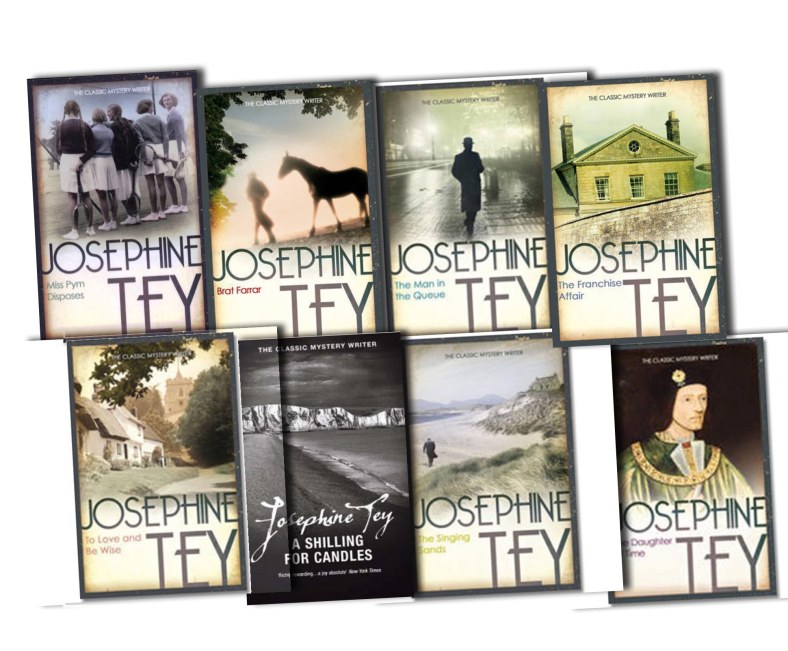
Faithful readers of Golden Age crime novels often read, and re-read, their favorite writers out of devotion to this inimitable era and style of crime fiction. Golden Age works were primarily written by British authors but also a few famous practitioners in the United States; these include Mary Roberts Rinehart, whose popularity in her heyday rivaled Agatha Christie’s. Rinehart’s novel The Door popularized the phrase “The butler did it!” even though those words appear nowhere in the book. In Great Britain, one of the best but most underappreciated writers in this style was Scottish author Josephine Tey. A versatile writer of plays, poetry, and short stories as well as mystery novels, Tey is most famous for the work declared “Greatest Crime Novel of All Time” by the British Crime Writers’ Association: The Daughter of Time (also available as an eaudiobook from Libby/OverDrive).

The book cover depicts a painted, framed portrait of a king, presumed to be Richard III of England, against a white background.

Tey’s series character, Inspector Alan Grant, is sidelined in a hospital bed with a broken leg and bored to tears with inactivity. A friend of Grant’s, actress Marta Hallard, suggests that he try his hand at solving a famous historical mystery, since he can’t actively investigate clues or hunt down a killer while confined to the sickroom and limited in his movements. While researching various figures, Grant discovers that Richard III looks kindlier than the way he is portrayed in the historical rogues’ gallery of villains. In fact, Grant wonders if the famous Tudor king was really responsible for all the tragedy and evil attributed to him, including the deaths of his young nephews Edward and Richard? Richard III was serving as regent for Edward V when the two boys were declared illegitimate, then disappeared from history. Now, Inspector Grant is on the case!

The novel becomes a thorough exploration of that important task of historians: to sift the facts from myth and legend, to figure out what version of an event is authoritative, to consider how one viewpoint’s retelling becomes prevalent while another fades into the mists of time. The reader learns about history as a construct while Grant learns more about his infamous subject. It becomes the mission – if not the obsession – of Grant and his eager young assistant, British Museum researcher Brent Carradine, to crack the case.

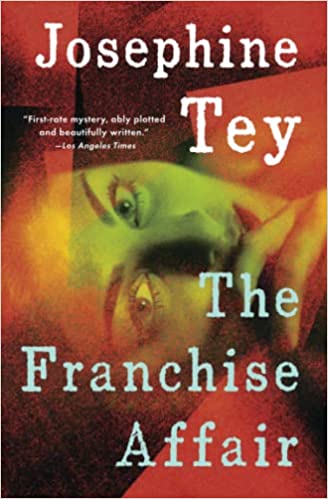
The book cover depicts the headshot of a woman, lying on her side and staring at the viewer, with her fingers to her mouth. Her eyes are wide with long lashes and carefully manicured brows.

Tey wrote one other mystery with a tinge of history, The Franchise Affair, based on a famous kidnapping case in the eighteenth century even though it is set in the 1940s. This book and six others are part of Tey’s series featuring Inspector Grant, although he appears in it only briefly. I recently read the second book, A Shilling for Candles, and I loved what her fellow Scot, crime writer Val McDermid, had to say about her in a CrimeReads article. McDermid postulates that Tey is actually a bridge between the Golden Age writers and modern crime novelists like Ruth Rendell (my all-time favorite) and Patricia Highsmith, with a more subtle, psychological, sexually ambiguous character study than authors like Christie and Ngaio Marsh. Her work is an uneasy, darker take on individual identity that is decidedly a forerunner to Rendell and Highsmith. A Shilling for Candles (also available in ebook format from Libby/OverDrive) is also a good story for film and theatre buffs (like many of Marsh’s Roderick and Troy Alleyn novels). Tey’s experience as a playwright gives her remarkable insight into the competitive, dramatic lives of actors and actresses on and off the stage and screen.

Read Josephine Tey’s Inspector Grant novels if you have a hankering for a “new “author who is just as deserving as Dame Agatha of acclaim and fame. For those interested in whether Richard III really murdered his nephews, Marylander Barbara Mertz, who also wrote fantastic romantic thrillers under the pseudonym Barbara Michaels, explored this historical puzzle further in her novel The Murders of Richard III (available from Libby/Overdrive as an ebook), written under her more famous pseudonym, Elizabeth Peters. And finally, Nicola Upson has a great historical mystery series of her own, featuring none other than Josephine Tey as her amateur sleuth.

Julie is an instructor and research specialist at HCLS Miller Branch who finds her work as co-editor of Chapter Chats very rewarding. She loves gardening, birds, crime fiction, all kinds of music, and the great outdoors.

Cartoons and Memoirs with Alison Bechdel

by Holly L.

If you don’t think you know Alison Bechdel, cartoonist extraordinaire whose 2006 graphic novel Fun Home was adapted as a Broadway musical, you may have heard of the Bechdel test. The Bechdel test, a tool for evaluating the depiction of women in film (though the test can be applied to literature as well), has its origins in The Rule, a 1985 strip of her long-running comic Dykes to Watch Out For. In response to being asked to go see a movie, a character explains her “rule” about movies having to meet three requirements: 1) it has to have at least two women in it who 2) talk to each other about 3) something besides a man. Bechdel has expressed surprise at the cultural influence of something that came about when she was out of ideas for her strip and heard her friend Liz Wallace mention her own version of the “rule.”

“The only movie my friend could go see was Alien, because the two women talk to each other about the monster. But somehow young feminist film students found this old cartoon and resurrected it in the Internet era and now it’s this weird thing. People actually use it to analyze films to see whether or not they pass that test. Still … surprisingly few films actually pass it.”

Bechdel got her start as a professional comic artist in June 1983 when WomaNews, a New York-based feminist newspaper, published her first strip. Her single panel art evolved into multi-panel strips and she was later picked up by several national alternative and gay weekly papers. Dykes to Watch Out For (DTWOF) chronicled the everyday lives and misadventures of lesbians in a mid-size American city. Bechdel referred to it as “half op-ed column and half endless serialized Victorian novel.”

Bechdel, who identifies as a lesbian since coming out at age 19, may be best known for her graphic novel memoirs that explore sexuality, identity, and familial relationships. Fun Home: A Family Tragicomic was published two years before DTWOF ended its run in 2008. This richly-detailed, poignant, and humorous autobiography delves into Bechdel’s past as the daughter of Bruce Bechdel, a closeted gay funeral home director.

A green tinted illustration show a table with a black and white family portrait. Title appears in yellow lettering

The details of the author’s youth are as carefully rendered as the family’s gothic revival house was painstakingly restored by her father, an aesthete who, “treated his furniture like children, and his children like furniture.” Bechdel compares her late father to F. Scott Fitzgerald, an author he revered, and the entire novel is peppered with literary allusions, which is fitting considering both her mother and father were teachers and voracious readers.

As Bechdel reflects on her relationship with her late father, I was moved by her ability to render him with sympathy despite his many flaws as a parent. I’ve heard some refer to Fun Home as a “gateway” graphic novel, as its themes of family and identity and its tender, comic narrative have a universal appeal, making it accessible to readers who may be new to the form.

Are You My Mother?: a Comic Drama was published in 2012 and was the first full length work of Bechdel’s that I read. Pregnant with my first child at the time, I was especially drawn to this fascinating portrait of Bechdel’s complicated relationship with her mother. A formidable figure, Bechdel’s mother kept her daughter at a distance, and stopped touching or kissing her good-night at the age of seven.

The red tinted cover includes a vanity handheld mirror, a lipstick tube, bed, and a black and white photograph. The title appears

A frustrated artist stuck in a deeply unhappy marriage, Helen Bechdel might be what English pediatrician and psychoanalyst D.W. Winnicott called a “good enough mother”- a mother who, in her imperfection, gives her child space to grow and develop independently of her. Bechdel spends quite a bit of ink on Winnicott and his object-relations theory, and on psychoanalytic therapy, where Bechdel has spent many hours over the years. In addition to examining her intense relationship with her mother, she also chronicles her romantic relationships with women over the years as a self-confessed “serial monogamist.”

I think that many readers will sympathize, as I did, with Bechdel’s simultaneous desire to please her mother while also trying to establish her own creative identity. A scene that I found especially touching involved Bechdel’s mother taking dictation from a young Bechdel, as she narrated the events of her day: a mother-daughter diary collaboration as well as a foreshadowing of the years of therapy to come in Bechdel’s future.

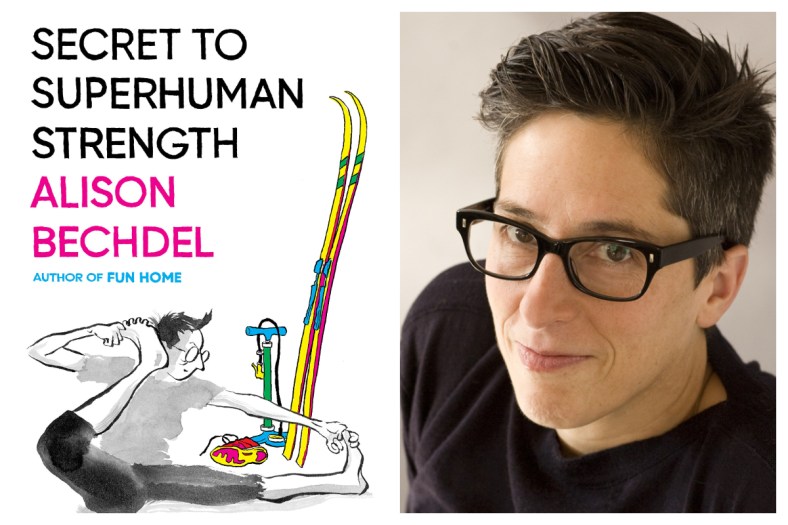
Bechdel’s most recent graphic memoir, The Secret to Superhuman Strength, came out in 2021 and focuses on the author’s lifelong obsession with working out.

Illustration of a person doing silly stretches with a bike pump and skis behind them.

Starting with a childhood preoccupation with the Charles Atlas bodybuilding ads she saw in her comic books, Bechdel became fixated on exercise as a means of quieting her anxious brain and controlling, and even transcending, her physical form. Although I was a bit skeptical when I first heard the subject of the book, any misgivings were laid to rest as I quickly became absorbed by the narrative, following Bechdel on a diverse tour that visits Jack Kerouac and the Beats, the Romantic poets, and Transcendentalist thinkers, along with figures from Bechdel’s life.

On this journey, Bechdel uses exercise to explore bigger subjects, digging at the question of why we exercise, which can be extended to why we do anything. Organized by decade, this is a book of substance and plenty of style, with Bechdel’s trademark precise drawings enlivened by her partner artist Holly Rae Taylor’s brushstrokes of vivid color. As much as I loved her previous two memoirs, they dealt with pretty heavy subjects, and The Secret to Superhuman Strength, while just as thoughtfully crafted as any of her other works, is a bit lighter, making it a perfect candidate for a great summer read.

Holly is an Instructor and Research Specialist at the Miller Branch. She enjoys knitting, preferably with a strong cup of tea and Downton Abbey in the queue.

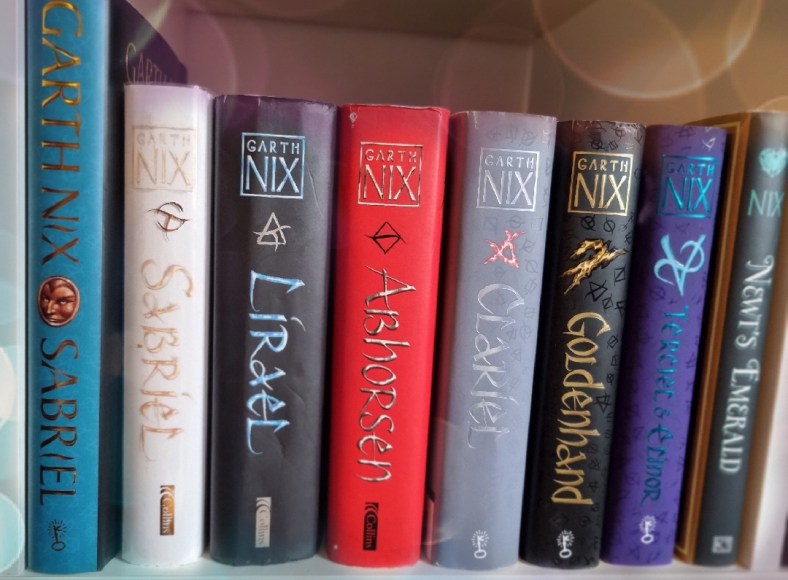
The Old Kingdom series by Garth Nix

The illustration shows a young man in blue holding a very small bell standing back-to-backwith a young wman in brown with knives drawn. A white cat sneaks along side them.

by Kristen B.

One of my favorite series debuted a long time ago with the publication of Sabriel in 1995, which introduced us to the Old Kingdom and Ancelstierre – a magical world and a vaguely Victorian British country joined by mysterious means across a Wall. Author Garth Nix has written in this world off and on for almost 30 years. It’s not a huge series with a new book available annually, but it includes the first trilogy, a variety of short stories, a sequel, a side story about a secondary character, and now the newest installment of Terciel and Elinor.

Title character Sabriel is a young woman finishing her rather unusual education at Wyverly College, a boarding school in Ancelstierre close to the Wall. Her father is a powerful mage from the Old Kingdom, the Abhorsen – an inherited position responsible for making sure the dead remain dead. Death is presented as a river with many precincts that sweeps souls along to their final rest beyond the Ninth Gate. Unfortunately, in the Old Kingdom, the dead don’t always stay that way and necromancers try to increase their power by manipulating Death. It’s all wonderfully gothic and atmospheric (but not particularly scary) with appeal for teens and adults alike. Abhorsens battle the necromancers and Greater Dead with their magical bells and sword, with each bell sounding a specific command – like walking or sleeping.

Back in Ancelstierre, Sabriel receives a bandolier of bells and a sword and realizes that something has gone very wrong with her father. She travels into the Old Kingdom to discover that Bad Things are afoot. With the help of a lost prince and a talking cat who is much more than he seems, Sabriel must conquer an old nemesis and restore the Kingdom. The next two books move forward a generation, but they continue with fraught necessity the quest to defeat the ultimate evil and save the world. Honestly, what more could you ask for?!

Nix published Terciel and Elinor in 2021, and it tells the story of Sabriel’s parents, of how they met and fell in love. It explains so much of the background for the original series, while still giving us new characters to root for. Elinor is a delight as a neglected but independent daughter with a passion for stagecraft and a willingness to meet whatever comes her way with knives drawn. Terciel matches the orphan vibe with a sketchy background of his own, as he reluctantly accepts his future role as the Abhorsen. A competent ranger and taciturn current Abhorsen provide good counterpoints to the young (rather callow) and energetic main characters. I think this sort of immediate prequel is immensely difficult to do well precisely because we know the ending of the story, nonetheless this was an enjoyable read with high enough stakes to keep me turning pages well into the night.

You can start reading either with the newest book, or read in original publication order beginning with Sabriel, Lirael, and Abhorsen. For a real treat, listen to the audiobooks narrated by actor Tim Curry, whose dark voice perfectly suits a series that features the river of Death.

Kristen B. is a devoted bookworm lucky enough to work as the graphic designer for HCLS. She likes to read, stitch, dance, and watch baseball (but not all at the same time).

Literary Day Trips with Kids

The cover illustration shows Benjamin Banneker with a timepiece in the palm of his hand; he has opened the cover of it and is examining its inner gears.

by Jean B.

Books can take you anywhere – you can discover all kinds of places and people from the comfort of home. But books can also lead you OUT into real life adventures. This summer, check out some of these children’s books with local connections then take a family excursion to live it yourself!

Interested in ingenuity? For an adventure in Howard County’s backyard, read TickTock Banneker’s Clock by Shana Keller. Learn about the African American colonial scientist Benjamin Banneker, then explore the Benjamin Banneker Historical Park in Oella. Tour his restored colonial cabin and gardens, hike woodland trails, and participate in fun summer programs with nature and colonial history themes.

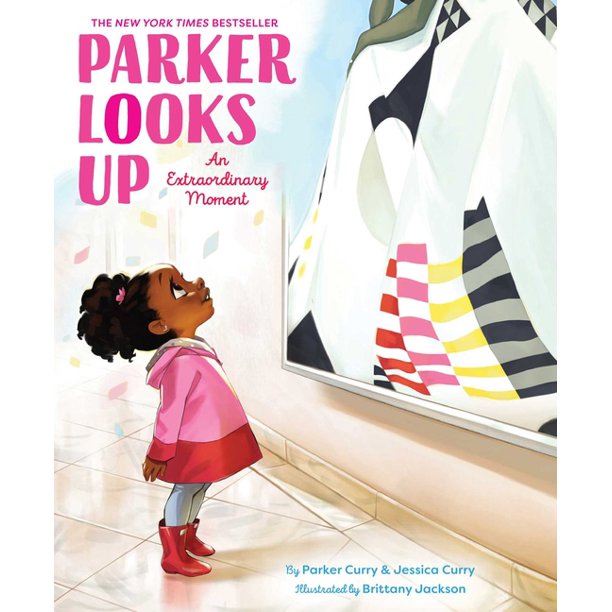
The cover depicts the title character, author Parker Curry, looking up at the portrait of Michelle Obama that hangs in the National Portrait Gallery.

Fascinated by famous faces? Read Parker Looks Up by Parker and Jessica Curry. Visit the National Portrait Gallery to see the portrait of Michelle Obama for yourself, as well as those of many other interesting Americans of the past and present.

The cover is an illustration of baseball player and home run king Babe Ruth.

Seeking sports glory? One of baseball’s legends, Babe Ruth, grew up in Baltimore. Explore his childhood story and how he was introduced to the game – you may be surprised! – with the book Becoming Babe Ruth by Matt Tavares. Then visit the Babe Ruth Birthplace and Museum, or go to a baseball game at Camden Yards or Bowie.

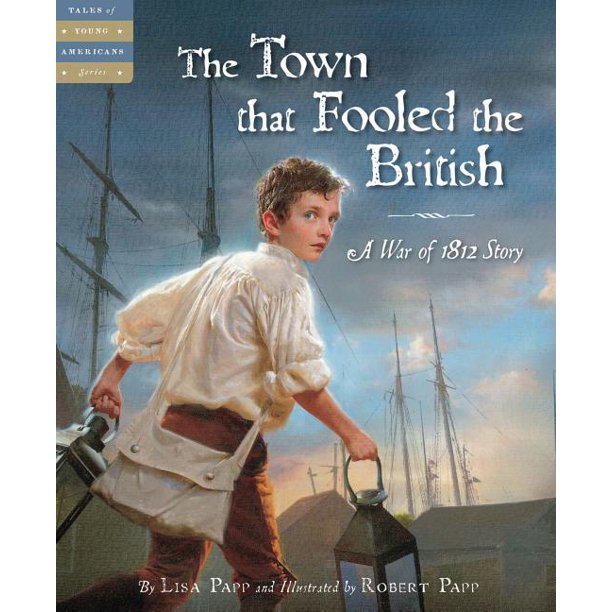
The book cover depicts a boy carrying two lanterns and looking over his shoulder, with the masts of ships in the background and a knapsack slung over his back.

Intrigued by history’s mysteries? Take a drive to the Eastern Shore of Maryland and you’ll find the quaint waterfront town of St. Michael’s. Before your visit, check out the picture book by Lisa Papp, The Town that Fooled the British: A War of 1812 Story, to uncover the clever trick that saved St. Michael’s from destruction 200 years ago.

The book cover depicts a grinning skeleton in a blue wash, almost as if at the bottom of the sea.

For the ambitious, a trip to Jamestown, Virginia could be like a true crime investigation when combined with the award-winning nonfiction book, Written in Bone by Sally M. Walker. This fascinating (and sometimes gruesome) account shows how forensic scientists are studying skeletons found in Jamestown’s colonial ruins to decipher exactly who these bones belonged to, how they lived, and how they died.

Jean B. is a Children’s Instructor and Research Specialist at the Central Branch and loves reading books for all ages when she isn’t enjoying the outdoors.

The Actual Star by Monica Byrne

A black and gold swirl centers on a pinpoint of a star. Two blue bands stripe the book vertically, while the text appears in orange horizontal bars.

By Sahana C.

It’s hard to find a good place to start with this book, so I’ll start at the end, in the year 3012. Society is different, and so are the people as the result of hundreds of years of war and compromise and cultural evolution. As a species, we are a genderless and raceless band of nomads, with a blatant disdain for those who settle down in nuclear family units.  

So yeah, there’s a lot going on. The above phrasing makes it seems starkly unnatural, but somehow, Monica Byrne’s weaving together of three different stories across time makes the future version of us feel tangible. Despite all of the modifications and the general foreignness of the shape of this future society, the basics of humanity remain the same. We are emotional and community oriented, no matter when we are in history. We follow patterns that remain, no matter how far we try to stray outside the bounds of history.  

The ripple effects from past to present to future were incredible. Seeing names and places that were mentioned briefly in the past become more important in the future was almost an exciting reward for paying close attention through the timelines. And this book does reward close attention. It is obvious that Byrne put immense time and research into all aspects of the novel, going from the Maya, to modern Belize, to what made sense for the future based on the results of the events she described in the first two timelines. Most importantly, the story of the Hero Twins, some of the most important figures in the Maya mythos, is described and adapted in such a faithful light that Byrne has room to play with the elements of the mythology.  

The story of the Hero Twins is one that Byrne explains in the novel, but, like the rest of Maya mythology, it is complex and bears repeating. The Hero Twins were the central characters of one of the oldest preserved Maya works, the Maya equivalent of the Epic of Gilgamesh, with just as much adventure. They were often portrayed as complementary forces, the sky and the earth, the sun and the moon, the masculine and feminine, life and death. All in all, the Hero Twins were born to represent the two sides of a single entity. The shortest way to explain their greatest triumph is that they defeated the lords of Xibalba, the Maya equivalent of the realm of the dead, in a ball game, essentially representing that together, they had conquered death and diminished the power of all Xibalba. 

In the first of the three timelines in the novel, the year 1012, we are introduced to Ixul and Ajul through the point of view of their little sister, Ket. They are royalty and are said to be the reincarnation of the Hero Twins, with all the strength, power, and greatness that entails. The second timeline in 2012 follows Leah, a nineteen-year-old half Maya girl from Minnesota who goes to Belize to reconnect with her heritage. While she is there, she explores sacred caves and meets Javier and Xander, another set of twins, who work as tour guides. Business is booming, because in 2012, at the end of one Maya calendar, the Western world had decided the world was going to end. And then, in 3012, we follow Niloux, someone who is speaking out about the way society has evolved. She is embroiled in debate about the very nature and purpose of humanity, a thousand years after the change in the Maya cycle.  

Each of these timelines finds the characters on the precipice of a great and life altering change. The story is a blend of mythology, history, and sci-fi, and speaks, ultimately, to the way we use history to justify the present, and the way that our understanding of the past informs our future, no matter what we do.  

The Tor.com review called the novel, “one of the most effective examples of worldbuilding you’re likely to see on a page this year,” and I have to agree. Despite being longer than 600 pages, it’s somehow still a fast read. It’s a hefty book that tries to cover a lot, and sometimes just doesn’t have the space to explore all of the various threads it brings up, but when Byrne is allowed to go into detail on a subject, she does not miss.   

The Actual Star is available in print.  

Sahana is an Instructor and Research Specialist at the Savage Branch. She enjoys adding books to her “want to read” list despite having a mountain of books waiting for her already.