Devil House

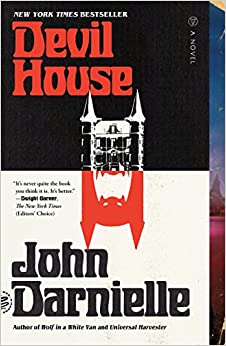
The cover of the book shows an old house with two turrets silhouetted in black and white against a black background. Beneath it, against a white background, is a red outlined reflection of the house's shape, illustrated to resemble a vampire bat. The red and black lettering is in a Gothic style and gives the cover a retro, pulpy feel.

It’s changed since you were here, or else it hasn’t
It was special, it was deadly
It was ours and then it wasn’t

– The Mountain Goats

By Ben H.

An entertaining book full of mystery, empathy, and suspense, Devil House is also a thoughtful examination of authorial responsibility. John Darnielle excels at building meaning by layering stories. As the frontman of The Mountain Goats, he’s a storytelling genius. He’s magical and efficient. He’s an all-time great songwriter.

Speaking of authorial responsibility, I should state upfront that I think Darnielle is a better songwriter than he is novelist. Devil House would have benefited from heavy editing. That being said, I like the book and I consider my responsibility as the author of this review now satisfied.

Devil House is the story of true crime writer Gage Chandler. Chandler fictionalizes true stories for money, the job of all novelists, really, but he isn’t Thomas Wolfe writing about Asheville. Chandler writes the new Hulu documentary about a mother who poisoned her kids or a couple who killed boarders and buried them under the hyacinths. Chandler writes books that are adapted for the small screen and become the must watch shows of the week. He approaches the gruesome devil house murders of Evelyn Gates (the greedy landlord) and Marc Buckler (the sleezy real estate mogul wannabe) the same way he approached previous cases, but things get complicated.

The titular house is the center of the novel and serves as a cipher for all the characters. Chandler, Buckler, Gates, Seth, Alex, and Derrick all revolve around its foundations in one way or another. It’s Chandler’s next project; it’s work. Buckler and Gates see it as an asset or potential asset. High school students Derrick, Seth, and Alex use the abandoned house as a hideout. They make it a castle. It’s a safe place to sleep at night. Many of the highlights of the book occur when Chandler describes the boys and their relationship with the house.

Chandler’s methods are extreme. He’s the Daniel Day Lewis of true crime writers. Joaquin Phoenix ain’t got nothing on Gage Chandler. He lives where the crimes were committed (he literally moves into the building known as devil house). He holds items held by those involved as if they were talismans. He haunts eBay looking for paraphernalia tangentially connected to the case. He becomes the victims. He becomes the murderer. Chandler recreates lives based on evidence left behind. He imagines conversations and relationships based on the contents of a junk drawer. He establishes character and personality based on notebooks full of doodles. He gives his characters depth. He uses empathy to create details and narratives for his characters; but has he cold-heartedly monetized empathy?

While living in devil house, an old case that involves the murder of two students by their high school teacher, which Chandler turned into the book The White Witch of Morro Bay, comes back to haunt him. He receives a devastating letter from someone questioning his depiction of a certain character. Chandler prides himself on being fair to his characters, but how can you be fair to someone’s son when to you they are just a character you have partially fleshed out? His resolve shaken, he questions his methods and his career.

For those thinking that what this book sounds like it needs is a medieval section in middle English, you’re in luck! For me, this strange interlude emphasized the depth of the world-building that Derrick, Seth, and Alex were doing. It’s like I always say, “whan that Aprille with his shoures soote, / The droghte of March hath perced to the roote.” I also always say that if you can cut the section in middle English from the book you wrote in 2022, you should.

As in Wolf in White Van, Darnielle moves back and forth in time, weaving patterns and stacking stories. The payoff is well worth it. I reread the reveal a couple of times because it was so satisfying. The obvious takeaway for me was a critique of true crime books, shows, and movies. Devil House also offers a commentary on how society treats its vulnerable members. Whatever meanings you find inside Devil House, I think you’ll enjoy exploring most of its pages.

Harbor me when I’m hungry
Harbor me when I’m hunted

– The Mountain Goats

Ben Hamilton works at Project Literacy, Howard County Library’s adult basic education initiative, based at HCLS Central Branch. He loves reading, writing, walking, and talking (all the basics).

Elevation by Stephen King

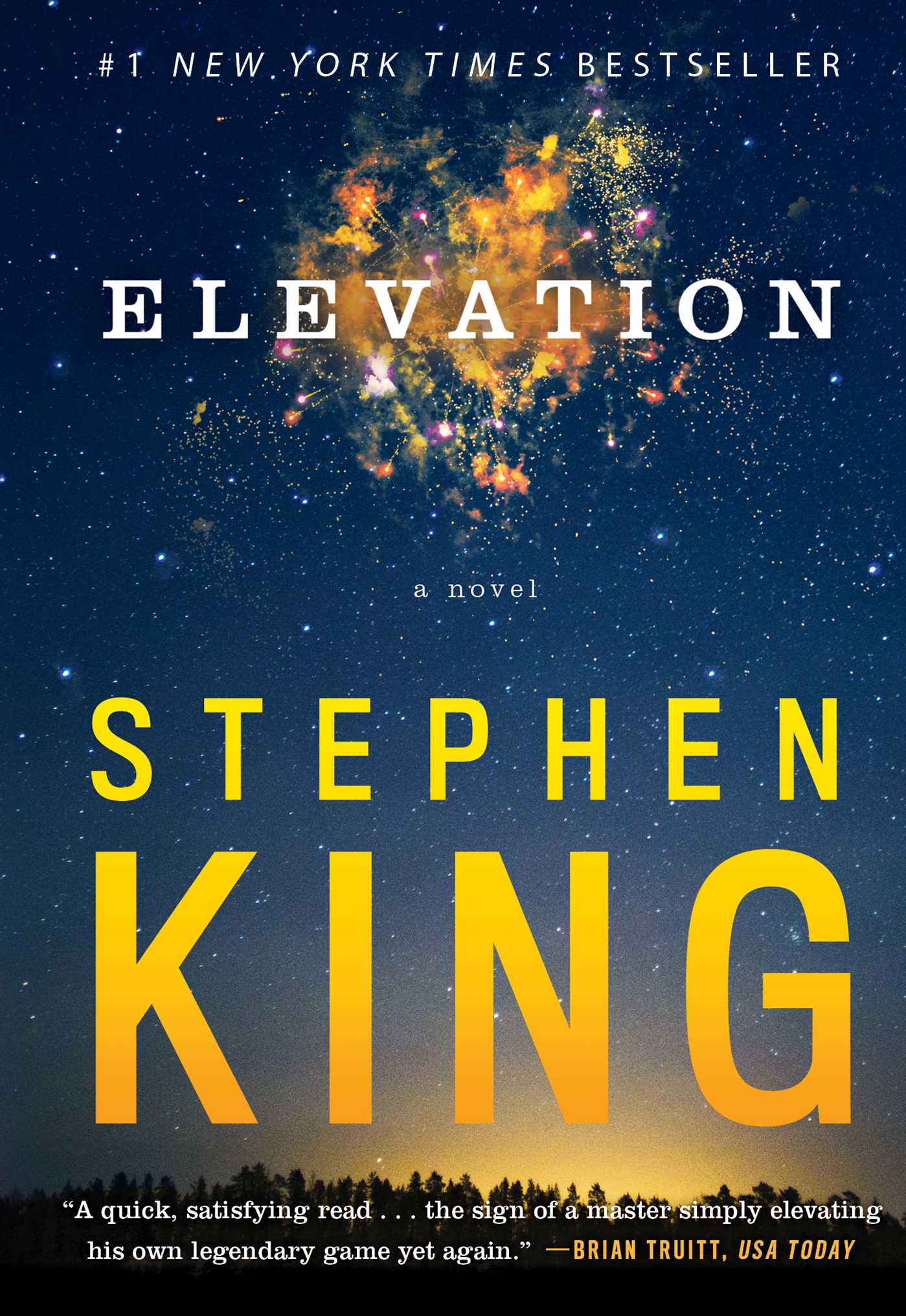
A deep night sky shows a sort of explosion, the tree line at the bottm is also illuminated.

By Gabriela P.

Short on time? So is Scott Carey, the main character of Stephen King’s novella, Elevation. Forty-two years old and in relatively good health despite a disposition towards being heavy-set, Scott discovers he is afflicted with a strange condition where he continuously loses weight but not mass. Eventually, he comes to understand that, soon, he will literally be leaving the physical Earth as his weight plummets. With a divorce in his recent past, a too-large house, and a complacently settled routine in the town of Castle Rock, it takes two new neighbors moving in down the street to spur the unfolding of a moralistic but heartwarming comedy.

Scott’s two new neighbors are women. In his small town, same-sex relationships are at best tolerated…but same-sex marriage becomes a root for tension, gossip, and outright hostility. Scott himself bears no ill-will towards Deirdre and Myra, except a slight annoyance with their dog’s preferences for his lawn. When he confronts the two, he is received coldly, a result of a necessary guard the two have had to put up in the face of prejudice.

Unlike the plot development one might expect from a Stephen King story, Elevation does not dive into the wild undoing of a man and a town, but instead comedically highlights one man’s gradual, though admittedly somewhat naive, social enlightenment. While Scott Carey literally begins to leave the ground, he is also able to figuratively rise above prejudice. To really tug at the heartstrings, readers should consider the irony of strengthening bonds and belonging with an inevitable end.

Also available as eBook, eAudiobook on Overdrive and CloudLibrary, on CD, and in large print.

Gabriela is a customer service specialist at the Miller Branch. She loves long walks, reading with her dog, and a good cup of coffee.

Reading Human Rights

You’re invited! Reading Human Rights is a monthly book discussion hosted by the Howard County Office of Human Rights & Equity and Howard County Library System. We read books that promote cultural awareness, diversity, and equity.
Tuesdays at 6:30 pm in person at the Miller Branch

The title appears in large, all caps with fire illustrating the letters. The author's name appears below in cool blue.

May 24: Minor Feelings by Cathy Park Hong
Register at bit.ly/minorfeelingshcls

Poet and essayist Cathy Park Hong fearlessly and provocatively blends memoir, cultural criticism, and history to expose fresh truths about racialized consciousness in America. Part memoir and part cultural criticism, this collection is vulnerable, humorous, and provocative—and its relentless and riveting pursuit of vital questions around family and friendship, art and politics, identity and individuality, will change the way you think about our world.

Available as a book, eBook, and eAudiobook.

A stark cover with a faded map has the title in red shadowed letters and a small gold star.

Jun 23: On Juneteenth by Annette Gordon-Reed
Register at bit.ly/juneteenthdiscuss

The essential, sweeping story of Juneteenth’s integral importance to American history, the book is told by a Pulitzer Prize–winning historian and Texas native. Combining personal anecdotes with poignant facts gleaned from the annals of American history, Gordon-Reed shows how, from the earliest presence of Black people in Texas to the day in Galveston on June 19, 1865, when Major General Gordon Granger announced the end of legalized slavery in the state, African-Americans played an integral role in the Texas story.

Available as a book, eBook, and eAudiobook.

Everyone in This Room Will Someday Be Dead by Emily Austin

A pale yellow cover features bunnies in many poses and many colors, with the title in a quirky script.

By Sahana C.

This book is cathartic. It feels like therapy, except things get way worse, more cringey, and infinitely harder to handle before the payoff hits, and all of the suffering of the previous two-thirds of the book ease into something manageable and even likable.  

I will not lie – I judged this book by its cover. There was something about the whimsical nature of the rabbits juxtaposed with the bold cursive proclaiming “everyone in this room will someday be dead” that struck me. What room? The very room I was in? I looked around the adult fiction section of the Savage Branch surreptitiously to see who was nearby. I went back up to the front desk, still holding onto the book, and thinking, “Yeah, actually, that’s true.”  

Dear Reader, obviously. This is not a new concept, that everyone, one day, dies. But sometimes, a book like this will bring this into perspective, throw a new light on something you know deep down but don’t consider very often. Emily Austin’s debut novel has moments I’m sure she would categorize as semi-autobiographical (I threw the “semi” in there for her sake, as the main character, Gilda, is truly a disaster), especially since there are moments in the book that I felt were semi-autobiographical and was alarmed at how close Gilda had gotten to my reality.  

Emily Austin was not referring to the Savage Branch when she was referencing her room. She was talking about every room Gilda, a noted hypochondriac, ever walked into. Gilda is a twenty-something lesbian and atheist, well known in the emergency room at her local hospital to the point that the janitorial staff know her by name. When we first meet her, she has just been in a car accident and broken her arm, a more physically obvious issue than the anxiety that normally brought her in for a check-up. In an attempt to get her anxiety under control, Gilda follows a flyer for free therapy to a Catholic church, where she meets Father Jeff and accidentally gets a job instead of therapy.  

From there, Gilda searches for a missing cat, deals with her younger sibling’s deteriorating mental health, tries to keep her old friends, tries to pretend like she’s Catholic, well-meaningly catfishes an old woman, and tries to solve a murder mystery that might not have involved murder, actually, all while trying to stay afloat.  

I read this on a long plane ride, which perhaps compounded the feeling of claustrophobia as Gilda kept tangling herself further and further in her web of lies. It meant that as I was reading an especially cringey section and closed the book for a moment, I couldn’t get up and go for a long walk, like I normally do. I was confined to the middle seat, stuck between two people who were fast asleep and were completely unaware of my distress, and, much like Gilda, all I could do in that moment was keep going. Keep reading and hope that somehow, something was going to get better.

Thank goodness it did, because otherwise, also like Gilda, I probably would have had a nervous breakdown. This book is wholly about the existential dread that comes with being an adult and looking around to realize your general existence is not exactly what you thought it’d be, then figuring out how to cope with that anyway. 

I would like to make it very clear that I do, indeed, like this book. I want everyone to read it, despite how difficult it can be. I’ve been recommending it to everyone, describing it as “anxious queer fiction” and asking friends, “Have you ever felt completely directionless and stuck? Well. Gilda will make you feel better. Because she had it worse.” I think if we all take a moment to reflect, the way Gilda does, on the way things are going, we might not always like what we see, but at least we know that we’re not alone in our discontent.

(And if you really want to feel like you’ve got a community, look at the Goodreads reviews for this book here.)

Everyone in This Room Will Someday Be Dead is available in print and eBook

Sahana is an Instructor and Research Specialist at the Savage Branch. She enjoys adding books to her “want to read” list despite having a mountain of books waiting for her already.

The Solidarity Dividend

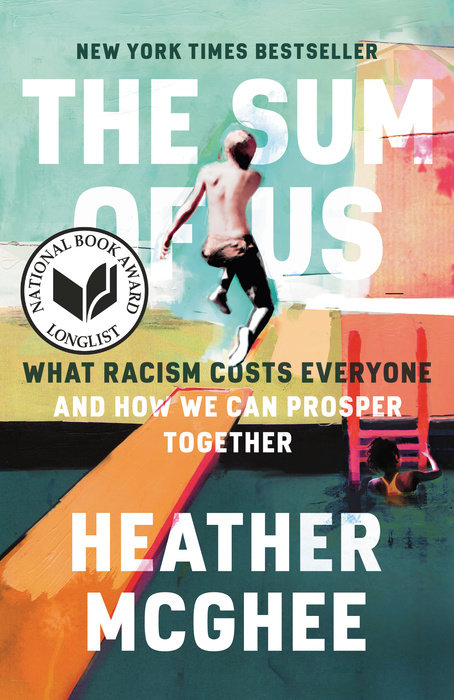
The Sum of Us by Heather McGhee: A cover full of color blocks resolves as a diving board into swimming pool with a white boy jumping off the end and a black girl climbing the ladder.

“I’m a white male, and I am prejudiced.” In August 2016 on C-SPAN’s Washington Journal, public policy expert Heather McGhee, answered the challenge presented by Garry, a caller from North Carolina. He asked, ”What can I do to change, you know, to be a better American?” The video went viral due to McGhee’s reasoned, compassionate response. Thanking the caller for being honest while acknowledging we all have prejudices, McGhee proceeded to offer advice including, “In order to be a demos that is united across lines of race and class and gender and age, we have to foster relationships. We have to get to know who one another actually is.” When McGhee’s book, The Sum of Us, was published, I was curious to learn more from her. After reading it, I especially appreciate McGhee’s insight into how the mentality of “us and them” was built and how we can break it down. 

The Sum of Us: What Racism Costs Everyone and How We Can Prosper Together describes how all ethnic and class groups suffer when racism influences government policy. McGhee researched the roots of economic disparity in the United States and explored causes and solutions from a perspective of unity rather than division. She argues that many problems with wage distribution, education, health care, housing, and environmental policy arise from the concept of a zero-sum game. When citizens perceive one racial group’s gain as another group’s loss, we cannot work for a common good. She documents how everyone loses out when racial hierarchy guides legislation. When public pools are filled with cement to circumvent enforcement of desegregation legislation, all the kids whose parents can’t afford private pools can’t go swimming. Using the concept of the public pool as a central metaphor, McGhee deconstructs how the US reached today’s level of political division and how American society can move forward, allowing all races, ethnicities, and classes to thrive. 

Of course, the idea of “what helps you, hurts me,“ goes beyond kids not being able to cool down in a pool in the summertime. The Sum of Us carefully traces trade union busting, healthcare access gaps, rising costs of public colleges, and the sub-prime mortgage crisis back to racial profiling. The resulting wage stagnation, benefit cuts, student debt, and foreclosures affected all racial groups.  

McGhee’s empathy raises The Sum of Us to a higher level than some other books I’ve read on similar topics. For example, as a self-proclaimed data nerd, she clearly explains the economics of the 2007-2010 financial crisis but then goes beyond the numbers to show, “what was risky wasn’t the borrower; it was the loan.” I gained understanding not only of the economics of the crisis, but the societal toll. Although predatory loan practices were initially targeted at low-income Blacks, later, the loans were pitched to everyone, regardless of their credit status. Many borrowers were eligible for prime mortgages but were manipulated to accept sub-prime mortgages because of the financial bonanza for the lender. McGhee presents this as yet another situation where racism eventually hurt everyone. 

McGhee has coined the phrase “Solidarity Dividend” for the benefits arising from communities collaborating across the racial divide. From minimum wage increases to investment in affordable housing development to improvement in air and water quality, the Solidarity Dividend boosts the economy while enhancing quality of life. “Getting white support to address those different levels of need, and to acknowledge the racism that caused these differences, is never easy – particularly when the zero-sum mental model turns every concession into a threat of loss,” McGhee writes. The Sum of Us demands to be read both for the well-researched documentation of the past and the message for our future.  

By the way, Heather and Garry, a disabled Navy veteran, built a friendship. Garry continues to work on understanding racism and realigning his own thinking. 

Cherise Tasker is an Adult Instructor and Research Specialist at the Central Branch. When not immersed in literary fiction, Cherise can be found singing along to musical theater soundtracks. 

Author Works: Sarah Gailey

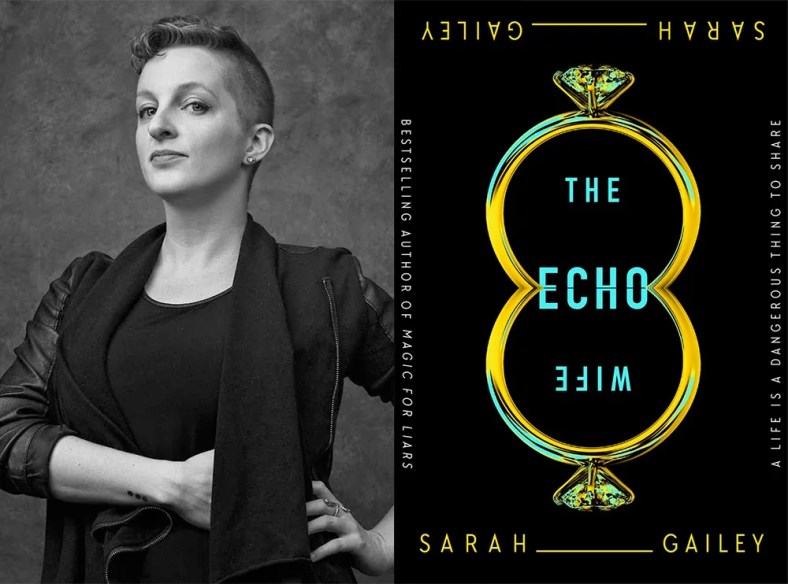
Black and white photo of the author, with short hair and one hand tucked inside her jacket, sits next to a cover of The Echo Wife. The cover shows an engagement ring and its reflection in gold with blue highlights, the title appears in blue inside the rings.

Tue, May 17 at 7 pm online
Register at bit.ly/echowife.

by Kristen B.

Author Sarah Gailey discusses their acclaimed novel The Echo Wife (also eBook and eAudiobook) in conversation with Maggie Tokuda-Hall, author of Also an Octopus (reviewed here). Gailey’s most recent novel, The Echo Wife, and first original comic book series with BOOM! Studios, Eat the Rich, are available now. Other shorter works and essays have been published in Mashable, The Boston Globe, Vice, Tor.com, and The Atlantic, and their work has been translated into seven languages and published around the world.

Publisher’s Weekly review of The Echo Wife:

This creepy, exhilarating science fiction outing from Gailey (Magic for Liars) dissects an unconventional affair that violates both a couple’s marriage vows and scientific integrity. Dr. Evelyn Caldwell is startled to discover that her husband, Nathan, has been seeing another woman—and even more shocked to learn that the other woman is a clone of Evelyn herself. Nathan created Martine to be everything Evelyn isn’t: attentive, submissive, and family-oriented. Adding insult to injury, Nathan used Evelyn’s own research to do so. An explosive confrontation among the three ends in Nathan’s murder, leaving Evelyn and Martine forced to work together to cover up the crime. It’s a situation that is not entirely unfamiliar for Evelyn, whose troubled past is teased out bit by bit. The women slowly discover that Nathan was hiding more secrets than either of them knew, forcing Martine and Evelyn to think on their feet in order to save themselves and the odd little family they create along the way. Gailey’s story unspools as a series of dark reveals that leave both the characters and the audience reeling. Readers won’t want to put this one down. (Feb.)

Gailey is a Hugo Award winning and bestselling author of speculative fiction, short stories, and essays. They have been a finalist for the Hugo, Nebula, and Locus awards for multiple years, and their bestselling adult novel debut, Magic for Liars, was published by Tor Books in 2019.

A bright pink cover shows a black hand upside down with its fingers crossed and a mystical eye on the wrist. the title of the book frames it in large yellow layers.

My book club (Books on Tap) read Magic for Liars for our May meeting. As with many other of Gailey’s books, it doesn’t fit neatly into one category. Yes, it’s a murder mystery complete with clues, red herrings, multiple suspects, and gory details. The book also tackles grief, illness, and how families deal with both. These weightier topics rather sneak around the edges of the crime scene. Our protagonist and Private Investigator, Ivy Gamble, is hired to solve the death of a teacher at the school for magical students where her sister teaches. She tells us up-front that she’s a liar, that she resents the living daylights out of her magical sister, and that she’s not proud of how the situation resolved. To say they are estranged doesn’t begin to cover the levels of distrust and bitterness that separate these twin sisters – one magical, one not. Do you trust that sort of narrator? It’s a terrifically entertaining read that nonetheless leaves you thinking about what you might do in a similar situation.

Magic for Liars is available in print, as an eBook and an eAudiobook.

A Deadly Education

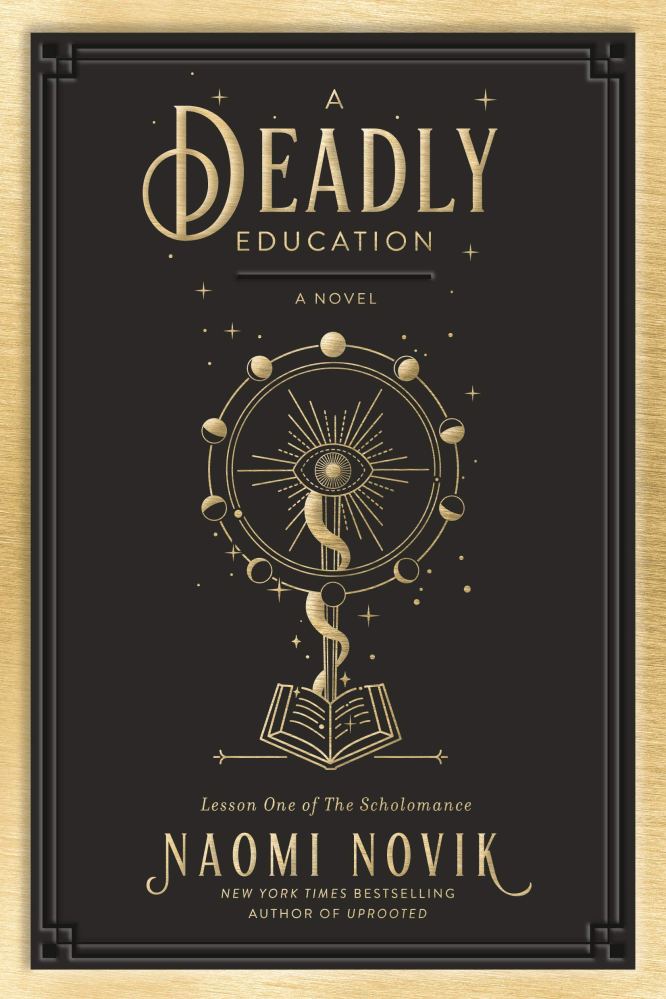
A black cover with gold text and a mysterious illustration of the phases of the moon, a mystical eyes, and spiral all centered above a book.

By Gabriela P.

Did you think your high school years were tough? Count yourself lucky that you could at least eat lunch without having monsters come at you. In Naomi Novik’s A Deadly Education, Galadriel “El” Higgins goes to her classes, studies, and navigates her social sphere all while trying to stay alive. She attends the Scholomance, a school for magic, where there are no teachers, holidays, school events, or friendships. Attending students are suddenly thrown into this school located within a terrifying inter-dimensional void. With monsters, or “mals”, in every shadow and around every corner, the students have only one goal – to graduate, which means staying alive.

El is a junior at the Scholomance, and has a unique problem. While every other student has to figure out how to protect themselves from mals and students-gone-dark, she has to concentrate on not destroying everything she touches. A rather bothersome prophecy, something about her being the bringer of mass destruction, keeps her more preoccupied with making sure she doesn’t end up destroying the world than with making friends. Though in this school, friendships are usually strategic. When we are introduced to the snarky, anti-social El, she makes it clear that her only plan is to make it as close to graduation as she can without attracting unwanted attention to herself. Then, in her senior year, she plans to figure out how to impress students from well known magical enclaves to guarantee her and her mother’s safety during and after graduation. However, her not-so pleasant disposition means her chances are slim.

Orion Lake, a student from a major enclave with a major savior complex, is famous among the student body, mainly because he is pretty much responsible for the higher-than-normal survival rate of their junior class. When he saves El’s life once, then twice, the spotlight suddenly turns to her. Suddenly El has to figure out how to use the attention for her benefit, but ends up finding herself drawn into a much bigger problem. On top of all that, she finds herself stumbling upon the discovery that she might be…making friends.

A Deadly Education is a refreshing spin on well-known tropes; magic schools, I-hate-him-I-like-him, monsters with a taste for children – the usual. Naomi Novak skillfully builds a fantastical universe with dynamic characters that you can’t help but fall for. Darkly funny and terrifyingly captivating, this book is definitely one that you won’t put down until the end.

You can borrow A Deadly Education as a book, an eBook, and an eAudiobook.

A dark green cover with golden text and illustration of a keyhold with points and rays, and a dangling key.

The story continues (which you will want to do immediately) with The Last Graduate, and the third installment, The Golden Enclaves, is due this fall. The second book is also available as an eBook and an eAudiobook.

Gabriela is a customer service specialist at the Miller Branch. She loves long walks, reading with her dog, and a good cup of coffee.

Empire of Pain by Patrick Radden Keefe

A spoon overflowing with pills, one of them red, sits above the title where "Empire of Pain" appears in bold red lettering.

By Rebecca W.

According to the U.S. Department of Health and Human Services, in 2019 roughly 48,000 deaths were attributed to synthetic opioid overdose, and more than 10 million people reported abusing prescription opioids. While many of us have heard, for years, reports of the devastating consequences of opioid abuse, one side of this story only recently hitting the media revolves around the Sackler family. In his book Empire of Pain: The Secret History of the Sackler Dynasty, Patrick Radden Keefe takes a pointed look at the Sackler family and their role in the current opioid epidemic. While this book is not the first of its kind, Keefe reports on the family at a time when numerous lawsuits against the family’s company, Purdue Pharma, have brought to light compelling and abundant evidence of the direct impact the family had on the current epidemic and the lack of responsibility the family has taken.

What I found most interesting about this book was Keefe’s decision to devote nearly a third of the book to Arthur Sackler. While the family patriarch could be considered the father of pharmaceutical marketing, he is very much removed, if related at all, to the modern Sackler family and Purdue Pharma. Arthur Sackler, the eldest of three brothers born to immigrant parents in early 20th-century Brooklyn, made a name for himself through his pharmaceutical ad agency’s marketing of the tranquilizing drug Valium (also know as Diazepam). Valium’s creator, Roche, and Sackler made Valium one of the most-prescribed drugs to date, earning a fortune well into the hundreds of thousands in the process. Today, there is a well-established history of abuse and over-prescription of the drug.

While this portion of the book is certainly an interesting read, it does not directly pertain to the current Sackler family machinations, with Arthur’s heir selling shares of the original company to other family members well before the development of the company’s flagship drug, Oxycontin. While an argument can be made that Arthur more or less created the playbook that future Sacklers would use to enhance their empire, I feel there was another reason Keefe devoted such length to Arthur’s story. When reading the story of Arthur’s life, I saw blatant ethical missteps fueled by greed. However, when I began reading about the modern-day Sacklers, I found myself looking back on Arthur’s story, suddenly seeming like a tip-toe over the line of ethical practice. When looking at corruption that deals with billions of dollars, millions of people, and high-level corporate practices, keeping your perspective can be challenging. For me, the knowledge of Arthur’s story, and how my thoughts changed around it throughout the book, helped me maintain my perspective when trying to follow a story with details at a higher level then my understanding.

If you are someone who has followed the story of the Sackler family, recently finished watching ‘Dopesick’, or just learned of the Sacklers, I would highly recommended reading (or, like me, listening) to this book.

Learn more about the Opioid Epidemic in the US and MD here.

Becky is an Adult Instructor and Research Specialist at the HCLS East Columbia Branch who enjoys art and everything science.

Quick Peek at Silly Summer Stories

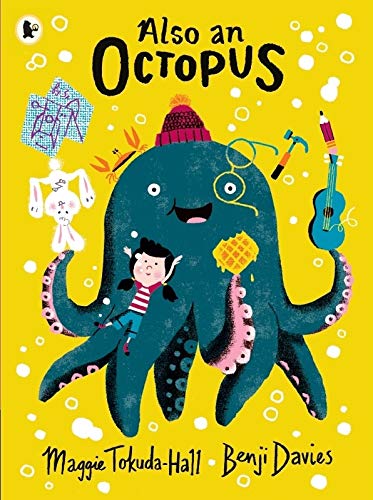
A bright yellow cover pictures a dark blue octopus wearing a red stocking cap, holding an upside down rabbit, a girl, a waffle, and a guitar. Lots of bubbles float around.

By Monae R.

Whenever I need something fun, silly, easy to read, mindless, or just cute to read or take my mind off of adulting, I go straight to the children’s department. Here are some silly summer reading favorites that are worthwhile selections at any time of year for adults and children alike.

Also an Octopus is a heartwarming reminder that the simplest things make you amazing. The story explains that every story starts with nothing and that is perfectly fine. Creativity will help you fill the nothingness. Another imagination-stimulating book is Field Trip to the Ocean Deep, which immediately gives me Magic School Bus vibes. It follows the story of a group of students who go to the deep ocean to see the creatures and surroundings, only to have one student left behind. The student makes friends and is able to show the rest of the class some very distinctive photos when he is rescued. This story is unique as it is told without any words. You must create the words and story to accompany the images.  

Some stories are not so goofy, but instead focus on curiosity and learning. Seaside Stroll and What the World Could Make take an innocent view of the world. Seaside Stroll follows a girl and her mother on a walk along a snowy beach. With the story evolving with every word starting with ‘S’, even in the title, a child not only learns the sound the letter makes, but learns some strong vocabulary as well. Nouns, verbs, adjectives, and even some interjections are thrown onto every page of this book. Education and beautiful art collide in these stories. Two friends explore the world and appreciate its beauty and wonder over the seasons in What the World Could Make, a warm and filling story about hope and the gifts of the world. 

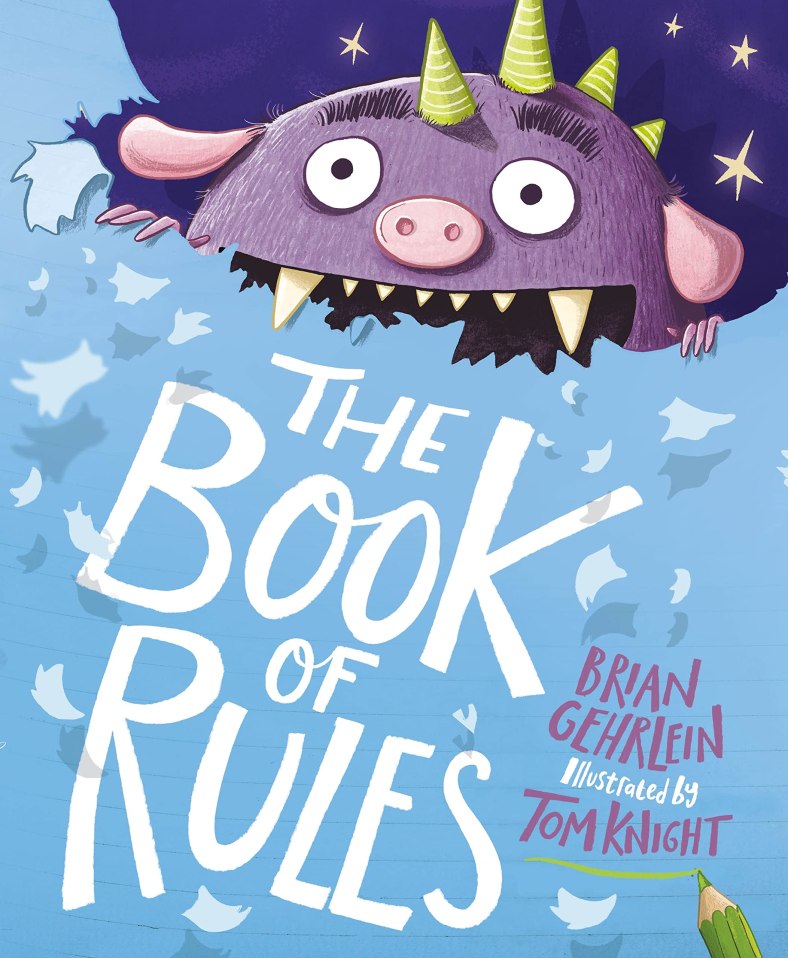
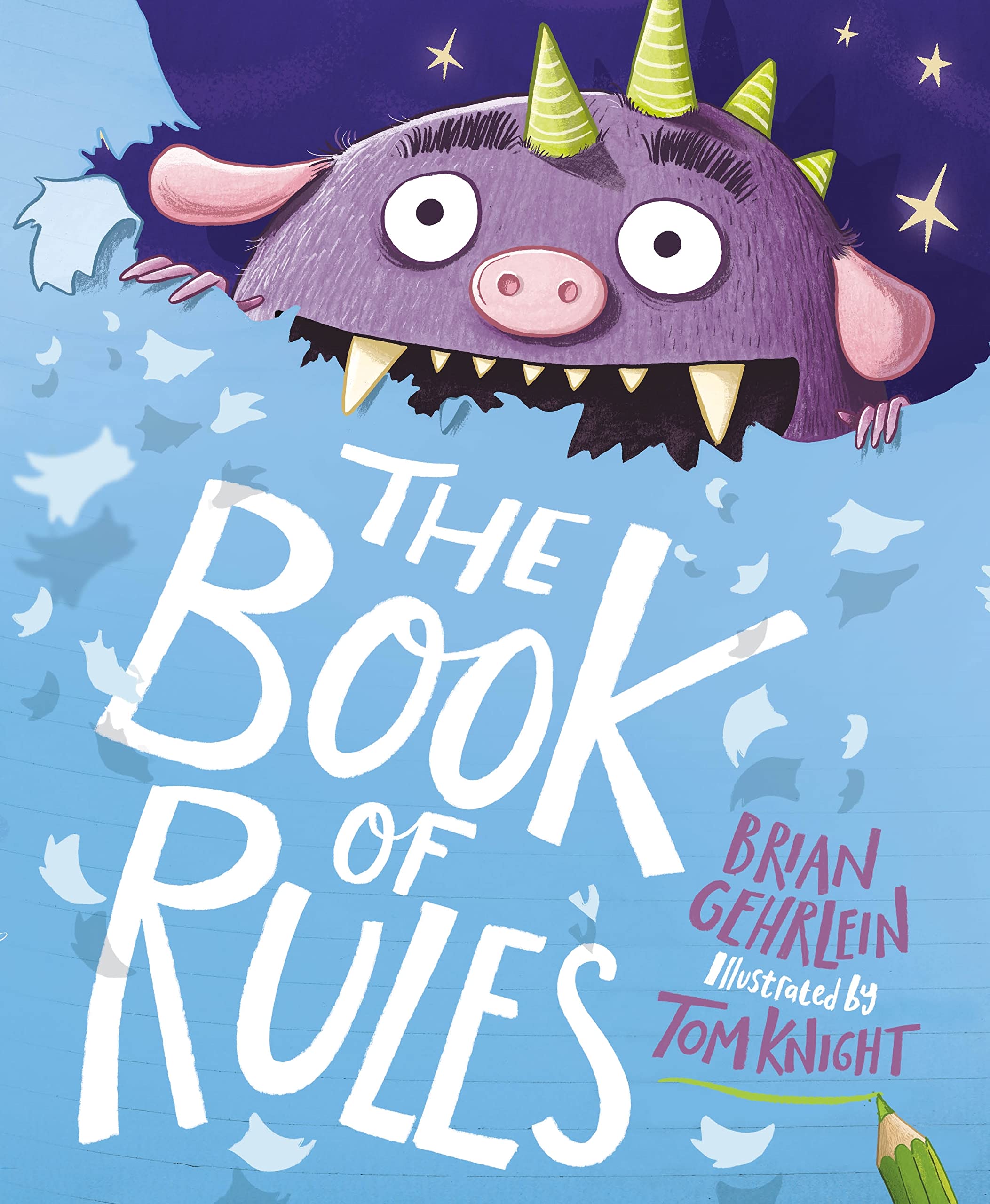
The blue paper of the cover is apparently being consumed by a cute purple monster with green spikes and fuzzy eyebrows.

Stories like those above are wonderful, but goofy and silly is not bad either. Stories like Dino-Gro and The Book of Rules can teach a lesson and still be super silly. I have used The Book of Rules in children’s classes multiple times for the genuine laughs it brings out of people, adults and children alike. The story encompasses eleven rules to follow if you don’t want to be eaten by a monster. Children can follow along with the story doing goofy tasks until they reach the last rule for a surprise. Dino-gro, about a tiny new dinosaur toy that grows in water until it no longer fits in the house, feels like it could be a short snippet from a chapter book. I would certainly read this fiction story if it existed. 

These are a just few of my favorite picture books, some of which you will find on this summer’s Kindergarten through First Grade Summer Reading List.

Monae is a Children’s Instructor and Research Specialist at HCLS East Columbia Branch.

The Mountains Sing by Nguyen Phan Que Mai

Deep green mountains fade to brilliant yellow and orange to the top and bottom of the cover. Dark branches cross the orange sections, with leaves traced in gold.

by Kristen B.

A highly lyrical novel, The Mountains Sing talks about the price of war and who pays it. At one point, one of the characters muses that if only everyone could spend more time reading books, maybe we would spend less time fighting wars. It seems like a particularly timely sentiment.

Set in Vietnam, The Mountains Sing is told between a grandmother and her granddaughter, with one timeline taking place during the 1950s and the other in the 1970s. Both decades were particularly turbulent ones, covering the rise of the Viet Minh, the Land Reform movement, and the war between north and south that so fatefully embroiled America.

America has repeatedly told the story of its Vietnam War, particularly in films such as Apocalypse Now and Full Metal Jacket. Nguyen’s book provides another perspective, almost entirely. A noted author and poet in her homeland, this is her first novel in English. On her website, she explains that the second language allowed her to frame a story that she didn’t necessarily know how to tell in her native tongue.

Tran Dieu Lan was born to a well-to-do farming family that owned their land and employed several people in their hometown in the middle region of Vietnam. Politics eventually brought the downfall of the small landowners, forcing Dieu Lan to flee her home with five children in tow, grieving her oldest who escapes separately. She slowly, reluctantly leaves them in relative safety along the long walk north to Hanoi, promising to come back to find them once she’s settled.

Her granddaughter, Huong (or Guava), grows up in Hanoi and goes to school during the worst of the American bombing raids and after as the communist government establishes itself. The two women live together in the old city while all the members of the in-between generation are taken away by the war in one way or another. Huong’s own troubles and those of her extended family illustrate the trials of ordinary Vietnamese people during the turbulent times. She struggles to understand the adults in her life, and how the war changed them.

As the book progresses, Dieu Lan rediscovers her entire family as she originally pledged – both as children when they fled their village and later as the war ends. Grandma’s story is an agonizing portrayal of the hard choices women make to survive.

The title references a small native bird. Huong’s father carves a wooden version for her while he’s gone to war. The name of the bird translates to “the mountains sing” for its constant song, but its survival became endangered after Agent Orange was used on the upland regions. The symbolic heart of the book, the wooden carving comforts Huong and reminds us of the fragile nature of peace and the continued hope that, one day, the mountains will sing again.

The title is also available as an eBook and an audiobook on CD.

Kristen B. is a devoted bookworm lucky enough to work as the graphic designer for HCLS. She likes to read, stitch, dance, and watch baseball (but not all at the same time).