New Year’s Resolutions, The Empire Strikes Back, and The Great Gatsby 

A close up shot of Yoda with his eye closed and one hand out in front of him, all in greens and blues.

By Eric L.

Well, it’s the new year!

The last two years have been a bit of a…(Fill in the blank with whatever you’d like here). Personally, I’ve spent the last two weeks at home since my spouse and kids have all had very mild cases of COVID, thankfully! That said, I like a new beginning, and I’ve always liked the idea of a new year as a new start, even if the calendar year is all a human construct. Over the years around this time, I’ve read the articles about new year’s resolutions. Normally the crux of these pieces is how and why they fail, recipes for how to set “achievable” goals, and the like. Frankly, I find all these articles pessimistic. I won’t allow anyone to convince me it’s not a constructive endeavor to try to improve something about one’s life. Moreover, I’m certainly going to dismiss the platitudes espoused in certain George Lucas films about “do, or do not, there is no try.” (It is good film by the way, and you can borrow it from us. Although I’d argue that the best scenes involve the raw guttural noises and acting of Peter Mayhew as Chewbacca.).

At any rate, trying is really important in my opinion! For example, let’s say you want to exercise more and get in great “shape” (a common new year’s resolution). I think if you start walking around your neighborhood, and don’t end up on the cover of some fitness magazine, that’s an improvement over sitting on your couch streaming the latest TV series for hours, and you’re exercising. A secondary benefit is that you might meet some of your neighbors. It could happen.

Here’s my list of things I’d like to do in 2022:

  • Get back to the gym (it’s been a tough two years for that).
  • Make the time to visit some out-of-state friends.
  • Hike more than my usual trails.
  • Ride my bike more (I feel as though I slacked this year).
  • Drink less wine (we’ll see).
  • Be calmer.
  • Judge less.
  • Read more, and diversify my title selections more.

Some of these are goals that come up year after year. Perhaps I won’t achieve these things, but I’m not about to hear that there is “no try.”

The future and the New Year bring to mind the combination of optimism and pessimism expressed by Nick, the narrator of The Great Gatsby, at the very end. F. Scott Fitzgerald’s writing of conflicted feelings of pity for and admiration of Jay Gatsby’s optimism is poetic, in my opinion:

“Gatsby believed in the green light, the orgiastic future that recedes before us. It eluded us then, but that’s no matter-tomorrow we will run faster, stretch our arms out further…and one fine morning-” (180).

And although the book ends disastrously, The Great Gatsby‘s commentary on the American dream has always resonated with me. I think it’s the complicated nature of the belief that anything is possible, and America in general. So maybe if you’ve not read The Great Gatsby, or it’s been a bit, try it out, it’s great.

There have been many, but the fairly recent film adaptations are also great. I’m a fan of both the Robert Redford 1974 and the 2013 Leonardo DiCaprio adaptations. The latter we own, the former you can request via Interlibrary Loan.

If you’ve read it, or you’re just not into Gatsby, we have some other recommended titles for you this month. Also, please consider the HCLS Winter Reading Challenge, now through February 28 – pick your own books or use our challenges to inspire your Winter Reading!

Lastly, come see us in the branches and speak with us about the books we like in January.

Happy New Year!

Eric is a DIY Instructor and Research Specialist at the Elkridge branch. He enjoys reading, films, music, doing nearly anything outside, and people.

American Dirt by Jeanine Cummins

The cover art evokes tiles painted with stylized blue birds, separated by barbed wire.

By Gabriela P.

American Dirt’s story begins with Lydia’s family joyously gathering to celebrate her niece’s quinceanera. The day quickly becomes the beginning of a nightmare when the party is suddenly interrupted by a group of men with no regard for human life launching a violent attack. Lydia and her son, Luca, make it out only through luck. She realizes the attack was planned in vengeance against her journalist husband, who had recently exposed the identity of an infamous drug cartel’s leader. She realizes the leader was a frequent patron of her bookstore, one that she had considered a kindred spirit and even a friend because of his love of books. It is then that Lydia realizes the race is on to save both of their lives. Without time to bury her relatives or even cry, they leave their home in Acapulco. With this begins a story of cat and mouse as Lydia and her son set off on a dangerous mission to find refuge in the United States, following in the footsteps of many Central American immigrants before them.

When mention of American Dirt came up in conversation, several of my colleagues asked me, being Latina, of my opinion of it after it was received with controversial reviews. I was hesitant to pick it up only because of my familiarity with the tragic history of Central American immigrants to the United States, and I knew how emotionally taxing the subject could be. Looking back, I am glad I decided to read it, if only to be able to speak on its shortcomings. I have to say that I feel that, while detailed and evocative, the story came up short in its representations of immigrants and was especially off the mark when it came to cartels. The cartel leader is romanticized, being painted as a man of poetry and philosophy, with a deeply rich life. In reality, cartels are dysfunctional and dehumanizing organizations full of fear. They certainly have no mysterious allure to them.

In regards to our protagonist, Lydia, her background as a highly educated woman of the middle class does not align with the decisions that she made in the story. The danger that she put her and her son in was unnecessary and a poor decision. She leads them along one of the dangerous paths to the United States border, one usually only followed by the most desperate and poor immigrants as a final resort. Unlike so many of the people who would have taken that path, Lydia had options. She was comfortably middle class, with a college education, connections, and resources available to her. As such, I have to say that her story is not very realistic. Instead, I would have liked to read more about her companions on the journey, who truly represent the people who would have had to adopt such dangerous measures. These people holding on to hope, fleeing for the safety of themselves and for the survival of their loved ones, truly represent bravery. The end of Lydia’s story, though conclusive, left me frustrated. Her complacent satisfaction with her new job in the United States left a bitter taste in my mouth, speaking as a Central American immigrant myself. 

If you choose to dive into American Dirt, I would take its legitimacy and credibility with a grain of salt. Let’s not forget it’s fiction. If you are interested in a nonfiction book that explores the topic with more nuance and depth, I highly recommend Enrique’s Journey by journalist Sonia Nazario, her account of a young Honduran boy’s perilous quest to reunite with his mother in the United States. Nazario based the book on her Los Angeles Times series of articles, also called Enrique’s Journey, which won the Pulitzer Prize for feature writing in 2003.

American Dirt is also available in eBook and eAudiobook format from Libby, and also as an eaudiobook from CloudLibrary. Enrique’s Journey is also available as an eBook from Libby, an eAudiobook in Spanish, also from Libby, and in a young reader’s edition for teens, which was chosen by Kirkus Reviews as one of four books on their Best Teen Nonfiction Book of the Year list for 2013.

Gabriela is a customer service specialist at the Miller Branch. She loves long walks, reading with her dog, and a good cup of coffee.

Lawrence Lanahan and The Lines Between Us

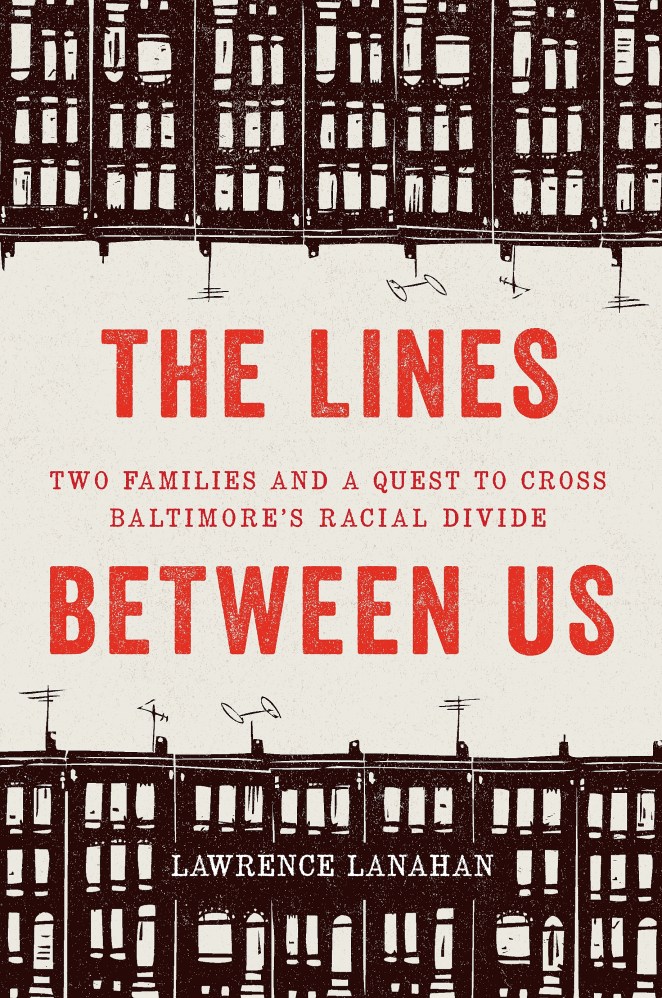
Stylized black and white drawing of typical Baltimore rowhouses frame the title.

By Holly L.

Journalist Lawrence Lanahan’s 2019 book The Lines Between Us: Two Families and a Quest to Cross Baltimore’s Racial Divide opens with two epigraphs:

It’s in the way their curtains open and close.

“Respectable Street,” XTC

I don’t even have to do nothing to you.

“Big Brother,” Stevie Wonder

The first line comes from English post-punk band XTC’s 1981 song about what songwriter and frontman Andy Partridge considered “the hypocrisy of living in a so-called respectable neighborhood. It’s all talk behind twitching curtains.” The second lyric is from a track from Stevie Wonder’s 1972 album Talking Book. In the song, Wonder takes the white establishment (Big Brother) to task for only coming to the ghetto “to visit me ‘round election time.” He continues his indictment – “I don’t even have to do nothin’ to you” because, from offenses ranging from criminal neglect of its black citizens to having “killed all our leaders…you’ll cause your own country to fall.”

It is fitting that Lanahan chose these words and these voices to begin this story, as his narrative weaves together multiple perspectives but most closely follows the criss-crossing threads of two individuals, one black and one white.

Nicole Smith is a young black woman living with her family in a West Baltimore rowhome owned by her mother, Melinda. When we meet Nicole, she is twenty-five and is contemplating the crossing of a line—leaving her neighborhood (and family and community) behind in search of security and opportunity for herself and her six-year-old son, Joe. Though she is enrolled in Baltimore City Community College and is on a waitlist for affordable housing in the city, Nicole seems to be on an existential treadmill, running but getting nowhere fast. She’s heard of a place called Columbia, a planned community in Howard County, with a reputation for good schools, plenty of jobs, and safe streets. Could she make it there?

Mark Lange is a white man raised in the Baltimore suburbs who, after a spiritual reckoning in his late teens, embarks on a path of service informed by the teachings of Mississippi civil rights activist and Christian minister John M. Perkins, who argued that those who wanted to help communities in need must live among them. As Mark’s story begins to be told, he feels a gravitational pull from his comfortable suburban life in Bel Air toward Sandtown, a West Baltimore neighborhood where his best friend Alan Tibbels, a like-minded white Christian with a mission of racial reconciliation, relocated with his family. If he moves, would Mark prove to be just another “white savior” looking to appease his own guilt? Or would be able to form meaningful relationships and help foster change in an impoverished community?

In this meticulously researched book, Lanahan alternates the fascinating tales of Nicole and Joe with the complicated history of Baltimore’s segregation and the resulting devastating impact on its black communities. Having its genesis as a year-long multi-media series on inequality in the Baltimore area broadcast from September 28, 2012 to October 4, 2013 on WYPR, Maryland Public Radio, the depth and breadth of Lanahan’s reporting is detailed to an almost dizzying degree. But just when a reader’s brain might start to get overwhelmed by the minutiae of historical detail (as mine sometimes did), my attention would come swiftly back into focus as the humanity of Nicole and Mark’s stories propelled me through the book. The Lines Between Us should be required reading for anyone who wishes to understand the institutional forces that shape inequality in our region and for those whose understanding of their neighbor might require them to cross a line. And isn’t that most of us?

Join us: Author Works with Lawrence Lanahan
Wednesday, January 12 from 7 – 8:30 pm
In person, HCLS Central Branch
Register at bit.ly/3pFTq3y

To learn more about the historical policies of redlining, visit the interactive exhibit currently at Central Branch. Undesign the Redline explores the history of structural racism and inequality, how these designs compounded each other from 1938 Redlining maps until today, and the national and local impacts. Join a guided tour on Wednesdays at 11 am and Saturdays at 2 pm.

Holly L. is an Instructor and Research Specialist at the Miller Branch. She enjoys knitting and appreciates an audiobook with a good narrator.

Oona Out of Order by Margarita Montimore

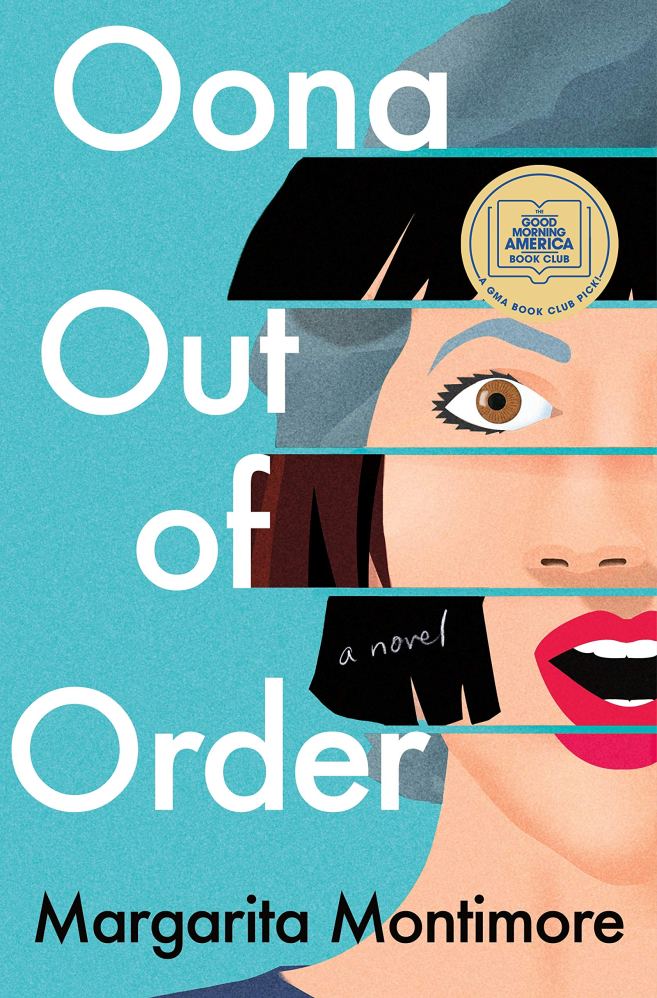
The bright blue cover shows the sliced up illustration of white woman with short dark bobbed hair with eyes and mouth wide in suprise. The portrait is only halfway on the right side of the book and the sliced strips are disjointed.

by Kristen B.

Oona Out of Order is a slightly different sort of time travel novel … Oona’s mind jumps randomly from year to year into her chronologically aging body, always on her birthday, which happens to be January 1.

Imagine never being quite sure what year you’re in, although you’re always you. What would your touchstones be? For Oona, it’s her mom and, for later years, her personal assistant.

As the novel begins, Oona enjoys a rocking New Years Eve party with her boyfriend, the band they are in, and most of her friends, and she’s about to turn 19. De rigueur teen drama plays out all around, but there are some real decisions that Oona has to make soon, decisions that set the stage for the rest of the book. She can either skip out on college and go on a European tour with the beloved boyfriend and the band (opening for other, larger acts) or she can do a year abroad in London with her bestie from childhood.

Only when the clock strikes midnight, Oona finds herself completely disoriented at age 51. That turns out to be a quiet year, taking stock and figuring out what’s what. In subsequent years, Oona jumps around from party-hard years in the New York club scene, to a brief foray into married life, to traveling the world.

Montimore was smart about creating the structure of her impressive debut. She never explains or solves the time-traveling issue; it’s just a given. She also sets up Oona as being independently wealthy after some good bets and smart stock trading given her knowledge of future years. Managing her portfolio (literally a set of folders) is her only job, leaving her free to absorb each year as it comes. Being based largely in New York helps a lot, too, as she can always find another facet of life to become immersed in.

There’s also Oona’s mom, who helps her (mostly) to bridge the years and explain what’s going on. In fact, Madeleine may be my favorite character, who is trying her best to live her own life as well as take care of her daughter’s chaos. Not always an easy relationship, it rings true in many ways as it’s the only one that Oona manages to sustain for much of the book. Oona’s love for music provides the other constant in her life, to the point that you might be tempted to listen to some Velvet Underground and Blondie as you read.

Monitmore gives us a fun book that doesn’t take itself too seriously, but nonetheless asks questions about what it means to live a good, meaningful life. It does also give some closure to the big questions facing Oona at the beginning of the book – which she gets to answer with a lot more maturity and experience than most 19-year-olds have at their disposal. Don’t you wish you could tell your teenage self a few things?

Oona Out of Order is available as a book, an eBook, and an eAudiobook.

Kristen B. is a devoted bookworm lucky enough to work as the graphic designer for HCLS. She likes to read, stitch, and make soup in the winter.

Thank you for reading in 2021

A blue background with "snow" above a white block at the bottom, on which rests 2022. Happy New Year appears below the year.

Thanks for reading Chapter Chats through another year of pandemic and uncertainty. We now have more than 180 followers, who have viewed posts almost 40,000 times (maybe we’ll be influencers soon?). The library went through some big changes, from contactless pickup to having all six branches fully open again. We talked about all sorts of things on the blog, from democracy to Paddington Bear, from National Library Week to National Geographic. Hopefully, you found something to suit you.

These blog posts were some of the most popular during the past year; make sure you didn’t miss out:

The Other Black Girl reviewed the hit title and invited you to an author event.

Celebrating Women’s History Month with #ELKReads promoted titles for all ages.

Learn about taking free music lessons with ArtistWorks

Pandemic Reads took a look at Station Eleven and The Plague.

Everyone Has a Flavor reviewed the graphic novel series, Space Boy.

All Things LEGO! talked to folks who love to build with blocks.

The Nature Fix reminded us of the importance of being outdoors.

The Daughters of Erietown reviewed Connie Schultz’s novel of small town, blue collar America.

But maybe you missed some of these other excellent reviews:

Mistborn takes a look at best-selling author Brandon Sanderson’s first series.

Definitely Hispanic offers a light-hearted reflection on owning an identity.

Cooking Up Some Comics introduces some manga titles that feature food.

Happy New Year! We hope to see you often in 2022 – on the blog and in person!

Half Sick of Shadows by Laura Sebastian

The cover shows a young woman in profile, in a long sweeping green dress with long hair flowing behind her against the backdrop of a full moon. She has a sword raised and resting over her shoulder.

By Sahana C.

Half Sick of Shadows caught me with its premise. Billed as a feminist version of Arthurian legend, I really wasn’t sure what to expect. King Arthur, the Round Table, and all of the many stories of knights and chivalry are…really not known for their peak feminist content. In fact, the two major women within Arthurian legend, Guinevere and Morgana, both end up being villains and betraying Arthur when he needs them most. But Sebastian lets the reader into a world where, it’s true, there are places that Guinevere and Morgana, and even Lancelot, could betray steadfast Arthur, but she makes sure the origins of the myth are clear. To do that, she introduces Elaine, a minor character in Arthurian lore who plays the leading role in one of Alfred Lord Tennyson’s famous poem, “The Lady of Shalott.”  

Tennyson’s Lady and Sebastian’s Elaine couldn’t be more different in terms of temperament, abilities, and importance, but elements of the poem are woven tightly into the narrative; the Lady falls for Lancelot at first sight, she has some sort of prophetic power, and she believes, deeply, that she is cursed. See, the Lady of Shalott can only see the world through the mirror above her as she weaves. Tennyson opens the poem with great detail about the beauty of the world outside only to tell us that the Lady never sees it. She sits with her back to the window, but cannot escape the draw of the world outside, and as it finds its way into her weaving, she glances at the mirror to ensure accuracy. In fact, in one of the most poignant stanzas of the poem,  

“But in her web she still delights 

To weave the mirror’s magic sights, 

For often thro’ the silent nights 

A funeral, with plumes and lights 

       And music, came from Camelot: 

Or when the moon was overhead 

Came two young lovers lately wed; 

‘I am half sick of shadows,’ said 

       The Lady of Shalott.” (Tennyson)  

Sebastian’s version of the Lady of Shalott, Elaine, is an oracle haunted by a tower in Camelot, just the same, but this Elaine takes control of her future. She is taught to understand her seeing by the Lady of the Lake, she lives among the Fae, and most importantly, she is the last addition to a group of children who grow up in Avalon, balancing between the Fae and the Human worlds. That group of children? Lancelot, Guinevere, Morgana, and Arthur himself. By setting up these friendships so firmly, Sebastian makes the thought of future betrayal gut-wrenching. Because the reader gets to follow her growth, it makes Elaine’s role as oracle and Arthur’s top advisor even more important. And this is the beauty of Sebastian’s story-crafting: Elaine, the fair damsel with no real grit, becomes Arthur’s top advisor and the most important woman in this world. Guinevere is bold and brash and deeply in love with Arthur, but could never be disloyal. And Morgana is the fiercest protector Arthur has on his side, her magic at his service, no matter the personal cost.  

Half Sick of Shadows by Laura Sebastian is well worth a read for those who appreciate historical fantasy, Arthurian myth, and coming-of-age stories, all in one.  It is available in print and eBook format. 

Sahana is an Instructor and Research Specialist at the Savage Branch. She enjoys adding books to her “want to read” list despite having a mountain of books waiting for her already.

A Tale for the Time Being by Ruth Ozeki

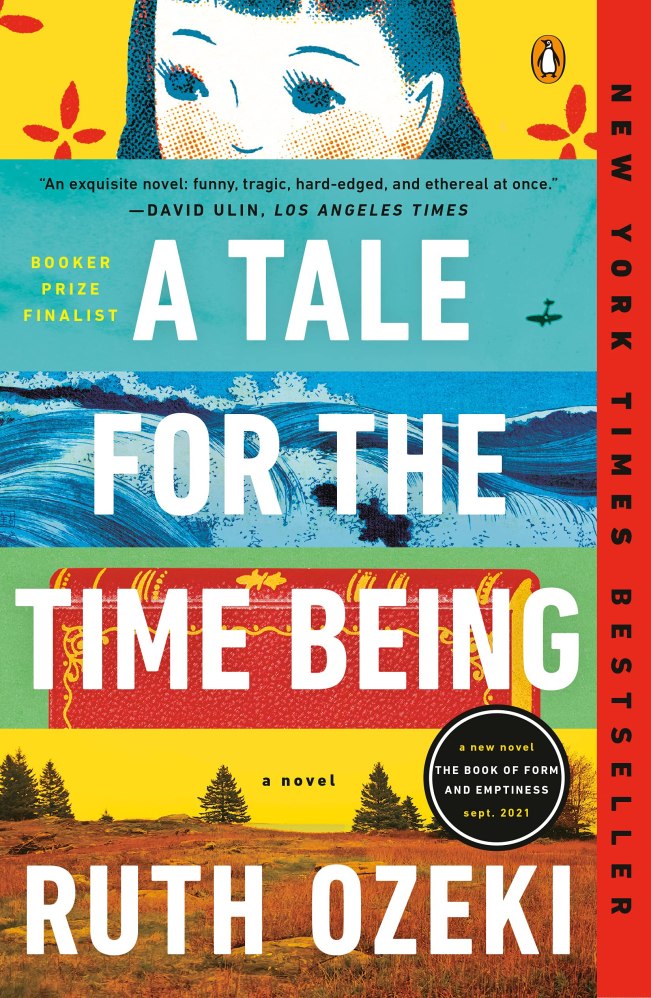
A cover of stripes, from top to bottom: yellow with the eyes and nose of a young girl's face; Light blue with a dive bombing plane reads A Tale; deeper blue with waves reads For The; mint green with a red book read Time Being; yellow with a brown field and pine trees

by Ben H.

“Time itself is being and all being is time…In essence, everything in the entire universe is intimately linked with each other as moments in time, continuous and separate.” 

Dōgen

Ruth Ozeki’s A Tale for the Time Being is a lovely book. Part meditation on time and presence, part drama, and part mystery, Ozeki balances her story between two narrators connected by a diary written in the shell of a repurposed copy of À la Recherche du Temps Perdu (In Search of Lost Time) by Marcel Proust. 

Nao is the teenage author of the diary. She now lives near Tokyo with her mom and dad. Nao faces bullying, parental drama, homesickness for California, and severe depression. Ruth, a novelist, now lives with her husband on a remote island in British Columbia. She faces writer’s block and homesickness for Manhattan.

Nao’s diary washes ashore in a Hello Kitty lunchbox and Ruth becomes fascinated with it. Nao’s diary is witty, emotional, and bracingly frank. Ozeki phenomenally recreates the way a diary juxtaposes the quixotic and the realistic, the banal and the devastating, the humorous and the tragic. Nao is viciously bullied at school. The bullying is brutal, both physically and emotionally. Nao reports it to her diary in a light tone, but it’s heavy stuff. Suicide is also a common topic in the book, as multiple characters plan to kill themselves. Nao finds refuge from the bullies when she is left with her 104-year-old grandma Jiko, a feminist Buddhist nun, in a crumbling monastery in the mountains for the summer (ghostly hijinks ensue).

Ruth (the character not the author) fills her chapters with lovely descriptions of the natural world. In her displacement, Ruth doesn’t face anything as dramatic as Nao does, but Ruth is out of her element. She’s still searching for her identity on her new rural island. One of my favorite parts is when Ruth takes another diary from the Hello Kitty lunchbox (Nao’s great uncle Haruki #1’s secret diary written in French to hide it from his commander in the army) to Benoit to be translated. Benoit manages the dump on the island and has carved out a perfect little niche for himself, complete with a library full of books rescued from the garbage. Managing a dump on a remote island might not be everyone’s cup of tea, but it sounds nice to me.

In some structural ways, A Tale for the Time Being reminds me of Don Quixote (Ozeki even makes a Don Quixote reference). There are embedded narratives for everyone. There are hidden diaries and lost books and real texts and fake texts. Nao even reports in her diary on the texts she sends to Jiko while writing her entry. The transference of meaning between all of the texts, the way they bring new elements to the story or change the context, creates a rich background for the main thrust of the narrative. I totally escape reality when I get lost in a story buried in another story. Instead of getting immersed in ONE book, I’m immersed in a letter reported in a diary reported in another diary reported to me through a character in a book. I’m gone.

Ozeki, a Buddhist priest, fills the book with quotations from Buddhist masters. Even Ozeki’s structure, the interlinking stories, illustrates Dōgen’s ideas of the connectedness of the universe. Nao explores time in her diaristic musings, as does Ruth. In Ruth’s case, she finds herself searching for lost time in a way I think we can all relate to. The internet, the great thief of time, is one of the main culprits behind Ruth’s writer’s block. Ozeki wields form, font, and white space to visually represent how It feels to waste time online, as only a person who remembers a time before the internet can.   

Sometimes you read a book and you and the book just click. A Tale for the Time Being was one of those books for me. If none of the things in my review have piqued your interest, A Tale for the Time Being also features at least one ghost, a magical crow, an episode in the multiverse, and a cute cat.

A Tale for the Time Being is available from HCLS in print format, as an audiobook on CD, and as an eBook and eAudiobook from Libby/OverDrive.

Ben Hamilton works at Project Literacy, Howard County Library’s adult basic education initiative, based at HCLS Central Branch. He loves reading, writing, walking, and talking (all the basics).


Becky Chambers: Hope for Humanity

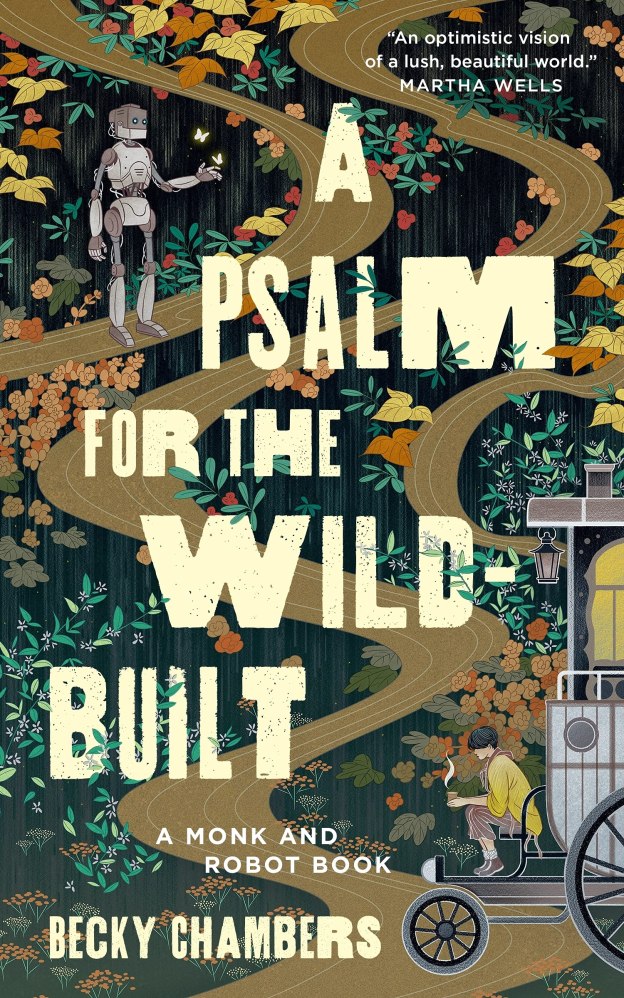
On a busy cover, you see a branching curvy path through plants and flowers. At bottom sits a young man on a cart, holding a cup of tea. At the top stands a grey robot with butterflies floating above his hand.

by Eliana H.

What’s your favorite book? If you can decide, feel free to leave it in the comments. I always have a terrible time answering this question. It depends so much on what I’m in the mood for, but I recently finished A Psalm for the Wild-Built by Becky Chambers, and it reminded me yet again why I love this author’s work. She has won the Hugo Award and been nominated for the Arthur C. Clarke Award, the Locus Award, and the Women’s Prize for Fiction, among others. In case you are less familiar with those particular awards, Becky Chambers writes science fiction. 

The first Becky Chambers book I read was The Long Way to a Small, Angry Planet, her debut novel and the first book in the Wayfarers series. I actually read it for a meeting of In Other Worlds, one of the many fantastic book clubs that the library offers. I remember during our discussion that other participants agreed with me that it was such a lovely, comforting read. One friend described it as comfort food in book form. You can see a little more about this title in one of our previous blog posts

As I read more books by Becky Chambers, I continue to be struck not only by her storytelling, but also by the appeal of the worlds she creates. Each book is like a warm hug, easing me out of the everyday struggles and worries we all experience and into this universe in which everything is different. But although everything is different, there is so much that is familiar. I can relate to the characters and their feelings about what is happening around them, even when they are a completely dissimilar species to myself. 

One of the most refreshing parts of diving into the universe that Chambers shows us in the Wayfarers series is that humans are nowhere near the top of the food chain. Far from being the species in power, humans were some of the last to join the Galactic Commons and are not very technologically advanced. But beyond the change in perspective offered by that dynamic, my favorite aspect of Becky Chambers’s books is the hope they provide. Each is filled with people (mostly non-human, but still people) treating each other respectfully and considerately. Although they may not understand the traditions and habits of those so different from themselves, people originating from an enormously diverse array of cultures find common ground and consistently demonstrate their regard for every individual’s inherent value and rights. It is a profoundly inspiring universe. 

I hope that you will find as much joy and satisfaction from any of the Becky Chambers books you choose to explore. While titles in the Wayfarers series do have a numerical order, they can generally be read as stand-alone novels as well. You can find the following books written by Becky Chambers available now. 

Eliana is a Children’s Instructor and Research Specialist at HCLS Elkridge Branch. She loves reading, even if she’s slow at it, and especially enjoys helping people find books that make them light up. She also loves being outside and spending time with friends and family (when it’s safe).

Skye Falling by Mia Mackenzie

The book cover shows a cityscape with multicolored homes in the foreground, trees in the middle ground, and a skyline view of tall skyscrapers in the background.  People are in purple silhouette walking along the street, sitting or leaning on their porches, and looking out of windows.  The whole cover is done in shades of blue, purple, pink, and peach.

by Ash B.

If you’re looking for a heartwarming read that is thought-provoking, discussable, and hilarious, look no further than Skye Falling by Mia McKenzie. 

Skye is an elder millennial who is quickly approaching her 40th birthday, and she has no interest in ‘settling down’ or having any deep sort of meaningful human connection. The successful founder of a small travel company, Skye has spent years adventuring around the world in the fleeting company of strangers… which has provided her the perfect opportunity to avoid lasting relationships of any kind.  

In short, Skye has an impressive career but she is a hot mess when it comes to her personal life. 

Her brief returns to her hometown, Philadelphia, usually consist of crashing at her friend’s B&B, dodging her brother’s calls about their chronically ill mother, and planning for upcoming trips she will lead for work. She typically does not spend this time reflecting on the past or dredging up emotions that she has long since buried. 

So, when she finds that the egg she donated over a decade ago has actually developed into a real human child – now a twelve year old girl, to be exact – her initial reaction is to run. Literally. Skye tries to run and hide from this girl, Vicky, who introduces herself as “your egg.” But it turns out Vicky is actually pretty cool… so cool that Skye might want to stick around and try to be responsible for the first time in her life.  

However, this is complicated by the fact that Vicky’s aunt and caretaker is not a big fan of Skye, at least not at first. But, as they get closer, let’s just say the tension between these two women isn’t solely about their different approaches to parenting…  

In the interest of avoiding spoilers, believe me when I say McKenzie is a master of comedic writing. The outrageous situations she puts her characters in, and the figurative language she uses to describe them, is top tier. Not to mention her hilarious one-liners, too! 

This novel isn’t just funny, though – it is emotionally rich and insightful about a range of issues from family trauma and fractured friendships to gentrification and policing. McKenzie creates an engaging balance between humor and tragedy, joy and anger, fear and love. The result is a feel-good, fun book that holds space and respect for serious topics that are part of everyday life. 

This is ultimately what makes Skye Falling one of my favorite 2021 releases, and I believe it is also what makes it a great choice for book club discussions – which is why I included it on the HCLS 2022 Books for Discussion list (which you should take a look at for more reading suggestions). 

While I think Skye Falling can appeal to a variety of readers, I would particularly recommend this title to lovers of Honey Girl by Morgan Rogers. Both novels center queer Black women who put pause on their careers in order to sort out personal relationships, figure out what they are doing with their lives, and eventually begin to process their complicated relationships with their parents. They each have rom-com elements without that being the entire plot, are full of millennial humor (albeit on different ends of the generation), and celebrate friendship and chosen family. I wholeheartedly recommend both! 

Skye Falling is available to borrow from HCLS in print and is one of the many titles included in our Equity Resource Collection.  

Ash is an Instructor & Research Specialist at Central Branch and is a co-facilitator for Reads of Acceptance, HCLS’ first LGBTQ-focused book club. This time of year, they are especially fond of reading while cuddling with their golden retriever and sipping hot cocoa or tea.

When No One is Watching by Alyssa Cole

The book cover shows a brick townhome or apartment building shaded in blue shadows, with greenery from tree branches around the edges. There are marble steps and railings up to the front double doors, and eight windows on three floors, one lighted behind a curtain, and one dark but with a curtain pulled back as if someone is watching from the dark.

By Sahana C.

Fans of Jordan Peele’s Get Out, this book is for you. Romance author Alyssa Cole’s first venture into the thriller genre comes to us with a bang, a gentrification thriller that talks about all of the ways a neighborhood disappearing can truly be insidious.  

When No One is Watching follows Sydney, a Black woman recently returned to the Brooklyn neighborhood where she grew up, and Theo, a White man, who has also recently moved into the neighborhood with his extremely wealthy (and pretty catty) girlfriend/ex/it’s-complicated, Kim. Neighborhood shops disappear and turn into national chains, but it isn’t until Sydney hears about neighbors moving suddenly that she starts to think something unusual might be going on. She teams up with Theo to work on an accurate tour of the neighborhood, but is unsure if he’s trustworthy or part of the problem. 

Cole does a wonderful job marrying the two perspectives, Sydney’s and Theo’s, into a cohesive narrative, in a time and situation where their points of view appear to be polar opposites. When we are reading from Sydney’s point of view, it is nerve-wracking and jarring, a new problem around every corner. When we are seeing the world from Theo’s eyes, it is us trying desperately to understand problems that don’t hurt us the way that they hurt other people.  

This novel approaches gentrification with a firm and education-based stance. There are some moments where it feels like Cole is trying to make sure that her readers are walking away armed with facts, not just the thrill factor. Admittedly, that can feel a little distracting when there is the next big bad problem only pages away, but waiting with the characters and following the pace that Cole sets up is well worth it for the explosive finale.  

The influence of Get Out is clear as well, and fans of the movie will notice the pacing of the book matching closely to the movie. No matter how similar the two seem, however, the ending is still something that will catch readers by surprise, keeping you hooked to every page.  

It is an easy, captivating read for people who want the conventions of a thriller while also feeling like they are learning something. New York Times bestselling author Alafair Burke wrote, “From the first page of When No One Is Watching, I felt like I was right there in the gentrifying Brooklyn neighborhood, filled with sharply etched characters and dialogue that zings. Then bam!  I was knocked over by the momentum of an intense psychological thriller that doesn’t let go until the final page. This is a terrific read.” 

When No One is Watching is available in printaudiobook on CD, and as an eBook and an eAudiobook through Overdrive/Libby.

Sahana is an Instructor and Research Specialist at the Savage Branch. She enjoys adding books to her “want to read” list despite having a mountain of books waiting for her already.