My Teacher Blew Up the Moon: Assassination Classroom by Yusei Matsui

Bright yellow cover has a broad smile and two pinpoint black eyes under the title.

by Khaleel G.

The old saying goes, “Don’t judge a book by its cover” – but what about a title? 

Assassination Classroom is a manga whose title initially repelled me. Even with its bright and simple covers, I looked at a volume, read the back description, and wondered if this was another manga like Death Note. You know, that sort of intensely serious story, full of extended monologues about power and authority, each chapter twisting into the next. Because, after reading Death Note, I was satisfied; I didn’t need another version of that grim-dark comic book. With a title like “Assassination Classroom,” how could this series be anything else?

Well, I couldn’t have been more wrong. Assassination Classroom has an overall story, yes, and it certainly has intrigue: spies and soldiers working in the shadows of government organizations, with alphabet soup names. But mostly, it’s a gag manga. Yes, the manga about a class of teens attempting to kill their omnipotent teacher is, shockingly, mostly about dumb jokes and silly characters learning about themselves. 

One day, the moon suddenly explodes. The culprit makes himself known to the world with a declaration: I will destroy the world in one year’s time, unless I am stopped. He is a monster of superhuman strength and speed, who then demands the world government let him…teach a class of lovable misfits? Did I mention the monster is tentacled, bright yellow, and wears a classical teacher outfit with a robe and square hat? 

In another author’s hands, this premise would be deathly serious in tone. But here, author Yusei Matsui takes all that global turmoil and high stakes and makes it super light-hearted. Koro-sensei (a pun on “to kill” in Japanese) has threatened to destroy the world, yes, but he also wants to actually teach these kids – not only about science, math, and literature, but growing up and being a better person, too. And uh, also firearms, subterfuge, and assassination techniques, as he playfully dodges their barrages of bullets, all while offering praise and critiques.

Over 21 volumes, we meet the students and fellow staff at the school, watching them react to this absurdity. Nagisa, the closest thing to a protagonist we have, was bullied for his small frame, but under Koro-sensei’s tutelage, he learns how to accept himself and be confident. Mr. Karasuma is a military officer charged with overseeing Koro-sensei, but as he teaches both gym and martial arts, he softens into a capable instructor. Even Miss Jelavic, a trained assassin disguised as an English instructor, learns that education is a two-way street – as you teach, you learn more than you’d imagine.

Yes, it is corny! Underneath the global plot to destroy a banana-colored octopus, the story is heartfelt and honest. I was fairly effected by the series’ conclusion, despite the tonal clash throughout. The simple and cartoonish art makes the characters more personable, making both the jokes and earnest conversations more meaningful. No one is some “cool” and impervious hero – they’re students and teachers, goofing off while learning how to be better than they are.

In this way, Assassination Classroom resembles a coming-of-age school story, like Ouran High School Host Club (with guns) or Naruto (but far less serious). Its title hides the lightness of plot, how quickly and jovially it moves from school trip to midterms to holiday breaks. The result is a pleasure to read, for its stream of gags and touching moments, for Koro-sensei’s silly faces and his quips of honest wisdom.

Be aware though – this is a title for older teens and adults. The violence of the series is mostly unserious, but the lives of these students and teachers sometimes share the mature themes of the best of Young Adult literature. Bullies, abuse, and family trauma are the dangers in these characters’ lives, not the moon-destroying creature who can move at Mach-20. Still, this is a comedy series first and foremost, and these more “real” themes come forth only in certain moments, and never in a way that I found triggering.

I really enjoyed my time with Assassination Classroom, and was delighted to see how wrong I was to judge this one by its title.
 
Assassination Classroom is 21 volumes and is available in print from HCLS branches.

Khaleel has worked at the Miller Branch since 2015, though he’s been back and forth between HCLS and high school, college, an

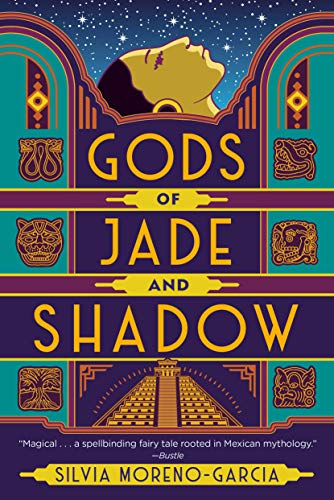
Gods of Jade and Shadow by Silvia Moreno-Garcia

A colorful cover full of jade green, deep purple, and gold features the profile of a young Mexican woman gazing at the starys. The panels are decorated with Mayan symbols, including a double headed snake, a caiman, and a skull.
Cover image of Gods of Jade and Shadow

by Kristen B.

Casiopeia Tun, the main character in Gods of Jade and Shadow, may be my favorite heroine so far this year! This Mexican young woman is grounded in real life and is as stubborn as the day as long. Casiopeia believes in fairness, mostly because life hasn’t shown much of it to her. She and her mother subsist as the poor relations within her mother’s family, who are the big fish in the small pond of their Yucatan peninsula town. Casiopeia lives at the mercy of her crotchety grandfather and her privileged cousin Martin, who combine to make her life mostly miserable with chores and petty insults. She suffers with no particular grace. I do love a girl who can glare!

When the rest of the family leaves for an afternoon of fun and relaxation, Casiopeia is left behind for perceived dereliction of duties. In a fit of curiosity and rebellion, she opens an old chest that resides at the foot of her grandfather’s bed. And so the adventure begins!

She has inadvertently awakened a Lord of Death, Hun-Kame. He invites her on a mission to recover his lost power and to defeat his twin brother. She accepts with much trepidation, figuring it to be her one chance to escape dusty Uukumil. The two embark on a quest that takes them across the country, from the Yucatan to Baja. The entire story is grounded in Mayan mythology filtered through 1920s Mexico. Grand hotels, Prohibition-fueled tourism, and early automobiles provide a lively backdrop. Casiopeia and Hun-Kame equally cross great personal distances, from lord and servant to friends who share dreams of the future.

Meanwhile, the insufferable Martin has been co-opted by the god’s twin brother, Vucub-Kame, who has long-laid plans to return to the days of worshiping the old gods with blood sacrifices. Martin tries on multiple occasions to lure Casiopeia away from Hun-Kame. I cheered for her and her stubborn sense of justice the entire way. Her interactions with Martin eventually influence how she understands the dynamics between the divine brothers. In the end, she must make a terrible choice … but I don’t want to give too much away.

This is a lovely, lush book. I am not overly familiar with Mayan myth, but the author so perfectly describes the Black Road through Xibalba (land of the dead) that I could picture it. When Casiopeia and Hun-Kame ride the trains, the evocative sense of motion and rhythm is conveyed beautifully. I enjoyed the book as much for its language and imagery as the fast-paced story itself.

Moreno-Garcia is best known, at the moment, for the best-selling Mexican Gothic. She joyfully mines her grandmother’s stories and her native Mexican mythology for her books. Gods of Jade and Shadow is available as a physical book, and as an eBook and an eAudiobook on Overdrive/Libby.

Kristen B. is a devoted bookworm lucky enough to work as the graphic designer for HCLS. She likes to read, stitch, and take walks in the park.

Brat: An ’80s story

Black and white photo of Andrew McCarthy in a tweed jacket, loosening a skinny tie.

by Eric B.

I’d completely agree with the author Jay McInerney’s (Bright Lights, Big City) assessment on the back jacket cover of Brat: An ’80s Story

“My only quibble with this absorbing, thoughtful, and sometimes painfully honest memoir is with the title; McCarthy is anything but a brat. He is certainly an unlikely movie star, and the story of how this diffident and insecure young man found himself at the center of the culture in the 1980s—and then decided to walk away from it all—makes for a fascinating read.”

Perhaps you’ve seen Andrew McCarthy on the talk show circuit, or just remember him from his 80s films. I am a fan of his work in Less than ZeroPretty in Pink, and St Elmo’s Fire. Moreover, and you may scoff, but I do realize the genius that is found in Weekend at Bernie’s. I’m a fan of McCarthy’s acting, and perhaps his general on-screen demeanor in these “period pieces.” He played thoughtful, “emo” characters before it was nearly a trope in myriad indie films (to be sure, I still love the sensitive emo characters). For example, I’d contend that Timothy Chalamet is successful in a way I’m not sure was possible in the recent past with more rigid gender roles.

Several years ago, I read some of McCarthy’s travel writing and liked his style. The piece was about Los Angeles and was personal for him, and he spiced it up with personal anecdotes about his memories. For fans of 80’s films and McCarthy, Brat is like a greatest hits collection.  

The book opens with him abruptly leaving the Pretty in Pink Hollywood premiere to slam drinks at the bar across the street. McCarthy briefly gets into his middle-class upbringing, childhood, his time at NYU studying acting, before landing his first role and dropping out to pursue Hollywood acting full time. The remainder of the book is about the roles and the experience of his meteoric rise in Hollywood during the decade. McCarthy lived in New York for the duration of his Hollywood fame, which I found surprising, but makes sense now. He laments the fact that he didn’t pursue the theater, instead of accepting some of the roles he was offered. 

He includes some interesting stories about his experiences in Hollywood and some of the characters he encountered. I would not describe this as a tell-all book, but rather a memoir of a person experiencing and observing the strange world of American film and celebrity but never really feeling terribly comfortable in it. John Hughes described him as a “wimp,” which seems like a nasty thing to say. His experience at a Paramount anniversary party with Hollywood legends and young up and comers, where he realizes he could not and had no desire to be Tom Cruise, is hilarious because we all know how their respective careers progressed. McCarthy includes many pictures, and this one of the entire group at the Paramount party is telling. 

Artists who have a tough time with the nature of celebrity interest me generally. I appreciate what it’s like to want to be noticed, appreciated, and recognized, but then not wanting all that attention. I’m terrified of someone trying to take my picture as I try to live my daily life. McCarthy has accepted his status as an 80s star and a member of the “brat pack,” even though this was a media term. He’s not seen some of these people since the respective films were completed.  

If you’re a fan of so-called “brat pack” films, or 80s movies, John Hughes films, or just looking for a book not concerning current affairs, it’s a pretty good read. I acknowledge my bias on this subject, but I enjoy McCarthy’s writing style and his reflective and analytical nature. Perhaps this comes through in his acting?  Andrew McCarthy does seem like someone I’d know, or someone I’d like, but perhaps this is how celebrity works. Briefly reflecting on his days at NYU, McCarthy said that after class he’d hang out in the “post-bohemian cross culture” of Washington Square Park, observe all the interesting people, buy two joints off a Rastafarian for a buck apiece, then go home and watch the Rockford Files. This sounds like a nice afternoon to me, or perhaps a celebrity dream date.  

Also available as an eBook and eAudiobook via OverDrive/Libby.

Eric is a DIY Instructor and Research Specialist at the Elkridge branch. He enjoys reading, films, music, doing nearly anything outside, and people.

Crying in H Mart

Against a red background, two sets of chopsticks hold noodles in long swoop that looks like an H.

by Ben H.

I’d be remiss to write about Michelle Zauner’s Crying in H Mart without mentioning Psychpomp, the 2016 Japanese Breakfast album that served as a preview for the memoir that debuted at No. 2 on The New York Times‘ best sellers List. Passages describing the creation of the album are brief, but lyrics are scattered throughout the memoir like Easter eggs.  

Zauner recorded the album in Eugene in the months after her mother died. Zauner’s mother is on the album cover, reaching toward the camera. It’s a rad shoegaze album full of great lyrics, and it’s my 2-year-old daughter’s favorite album. Kiki’s been listening to it since she was born. She points to this album cover when she wants to bop: 

Two Asian woman look down into the camera, one reaching out. They are under a blue sky and wind is blowing their hair.

Zauner, who was born in Seoul; raised in Eugene, Oregon; went to school in Philadelphia; and now lives in Brooklyn has a real Maryland vibe (whatever that means). Maybe it’s just me, but I felt close to Zauner after reading her book. It’s honest and intimate (I know that’s a book cover cliché and I still can’t help myself). 

The memoir is incredible. Her mom was only 56 when she died, and Zauner had a complicated relationship with her. She illustrates their relationship by detailing a series of events from childhood conversations to her mom’s final word. The book is only around 250 pages, but Zauner uses anecdotes and conversations like a pointillist uses points to create a full portrait. Her mother is down-to-earth, glamorous, pragmatic, whimsical, frustrating, mysterious, and lovely.  

Zauner writes about eating food, making food, storing food, watching videos of other people make food (Maangchi gets her own chapter), and it’s all great. The passage where she makes her first real batch of kimchi is one of my favorites. Food is the constant in her relationship with her parents: “What they lacked in high culture, they made up for by spending their hard-earned money on the finest of delicacies. My childhood was rich with flavor – blood sausage, fish intestines, caviar. They loved good food, to make it, to seek it, to share it, and I was an honorary guest at their table.” 

After her mother’s cancer diagnosis, her mental fantasies to cure her mom are heartbreaking. We’ve all tried to barter with the universe or with God to get something, and in that vein, Zauner writes, “I spent an hour on the treadmill. In my head I played a game with the numbers. I thought to myself, if I run at eight for another minute, the chemo will work. If I hit five miles in half an hour she’ll be cured.”  

The details of Zauner’s childhood in Eugene and her visits with family in Seoul are highlights, but I found myself returning to the intimate moments between Zauner and her mother. Crying in H Mart is officially going to be a movie; I can’t wait for the screen adaptation, but I think it’s going to be a tearjerker. 

You can place the book on hold, as many other folks want to read it right now, but it’s worth the wait. Also available as an eBook and eAudiobook.

Ben Hamilton works at Project Literacy, Howard County Library’s adult basic education initiative, based at HCLS Central Branch. He loves reading, writing, walking, and talking (all the basics).

Norfolk, Archaeology, and a Touch of Crime: The Ruth Galloway Mysteries

The cover of The Crossing Places shows a black owl with yellow eyes atop a black perch, against a turquoise background.

By Julie F.

London native and Brighton resident Elly Griffiths has had a phenomenal (and very busy!) career since publishing the first Ruth Galloway mystery, The Crossing Places, in 2009. The author of three children’s books, the Stephens and Mephisto historical mystery series, and the Harbinder Kaur mystery series, she is the winner of the 2020 Edgar Allan Poe award for Best Novel for the first Kaur mystery, The Stranger Diaries. She also won the Dagger in the Library award from the Crime Writers’ Association, which is a prize for a body of work by a crime writer that users of libraries particularly admire.

Although all of her work is acclaimed, the Ruth Galloway novels are especially beloved by her devoted readers. Ruth is a forensic archaeologist who teaches at the University of North Norfolk, where her best friend, Shona, is married to the head of Ruth’s department. Over the span of thirteen novels, Ruth nurtures a passion for the work that consumes her academic life but also spills over into her personal life and a second job as an adjunct to the North Norfolk police constabulary. Like many police officers, DCI Harry Nelson is haunted by the one case he couldn’t solve – that of a missing five-year-old, who was taken from her parents’ home ten years ago and is now missing, presumed dead. When bones are discovered on the beach near Ruth’s home, DCI Nelson calls on Ruth to help the police date and identify them. An Iron Age discovery ensues, another child goes missing, and Ruth finds herself pulled into a case that has ramifications both past and present. The Crossing Places is an excellent start to a series where following the quirky, familiar characters we learn to love doesn’t overshadow the intensity of the mystery; Griffiths is skilled at developing both character AND plot.

Through the course of the series, Ruth has chilling adventure after adventure: she carbon-dates bones found on the site of an old children’s home in the process of being demolished; she attends the scene of the discovery of a downed World War II plane which presumably has the skeleton of the pilot intact; and a jaunt to Italy at the request of a fellow archaeologist needing help with his own most recent discovery results in a kind of working holiday. As the books progress, her relationship with DCI Nelson, both professional and personal, goes through a series of ups and downs that has the reader rooting for both the cranky but decent old-school DCI and the strong-willed, independent archaeologist.

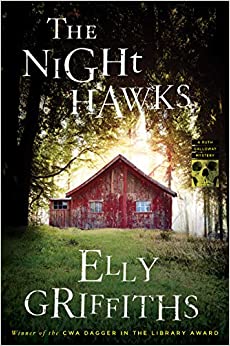
The cover of The Night Hawks shows a backlit red house with a triangular roof, with dark trees above and green grass in the foreground.

The most recent novel, The Night Hawks, has the titular group of treasure hunters combing the beach in North Norfolk when they come across a body – and a cache of Bronze Age weapons, which is of real interest to Ruth and a new university colleague. DCI Nelson speculates that the body, which is not from antiquity, might be that of an asylum seeker who washed overboard in a storm, but the death is quickly linked to a murder-suicide at a nearby house, Black Dog Farm. The name ties into local legend about a huge, spectral black dog who haunts the area, adding an element of the paranormal to an already complicated mystery.

Both The Crossing Places and The Night Hawks are worthy additions to a compelling series, but I can recommend every entry – I’ve read and enjoyed every story involving DCI Nelson and his team, and Ruth and her colleagues, for well over a decade now. I’m still looking forward to more suspenseful mysteries from them – in a recent interview, Elly Griffiths said she is hard at work on the fourteenth Ruth Galloway novel, The Locked Room. Fans of Louise Penny, Ann Cleeves, and other writers of character-driven police procedurals will find much to enjoy and admire about this suspenseful series.

Julie is an instructor and research specialist at HCLS Miller Branch who finds her work as co-editor of Chapter Chats very rewarding. She loves gardening, birds, books, all kinds of music, and the great outdoors.

Thrilling through Space & Time: Dark Matter & The Gone World

By Khaleel G.

As a genre, science fiction can be daunting to new readers. For some, the size of the books can threaten one’s attention span and bookbag; for others, the density of the language, with strange technical terms and invented rules, can be as repelling as a tractor beam in reverse. 

But fear not, gentle reader! Sci-fi is such an incredibly wide field, with myriad sub-genres within it, that there’s a story for any reader. I’d like to highlight two novels, both of which deal in the manipulation of time and space, but with enough flavor, tone, and character writing to carry you all the way to the final page.

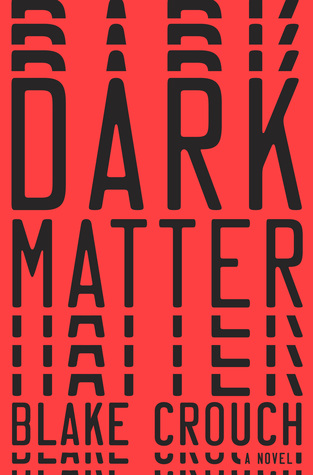
The book cover shows the lettering of the title and author's name in black lettering, overlapping themselves several times, against a red background.


Dark Matter by Blake Crouch seems initially like a crime thriller. Jason Dessen is on his way home from work, through the streets of Chicago, when he’s abducted by a stranger, who asks him, “Are you happy in your life?” After being knocked unconscious, he awakens, surrounded by strangers, all welcoming him back into a life he never lived. 

Any adult has those idle moments, wondering about what might’ve been – if they’d taken that job, or if they’d stayed with that person, or if they’d had the chicken instead of the fish at that one dinner, that one time. For Jason, that train of thought becomes real and absolutely alien. In short order, he realizes that this is a parallel world to his own, where he made a slightly different choice in careers…which resulted in his alternate self creating dimension-hopping technology. No biggie!

Worse yet, in this world, Jason didn’t marry his wife, and they didn’t have their child. Once these stakes are established, the novel fully becomes a thriller, as Jason struggles against the forces of man and physics to get back to his world and family.

The story bounces between worlds upon worlds, Jasons upon Jasons, but we never lose the plot’s thread. The mechanics of parallel worlds are clearly established, and the rules are not confusing.  By the end of the book, those rules have been pushed to their limits, but the pace and tension of the plot kept me engaged, absorbing the science-y bits alongside the emotional ones. The intertwining of those two strands – the emotional and the scientific – was so effective, I read this book in two sittings. It is THAT captivating!


On the other end of the space-time continuum, The Gone World by Tom Sweterlitsch explores time travel, but differently than other related tales like Back to the Future. Back in the 80s, a secret division of the US Navy discovered time travel, using it to explore and discover new futures. The book properly begins, though, in 1997, as Shannon Moss is working for the Naval Criminal Investigative Service. A Navy SEAL’s family has been murdered in West Virginia, and a girl has gone missing. What seems like a heinous but human crime is revealed to be much more, as Moss investigates ’97 and years, and decades, beyond.

The picture is of actor Michael J. Fox in his role as Marty McFly in the film Back to the Future, wearing a red puffy vest and collared denim shirt, with wide eyes indicating shock or surprise.
This book doesn’t play by Back to the Future rules…


The Navy’s time travel system doesn’t operate by popular rules, like Marty McFly’s “go back to 1950 to make sure your parents meet” sort. Instead, a person is sent only into the future, from that particular and exact moment in time. The future they experience is a sort of bubble, one in which all events played out exactly as they were set up at that moment of the time traveler’s departure. If this sounds confusing, rest assured that Sweterlitsch explains it far better than I. Like Dark Matter, the book lowers you slowly into the science, letting the human drama lead the pace.

In practice, time travel allows Moss to jump decades into West Virginia’s future, when neighbors and witnesses are more amenable to talk about this old, grisly murder. It also means that Moss can see how the world changed in her absence, as her family and friends think she simply disappeared. Astoundingly, the story takes place almost entirely within West Virginia and surrounding areas, as Moss bounces between 1997 and various points in the future; this grounds the story in a gritty reality of detectives, seedy motels, and criminal hideouts, not unlike its genre sibling, True Detective.

Did I mention there’s also this looming apocalypse in the future, called “the Terminus?” And in every possible future the Navy’s travelers go to, it’s still there, destroying Earth – and with each time travel leap, it seems to be arriving sooner? So while the main thrust of the plot has roots in Appalachia and crime fiction, there is still Deep Time, lost Navy starships, bizarre future evolutions of mankind, amid moments of time itself bending and cracking – all under this looming, seemingly inevitable threat.

Sweterlitsch combines snappy character writing, attention to detail, and readable action sequences to make this rather thick book into a page-turner, one that kept me up deep into the night to get to the next twist. It is a mix of grisly murders, police procedural, and cosmic horror – and I haven’t read anything quite like it elsewhere.

The book cover shows an icy landscape at night, with frozen trees and stars against a deep blue night sky.

The Gone World is smart and complicated, while also a non-stop thrill ride; its finale left me (as all my favorite books do) suddenly returned to my own body, yet my mind refused to stop and leave the story. Over the next few days, I would return to re-read sections, and I’m contemplating another read very soon (perhaps the audiobook from Overdrive?). 

And that’s the magic of great sci-fi!  The story can be about space armadas, alien princesses, time travel, or dimension-hopping – it doesn’t matter, as long as the author can wholly transport the reader into a world that’s different, but still human. As long as it leaves you in a state of wonder.

Dark Matter by Blake Crouch and The Gone World by Tom Sweterlitsch are available in print from HCLS, and in eBook (Dark Matter | The Gone World) and eAudiobook (Dark Matter | The Gone World) from Libby/Overdrive. Dark Matter is also available in CD audiobook from HCLS

Khaleel has worked at the Miller Branch since 2015, though he’s been back and forth between HCLS and high school, college, and graduate school since 2003.

Read it! Watch it!

by Emily B.

Book to film adaptations are some of the most beloved and memorable works of pop culture, and devoted fans are always excited to see their favorite novels made into movies or TV series. Whether the adaptation is completely faithful to the book or takes dramatic liberties to make the material fit the medium, reworking an author’s vision in a new format complements and enhances the reader’s understanding of the original work. Check out these awesome books, then see the stories come to life on screen! 

Paddington by Michael Bond (book and movie)
Follow the adventures of Paddington, the marmalade-loving bear from Peru, as he adjusts to life with a family of humans in London. The movie adaptations are the equivalent of a warm hug – wholesome and fun for all ages.
For all ages.

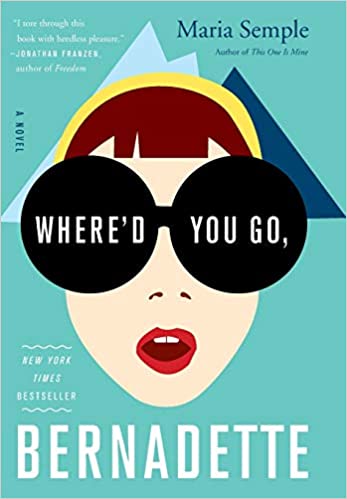
Where’d You Go Bernadette? by Maria Semple (book, eBook, eAudiobook, and movie)
After planning a big trip to Antarctica, the family matriarch Bernadette disappears with no notice, and it’s up to her teenage daughter to figure out what happened. Cate Blanchett stars as the titular character in the film adaptation.
For adults.

You by Caroline Kepnes (book and TV series)
An eerie tale narrated by an obsessive stalker and master manipulator, Joe, who will stop at nothing to be with his dream girl. In the television series, Penn Badgley perfectly plays the role of the unassuming creep.
For adults.

Big Little Lies by Liane Moriarty (book, eBook, eAudiobook, and TV series)
The perfect twisty summer read, Moriarty’s novel features elementary school drama, female friendship, and mystery. Season 1 of the television show is a fairly faithful adaptation of the novel, and season two continues the story and expands on the aftermath of the book’s ending.
For adults.

A Man Called Ove by Fredrik Backman (book, eBook, eAudiobook, and movie with subtitles)
The heartwarming tale of a curmudgeonly old man, Ove, whose world is turned topsy-turvy when a young family moves in next door. Will this new family be able to crack Ove’s tough exterior?
For adults.

Persepolis by Marjane Satrapi (book and movie)
This autobiographical graphic novel tells the story of Marjane Satrapi’s tumultuous childhood growing up in Iran amidst the Islamic Revolution. The film adaptation was nominated for Best Animated Feature at the 2007 Academy Awards.
For ages 14+.

Little Women by Louisa May Alcott (book and most recent movie)
Louisa May Alcott’s beloved coming-of-age tale of the four March sisters has been adapted many times. Most recently, Greta Gerwig’s 2019 adaptation garnered six Academy Award nominations and took home the prize for Best Costume Design.
For ages 14+.

The Hate U Give by Angie Thomas (book, eBook, eAudiobook, and movie)
The heart-wrenching story of Starr, a teen who witnesses her best friend’s murder at the hands of a police officer and has to deal with the emotional and political fallout that ensues.
For ages 14+.

Emily is a Customer Service Specialist at the Central Branch. She enjoys reading, listening to music, and re-watching old seasons of Survivor.

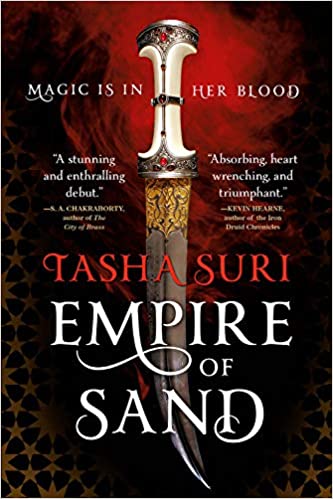
Two Tales of Two Sisters

An ornate curved dagger with a jeweled hilt appears against a swirling red background, with "Magic is in her blood" at the top and Tasha Suri, Empire of Sand across it along the bottom.
Book cover of Empire of Sand

by Kristen B.

Empire of Sand opens with a young woman painting a window sill with her blood, looking to ward against the daiva spirits of the wild sands. In some ways, the rest of Tasha Suri’s duology revolves around these older spirits that have been subjugated by the Ambhan Empire – and by those who consider them monsters and those who count them as family. Suri’s books are set in a lush, vibrant world based on the Mughal Empire – complete with vast deserts and verdant oases. Here, the Emperor governs but the Maha rules. Here, the upper class consists solely of Ambhan people and the Amrithi are outcast because of their magic.

Mehr is the privileged child of the regional governor, acknowledged but nonetheless the daughter of an Amrithi courtesan. She possesses the full inheritance of her mother’s people, but is protected by her father’s influence. Mehr lives in an uneasy truce with her step-mother, who has adopted Mehr’s younger sister as her own daughter to be raised as an Ambhan noblewoman. Mehr has no ambition for a noble marriage, but when she is discovered practicing Amrithi magic, she is given little choice.

The Maha rules the Empire through the prayers of his mystics. When Mehr accidentally divulges her abilities, she is forcibly married to the powerful mystic Amun and taken away to live a sequestered life in a distant oasis. At the Maha’s Temple, Mehr learns that she and her husband are expected to perform the Rite of the Bound. This magical rite, a choreographed dance with particular poses and gestures, allows the magic of the desert daiva and older gods to flow through the Maha and into the Empire, extending its territory and influence. Through their practice and discipline, Mehr and Amun learn about each other and the tragedies that brought each to the Maha’s temple.

It is this romance of desperation and rebellion that powers the second half of the book. I read this novel in large gulps, needing to know what happened next. As much as I enjoyed the world building, I truly came to love both Mehr and Amun, rooting for them to find a way to be together and free of the Empire. The underlying themes of colonization and prejudice give Empire of Sand an unexpected sense of gravity. There is no doubt but that individual lives were used and abused for the supposed greater good. The consequences of generations of such cruelty cannot easily be constrained or controlled.

A spear points downward against a patterned blue background, with "A curse is upon the throne" in gold script above "Realm of Ash" overlaying the spear, and "Tasha Suri" at the bottom.
Book cover of Realm of Ash

The second book, Realm of Ash, deals with the unfolding repercussions from Mehr and Amun’s story, but from another perspective entirely. We encounter Mehr’s younger sister, Arwa, again as she makes her way to a distant convent for widowed noblewomen. Arwa was, indeed, raised as an Ambhan noblewoman and married a military officer with a bright future. When the garrison is massacred by daiva, Arwa is one of the few survivors and chooses to absent herself from high society. Not entirely surprisingly, the convent is a hotbed of Imperial politics and Arwa soon finds herself on the way to the capital city to serve in the retinue of a princess.

Where her sister has the magic of the Amrithi rites, Arwa discovers that she has a different ability that allows her to access the memories in her blood, remembrances of her ancestors, in the Realm of Ash. The princess’ illegitimate brother lives in nocturnal solitude, researching and experimenting for a way to restore the Ambhan Empire to its former safety and prestige. Arwa must learn to embrace her Amrithi heritage to help the prince and to accept her own worth. Again, a forbidden romance (Ambhan noblewomen may not remarry) lies at the heart of a rebellion against a court built on deception and corruption. And again, I found myself rooting for these two against all odds.

In some ways I preferred Realm of Ash because it shows more of the interconnected elements of the Ambhan Empire, the military and the regular people of Jah Ambha (the capital city), servants and spies. As Arwa and her prince flee into the desert and join a pilgrimage, the wide variety of life outside of palaces and temples make for a wonderful sense of place and history. The bigger picture at play in the second book is, perhaps, only made possible by the laser focus of the first novel.

The fantasy genre is chock-full of strong heroines, women who can outfight anyone and snark about it after … the term kick-ass is usually employed. Mehr and Arwa gave me a much more grounded reality, finding their courage in the face of terrifying odds. Neither young woman wants to be an agent of change or is a rebel at heart. Both have learned to keep their heads down and mouths shut so as not to attract attention or draw criticism. They do have, however, an unerring sense of fairness and a desire to be allowed to live their own lives, loving whom they choose. These sisters indelibly alter their entire world by being brave enough to take the chances presented to them, sometimes fearlessly and sometimes with only a hope and a prayer.

Kristen B. is a devoted bookworm lucky enough to work as the graphic designer for HCLS. She likes to read, stitch, and take walks in the park.

Cool off in Patapsco Valley State Park

The writer's dog stands in thick grass near a trail marker in Pataspco Valley State Park.

by Eric L.

You may be hot and it may be humid, but this doesn’t mean you should stay indoors. To the contrary, you should get outside. If you’re reading this, it’s probable that you live close to Patapsco Valley State Park. The Park was founded prior to the National Park Service and encompasses approximately 16,000 acres. It offers some very fine East Coast nature, in my opinion. 

I’m from Baltimore, I have spent a lot of hours hanging around it, the recreation areas and even camping right off Route 40. My significant other finds this hilarious. I’m assuming because of the proximity to suburbia and the bustling thoroughfare right next to the camping area.

I’ve ridden my bike in it and hiked so many miles. I’d be curious to know the total – maybe thousands! I moved to Ellicott City to be in the Patapsco Valley. My neighborhood is on it, and I consider myself very lucky. There are not as many cicadas back there now, and it’s cooler than the blacktop world. Some of the views are just spectacular (perform an internet search for some of the scenery). 

All three of the dogs I’ve owned as an adult have logged thousands of miles with me. To be sure, I’m not a dog training expert, but I’ve been lucky, patient, diligent and have walked my dogs all over it, sometimes even off-leash. It’s a great place to take your kids to play, outside! My kids have also enjoyed many great afternoons in the Patapsco Valley. 

If you feel as though you need some motivation, borrow some of the great materials we have.  

Also, a great nonfiction read A Walk in the Woods by Bill Bryson (also as a book on CD, as well as an eBook and eAudiobook from Libby/OverDrive)Bryson tells the humorous account of his discovery, and attempts to hike the Appalachian trail. To be sure, this is not the story of an experienced hiker doing the entire trail from Maine to Georgia in record time, but rather the story of an average middle-aged person and his old friend hiking and discovering together. He interweaves interesting history and social commentary. Or try the film, starring Robert Redford.

There are so many different terrains one can hike, from flat, paved trails to some rocky terrain. That said, you need not be exceptionally fit, after all, it’s just a walk. You will need some comfortable shoes, running, or trail running. Hiking boots, or shoes, are certainly nice for some of the more rocky, advanced terrain. Please keep in mind that Maryland has a large deer population, and thus deer ticks. That said, dress accordingly, and use bug spray as needed. Do some research (Consumer Reports) about the most effective ones, it is very important! 

At any rate, don’t miss out. Get back there! It’s thought by many a lay person, psychologist, scientist that a walk in nature will make you feel better. View the Park’s website to find the right trail and place for you. Stop by the Elkridge Branch + DIY Center, where you can borrow trekking poles, a compass, binoculars in case you spy something you’d like to view up-close, and metal detectors for treasure hunting.  

Eric is a DIY Instructor and Research Specialist at the Elkridge branch. He enjoys reading, films, music, doing nearly anything outside, and people.

One Last Stop by Casey McQuiston

The cover, in shades of pink and lavender, shows the two main characters looking at each other; Jane is on the subway, dressed in a black jacket, torn jeans, a white t-shirt and orange sneakers; August is walking alongside the subway station, wearing a white t-shirt and black jumper and boots, carrying a cup of takeaway coffee with a purse slung over her shoulder.
Book cover of One Last Stop.

by Ash B.

If you’re at all aware of contemporary LGBTQ romance fiction, then you’ve no doubt heard about Red, White & Royal Blue by Casey McQuiston. I’ve honestly yet to read it, but I can confirm there is no sophomore slump for McQuiston with their second novel One Last Stop. 

One Last Stop follows August, a cynical 23-year-old college student, as she adjusts to life in New York – trying out yet another college in another city – complete with quirky roommates, a job at a pancake diner that she may or may not be qualified for, and a subway route that she happens to share with the most attractive girl she’s ever seen. The aforementioned “Subway Girl” goes by the name Jane, she is equal parts kind and fierce, and… well, her existence may defy reality as we know it. 

I leave this intentionally vague for a reason: I likely would have found the book even more enjoyable if I had no idea of the plot before I started reading, given that McQuiston spends quite some time building up the mystery of who – or what – Jane actually is. Therefore, I will refrain from going into detail about the book’s premise. Honestly, if this review piques your interest in the title, then I recommend that you simply dive into the book for yourself without reading the summary! 

However, I will divulge that, in my opinion, One Last Stop is an example of speculative fiction at its most accessible, and I absolutely loved it. In a recent interview, Casey McQuiston explains how they “have always loved that genre that’s sort of one step away from sci-fi, one step away from magic or fantasy. It’s a type of romcom that I think was really popular in the late ‘90s and early 2000s,” referencing films such as 13 Going On 30 and Freaky Friday. These are not stories typically considered sci-fi or fantasy – at least, not in the same way as Star Wars or Lord of the Rings – but they absolutely exist within the realm of speculative fiction, incorporating fantastical elements while allowing the author to set the story in an otherwise ‘normal’ contemporary world. The reader can take comfort in the familiarity of the overall setting but can be surprised, or at very least entertained, by the circumstances that arise from the speculative elements employed.  

Whereas these elements are often used for comedic potential in Hollywood movies, McQuiston is able to use them in a way that enriches One Last Stop with queer history and profound examinations about social differences between the past and present. And, of course, the situations created by the speculative elements are also well-suited for romantic tension and drama, which makes for a very engaging story.

I’ve found that a book is a particularly good read for me personally if it reminds me of other books I’ve loved, automatically encouraging my brain to go into “let’s compare these parallels!” mode while simultaneously being an enjoyable narrative on its own. One Last Stop is a perfect example of this! At the beginning, I found myself thinking of An Absolutely Remarkable Thing by Hank Green, as both of these novels feature mystery-loving bisexual female protagonists in their early twenties, living in present-day NYC, that end up being caught in the middle of seemingly unreal circumstances. McQuiston’s lovable cast of characters, development of a queer found-family trope, and flirtation with the “star-crossed lovers” trope (but with a happy ending!) reminded me of Cemetery Boys by Aiden Thomas. And by the end, as hidden family histories and unexpected connections between characters are revealed, I excitedly reminisced about The Seven Husbands of Evelyn Hugo by Taylor Jenkins Reid. Other than being some of my favorite reads in the past few years, I would not think to compare any of those three titles with each other… yet they fit perfectly in comparison to One Last Stop. 

In its best moments, One Last Stop is so tenderly written that it makes me yearn for a life in New York City – and that’s saying something, considering I’m a lifelong suburbanite who’s always been more drawn to the countryside than the city. McQuiston crafts likable characters who speak realistically about life in their city, honoring both the beauty and the struggles of the world which they inhabit. Not only that, but the city itself – and certain destinations within it, such as August’s apartment and the pancake diner where she works – feel like characters too. McQuiston writes them all with such care, I couldn’t help but feel connected to them, want to visit these places, want to be friends with these people and experience life alongside them. This makes for a wonderful book to escape into, and I strongly recommend it to anyone looking for a feel-good read about falling in love, finding one’s community, and growing into the best version of one’s self.

One Last Stop is available to request from HCLS in print as well as an eBook and eAudiobook from Libby/OverDrive.

Ash is an Instructor & Research Specialist at Central Branch and is a co-facilitator for Reads of Acceptance, HCLS’ first LGBTQ-focused book club. Ash is an eternal lover of coming-of-age stories, especially those that center queer and trans joy.