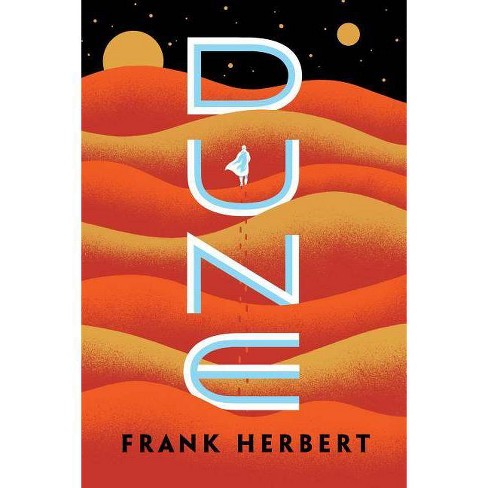
Dune by Frank Herbert

Orange and yellow waves of color suggest sand dunes. Title appears in bright white type vertically in the center, with a silhouetted figure within the "U". A black space sky is across the top, with stars.

By Eric L.

There has been quite a lot of buzz concerning the new Dune film, especially since with the new trailers being released. Frankly I’m a bit excited, too, although the theatre release has been delayed repeatedly (now scheduled for Oct 22, 2021). However, I can’t say that I’m a Dune fan from way back, since I had never read any of the 18 books in the series until recently.  

I host the HCLS book discussion group Read. Think. Talk. on the first Monday of the month. More often than not, we read and discuss classic, social, and philosophical sci-fi. Several members of the group wanted to read Dune (the original). Although I had a desire to read it, and with the new movie and an HBO series on the way, it seemed like a great time to familiarize myself with the source material. However, I was a bit reluctant, as it’s not a great idea to suggest a 600-plus page book, with three appendices and a glossary of terms, for a book discussion group. Moreover, I’ll concede I’m still a bit intimidated by long books!  

The plot centers around young Paul Atreides whose world is upturned when his family/house must relocate to the desert planet Arrakis, colloquially called Dune. A rival house, Harkonnen, was governing Dune and wants to wrest back control because of the planet’s valuable natural resource melange (also called spice). House Atreides is the more admirable of the two rival houses for a variety of reasons, not the least of which is the Harkonnen leader is a despicable person.

Melange enables interplanetary travel both via the pilot and as a fuel. It possesses a psychedelic effect, and people also ingest it as a mind-altering substance. Melange is only found in the sands of Dune, and harvesting it is a very dangerous endeavor because of the giant sandworms (the worms were really all I knew about Dune). The indigenous Fremen are the only folks who are able to survive in the desert with its extreme climate and dearth of water. 

Paul has an interest in the Fremen from the outset, even before a series of events place him in contact with them. I don’t want give away too many details concerning the drama and intrigue that lead to House Atreides losing control of the planet, but they make for a good read. The Fremen believe Paul to be their chosen leader and they have a common interest in defeating the Harkonnens.

This sort of story should all seem familiar, with revenge, an oppressive greedy regime, and the oft-repeated white male savior trope. However, Dune has some interesting differences. Paul is accompanied on his journey by his mother, Jessica, the unmarried concubine of his father and a member of the “Bene Gesserit.” One of the shadowy organization’s key tenets is controlling one’s thoughts to control how the body reacts. The members are taught to hone their intellect and possess the ability to persuade people using their words. They are not popular in the largely patriarchal society and are often and pejoratively referred to as “witches.” Jessica, against the rules of the Bene Gesserit, taught young Paul their ways. This skill set is the reason that some of the Fremen think he may fulfill their prophecy. 

There are interesting power dynamics between Jessica and Paul, their feelings about each other, and how individual goals change throughout the story. Other strong female characters exist as well, including Paul’s love interest. Author Frank Herbert was apparently also interested in Zen and peyote, and the book is very much a product of the late 1960s. It is undeniably long but moves quickly. The action scenes are not drawn out, in fact I found their brevity interesting. I liked that the political buildup was described more, which seems closer to reality to me. 

Dune has drama, intriguing characters, some philosophical issues, and an interesting environmental message. I half-read the appendices but found them rather dry without getting a feel for the characters first. That’s just me; perhaps you may like to have a complete understanding of the “world” before getting into the story. 

On the continuum of science fiction and fantasy (if there is one), I lean to the former. I’d argue this is more fantasy, although it’s debatable. At any rate, the book contains new words, lots of new names, worlds, and families, all of which are difficult to pronounce. This is a book that’s worth your time and great source material for a film. The new film will tell the story in two parts, unlike the 1984 David Lynch film, which is an interesting story in and of itself (I’d recommend it). 

In sum, one can get lost in another world and time in this book, and perhaps it’s nice to take a respite from current affairs for a bit. 

While you have to reserve the book right now because others are enjoying all of our copies, it is worth the wait to read. Also available as an eBook and an eAudiobook from Libby/Overdrive.

Eric is a DIY Instructor and Research Specialist at the Elkridge branch. He enjoys reading, films, music, doing nearly anything outside, and people.

Author works: Gail Tsukiyama

The book cover depicts the small town of Hilo at the shoreline, with buildings in shades of white and brown against a foreground and backdrop of turquoise sea and sky; in the distance, Mauna Loa is erupting into the sky, with yellow flame and reddish clouds above the silhouette of the mountain.

JOIN US! Author presentation: Thursday, Aug 5 from 7 – 8 pm, online
Register via this link or at hclibrary.org > classes & events. Once you register, a Zoom link will be emailed to you.

By Julie F.

The beloved bestselling author and recipient of the Academy of American Poets Award and the PEN Oakland/Josephine Miles Literary Award, Gail Tsukiyama returns with The Color of Air. A novelist whose dual Chinese and Japanese background features prominently in her writing, Tsukiyama presents a novel whose prose flows like the lava threatening her characters, with the grace of stringing leis with fragrant jasmine, kukui nuts, and ti leaves. The literal and figurative emblems of Hawai’i leap off the page and into the vision, sounds, taste, and touch of readers as they live alongside the Hilo locals, and hear the voices of the ghosts they cannot let go.

The residents’ stories move through alternating sections from 1935 to the even deeper past — a rich, vibrant, bittersweet chorus which tells the interweaving stories and a lifelong bond to each other and to others in their immigrant community. Even as the eruption of the Mauna Loa volcano threatens their lives and livelihoods, it also unearths long-held secrets that have been simmering just below the surface.

What I love about the book is that there is a subplot for everyone. If you’ve had a relative challenged by dementia or Alzheimer’s, you see how Mama Natua’s family tries to cope with the help of Daniel, the Hilo native and urban Chicago doctor who has returned to the island to work among his people. Daniel himself wrestles with paternal abandonment, maternal loss, and the guilty sting of feeling that he failed a patient on the mainland. His high school sweetheart, Maile, has an abusive relationship in her past and is tentative about finding happiness again. Razor, the best friend of Daniel’s uncle Koji, tries to unionize the immigrant workers who are taken advantage of by the sugar and pineapple plantation owners and overseers. Each person has their secrets and struggles, yet all come together to find solutions. That’s one of the best things about Tsukiyama’s novels: the sense of love, community, and found family that permeates each page, with characters who learn to face and overcome their fears in order to adapt and grow.

Another strength is the remarkable visual and sensual imagery of the island, which is like a living being itself: “just as volatile and unpredictable as anything a big city could offer” (48). The native Hawaiian words interspersed throughout give the reader a sense of the geology, the fruit, the pikake blossoms, the music of the Filipino bands in the town, and the diversity of languages spoken on the island (at one point, she notes that signs on the street were printed in Tagalog, Portuguese, and Japanese). Hawai’i is truly a distinct cultural melding of sounds, sights, and scents, and Tsukiyama’s descriptive language conveys its unique beauty.

In her years aside from writing, Tsukiyama co-founded the nonprofit WaterBridge Outreach: Books + Water. Alongside bestselling authors Ann Patchett, Gillian Flynn, Karen Joy Fowler, Mary Roach, and Lisa See, the foundation’s mission is to give children in developing communities hope for the future through nourishing their minds and bodies with books and water.

Gail Tsukiyama was born in San Francisco, California to a Chinese mother from Hong Kong and a Japanese father from Hawai’i. She is the bestselling author of Women of the Silk (available from HCLS in eAudiobook format from Libby/OverDrive) and The Samurai’s Garden, as well as the more recent A Hundred Flowers (also available as a book on CD and as an eAudiobook from CloudLibrary).

Julie is an instructor and research specialist at HCLS Miller Branch. She loves gardening, birds, books, all kinds of music, and the great outdoors.

Cooking up some comics, with a side of fantasy

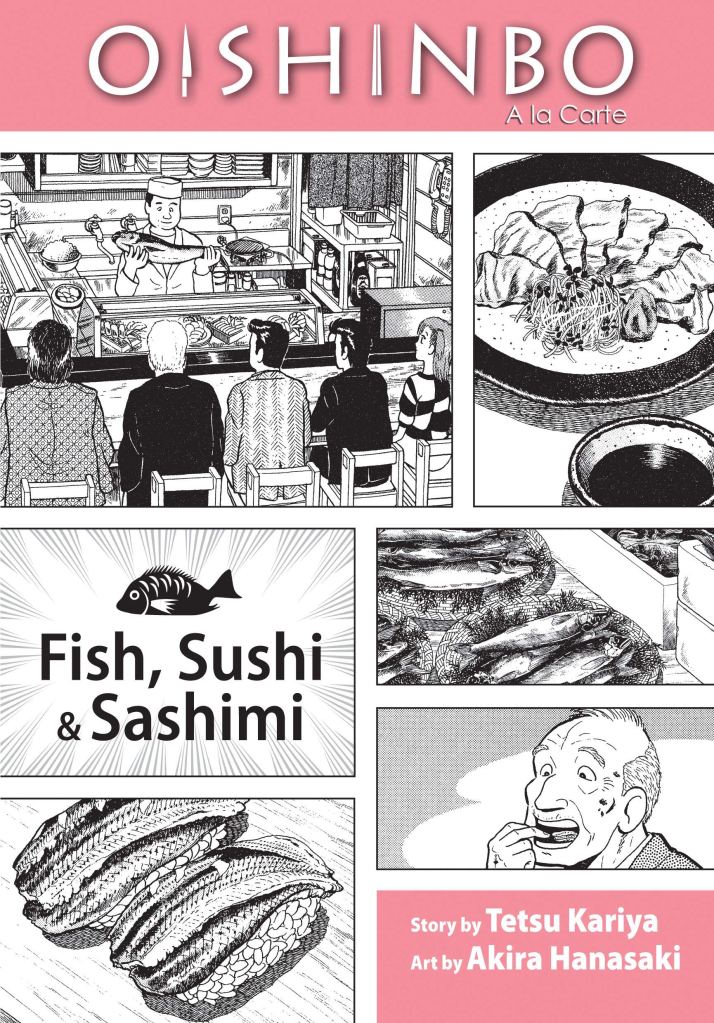
The cover of Oishinbo: Fish, Sushi, and Sashimi is a collage of black and white art depicting a group of patrons seated at a sushi bar watching the chef hold up a large fish for their approval; several plates of sushi and sashimi; a hungry patron; and a logo depicting the subtitle with a fish above it.

By Khaleel G.

One of the great things about manga is the wide range of topics authors can focus on. Sure, there are still those popular power fantasy series, with heroes rising from lowly origins to take on a supreme evil. Dragon Ball Z or Kimetsu no Yaiba: Demon Slayer play a similar tune to Superman and Batman. Still, over the last few decades, comics in the West have stretched outside superheroes into new genres, like autobiography, travelogues, and other strange and unique styles of story. There’s no shortage of variety for a graphic novels reader in 2021.

But there’s one genre that the west hasn’t really explored, while manga has done so quite thoroughly: food. Yes, manga about baking, frying, cooking, and eating – they exist, and they’re quite popular, too!

More interestingly, as a genre, food manga isn’t strict about its features. In “shonen” manga, like Bleach or Naruto, there’s a specific path the hero follows, training to becoming better and overcoming new challenges to fulfill their dream. In romance manga, like Skip-Beat or Nana, our protagonist stumbles into young love, leaving us to wonder if those two crazy kids will or won’t finally kiss (until they finally do (at the very end)).

But in food manga, you can really mix any other genre – like documentary or fantasy or combat or history – with the presentation and description of some aspect of food and cooking. The results can be intensely different!

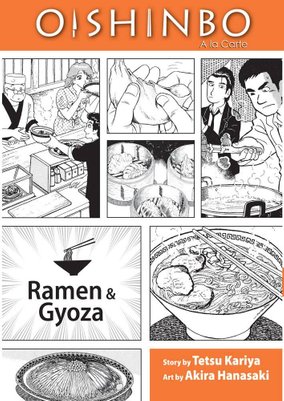
The cover of Oishinbo: Ramen & Gyoza depicts a collage of black and white drawings: a cook handing a bowl to one of two seated patrons, one of whom is already eating; a pair of hands holding a single gyoza; a cook preparing a dish as someone looks on behind him; and two dishes of food, one ramen with chopsticks resting on the rim of the bowl. The subtitle is depicted with a ramen bowl in silhouette, with chopsticks above holding some ramen aloft.


Oishinbo is a more direct sort of food manga. In each of its six volumes, its author, Tetsu Kariya, focuses on a different aspect of Japanese cuisine and food culture (helpfully described in each title). In one volume, we can learn about ramen and gyoza (fried dumplings), those two staples of Japanese street food, and in another, a deep dive into sushi and sashimi, two varieties of raw fish with rice. Of course, there are gorgeous drawings of the dishes, feeding the reader’s eyes in the same way Studio Ghibli films do. But along the way, we’re told more about the history and culture surrounding the food, in addition to the step-by-step process of making each. 

But this isn’t a printed Instagram feed of cool food art – no, there is a plot! Or, at least, there are characters. Shiro Yamaoka is a journalist who has a troubled family history with cooking, but he still tries to develop the “Ultimate Menu” as a project, visiting restaurants and chefs across Japan. He is joined by Yuko Karita, his assistant, as they sample foods and consider the history of the dishes alongside their own experiences. Keep in mind: Oishinbo ran for over 30 years and 111 volumes, and these few volumes we have are an “A La Carte” compilation. As such, the overarching story has been compressed and mostly removed, resulting in these translated volumes feeling like episodes of documentary travelogue. And that’s alright by me!

Reflecting the time in which the manga started, the characters have a very 1980s aesthetic to their designs. For long-time readers of comics, the style can be nostalgic, but even for new readers, I think the clearer and less-cute style helps the manga’s focus come through much clearer. And that focus? Food is good. It’s a perfect mini-series for amateur chefs, readers new to manga, or for anyone who wants to know more about Japanese cuisine.

The cover of Delicious in Dungeon Vol. 1 shows a young man in armor with brown boots and a bedroll on his back, holding a spatula and frying pan. He appears to be in a castle dungeon, with other characters deeper in the hallway behind him, as well as a red dragon approaching that none of them see because their backs are turned.


On the far end from the realism of Oishinbo is Delicious in Dungeon, by Ryoko Kui. Yes, that’s a silly title, but this is a very silly series – about fantasy food!  One of the recent trends in anime/manga are stories featuring western-style fantasy, a la Lord of the Rings, Dungeons & Dragons roleplaying, and console roleplaying video games. Delicious in Dungeon is about a party of adventurers in such a fantasy world. You have Laios, the dimwitted human knight, Marcille, the squeamish elf mage, and Chilchuck, the halfling lockpick. They’re trying to get to the bottom of the dungeon to save Laios’ sister, but man, it’s a long way down…

During one of their hungrier moments, they meet Senshi, a dwarf, who shows them the craft of cooking beasts they find (and fight) in the dungeon. Which is, as you might imagine, a strange prospect for our adventurers, who aren’t sure if they want to eat boiled mandrakes or a wyvern egg scramble. But Senshi shows them the benefits and necessity of “eating off the land,” as they can delve deeper by cooking along the way. 

So we have action and fighting, as the party battles various mythical monsters. But then we get Senshi cooking their conquest over a fire, using his shield as a wok. Kui draws the process of cooking and the final dish with the same care as Kariya did in Oishinbo, but instead of buckwheat noodles, it’s tentacles. Recipes are included with each fantastical dish, making the whole thing seem both real and absolutely ridiculous. Yet, you know, that roast dragon flank does look pretty good…

These are just two examples of food manga we have at HCLS! We have other series too:If you’re looking for another fantasy cooking series, Drifting Dragons has a visual style and tone similar to Delicious in Dungeon, but a large world and character designs reminiscent of Nausicaa of the Valley of the Wind.

If you’d rather have a more cozy experience, Otherworldly Izakaya Nobu is a slice of life story of fantasy characters (I told you it was a popular topic) magically transporting into an izakaya, a sort of pub in Japan. 

  • If you’re looking for another fantasy cooking series, Drifting Dragons has a visual style and tone similar to Delicious in Dungeon, but a large world and character designs reminiscent of Nausicaa of the Valley of the Wind.
  • If you’d rather have a more cozy experience, Otherworldly Izakaya Nobu is a slice of life story of fantasy characters (I told you it was a popular topic) magically transporting into an izakaya, a sort of pub in Japan. 
  • And if you’d rather have some competition with your food, Food Wars! is a fun shonen series, wherein chefs compete in cooking duels to see who’s the best. 

Whether you’re new to comics or if you’re just hungry for something new (ha), food manga is a genre worth sampling. 

Oishinbo and Delicious in Dungeon, and the above-listed series, are available in print from HCLS.

Khaleel has worked at the Miller Branch since 2015, though he’s been back and forth between HCLS and high school, college, and graduate school since 2003.

Leave The World Behind by Rumaan Alam

The cover shows tree branches in a dark silhouette with a dark blue sky, with the corner of a turquoise swimming pool and a lighter blue diving board with triangular metal handles in the foreground. The title, in block letters, is in complimentary shades of turquoise and blue.

by Aimee Z.

Is allyship a myth?  

Rumaan Alam explores this and more in his astute and fascinating third novel, Leave The World Behind. It begins simply enough:  A white Brooklyn family leave their hipster digs for an Airbnb week in the Hamptons. Like many Americans, Amanda, Clay, and their two teens view a beach vacation as an entitlement. It must be perfect – down to the SPF that won’t hinder your tanning goal.  

En route, Amanda orders Clay to stop at a small grocery store where she buys staples for the week: sustainable napkins, sourced maple syrup, even, Alam slyly adds, that “politically virtuous ice-cream, Ben and Jerry’s.” They pull up to the modest beach cottage and are delighted with the view of the water, a hot tub – even a pool. They barbecue, break out a $12 bottle of wine, swim – Amanda and Clay even have vacation sex that night.  Everyone falls into a blissful sleep as you, the reader, curl up with what feels like another mindlessly generic beach read.  

Then: there’s the proverbial knock at the door. It wasn’t a good thing for Little Red Riding Hood or Hansel and Gretel, and it surely can’t be for Amanda and Clay. They know that the only good door knock anyone ever gets is from an Amazon delivery driver. Eventually, Clay peeks through the chained door and is greeted by an elderly African-American couple: G.H. and Ruth. 

Calmly and politely, they explain that they are the owners of the Hampton vacation house that Amanda and Clay are enjoying. Amanda clutches her phone, Alam writes, like it’s a soft toy. She’s convinced they are scammers. Worse, this is a home invasion – especially when G.H. and Ruth cook up some lie that all of Manhattan (where they were staying) has succumbed to a total blackout. 

Suddenly, that beach read you thought you were enjoying has become something entirely different – its focus now a witty and revealing spin on the social dynamics between black and white. And it is. Sort of. 

Eventually, G.H. and Ruth (over G.H.’s private stash of very old whiskey) convince Amanda and Clay that some kind of crisis must be taking place. No internet, a consistently blue TV screen, as well as dead cell phone reception are worrisome though not alarming – until Amanda and G.H. spot a flock of pink flamingos in the pool and an unearthly sound, capable of chaos, brings them all to their knees. 

Eloquent and urgent, especially as we come out of this last and devastating year, Leave the World Behind is the one book everyone must read. 

Leave the World Behind is also available at HCLS as an ebook and an eaudiobook through Libby/OverDrive.

Aimee Z. is part of the adult research staff at HCLS East Columbia Branch. She lives on a lake with her two labs, Dixie and Belle, who enthusiastically approved the content of this review in exchange for a peanut butter and jelly biscuit.

Definitely Hispanic by LeJuan James

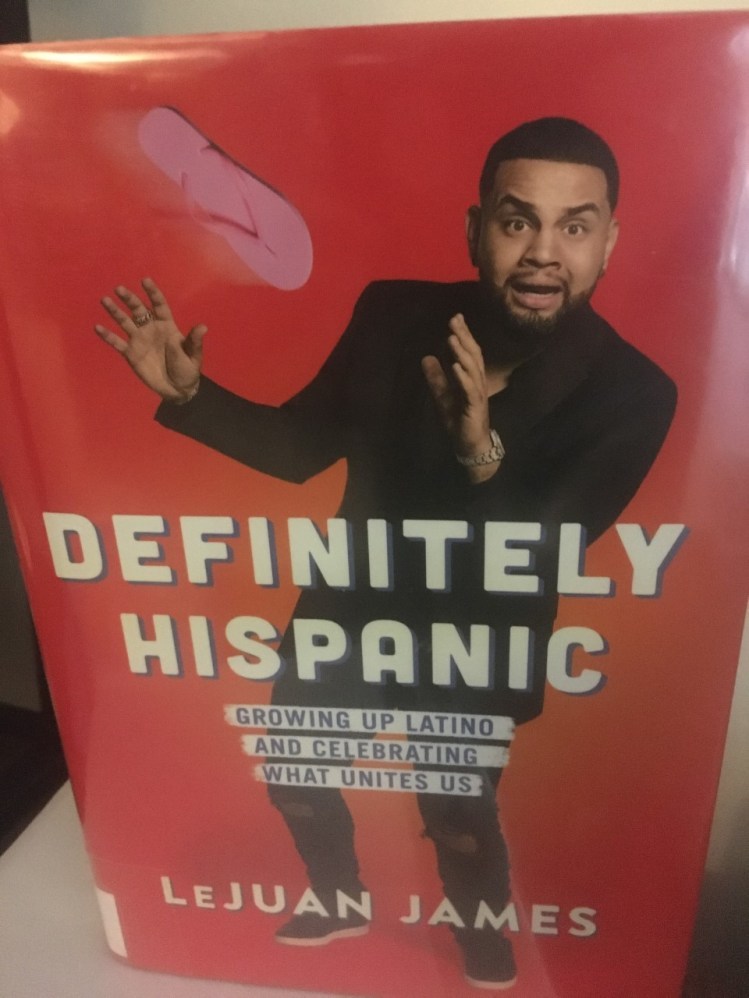
The book cover shows the author in a black suit and sneakers with a startled expression on his face, about to catch a pink flip-flop that is flying towards him through the air. He is posed against a red background.

By Carmen J.

With racial equity at the forefront for the library and the county, a much-needed read on Hispanic life crossed my path recently. 
For those who may not know, I’m Cuban American. I’m in that nice little hybrid world of always exploring my Cuban-ness amidst my American-ness. I’m often torn between both worlds and questioned if I was Cuban enough for not speaking enough Spanish and not having a plethora of Hispanic friends. Yet my childhood and its lasting effects on my family orientation, personality, and work ethic set me apart from some of my “American” counterparts.

Long story long – another lovely Hispanic trait – I’m recommending Definitely Hispanic: Growing Up Latino and Celebrating What Unites Us by comedian and YouTuber LeJuan James (in homage to Lebron James, with his real name: Juan Atiles) for your primer on Hispanic and Latino life. James started as a Vine creator and moved on to YouTube with his hilarious parodies of his parents. The short, family-friendly videos highlight the realities of Hispanic culture in a good-natured format with himself acting out all of his characters (including his mom while keeping his signature beard, no less).

This engaging and honest book of essays brings to light all of the memorable things I appreciated while growing up Hispanic, including celebrating holidays dressed in all of our finery with an open door of family and friends; enduring the family gossipers and “roasting” (such as comments on weight gain or a less-than-becoming outfit) by relatives; escaping spankings via “la chancla” in a thrilling game I’d refer to as dodge-belt; watching telenovelas;  and the comical list goes on and comically on.

James’ musings focus on the funny as well as tender-hearted moments surrounding his nomadic upbringing between the Dominican Republic, Florida, and Puerto Rico. In addition, he beautifully shares the strong influences of his mother and grandmother and their impacts on his work as a YouTuber. The book serves as an education on Hispanic culture, without falling into caricature or stereotypical territory. The essays are detailed and full of heart. They served as a reminder to this Cuban American that the joys of being and growing up Hispanic involve more than language.

I encourage you to check out his short and funny posts on YouTube. Here is one of my recent favorites: 
https://www.youtube.com/watch?v=czUIhnOwAE0

Definitely HIspanic is also available as an ebook and an eaudiobook from Libby/OverDrive and as an eaudiobook from CloudLibrary.

Carmen J. is a teen instructor at HCLS East Columbia. Among her favorite things are great books, all things 80s, shamelessly watching The Bachelor, gardening, and drinking anything that tastes like coffee.

Summer Fun with #ELKReads

by HCLS Elkridge Branch Staff

The past year (plus) has been hard for everyone. As we start to move toward something approaching our previous normal, many families are looking for special ways to enjoy the summer. The Elkridge staff has selected a wide range of titles for all ages to inspire and entertain, no matter your plans for the summer. Read fun stories together, learn about activities that you might try out, or plan a trip to take. If you’re not ready to travel for real, armchair traveling along with authors and photographers is the next best thing. Let the library help you make memories all summer long with these fun reads and many more! Join Summer Reading and check out our calendar to find classes and events for even more summer fun. 

Summer by Ailie Busby Our Celebración! by Susan Middleton Elya Cannonball by Sacha Cotter Where Is Baby's Beach Ball? by Karen Katz One Hot Summer Day by Nina Crews Where's Rodney? by Carmen Bogan

For Little Kids 

Cannonball by Sacha Cotter and illustrated by Josh Morgan 

How would you perform the most perfect cannonball into the pool? Would you wiggle your arms and do a little twirl? That is just what the main character of our story is trying to figure out. Join your little one this summer and learn about overcoming fears, being true to yourself, and nailing your perfect cannonball!

One Hot Summer Day by Nina Crews 

What can you do outside when it feels too hot to do anything? Can you shade yourself from the sun or chase your shadow? Explore all the fun things in this book you can do on a hot summer day or even during a sudden summer thunderstorm!

Our Celebración! By Susan Middleton Elya and illustrated by Ana Aranda 

This rhyming, bilingual story invites readers to join a small town’s summer celebration, which even a rain storm can’t diminish. The illustrations give a glimpse into the full range of festivities, including foods, parade floats, animals, and even a firework celebration to end the night. A glossary at the end helps readers learn new words found in the text.

The cover of The Nebula Secret by Trudi Trueit depicts a boy and girl jumping from a high cliff into blue water, with orange butterflies in the background. The cover of The Season of Styx Malone by Kekla Magoon depicts a boy in a backwards baseball cap and jean shorts diving into a pool over the heads of two friends who are seated by a small waterfall watching him. 
 The cover of Aquicorn Cove by Katie O'Neill shows a redheaded girl in blue shorts and a beige top riding a peach-colored "aquicorn," or aquatic unicorn, over the waves with mountains and clouds in the background.  The cover of Backyard Adventure: Get Messy, Get Wet, Build Cool Things, and Have Tons of Fun! 51 Free-Play Activities by Amanda Thomsen is a collage of photos showing children doing fun outdoor activities including science experiments, a tire swing, performing on an outdoor stage, banging on a wall of noise, and making exploding sidewalk chalk. 
 The cover of Ranger Rick Kids' Guide to Hiking: All You Need to Know About Having Fun While Hiking by Helen Olsson shows two hikers in silhouette with trekking poles and backpacks, one looking through a monocular and one pointing at the other, with mountains and pine trees in the background against a yellow-orange sky.  The cover of The Parker Inheritance by Varian Johnson depicts two children biking on the sidewalk of a small-town street, one wearing a backpack, with an antique store and other local businesses in the background.

For Big Kids 

Aquicorn Cove by Katie O’Neill 

When Lana and her father return to their seaside hometown to help clean up after a terrible storm, she begins to remember how much she missed the sea, as well as her aunt. As Lana explores the beach, she discovers something wonderful: a colony of aquicorns. She rescues an injured aquicorn and cares for it with the help of her aunt, who seems to know far more about these incredible creatures than she’s letting on.

The Nebula Secret (Explorer Academy Series Book 1 of 5) by Trudi Trueit (also available as an eaudiobook on Libby/OverDrive)

If you loved the questing and mysteries of Harry Potter, the puzzles of The Mysterious Benedict Society, or the thrilling history of I Survived books, The Nebula Secret by Trudi Trueit will keep you on the edge of your seat. This book is the first in a fantastic adventure series by National Geographic that’s full of action, cutting-edge tech, and plenty of surprises. Join a diverse and relatable cast of tweens as they train to become elite explorers. Cool maps and real photos take this captivating story to the next level.

Ranger Rick Kids’ Guide to Hiking: All You Need to Know About Having Fun While Hiking by Helen Olsson 

Hiking is a fun summer activity for children to explore! This great book introduces hiking and hiking safety to children, including topics such as trail etiquette, staying safe, and what to wear. Check it out to prepare for family fun on trails in and around Howard County.

The cover of When Dimple Met Rishi by Sandhya Menon shows a girl with a bright smile and an orange shirt drinking a cup of iced coffee through a plastic straw.  The cover of Camp So-and-So by Mary McCoy depicts a black raven on top of the sign for the camp, which is attached to a tree stump in a ghostly wood.  The cover for  Unbored: The Essential Field Guide to Serious Fun by Joshua Glenn and Elizabeth Foy Larsen shows line drawings of various summer objects and activities such as lawn chairs, flashlights, guitars, microphones, cameras, and pizza, among many others.  Anna K: A Love Story by Jenny Lee shows the title character in a tan jacket and blue-lensed glasses, looking up into a bright blue sky.  The cover of Witch Hat Atelier by Kamome Shirahama depicts a girl in white robe, blue coat and pointed blue and white hat, gesturing with an arm out as if casting a spell.  The cover of A River of Royal Blood by Amanda Joy shows two women facing each other, one in a silver collar and brown robe with tattoos on her outstretched arm holding a dagger, the other also in a silver collar with a teal dress, holding a glowing orb.

For Teens 

Camp So-and-So by Mary McCoy (also available as an ebook on Libby/OverDrive)

Twenty-five campers who were invited to Camp So-and-So back in February arrive in the summer to discover that this is a wholly different kind of camp. Rather than arts and crafts, activities on the lake, or friendly games, the girls at Camp So-and-So have been divided into five cabins that each have to navigate unexpected and sometimes quite frightening challenges. Trapped in this remote camp with no adult supervision to be found, the campers are forced to find their own way in this creative, unusual story.

A River of Royal Blood by Amanda Joy (also available as an ebook on Libby/OverDrive)

In the land of Myre, Eva is princess born with a dark and terrible magick inside her, one that has not been seen for generations. Eva must learn to harness this power to defeat her sister, Isa, in a battle to the death to ascend to the throne.

Unbored: The Essential Field Guide to Serious Fun by Joshua Glenn and Elizabeth Foy Larsen 

Readers will find plentiful inspiration in this volume with a wide range of activities for young people, keeping them entertained all summer long. Some old favorites are sprinkled among creative new adventures for kids and teens, with detailed instructions and safety guidelines as needed. Vibrant illustrations and extras such as timelines, trivia, and interviews, bring this book to a level beyond your traditional how-to.

The cover of Destinations of a Lifetime: 225 of the World's Most Amazing Places (National Geographic, author not listed) is a photograph of a wooden house set into the side of a tall cliff, with a blue cloudy sky and mountains in the background.  The cover of Great Hiking Trails of the World: 80 Trails, 75,000 Miles, 38 Countries, 6 Continents by Karen Berger is a photograph of Mt. Ngauruhoe,  along the Tongariro Crossing on North Island, New Zealand. The cover of Secret Journeys of a Lifetime: 500 of the World's Best Hidden Travel Gems (also National Geographic, author not listed) is a photograph of rows of lavender plants in a sunny field. The cover of My Mamma Mia Summer by Annie Robertson depicts a straw beach bag with overhanging towel and sunglasses, flip flops, and a beach hat on the sand overlooking the Mediterranean.  The cover of The Jersey Shore Cookbook: Fresh Summer Flavors from the Boardwalk and Beyond by Deborah Smith shows a lifeguard stand and beachgoers by the shore with a roller coaster and ferris wheel on a pier in the background.  The cover of Motor Crush by Brenden Fletcher depicts the main character, Domino Swift, dressed in bikers' gear and perched on a motorcycle, looking back over her shoulder with a board with nails sticking out over her other shoulder.

For Adults

Destinations of a Lifetime: 225 of the World’s Most Amazing Places 

If you are planning an epic journey for this summer, next year, or sometime in the next ten years, you will want to check out this book on awesome places to visit. In fact, even if you are not planning to leave your zip code at all, the dramatic and colorful pictures captured in Destinations of a Lifetime will brighten your thoughts and your coffee table. The travel section at your local library is the perfect place to go to plan vacations, staycations, and to feed your imaginations.

Motor Crush by Brenden Fletcher, Cameron Stewart, and Babs Tarr

In the stylish, futuristic city of Nova Honda, Domino Swift is a champion motorcycle racer. By day, she competes in the World Grand Prix, earning fame and fortune, and by night, she races on the streets, pulling off dangerous maneuvers and making risky bets to score Crush, the illegal engine stimulant her body needs to survive.  Filled with hot locales and cool characters, this graphic novel has all the fast-paced action and fun of a favorite summer blockbuster.

My Mamma Mia Summer by Annie Robertson 

Pick up this charming summer read to join Laurel as she takes her recently deceased grandmother’s words to heart and jets off to Greece to follow her dreams. As she lives out her own version of her favorite movie, Mamma Mia!, Laurel finds herself feeling more at home than she expected on her vacation. With romance blooming, will Laurel decide that Skopelos is where she’s truly meant to be?

Author Works with Daniel Silva

Photo credit: Marco Grob. Author wears a dark jacket, a white shirt, and black framed glasses. He leans against a wall with his arms folded
Photo credit: Marco Grob

by Kristen B.

ONLINE EVENT: Wed Jul 21 7 – 8 pm
Register at hclibrary.org > classes & events

WIN A BOOK!  One hundred lucky Zoom (randomly selected) attendees will win a hardback copy of The Cellist by Daniel Silva. Book giveaway sponsored by Friends & Foundation of HCLS.

What do you consider ideal summer reading? Do you dive into doorstop-sized classics or do you look for a bit of fun fluff to read in the sunshine? I think summer is a great time to fall into a series and get to know one set of characters. Sometimes, it’s the perfect time to re-acquaint myself with a long-running series that I’ve let languish.

Such is the case with Daniel Silva’s spy thriller series featuring Gabriel Allon, which began in 2000 with The Kill Artist. Gabriel Allon may be the perfect action-adventure hero. Honestly, I’m surprised there isn’t a film franchise yet. He’s darkly handsome, desperately in love with his young beautiful wife, has a tragic, haunting background, and works as an art restorer of Renaissance paintings. He resides in a cliffside cottage in Cornwall and goes for long brooding walks between missions. What’s not to love?!

About those missions: Gabriel Allon is also an operative for the Israeli version of the CIA (referred to in the books as The Office), and he travels the world with his trusted team protecting the safety and integrity of his homeland against all sorts of criminals, politicians, terrorists, and other nefarious folks. This series never disappoints with books set in Germany, France, Switzerland, the Vatican and Italy, Israel, Afghanistan, Russia, and the US. Often, many of those countries are involved in one story’s whirlwind, time-racing plot. As with many books in this genre, these are not for the faint of heart, as they contain graphic violence and hard people making hard decisions, most of whom will do anything to advance their own agendas and desires.

As I mentioned above, I plan to spend this summer jumping back into this series since I’m a couple of books behind. The last one I read, The Black Widow, published in 2016, is probably the best spy thriller I’ve ever read. It encompasses modern geopolitics, ancient grudges, double agents, and enough heart-pounding action that I’m pretty sure I lost sleep to finish it. The books are also excellent audiobooks, if you prefer to listen (beware the inevitable point of not being able to stop the story, though).

Book cover for The Cellist: A woman wearing a bright red coat and high black heels walks with her back to the reader. The cover is a bright blue that fades to black along the edges.

So, I invite you to join me at an upcoming Author Works event with author Daniel Silva! His newest novel (being published July 13), The Cellist, follows up the acclaimed #1 New York Times bestsellers The Order, The New Girl, and The Other Woman with a riveting, action-packed tale of espionage and suspense. The fatal poisoning of a Russian billionaire sends Gabriel Allon on a dangerous journey across Europe and into the orbit of a musical virtuoso who may hold the key to the truth about his friend’s death. The plot Allon uncovers leads to secret channels of money and influence that go to the very heart of Western democracy and threaten the stability of the global order. The Cellist is a breathtaking entry in Daniel Silva’s “outstanding series” (People magazine) and reveals once more his superb artistry and genius for invention—and demonstrates why he belongs, “firmly alongside le Carré and Forsyth as one of the greatest spy novelists of all time” (The Real Book Spy).

Kristen B. is a devoted bookworm lucky enough to work as the graphic designer for HCLS. She likes to read, stitch, and take walks in the park.

Another Country

The Penguin Classic cover features red cut-outs of figures layered over a neutral background.
Penguin Classic edition

by Ben H.

“Beneath them Rufus walked, one of the fallen – for the weight of this city was murderous” 

James Baldwin

Another Country is a novel that’s more like a play or a poem. Short descriptions set scenes like flashes of light, and dialogue propels us through the story. James Baldwin is brilliant and empathetic; his depiction of humanity is beautiful. Passages that make you weep are followed immediately by passages that make you laugh. Dark episodes in the cold rain follow erotic passages in warm apartments. Baldwin’s relentless prose attack zigs and zags at the reader, and he never lets up. He pulls the threads of the tangled ball of relationships at the center of the novel tighter and tighter. Another Country is addictive and almost unbearably tense. 

Baldwin explores race, gender, sexuality, religion, art, and life in America in the 1950s through the interactions of a group of memorable characters. First, we meet Rufus Scott, a black jazz drummer, stumbling out of a movie theater in New York, disheveled and desperate. His experience as a black man in America is really the central pillar of the story. His wretched love/hate relationship with Leona, a white woman from the south, ruins both of their lives and sets a grim tone for a serious book. Vivaldo, a white man, is arguably the main character. Vivaldo is a struggling writer and Rufus’ best friend. Vivaldo is everywhere. He felt to me like a stand-in for James Baldwin himself.

France offers the reader a brief respite from the grimness of New York. We first meet Eric and his boyfriend Yves on a French beach. The passages set abroad are lovely and warm, while the scenes in New York are often brutal and freezing or unforgiving and sizzling. Baldwin’s depiction of France juxtaposed with that of America neatly illustrates the way Baldwin, a gay black man, felt in France versus the way he felt in the United States.

The many protagonists provide a narrative richness I really loved. Besides Rufus and Vivaldo, Cass (maybe my favorite character), Ida (Rufus’s sister and an incredible character), and Eric (in his own way the heartbeat of the book) are the other main players in this story of relationships and race. The New York Times compared Another Country to T.S. Eliot’s The Waste Land, and I think it’s a great comparison. Baldwin also brings the furious pace of a sax solo to his poetic novel. If you want to know what it’s like to read Another Country, listen to “Countdown” off of John Coltrane’s Giant Steps.

Another Country really does have a momentous heft to it. Baldwin, like an alchemical wordsmith, achieved something magical with everyday material. On the surface, it’s just the story of a few overlapping relationships during the 50s. But by the time you turn the last page, it feels like you’re holding something vital in your hands. I really do believe that books like this can change the way people view and treat one another.

If you’ve already read Another Country, visit HCLS and see if we have a Baldwin that you haven’t yet read (or if we can recommend something similar). If you haven’t read Another Country, you have money in the bank. You can’t go wrong with Mr. Baldwin.

Ben Hamilton works at Project Literacy, Howard County Library’s adult basic education initiative, based at HCLS Central Branch. He loves reading, writing, walking, and talking (all the basics).

Youth and Heartache in Four Volumes: Our Dreams at Dusk

Cover of "Our Dreams at Dusk" manga with a monotone illustration of the main character looking disheveled and distraught, with a cityscape in the background.

Content Warning: Suicidal ideation

by Khaleel G.

Reading a multi-book series can be a bittersweet thing. On one hand, you get to spend more time in the world of the story, more time with the characters, seeing them grow and change with each volume. On the other hand, even the best series must ultimately end, or risk devolving into endless sequels with lesser and lesser impact. How does an author balance continuing a story versus ending it?

In the world of graphic novels, this is an eternal problem. For superhero comics, authors and illustrators can swap in and out, resulting in entirely different styles – sometimes, Batman is a gritty noir detective, and other times, he’s an ultra-genius rubbing elbows with omnipotent aliens. For manga, authors don’t often get replaced, but over the course of a long series, the authors themselves change, for better and for worse. Compare the first volume of Bleach with the sixtieth, and you’ll see an incredible difference in visual and narrative style. It can be jarring, particularly if you’re reading it after years (or decades) of publication.

This is why a short series can pack more impact in a few volumes. Our Dreams at Dusk is a perfect example. The author, Yuhki Kamatami, wrote twenty-three chapters, which are collected into a mere four volumes. You can hold the entirety of the tale in your hands.

And it is a tale to read, one that I didn’t want to end. Tasuku Kamane is a teen, hiding his sexual identity from his family and peers. He’s gay, and he loves his table tennis clubmate, Toma – but he can’t say anything, he can’t be himself. When his classmates discover some gay erotica on his phone, he’s driven to self-harm and worse. But at that darkest point, he meets Someone. 

Someone is a person who refuses to be identified, or even really known. At the top of the town’s highest point, they appear like a spirit to Tasuku, talking to him with a quizzical honesty. They guide him to the Drop-in Center, a local hang-out spot for LGBTQ+ people, those who can’t really be themselves out in the town. It is an oasis for Tasuku, exactly what he needed at the moment he needed it.

Tasuku realizing his feelings: illustrated as shards of glass reflecting a wide variety of images.


Haruko and Saki are a lesbian couple who haven’t made their relationship public to their families, but at the Drop-in Center, they can be together with a degree of comfort. Tchaiko is an older gentleman, who makes fine coffee and plays Tchaikovsky for the group, but quietly hides his long-term relationship with his partner. And over time, we meet Shuji, a middle schooler who is wrestling with how to identify, and others, all seeking some zone in which they can be accepted.

It is not a wholly happy tale. Tasuku and the others don’t always find acceptance among their family and friends – or even each other, at times. Feelings are stepped on, and feelings are crushed. Tasuku himself even hurts others, in his growing understanding of gender, resulting in some chapters that were incredibly hard to read. 

But by the end of the fourth volume, people have changed, mostly for the better. We see a small slice of each character’s journey, which will assuredly continue after closing the book. I put off reading the final volume for months, not wanting the story to end – partly because I didn’t want to discover an unhappy ending for anyone, and partly because I didn’t want it to be over. But it ends as best it can, and for that, I am grateful. Even Someone has their mystery revealed (but not the whole of it, just as they’d prefer). 

There is a certain aspect of Our Dreams at Dusk that feels like checking off the boxes of the LGBTQ+ experience, ensuring the story represents some major facets of gender and sexual identity. On one hand, it can seem a bit forced, but on the other hand, I wasn’t thinking about that at all – the art carried me along, finding ways to say what words couldn’t. This is the sort of illustration that captures youth and longing, commitment and family, those experiences that are universal and those that are entirely specific to one human being. The art is sometimes fragile, and sometimes harsh, but it always finds a way to visually speak to the interior experience, in that way only masterpieces of graphic novels do. 

Our Dreams at Dusk is an LGBTQ+ story, but to sell it as only that wouldn’t be right. It’s a coming of age story, and a love story, and a mystery, with comedy and tragedy laced throughout. I’ve not read anything else quite like it in manga. Its handling of its characters and LGBTQ+ issues, particularly from a Japanese perspective, are unique, and all of this is built upon an amazing art style that shows off what this medium can do.

I can’t recommend it enough – to readers of manga, of LGBTQ+ fiction, and of quality books of any stripe. Plus, as I said, it’s only four volumes! So if you’re a tad nervous about reading a graphic novel series for the first time, this is a great one to start with, if you can handle a bit of heartache along the way.

Our Dreams at Dusk by Yuhki Kamatani is available in print from HCLS.

Khaleel has worked at the Miller Branch since 2015, though he’s been back and forth between HCLS and high school, college, and graduate school since 2003.

The Cold Vanish

The book cover is an aerial photograph of a mountainous area covered in conifers, with a cloudy gray-white mist settled over the dark green of the treetops.

“Searching for a missing person, after that first week, is a believer’s game” (219).

The Cold Vanish: Seeking the Missing in North America’s Wildlands is a gem of a book, written by Jon Billman, a fiction and journalism professor at Northern Michigan University. He also writes for Outside magazine, where I found the article that was the germ of the idea for The Cold Vanish. Billman tells the stories of a myriad of the disappeared, people who seemingly stepped off a trail at Mesa Verde or Yellowstone or Olympic and were never seen again. He intertwines their (shorter) stories with the book-length account of Randy Gray, father of Jacob Gray, a young man who parked his bike on the side of the road in Olympic and vanished into the woods of northern Washington. Although the disappearance is Jacob’s, the story really belongs to Randy, as we see the lengths he goes to in order to keep hope alive and continue the search for his son. Randy is a character – a Christian hippie surfer and building contractor, full of boundless energy and humor, enthusiastic, and generous. He is also willing to explore (if not exactly embrace with open arms) any theory that might locate Jacob and give him and his family some closure. My favorite anecdote about Randy: “Randy Gray cannot tell a lie, and so declares the two avocados rolling around somewhere in the back of the Arctic Fox when the customs agent asks if we have any produce. The agent pretends she doesn’t hear him, hands our passports back, and welcomes us to Canada” (274).

One of the stories really struck a chord with me. I’ve been to Mesa Verde, and walked the trail Billman mentions from the interpretive center to Spruce Tree House – “more of a sidewalk – it’s wheelchair accessible for less than a quarter mile, where visitors can view the [Anasazi cliff] dwellings from the shade of the overhanging cliff” (119-120). Yet 51-year-old Mitchell Dale Stehling disappeared while walking that trail and was not found until last year (his remains were located after the book was published, in August 2020). No other park visitor has stayed missing from Mesa Verde since the park was founded, and the area encompasses just over 50,000 acres. How could someone disappear off of a trail adjacent to the park’s gift shop?

The accounts of the disappeared have many explanations, some plausible, some completely off-the-charts crazy. I love a book like this that takes a journalistic viewpoint and presents the theories without passing comment; a book about conspiracy theories *not* written by a conspiracy theorist. In that respect, The Cold Vanish resembles another of my favorites in this genre, Where Bigfoot Walks: Crossing the Dark Divide by Robert Michael Pyle. In that book, acclaimed naturalist Pyle explains why the flora and fauna of the Pacific Northwest would be conducive to the existence of the Sasquatch – should such a creature exist. Like Pyle’s book, Billman’s presentation is open-minded and even-handed, and he makes valid observations and connections about why someone like Randy Gray might entertain the wild ideas of psychics and Bigfoot hunters. “Randy is the ultimate optimist. He’s wildly curious. The seeker from the Who song. ‘What else do I got?’ he says. ‘What else can I do?'”(217). Billman makes the reader understand Randy’s quiet desperation for any tenuous thread to follow.

He also explores other stories and disappearances: people who choose to go missing, the hunt for the Utah survivalist “Mountain Man” Knapp (who evaded authorities for seven years by breaking into remote cabins and stealing food and guns), and the serial killers in the Great Basin and in the Yosemite area who sought victims in remote wilderness areas. One of the best anecdotes is about Alan Duffy, a bloodhound trainer and handler who teaches his dogs, Mindy Amber and R.C., to search for the missing with a single verbal cue – either “Gizmo!” for cadavers, or “Find!” for a living person.

The book will leave you full of wonder at the majesty and hidden depths in what might seem like a benign, unspoiled setting, but which really harbors dangers that amateurs and enthusiasts ignore to their peril. You will also ponder the number of missing persons cases still unsolved: where are the (still) disappeared in our national parks and wild places, and will they ever be found?

The Cold Vanish is also available from HCLS as an eaudiobook from Libby/OverDrive.

Julie is an instructor and research specialist at HCLS Miller Branch. She loves gardening, birds, books, all kinds of music, and the great outdoors.