Introducing… Reads of Acceptance!

Horizontal rainbow stripes with an inset of triangle of white,

by Ash and Angie

C.S. Lewis once said that we read to know we are not alone, which is why many of us look to literature as a source of comfort. Years ago at the library, Angie helped a teen find young adult novels on coming out. The teen quietly said thank you, and afterwards, Angie could not help but notice that she went over to a woman whom she called “mom.” As she showed her the books, the woman hugged her and told her it was going to be okay.

One of the most rewarding opportunities while working in a library is being able to connect customers with reading materials that can make a profound impact in their lives. This holds especially true when dealing with potentially sensitive subject matter such as LGBTQ+ issues, which often come with fear of judgment. In Teri Gross’s All I Did Was Ask: Conversations with Writers, Actors, Musicians, and Artists, she interviews Ann Bannon, one of the first writers of lesbian pulp fiction. In answer to Gross’s question about what it was like to be gay in the 1950s or to write lesbian fiction, Bannon responds:

The big thing was ‘Thank God, I’m not the only one.’
That’s how isolated people were then.
But also that it’s okay to open up a little bit. It can be healthy. It can be a warm, generous, wonderful way to spend your life.
It is scary to walk up to a drugstore counter with your arms full of lesbian paperbacks and survive the stare from the clerk,
pull yourself together, buy them, and walk out with your head held high.

Having your voice heard and knowing there are others out there, both through the books you read and the people you meet and sometimes befriend, can go a long, long way to helping you survive in a world not always friendly to LGBTQ+ people. No matter your age, your background, your outness or your in-ness, you can find comfort in the universality of knowing “you’re not the only one.” That is one reason, among many, it can be so good to find a sense of community.

Howard County Library System’s new LGBTQ+ book club, Reads of Acceptance, holds its first meeting on Monday, April 19 at 7 pm. This monthly book club aims at fostering social support, personal growth, and intergenerational learning for LGBTQ+ adults and our allies. Reads of Acceptance will encourage education, reflection, and respect for LGBTQ+ identities by hosting group discussions that connect literature with our lived experiences.

Pale blue color with the title at the bottom shows a man in a blue suit falling. He is busy writing and papers surround him.

At Reads of Acceptance’s first meeting, we will discuss the Pulitzer Prize-winning Less by Andrew Sean Greer (also available in eBook and eAudiobook format). Funny yet also sad, the novel follows writer Arthur Less while he travels the world on a literary tour to try and get over the loss of the man he loves. Turning 50, Less finds himself struggling with life, including his career as a writer not going where he had hoped it would. Even so, he could handle being a bad writer, but being considered “a bad gay”?

That is so much harder to grapple with. It also speaks to a constant fear for queer people: that your community will reject you on top of everything else. (Source: https://ew.com/books/2018/07/24/less-summer-breakout-essay/) Greer’s writing speaks to an experience so many of us, queer or not, can relate to in a way that says, “Yes, I have been there.”

Relating to media in a manner that resonates with and reassures one’s identity is part of what makes seeing ourselves reflected in art and literature so affirming and powerful. Being able to relate to real-life people can be even more so. Both older and younger people in the LGBTQ+ community have often suffered in silence or experienced ostracism, looking for safe outlets to share their feelings, thoughts, and what they have been through. Reads of Acceptance can be one of those safe outlets. We hope to see you there! Register here.

For a special preview of Reads of Acceptance and an opportunity to meet Ash and Angie, join Book Corner on Friday April 16th @ 11am. Register here.

Angie is an Instructor & Research Specialist at the Central Branch of HCLS.

Ash is an Online Instructor & Research Specialist, also at Central Branch. Their favorite reads often involve magic, nature, queer and trans joy, coming of age, cultural traditions, romance, and cute illustrations.
Author event with Kekla Magoon

Photo of author Kekla Magoon, who has a wide smile, rectangular glasses, and short hair with lots of curls. She's wearing a deep V-neck in a black and white print, pictured with a green yard behind her.

One of this year’s Battle of the Books titles is The Season of Styx Malone by Kekla Magoon. The author is visiting virtually on April 14 for a 30-minute live Q&A! You may type your questions in advance within registration or hold them for the event.

The Season of Styx Malone tells the funny, poignant story about one amazing summer in small-town Indiana, when Caleb and Bobby Gene make friends with the slightly older, way cooler Styx Malone. Let’s be clear: Styx Malone is definitely too cool for school! He knows things… like about elevator trading, where you can essentially make something out of nothing. These boys are going to make a bag of fireworks (obtained by temporarily trading their baby sister) into a green moped. All these brothers want is to see the big city of Indianapolis, but their (maybe overly) protective father wants them to stay close to home in Sutton. The desire for adventure wars against the need for safety throughout the family’s interactions.

The boys follow foster child Styx into one “interesting” choice after another, hoping to achieve their dream of having independent mobility via the green moped, affectionately nicknamed Grasshopper. When things take a turn for the worse, everyone has to reconsider what a happy ending will look like. As Caleb and Bobby Gene lobby for adopting Styx, it turns out that adults can sometimes make good things happen. It’s a delightful book full of good humor from the point of view of three bored friends longing for more from summer than watering holes and doing chores (Mom was not happy about the baby sister trading).

Kekla Magoon is the author of many novels and nonfiction books for young readers, including The Season of Styx MaloneThe Rock and the RiverHow It Went Down, and the Robyn Hoodlum Adventure series

She has received the Margaret A. Edwards Award, the Boston Globe-Horn Book Award, the John Steptoe New Talent Award, three Coretta Scott King Honors, the Walter Award Honor, an NAACP Image Award, and been longlisted for the National Book Award. 

Kekla conducts school and library visits nationwide and serves on the Writers’ Council for the National Writing Project. She holds a B.A. from Northwestern University and an M.F.A. in Writing from Vermont College of Fine Arts, where she now serves as faculty. Visit her online at keklamagoon.com.

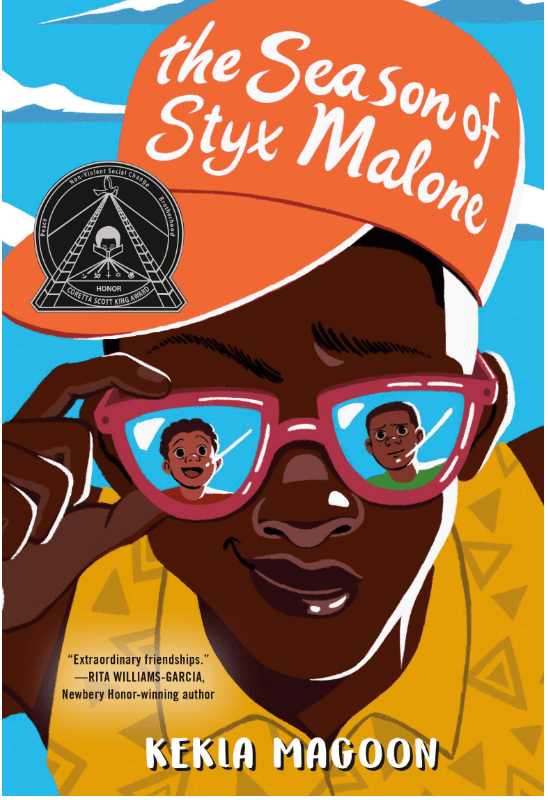
Cover art has an illustration of a Black teenager in a slightly off-center ball cap, adjusting his mirrored sunglasses. In the glasses, you can see two other Black kids. The title of the book appear in script on the orange hat.

The book is also available as an ebook, on CD, and as an eAudiobook.

Explore Nature with April #ELKReads

Spring is here! Temperatures are warming, plants are budding and blooming, and animals are reemerging – including creepy crawlies that we might be less than enthusiastic to greet. As you welcome the change of seasons, here are some reads that celebrate the natural world. Take a look below to find titles for all ages, and keep an eye on our social media to see additional suggestions for each age group.

A colorful collage of "Nature PIcks for Little Kids" with purple mountains in the background. Titles include: 
Plant the Tiny Seed by Christie Matheson whose cover features bright flowers and red type.
Call Me Tree/Llámame árbol by Maya Christina Gonzalez, which shows a boy in a green shirt and blue pants standing with arms outstretched in front of a tree.
Over and Under the Pond by Kate Messner and illustrated by Christopher Silas Neal shows a mother and child paddling along water and the rocks, reeds and fish under them.
The Invisible Garden by Valérie Picard and Marianne Ferrer has lush greenery enclosing a small girl in a blue dress.
What Does Bunny See? by Linda Sue Park and illustrated by Maggie Smith features a a small brown bunny in a colorful field.
Gator, Gator, Gator! by Daniel Bernstrom and illustrated by Frann Preston-Gannon has clear crisp painting of a girl with binoculars in a boat in a bayou.
:

For Little Kids:

What Does Bunny See? A Book of Colors and Flowers by Linda Sue Park, pictures by Maggie Smith

A rabbit explores a garden and finds flowers of every color, before hopping home for a nap and dreams of rainbows. Rhyming clues invite the reader to answer the question: What does bunny see? 

Over and Under the Pond by Kate Messner, illustrated by Christopher Silas Neal. Also available as an eBook.

Join your little one in discovering all the amazing creatures that live in the unique ecosystem of a mountain pond. As a boy and his mother paddle across the pond, they discover the interconnected nature of the creatures that call the pond home. Turn the pages to the end of the story to read facts about all the animals you see.

Call Me Tree = Llámame árbol by Maya Christina Gonzalez

Come balance, sway, sing, and stretch along with children imagining what it’s like to be a tree. Bright, colorful pictures show children of different backgrounds learning to embrace nature, each other, and themselves. The fun, singsong text is full of sweet affirmations written in both Spanish and English.

A colorful collage of "Nature PIcks for Big Kids" with purple mountains in the background. Titles include:
Wild in the Streets by Marilyn Singer and illustrated by Gordy Wright, which features a monkey with a juvenile on her back with a city in the background.
Love, the Tiger by Frédéric Brrémaud art by Federico Bertolucci shows a leaping, snarling tiger in full color.
Pilu of the Woods by Mai K. Nguyen has the title encircled by leaves and a child centered at the bottom holding a white flower.
Seedfolks by Paul Fleischman features a grid of six squares with pictures of a Black man, a pticher, and a young white woman in the top row; and an eggplant, an older white woman, and a jumprope in the bottom row.
One Well by Rochelle Strauss's cover features a coastline next to a rich blue sea.
Extinct by Lucas Riera has a collage of extinct and endangered animals on a pale yellow cover.

For Big Kids:

Extinct: An Illustrated Exploration of Animals That Have Disappeared by Lucas Riera

Explore the gorgeous illustrations in this volume filled with information about the species that have vanished over the last century. Along with the tragic stories of how many of these species have been lost to the world, this book also shares inspiring tales of species that were rediscovered and some that were successfully reintroduced into the wild.

Seedfolks by Paul Fleischman. Also available in eBook and eAudiobook format.

A vacant lot in inner-city Cleveland, Ohio brings together a community in unexpected ways in this classic tale. Follow the stories of 13 diverse residents as they discover the power of gardening and working together to heal and make change.

Wild in the Streets by Marilyn Singer

This richly illustrated book combines poems with the fascinating backstories of 20 animals who’ve figured out how to thrive in cities. From reticulated pythons in Singapore’s sewer system to coyotes in Chicago, discover why these animals came to be such close neighbors with humans. At the end of the book, enjoy bonus pages on poetry forms and resources to learn more about these clever creatures.

A colorful collage of "Nature PIcks for Teens" with purple mountains in the background. Titles include:
Zen and Gone by Emily France's cover is deep blue with orange, yellow, and aqua stylized trees.
I Am Still Alive by Kate Alice Marshall has a stark black and white cover with a pen/ink drawing of pine trees.
Feral Youth by various authors (Shaun David Hutchinson + 9 others) shows legs walking beside a puddle, reflected in the water, in watery blues and black.
Consider the Platypus by Maggie Ryan Sandford has a deep teal cover with a white circle from which a platypus emerges.
Up to this Pointe by Jennifer Longo shows a girl in a parka and a pointe shoes, with glaciers in the background, on a medium blue background.
Unicorn Power! by Mariko Tamaki features the manga illustration of a red-haired girl in rappelling harness.

For Teens:

Consider the Platypus: Evolution through Biology’s Most Baffling Beasts by Maggie Ryan Sandford, illustrated by Rodica Prato 

This beautiful nonfiction volume explores some of the quirkiest creatures you can find, along with more common animal companions and friends. Beginning with Darwin’s theory of evolution, the author also explains how advances in scientific knowledge, especially genetics, have expanded our understanding of how animals became their current selves.

Feral Youth

This multi-authored novel tells the story of ten teens left alone in the wilderness for a three-day survival test. The diverse group of troubled teens have to overcome their vast differences to survive in the wild with no readily available food or water, just the packs on their backs.

Zen and Gone by Emily France. Also available as an eAudiobook.

When Oliver takes a summer trip from the bustling city of Chicago to Boulder, Colorado, he experiences a bit of a culture shock. There he meets Essa, a nature-loving girl who plays wilderness survival games with her friends. The two begin to explore Buddhism and meditation at the local Zendo. When one of their survival games goes wrong, the two have to rely on their newfound spiritual strength if they are to save Essa’s sister, Puck, and survive the trip themselves.

A colorful collage of "Nature Picks for Adults" with purple mountains in the background. Titles include:
Down from the Mountain by Bryce Andrews has a rim-lit sihouette of a grizzly bear against a black ground.
The Overstory by Richard Powers shows a painting of a stand of trees, with an inset circle of the same picture smaller.
A Walk in the Woods by Bill Bryson has a the snout and ears of a brown bear peeking up from the bottom of the cover with green woods behind it.
The Drunken Botanist by Amy Stewart
has an old-fashioned typographical cover in greens and golds.
Gardenista by Michelle Slatalla shows the photo of a lush green garden on a misty morning.
Garden Renovation by Bobbie Schwartz features the photo of someone in an apron and gloves standing about potted decorative trees.

For Adults: 

Down from the Mountain: The Life and Death of a Grizzly Bear by Bryce Andrews. Also available in eBook and eAudiobook format.

In Montana’s Mission mountains, conservationist and rancher Bryce Andrews watches a young grizzly bear be tagged with a GPS collar. As the seasons pass, he tracks her through forests, cornfields, and cattle ranches as she struggles to feed herself (and later her two cubs) from a wilderness increasingly fractured by human use, while he works with farmers, hunters, and Native organizations to protect the bears. Tensions rise as bear encounters with humans and their property become more frequent and destructive, and, as a series of tragic events unfolds, Andrews eloquently wonders what can be done to find balance between these two species. While deeply personal and rooted firmly in the landscapes and culture of the American West, this story is also emblematic of global struggles where habitat loss is pushing wildlife into ever closer proximity with human settlements.

Garden Renovation: Transform Your Yard into the Garden of your Dreams by Bobbie Schwartz

Spring is upon us, and maybe you want to venture into the yard and get ready for outdoor living! In Garden Renovation, you’ll find practical do-it-yourself plans to build or re-build your garden environment. Like many gardening and outdoor project books, the beautiful pictures are just as much fun to look at and dream over as they are instructive. If you decide to take on a project, don’t forget the DIY Education Center can help!

A Walk in the Woods by Bill Bryson. Also available as an eBook, eAudiobooks on OverDrive or CloudLibraryaudiobook on CD, and as a Playaway.

If you’re not familiar with this humorous author, you are in luck, because we own many of his fantastic books. In A Walk in the Woods, Bill Bryson recounts his discovery of and attempts to hike the Appalachian Trail. In this book, you are not inspired by the story of a very fit hiker doing the entire trail from Maine to Georgia in record time, but rather laugh along with the story of an average middle-aged person and his old friend hiking and discovering together. While very funny, Bryson also weaves interesting trail history and social commentary into his tale. I always recall his comments on how few people walk in the woods, and how, after days in the woods, the modern world seems harsh, especially for those on foot. Robert Redford produced and starred as Bryson in the film adaptation, available on DVD

The Elkridge Branch + DIY Education Center opened the doors of its new building in March 2018. Our staff are always happy to help you with your questions about books, tools, technology, and more!

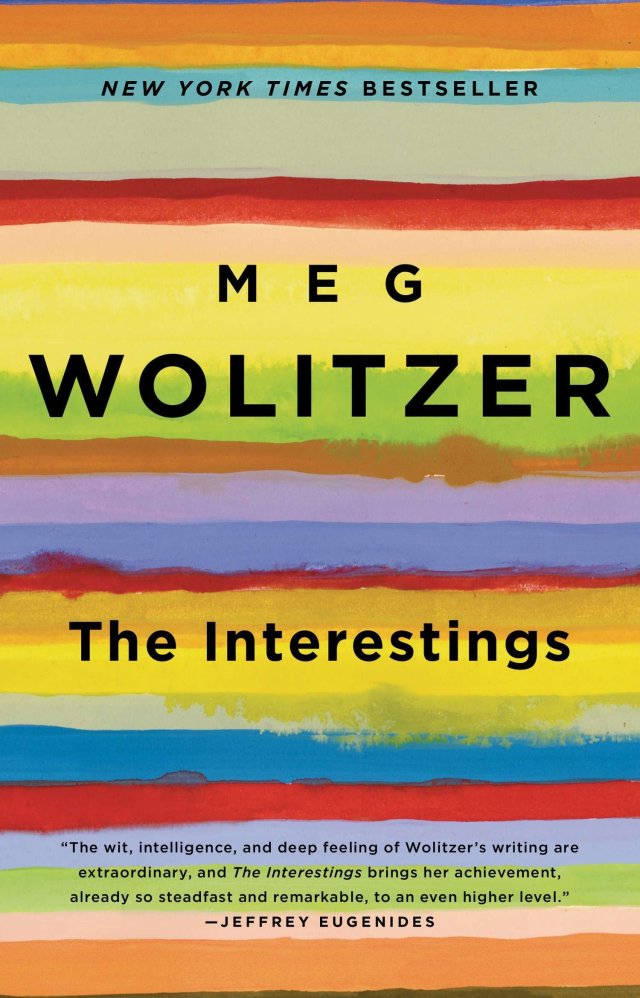
The Interestings by Meg Wolitzer

The cover shows the title and author's name against a background of brightly colored, wavy stripes in blues, greens, yellows, purples, oranges, and reds.

By Jean B.

The summer camp directories are out, and though summer will still be COVID-impacted, these camp listings have me thinking about the freedom and fun of summers past. Do you have any cherished (or miserable?!) summer camp memories? Do you think of s’mores or lakes or mosquitoes? While there are all kinds of camps and camp memories, one universal camp experience, it seems, is the intensity of friendships that form in that time-bounded space. When kids are briefly brought together from various places and situations and thrown into the intimate, shared life of a camp routine, something special happens.  

That powerful camp-created bond lies at the core of Meg Wolitzer’s engrossing novel, The Interestings. Six teenagers become friends at Spirit of the Woods camp in the summer of 1974, and the relationships they form with one another shape the rest of their lives. Spirit of the Woods is an arts camp, a place designed to foster talent and passion. Julie Jacobsen isn’t sure she belongs in this place but is thrilled when the self-named clique “The Interestings” enfolds her into their circle of specialness.

As the six kids grow, age, and build their lives and careers, Jules continues to measure her life against those of her camp friends and to use their experiences as a guide to what makes a life successful. Their diverse talents – so glittering in their camp days – play out in many ways in adulthood, and though the bonds of friendship provide a lifeline through crises, they also drive wedges as Jules’ and her friends’ fortunes diverge.  Through Jules’ eyes, readers can consider the question: what would you do for a friend?  

This beautifully written story made me think about my own friendships and how they’ve evolved over time. It swept me into the juicy world of these characters’ lives and relationships but also gave me lots to chew on – it’s both ice cream and salad, a perfect summer feast!  If you’re looking for something fun and, well, interesting, check out Meg Wolitzer’s The Interestings.

 Available in print and audio CD, or as an ebook and eaudio on Libby/OverDrive.

Jean B. is a Children’s Instructor and Research Specialist at the Central Branch and loves reading books for all ages when she isn’t enjoying the outdoors.

Reading Ursula K. Le Guin

The cover of "The Left Hand of Darkness" depicts a lunar-like surface with two opposite-facing profiles carved out of rock, against a dark sky.

By Eric L.

I read a lot of great authors, but that’s because I read great books! As we have been celebrating Women’s History Month, and HCLS has recommended a cornucopia of great material about and by women, I’d like to recommend the amazing Ursula K. Le Guin. 

Le Guin made a name for herself in the male-dominated world of sci-fi and fantasy half a century ago, and she wrote a great book about gender fluidity way before many others broached the topic. Le Guin said she recognized the ability to tell complex tales through the work of genre writer Philip K. Dick. Later, she openly criticized the way he wrote some female characters. Dick agreed, they became friends, and he thanked Le Guin for her influence on his subsequent works. I’d contend that in itself amounts to progress! 

A great starting point for Ursula K. Le Guin is watching Worlds of Ursula K. Le Guin on Kanopy. It provides a great introduction to the writer and her work. The interviews with the witty and charming Le Guin are terrific, as are the conversations with Margaret Atwood and Neil Gaiman and others about her influence on their writing and the genre. Gaiman astutely points out that the Harry Potter series owes a great deal to Le Guin’s Earthsea series.  

As I alluded to before, her most famous work The Left Hand of Darkness (also available in eBook and eAudiobook format) is a groundbreaking work, not just for the sci-fi/fantasy genre, but also for challenging our conceptions pf western masculinity and of western masculinity and femininity in a clever and subtle way. The protagonist, an envoy to the planet nicknamed Winter, struggles to understand a gender-neutral people using the social constructs of his own culture. Left Hand centers political intrigue and a forced epic journey across an icy planet while giving glimpses at the envoy’s gradual enlightenment. The drama and action of an arduous journey mirrors the personal journey of the protagonist and the relationships he builds.  

The Left Hand of Darkness is worth borrowing just to read Le Guin’s amazing introduction concerning science fiction and writing in general. Over the years, she has taken criticism for using the pronoun “he” for the gender-neutral characters in the book. To which she replied that just because the book was finished, it didn’t mean she was finished learning. I like this sort of thinking, the idea that we can all grow more and move forward. 

The cover for The Dispossessed depicts a man standing on a barren wasteland, looking towards another purple-toned planet with the sun peeking over its edge from behind, and a red-orange sky.

Le Guin’s other popular work The Dispossessed: An Ambiguous Utopia may be the perfect book for now, as the story of two opposing political views on how best to organize a society – collectivism versus individualism. The book examines power and extremes, and interrogates the best way for a society to temper those impulses. 

The protagonist Shevek (all names are computer generated) is a scientist from the anarchist commune-like planet, Anarres. Against the wishes of many of his people, he takes the opportunity to collaborate with the scientists of A-lo, on the planet Urras. The latter is a more individualistic, capitalist society. Shevek is attracted to the opportunity to further pursue his work, as he has begun to suspect that his society has some faults. Le Guin uses the protagonist’s perspective and experience to compare the two societies. The chapters alternate between Shevek’s youth and adulthood on Anarres and his present situation in A-lo. I thought this a clever technique, in a sort of nuanced compare and contrast story, but perhaps that’s just my conflicted mind? 

I believe Le Guin’s biases are evident, perhaps intentionally, but the book offers a provocative look at entrenched beliefs. The two societies are located on different planets and only know each other via their society’s own information (sometimes called propaganda), very similar to the way each of us arrives at our perspectives, beliefs, and, yes, biases. Le Guin cleverly has each society colloquially reduce the other to one-word epithets; the “propertarians” and “anarchists.” It’s certainly easier to believe we understand each other when we reduce ourselves to singular adjectives. 

This would be a great book to have people with opposing viewpoints read and discuss. The fact that Le Guin’s father was an anthropologist is evident in her work. Lastly, I’m inclined to conclude that Ursula K. Le Guin believes any thoughtful ideology should begin with a deeper understanding of each other and the forces that create fear and hate. 

Eric is a DIY Instructor and Research Specialist at HCLS Elkridge Branch. He enjoys reading, films, music, doing nearly anything outside, and people.  

The Actress and the Hunter: two (very different) classic movies

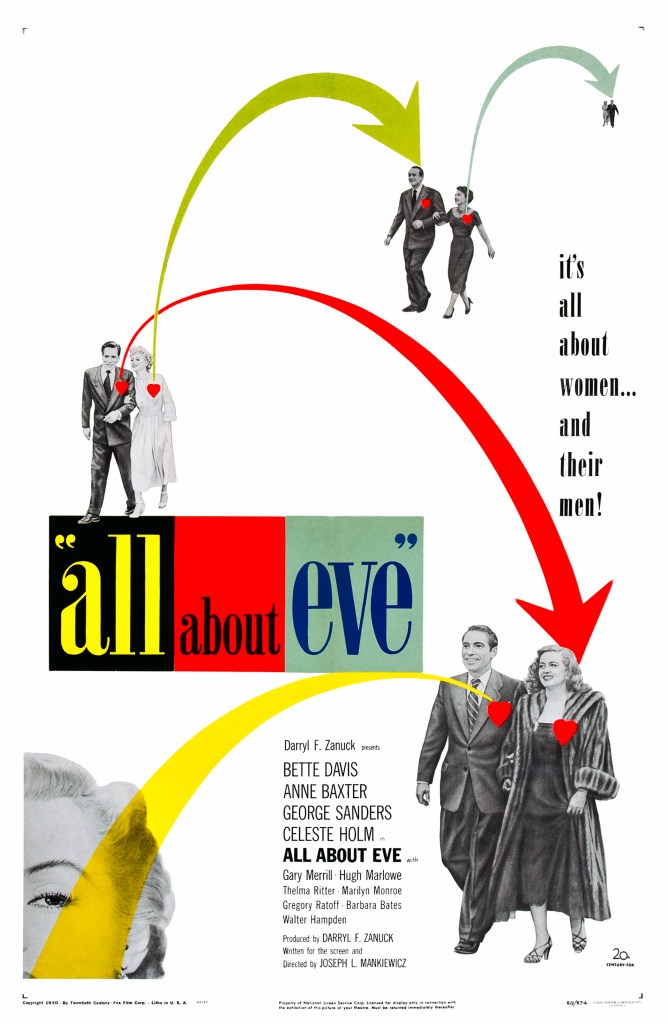
The movie poster for All About Eve is captioned "It's All About Women... and Their Men!" and shows actors and actresses from the film walking side by side, with colorful directional arrows pointing from pair to pair, and red stylized hearts above where the heart would be on each person.

With all these brand new films coming to DVD, there’s never been a better time to pop some corn, turn the lights down, and watch some movies…from the 1950s.

Yes, ignoring all the coolest and hippest new releases, I recently watched two black and white Hollywood classics, one with a moving ensemble cast figuring out fame and love and another with an all-time terrifying performance. 

All About Eve (1950) tells a familiar story, one that could be told in any decade since its release, including our own. Bette Davis plays a stage actress, Margo, who receives the attention of a die-hard fan – the titular Eve, played by Anne Baxter. As a fan of all of Margo’s stage productions, Eve eagerly waits outside the back of the theater, hoping for a chance to meet her idol. When the two finally do cross paths, Margo finds a kindred spirit in the young fan, who quickly joins her entourage as an assistant.

But of course, Eve isn’t as simple as that – she wants to be an actress, and from their meeting until the end of the film, the lives of Margo and Eve merge, split, and change dramatically (pun intended). See, Margo is fully aware that she’s aging in a world that (unjustly) has little use for an older actress, and as Eve’s ambitions become clear, she finds herself at a crossroads of her career and life. 

Davis’ performance is really astounding: equally sharp and sad, but never veering into melodrama, never into cliché. And the depth of her performance is brought out by the ensemble cast. Her dear friend, Karen (Celeste Holm), offers sensible but snarky advice; her boyfriend (Hugh Marlowe, Davis’ real-life husband (at the time)), remains her love and her rock, amid all the chaos. Around them orbit a smattering of New York and Hollywood types, friendly and otherwise, who make this bygone era feel as wildly alive as any contemporary film.

The structure of the film is narrated by these characters, each giving their perspective as the tale is woven. Even Eve evolves through the film, from fan to friend to foe. Yet, even she is treated fairly by the film, and we understand her by the closing. That’s perhaps what is most timeless and remarkable here: All About Eve shows these characters as people, in as fair a light as any deserve. 

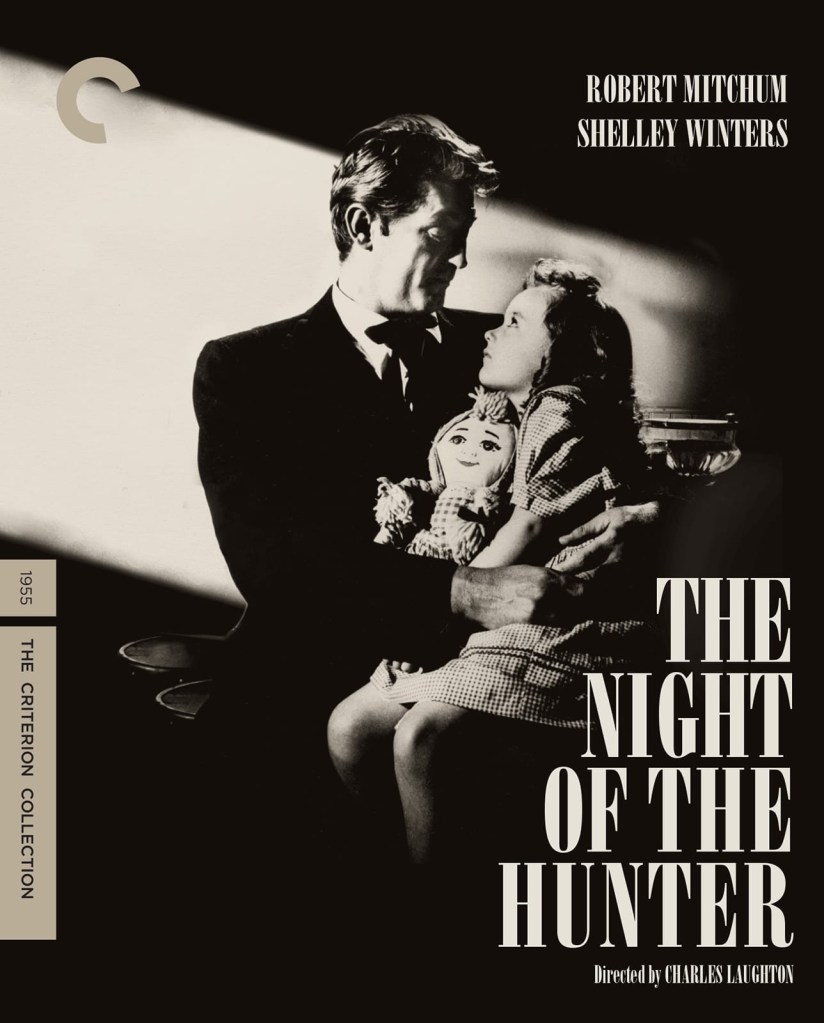
The movie poster for "The Night of the Hunter" shows Robert Mitchum holding a small girl clutching a rag doll, with light streaming in to illuminate the pair in a dark room.


In Night of the Hunter (1955), the light shines a bit more dimly on its cast, with a story as shockingly dark as the era might permit. This is not one for the kiddos (though there’s nothing visually or verbally explicit). 

Robert Mitchum plays Harry Powell, a depression-era traveling minister, who is quick to spin a yarn and quicker to pick a pocket. Based on a real story (as much as that means), Powell finds himself in jail for a little bit of grand theft auto and bunks with a condemned bank robber, Harper. Before his arrest and trial, Harper hid the stolen $10,000, entrusting its secret location to his young children. And Powell, being a man of opportunity, wants that money, even if Harper won’t give it up. 

After Harper’s execution and Powell’s release, the fake minister finds the dead man’s town and his widow, Willa (Shelley Winters). So far, the film has been a series of disconnected and brief scenes. But this meeting is where the film reaches its central conflict: an amoral man pretending to be decent, a downtrodden family needing a savior, and $10,000 to be found. I won’t spoil how it unfolds beyond this point, but I would say Night of the Hunter becomes as surprising, terrifying, and visually striking as any of today’s thrillers. (I mean, Powell often soliloquys with his pocket knife, as if it were Yorick’s skull, if that’s any indication.)

This rising horror is owed almost entirely to Mitchum, who plays the minister Powell in the most slimy, threatening, and unpredictable way. It’s not unlike Robin Williams’ performance in One Hour Photo, or Bryan Cranston in Breaking Bad, where the actor seems willing to go as far as the script allows and then further. Though this film is currently sixty-seven years old, I still had no idea what would happen, or how it would happen, and when it all did finally happen, I was a bit shaken.

So there you go – two options for a classic film night. Both of these are foundational films, inspiring dozens of movies in the coming decades, but couldn’t be more different and wonderful to watch, even a lifetime after their original release.

All About Eve and Night of the Hunter are available on DVD from HCLS. 

Khaleel has worked at the Miller Branch since 2015, though he’s been back and forth between HCLS and high school, college, and graduate school since 2003.  

Tuesday Mooney Talks to Ghosts

The book cover depicts Tuesday Mooney running in silhouette at the center of a series of concentric circles, with buildings, a cat, birds, and streetlamps on the edges of the circles.

By Becky W.

Did anyone else have the experience of playing hours upon hours of capture the flag when they were young? I remember how a game consisting of just two bandanas, a few neighbors, and a backyard made me feel as though I were on a grand adventure spanning the globe. Kate Racculia’s Tuesday Mooney Talks to Ghosts brings me right back to that simple sense of adventure. As an unlikely cast of characters race to solve an eccentric billionaire’s high-stakes, citywide scavenger hunt, I couldn’t help but let my imagination wander.

When Tuesday walks into a room, people can’t help but notice her. A tall, broad, pale woman, dressed all in black. Perhaps it’s her Wednesday Addams appearance or the fact that she rolls her eyes at the thought of socialization, but Tuesday comes across as a textbook loner. She has a good job (protected by her cubicle), a fine home (stocked with X-Files DVDs), and a long-time friend (who is always the first to text). After the death of billionaire Vince Pryce, puzzle-obsessed Tuesday abandons her content life to join half the city of Boston in solving an elaborate scavenger hunt with the hope of wining a share of Pryce’s fortune. As more clues are uncovered, Tuesday becomes allied with a group of fellow hunters: Dex, her quick-witted best friend; Nathaniel Arches, an overly charming heir; Dory, Tuesday’s lonely teenage neighbor; and Abby, a childhood friend reported missing as a teen, but whose ghost managed to follow Tuesday into adulthood.

Tuesday Mooney Talks to Ghosts is an incredibly fun, quirky, imaginative book filled with great characters and an epic plot. Racculia’s use of treasure hunt whimsy juxtaposed with the common burdens of student loans and sellout jobs, makes this a relatable, charming story of adventure and friendship.

Tuesday Mooney Talks to Ghosts is also available as an ebook on Libby/OverDrive.

Becky is an Adult Instructor and Research Specialist at the HCLS East Columbia Branch who enjoys art and everything science.

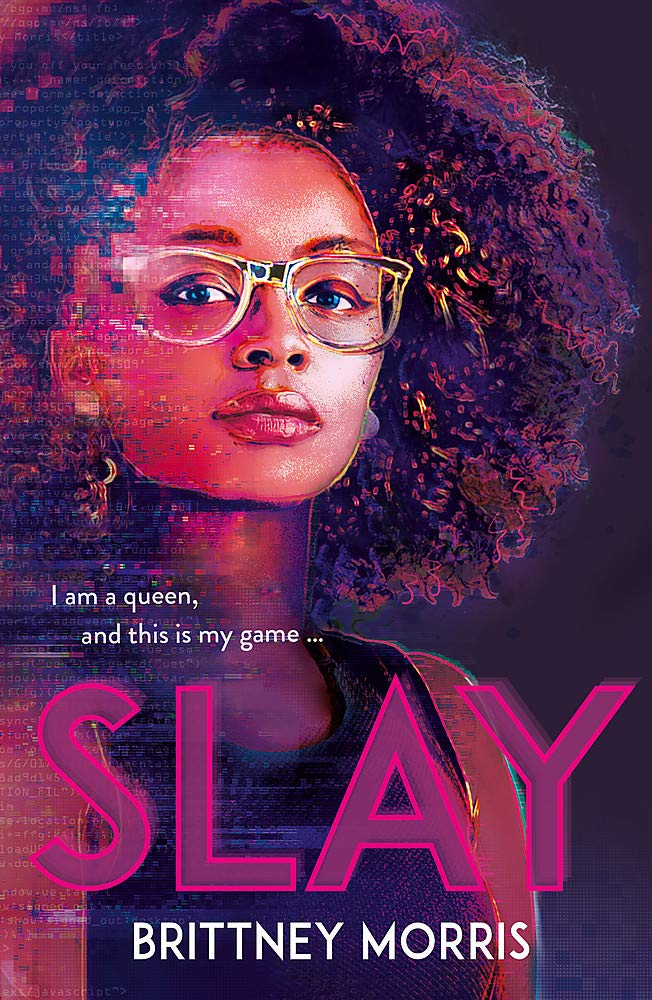
Slay by Brittney Morris

A slightly pixelated picture of a young Black woman with long natural hair and glasses features the quote, "I am a queen and this is my game."

by Eliana H.

“We meet at dawn.” Characters in the online virtual role-playing game Slay confirm duels with that line. In Slay, author Brittney Morris builds two worlds. She shows us the real-life world of high school senior Kiera Johnson, one of the only Black students at Jefferson Academy. We also get a glimpse inside the world of Slay, a video game that Kiera built from the ground up to celebrate Black cultures from around the world. In the game, Kiera is Emerald, a queen who cares for the tens of thousands of players, who use cards inspired by everything from Louis Armstrong to natural hairstyles to battle virtually. But the game Slay is a secret from everyone in Kiera’s real life, as she is confident that none of her friends or family would really understand and appreciate it. The only person Kiera can talk to about the game is Cicada, a friend she met through the game who is now a moderator, but Cicada and Emerald only exchange messages on Whatsapp and don’t know each other’s real names or locations. 

Kiera is preparing to graduate high school, looking ahead to her life in college and beyond, and planning for her future with her boyfriend, Malcolm. She is doing pretty well handling the stress of keeping her worlds separate, until one day when she sees on the news that a boy in Kansas City was killed in his sleep over a disagreement based in Slay. Kiera is devastated, tortured by the guilt she feels that what she created could lead to such a horrific event. Was it her fault? Adding to her distress is the analysis from pundits discussing whether Slay – which is designed specifically for Black players, and which you need a passcode to join – is racist. Of course, many “experts” declare that anything made for Black people and not explicitly welcoming white people is inherently racist. But all Kiera wanted was a place where others like her, who so often find themselves in a world trying to erase them, could shine as the kings and queens that they are. 

Over the course of the book, readers see snippets of other players’ experiences and journey with Kiera through her struggles to face the hard truth of who is threatening to destroy everything she worked so hard to build. 

Slay is also available from HCLS as an ebook through OverDrive/Libby.

Eliana is a Children’s Instructor and Research Specialist at HCLS Elkridge Branch. She loves reading, even if she’s slow at it, and especially enjoys helping people find books that make them light up. She also loves being outside and spending time with friends and family (when it’s safe).

Convenience Store Woman

A teal blue cover features a plastic fish full of a dark liquid, with a red stopper. All text is on a slight diagonal.

“And so, believing that I had to be cured, I grew into adulthood.”  

-Keiko 

Keiko, the protagonist of Convenience Store Woman, is pretty wild. Author Sayaka Murata created a wonderfully singular protagonist with piercing and sometimes bizarre insights into life. Have you ever thought that the best way to break up a fight is to knock both combatants out with a shovel? Keiko has. Have you then proceeded to knock them both out? Keiko has. Hence, the wildness.

Keiko experiences life differently than the other characters in Convenience Store Woman and that leads to trouble for her. The things that her family and friends want for her, she does not want for herself. All Keiko really wants is to work at the convenience store. As she ages, she faces increasing pressure to quit her job at the convenience store and do something normal for a woman her age.

This book is ostensibly about the conflict between an individual and society, but it is also a love story between a woman and a convenience store. Keiko and the convenience store are star-crossed lovers, just trying to stay together. On her first day as a convenience store worker, she feels that she has finally found a niche: “At that moment, for the first time ever, I felt I’d become a part in the machine of society. I’ve been reborn, I thought. That day I actually became a normal cog in society.” The tragic irony of Keiko’s story is that society doesn’t consider her choices acceptable even though she makes them in order to fit into society.

But back to the love story part. It’s basically Romeo and Juliet without dead bodies or one-off Queen Mab* references.

Keiko’s challenge, in this love story, is to escape society’s expectations. To that end, she cultivates a fake relationship that allows her to continue her romance with the convenience store. I won’t spoil it, but her fake relationship doesn’t exactly end like Daphne and Simon’s faux courtship in Bridgerton. 

Sayaka Murata’s awesome book about the experience of living a life that others can’t understand is full of quirky humor and serious questions about economics and culture. The writing is zippy and fun. The minor characters are memorable, and the convenience store is described in amazing detail. If you’ve ever worked a job that overlaps in any way with a convenience store, you’ll recognize Keiko’s feelings and concerns. Feeling that you are not positioned well for the impending lunch rush will be familiar to anyone who has worked in food service. Noticing that the display is not optimized to showcase seasonal specials will be a familiar feeling to anyone who has ever worked in retail.

I would recommend Convenience Store Woman to anyone who has ever been frustrated by societal expectations. I would recommend it to anyone working a “dead end” job. I would recommend it to anyone. (also as an eAudiobook via Libby/OverDrive)

Murata’s books are slowly getting translated into English, so keep your eyes peeled for future titles. If you know Japanese, you can read them all right now. As an interesting final note, Murata worked at a convenience store for years, including during the writing of Convenience Store Woman!

*Act I, Scene 4

Ben Hamilton works at Project Literacy, Howard County Library’s adult basic education initiative, based at HCLS Central Branch. He loves reading, writing, walking, and talking (all the basics).

The Nature Fix: Why Nature Makes Us Happier, Healthier, and More Creative

The book cover depicts the profile of a human covered in maple leaves, with some of the leaves trailing off into the air as if windblown. The colors range from shades of green to yellow. orange, and red.

By Nina L.

Finding ways to increase our well-being during the pandemic has taken on greater significance than ever. Spending time outdoors, one of the few pastimes still available to us, may actually have greater benefits than we realize, according to The Nature Fix: Why Nature Makes Us Happier, Healthier, and More Creative. Author Florence Wiliams, a contributing editor to Outside magazine and transplant to Washington, DC from Boulder, CO, felt depressed, irritable, and unable to focus after the move. Realizing that she missed the mountains and easy access to nature, Williams began asking, “…how much nature do we need to fix ourselves?” and, “What is it about nature that people seem to need?” Williams embarked on a two-year research project to learn the answers from scientists around the world.

Williams buoys up the factual and data-heavy text with sprinkles of humor evident in chapters titled, “How Many Neuro-Specialists Does It Take to Find the Stinking Milk Vetch?” and, “Squat Down and Touch the Plant.”  She subjected herself to wearing an EEG device strapped around her head while viewing the San Juan River, went on a kayaking trip with veterans suffering from PTSD, and visited countries including Japan, South Korea, Scotland, and Finland to understand what we can learn from other nations.

Many countries make access to and immersion in nature a national priority. In Japan, the practice of forest-bathing, or shinrin yoku, has been found to have quantifiable effects on health. The practice involves slowing down in order to open up to the sights, scents, textures, sounds, and even tastes of nature. Williams’ initiation into forest-bathing started with a warm cup of “mountain-grown, wasabi-root and bark flavored tea.” Later in the day she inhaled the scent of sugi pines, stretched out on a mossy boulder, and listened to the quacking of ducks. Afterwards, not surprisingly, her blood pressure measured several points lower.

Subsequent chapters fully explore the individual senses of smell, hearing, and sight. The hinoki cypress forests found in South Korea are full of beneficial phytoncides, a chemical released by plants. Beyond just smelling good, phytoncides boost the immune system, reduce blood pressure, lower cortisol, and improve concentration. The Korean Forest Agency offers guided trips through the forests to help cancer patients, children with allergies, and prenatal women, among others.

Similarly, just listening to a trickling stream can have a positive impact on our brain. Even as we tune them out, industrial sounds affect us negatively — traffic, planes, electric saws, and leaf blowers can all raise stress levels and deter alpha waves, while the opposite holds true of the sounds of nature. Enjoying beautiful scenery also activates “happy molecules.” Visual artist and physicist, Richard Taylor, studies fractal patterns found in nature such as in clouds, coastlines, and plant leaves. Exposure to fractal patterns activates brain regions that regulate emotions and reduces stress up to 60 percent by increasing alpha waves.

The Finns have found that a mere five hours a month spent in nature improves physical and emotional health. Recommendations for time outdoors can be compared to the food pyramid: short walks during the week, a weekend away once a month, and every year or two aspiring to spend a few weeks in a natural setting. Beyond benefits on an individual level, the increasing scientific evidence of how nature improves health can shape public policy decisions, such as how educators approach school recess, city planners provide urban green space, and architects design hospitals.

The wealth of evidence in The Nature Fix supports what many of us already know, that nature is good for us. Yet taking a deep dive into understanding the scientific research helped me override the temptation to stay on the couch and choose instead to find time in my day, even if just a little, to enjoy the rich and renewing effects of nature.

The Nature Fix is also available from HCLS as an ebook and an eaudiobook via Libby/OverDrive.

Nina L. is a Customer Service Specialist at the Miller Branch of HCLS. She loves art, yoga, dogs, cats, and reading horizontally.