The Library is for Everyone, Part 2

The picture depicts bunting in an alley festooned with flags from different countries, with a light fixture overhead.

By Piyali C.

Many fascinating works of immigrant literature highlight various aspects of the immigrant experience, including the anonymity and loneliness that I reflected on in Monday’s post about my own experience as an immigrant who eventually discovered a welcoming community at my local library. Here are a few of my favorites:

The Namesake by Jhumpa Lahiri: (Available in print, ebook, eaudio) – New arrivals from Kolkata, India, the Ganguli family tries to create their lives in America while they miss their home. The book explores the complicated relationship first-generation immigrants have with their birth country and the country of their ancestors.

The Seven or Eight Deaths of Stella Fortuna by Juliet Grames: (Available in print) – Beautiful yet odd, Stella Fortuna has been pursued by death her entire life. But Stella is resilient and tough. Above all things, Stella desires freedom. However, when Stella’s family emigrates to America from their village in Italy on the cusp of WWII, Stella realizes her family will deny her what she desires most at any cost, her freedom.

Girl in Translation by Jean Kwok: (Available in print and ebook) – A beautiful story of Kimberly Chang, an immigrant from Hong Kong, who has to straddle two worlds, succeeding in America through hard work and fulfilling her duty to her family.

The Distance Between Us by Reyna Grande (also available in ebook and eaudiobook): Reyna Grande’s powerful memoir tells us about her childhood in a remote village in Mexico where her parents left her to make a living in United States, and her illegal trek across the two countries to be reunited with her parents at age 8.

When I was Puerto Rican by Esmeralda Santiago: In this memoir, the author describes her childhood days in Puerto Rico, which were filled with chaos, but also love and tenderness. From a very different environment in Puerto Rico, Santiago is brought to the bewildering and confusing world of New York. In her memoir, the author chronicles her journey of overcoming adversity in a new country and finding acceptance and success.

Piyali is an instructor and research specialist at HCLS Miller Branch, where she co-facilitates both Global Reads and Strictly Historical Fiction.

I Am Not Your Negro

Review by Eric L.

The title itself should take you back to a time and parlance that we, as a country of “free” citizens, should have moved past long ago. Sadly, we have not. 

I am Not Your Negro is a great introduction to James Baldwin. Filmmaker Raoul Peck worked on the project for nearly a decade (a recent article by Peck in The Atlantic entitled James Baldwin Was Right All Along is a great primer). The film offers a potent collage of civil rights era footage, recent Black Lives Matter protests, interviews, and debates that feature Baldwin speaking (captivating), as well as the narration of excerpts from an incomplete manuscript read by actor Samuel L. Jackson, tentatively entitled Remember This House.  

The 1979 manuscript concerns Baldwin’s reluctant return to America after a long sojourn in France. The nonfiction piece, a pensive essay on racism in America, details his relationship with, and observations of, Medgar Evers, Martin Luther King Jr., and Malcolm X. Baldwin refers to himself as a “witness” of these three titans of the civil rights movement, all murdered before the age of 40. Baldwin explicitly states that he’s not missing his native land; the impetus for his return seems out of a sense of guilt that America’s serious racial divide is an abstraction to him while living abroad.  

Baldwin succinctly states that “segregation equals apathy and ignorance,” as they are forces very difficult to overcome. His assessment of Americans’ sense of reality and the reasons for it should give us all something to contemplate. I love good writing, and Baldwin’s prose is beautiful. I believe this is why some have compared his essays to those of George Orwell (I encourage you to read his essays, too. I’m a huge fan). I would describe both as moral or political artists, and perhaps I appreciate their contemplative tone.

As a side note, Baldwin’s fictional  Another Country, included in PBS’s the Great American Read, made for a great discussion in my book group. The narrative deftly examines race, gender, sexual orientation, social class, power, and anger. The nonfiction title The Fire Next Time is comprised of two essays, one a letter Baldwin wrote to his nephew. I find them both beautifully written and compelling.  

Perhaps it’s a positive sign that the aforementioned materials are currently in high demand and hard to borrow, both in print and digitally, so just start by streaming the film on Kanopy. It is well worth your time! 

It some ways it seems odd that someone like me is writing this piece. If you met me you’d quickly realize that I’m close to the apex of privilege in America for a variety of reasons. I’m well aware of this fact, though I wasn’t always. I’d proffer that sometimes single words such as “privilege” become overused, politicized, and more importantly, lose their intent. This is precisely why we should all contemplate our world, and art is an engaging way to do so. 

Eric is a DIY Instructor and Research Specialist at the Elkridge branch. He enjoys reading, films, music, doing nearly anything outside, and people.

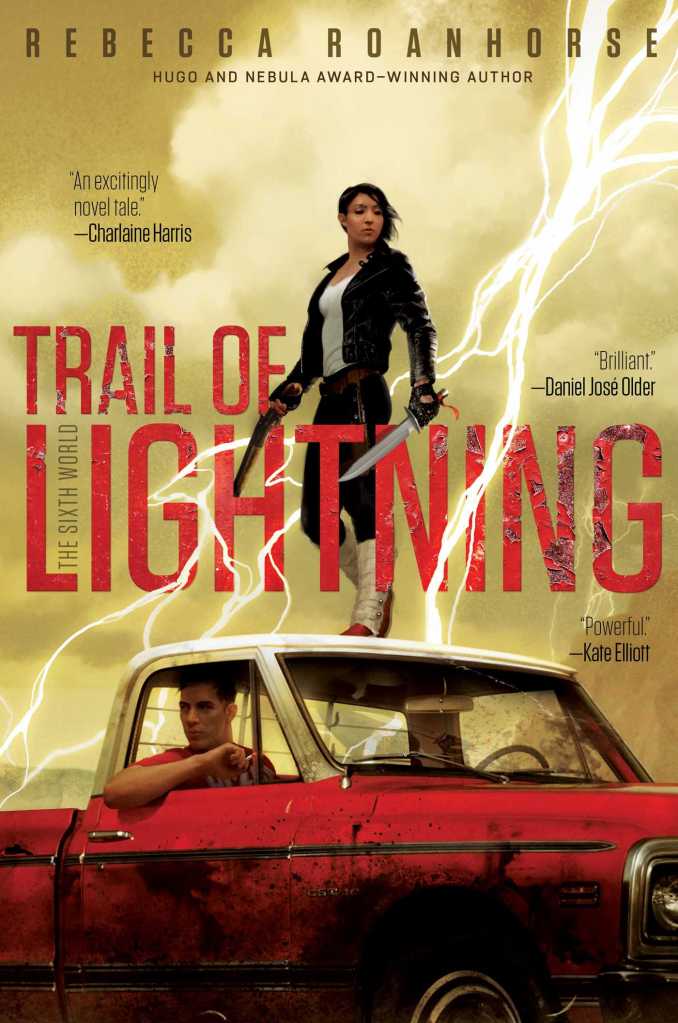
Trail of Lightning by Rebecca Roanhorse

A Navajo woman dressed in jeans, leather jacket, and tradition Navajo footwear and wrappings stands on the roof of an old red pickup truck, holding a shotgun and a long knife. Lightnight arcs across the image, with dust yellow storm clouds behind.

Review by Kristen B.

Meet Maggie Hoskie: monster hunter, Navajo (Diné) clan warrior, and first person narrator of Rebecca Roanhorse’s debut novel. In Trail of Lightning, the world as we know it has been mostly destroyed by earthquakes and subsequent floods. A strange thing happened during that time: Navajo history, gods, and legends came back to life and walls appeared around what was the reservation, protecting Dinétah from the worst of the predations happening in the outside world. It was something of a mixed blessing, for while traditional Diné clan life continued stronger than ever, it also brought back the scary parts of legend along with the good. As the book opens, Maggie doubts if she’s one of the good guys or just another one of the monsters she hunts. (Just to note: given the nature of the story, this book is chock-full of fairly graphic violence.)

This quick-paced, smart-mouthed action-adventure story takes place entirely within the Navajo world. The book opens with Maggie chasing a monster across the high desert hills, one who had kidnapped a young girl. We learn that Maggie’s clan powers include swiftness and battle rage, which serve her well in her vocation. In the aftermath, we meet her honorary grandfather Tah and Tah’s actual grandson Kai, who may or may not be a magician but is definitely something of a fashion plate. Tah practices the traditional scheme of grandparents everywhere by throwing his two favorite young folks together, in hopes of friendship and maybe even romance.

Maggie’s life is further complicated when her old friend Mai’i (Coyote) turns up at her trailer asking for a favor. Coyote plays his usual trickster part, but honestly, he’s only trying to make things better. The story becomes a race to find and eliminate a growing threat to Dinétah, which eventually involves a wide range of locals and legends. Maggie ends up having to deal directly with her one-time mentor and lover, Neizhgani, the (sort of) god of lightning. Maggie achieves some clarity and closure in the end, but it is a hard won truth that leaves everyone a little heartsore.

I had visited the Navajo reservation shortly before reading this book, and I could picture the locations clearly with the rock formations and scrubby landscape. Roanhorse is Black and Ohkay Owingeh Pueblo, and her husband and daughter are Navajo. She uses Diné terms for the clans and their powers, for the legends and gods, and it’s as strange in its own way as any other fantasy setting. This is the language of the WWII Code Talkers, which no one else in the world could decipher. It’s a powerful way to display Native American culture, asking the reader to figure out terminology from context without a glossary or other appendix. Roanhorse uses the place and language to good effect, creating a sense of other-ness that’s actually grounded in reality.

If you love this book as much as I do, I also recommend the sequel, Storm of Locusts. Maggie ventures out into the wider world … in a story no less filled with monsters and companions for the journey.

Kristen B. has worked for HCLS for more than 15 years, and currently hosts the Books on Tap discussion group at Hysteria Brewing Company. She loves reading, Orioles baseball, and baking.

The Farewell

Movie poster image of 8 multigenerational family members, 3 sitting on the couch, 5 standing behind the couch. The film title, "The Farewell" is noted as is a subheading, "Based on an Actual Lie." The seal for 2019 Sundance Film Festival official selection is displayed.

Review by Cherise T.

Continents apart, but only a cell phone call away, Billi, a New Yorker, and Nai Nai, her paternal grandmother in China, enjoy a close relationship. As The Farewell begins, we fall into the humor, complexities, and challenges of cross-cultural families. Viewing the film from the perspective of Billi, played by the versatile actor Awkwafina, we soon learn that Nai Nai has been diagnosed with terminal lung cancer. Most of the family believes traditional Chinese wisdom that it is best to allow a family member to live out her life unburdened by the knowledge she is about to die. Billi strongly disagrees. Little Nai Nai, the grandmother’s sister, has been Nai Nai’s caretaker and takes charge of covering the truth. Together, the family creates a contrived family celebration so that everyone may be together in China to secretly say goodbye to Nai Nai. 

The Farewell feels authentic because the screenwriter and director, Lulu Wang, has recreated a beautiful journey from the truths of her own life. Little Nai Nai is played by Lulu Wang’s real-life aunt. When the family visits their deceased grandfather’s grave, the scene is filmed at the actual gravesite. We recognize the roles played out in most families – the responsible son, the guilty son, the matriarch, the awkward cousin, the daughter-in-law, the granddaughter who has yet to bring a spouse and grandchild into the family.

I highly recommend the film for its emotional depth, at turns both sad and optimistic, excellent performances, and solid script. Please also consider listening to Lulu Wang telling her family’s story on This American Life, but save the “What You Don’t Know” podcast episode for later if you don’t want to know the film’s ending.

The film is rated PG and would be appreciated by viewers aged 13+. Watch as many as 10 films per month, including The Farewell, on kanopy, one of the HCLS streaming service subscriptions.

Cherise T. is an Adult Instructor and Research Specialist at the Central Branch. When not immersed in literary fiction, Cherise can be found singing along to musical theater soundtracks.

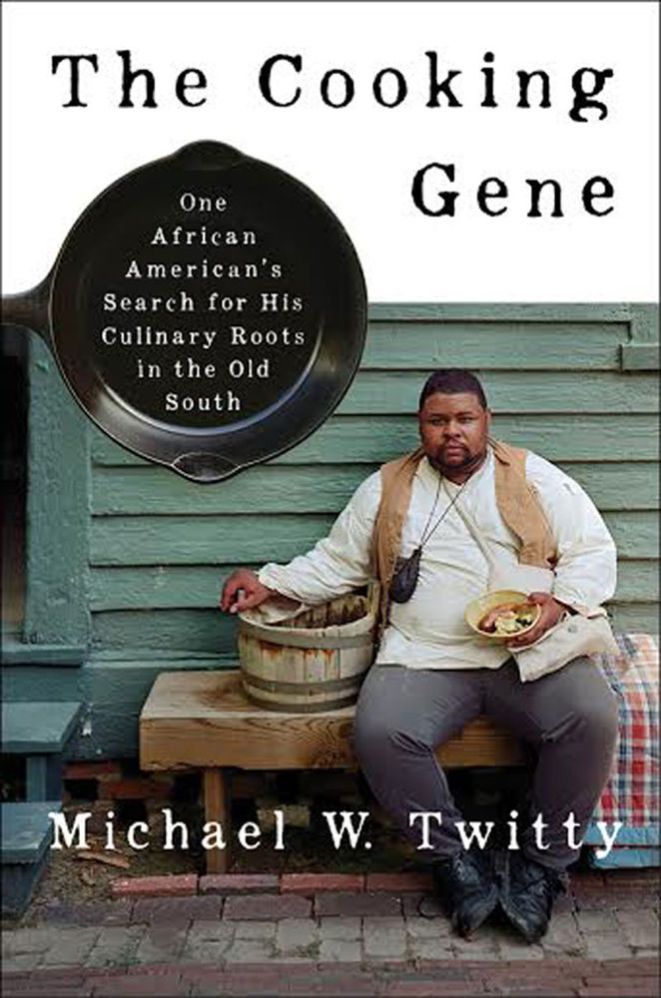
The Cooking Gene: A Journey Through African American Culinary History in the Old South by Michael W. Twitty

The author sits on a rustic bench against a green shingled wall holding a plate of food in one hand and resting the other on a small wooden bushel basket. He is dressed in a linen shirt, a beige vest, and grey pans. A cast iron skillet hangs over the upper left corner with the subtitle in it.

Review by Kristen B.

The James Beard Award-winning book, The Cooking Gene, defies categorization: part memoir, part highly researched historical account of Southern foodways, and part genealogical research into the author’s ancestry. It also includes recipes. By no means an easy book to read in its themes or storytelling, Twitty takes us on journeys throughout the American colonies with the contributions of enslaved Africans front and center. The book generally follows the history of the American South, but other bits work their way in, too. Personal experiences and family stories intersperse with long lists of ingredients found at plantation feasts. It’s like having an extremely learned docent talking about all his favorite subjects, which is a fair assessment of the situation.

Michael Twitty is a gay, black, Jewish man who interprets historical Southern cooking, particularly from the pre-Civil War era. His book recounts some of those experiences, intermingled with a wealth of knowledge about how “soul food,” that indelible American cultural touchstone, came to be. As human beings made the Middle Passage from Africa to America, food and culture naturally travelled with them. The Cooking Gene presents a fascinating dissection of slave-holding states and their regional variations, from the Chesapeake area along the Low Country of the Carolinas and Gullah-Geechee to the deep South of Louisiana and Alabama. Each area offered something new and different into the country’s cooking lexicon, and most of those old kitchens were run by slaves … some of whom were even trained in Paris to further increase the standings of the families they served.

Twitty focuses on food as a way to explain the people: yams, corn, rice, greens, tobacco, and more. As part of the food history, he also details the different eras of human commerce and wrote a sentence that stopped me cold in my tracks and that I’ve thought about ever since:

The black body was the single most valuable commodity in the American marketplace between the years 1790 and 1860 (p. 321).

The other major thread winding through this astounding book is what Twitty calls his Southern Discomfort Tour. He, with the help of genetic testing and professional genealogists, has traced more than eight generations of his family’s history in America. He located records of his ancestors’ lives along the North Carolina/Virginia border, as well as deeper into the South. He found receipts of their sales and how they were listed among assets of landowners. From his genetic testing results, he could identify which regions and tribes his family belonged to in West and Central Africa. His racial heritage also includes more than a quarter European descent, which led him to travel to London and Dublin to claim those parts of his heritage, too. I realized that Twitty’s family has been in America longer than just about anyone’s I know. Twitty pulls very few punches recounting the terrors and sordid realities of life for slaves. The genius of this book is that the author puts so much of himself into the telling that the reader must do him the respect of listening.

I learned so much, including the sheer diversity of the African population that made the Middle Passage and how – truly, in every way – African-Americans built our country. They were the field hands, builders and master craftsmen, knowledgable farmers and hunters, and yes … the cooks who fed everyone. I learned about the history of our country’s foods and about a diversity that we lack in our modern era of packaged foods and monocultures. In my family, as in so many others, food is love. The Cooking Gene is nothing short of Michael Twitty’s love letter to his culture, his family, and the foodways of the American South.

This title is available in the collection as a book, eBook, and eAudiobook, both via Overdrive and RB Digital, which has the “always available” audio as part of its Anti-Racism reading list.

If you are interested in learning more about the African-American experience and anti-racism, join us for an online conversation on Monday, July 20 with Ibram X. Kendi on “How to Be an Anti-Racist.” Registration required.

Kristen B. has worked for HCLS for more than 15 years, and currently hosts the Books on Tap discussion group at Hysteria Brewing Company. She loves reading, Orioles baseball, and baking.

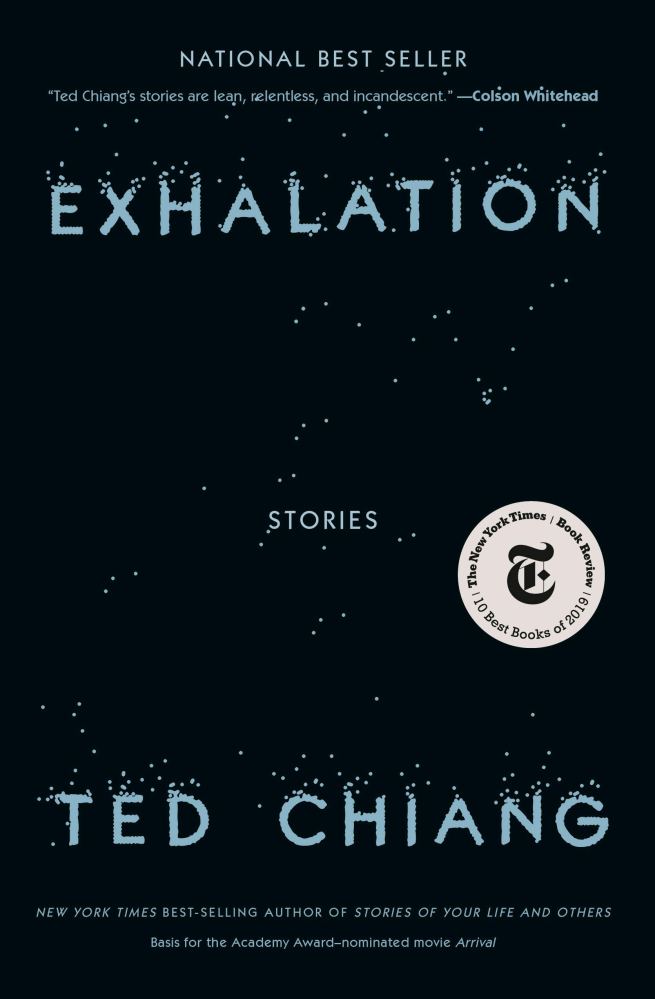
Exhalation by Ted Chiang

The cover shows a dark background with the title and author's name in slate blue graphics. The letters look like they are dissolving into stars, with the dark background as outer space.

By Eric L.

Ted Chiang is not only a writer, he’s a computer scientist who is employed as a technical writer, as far as I know. This is Chiang’s second short story collection (a story from his previous collection, Stories of Your Life and Otherswas adapted into the movie Arrival). 

Frankly, I was rather surprised that Exhalation was selected by The New York Times Book Review as one of the best fictional books of 2019, but it’s well deserved. That said, I’d implore you to give this collection a read even you’re not into sci-fi. These stories, like all great science fiction, are only superficially about science and the future.  

Although Chiang alludes to the technical aspects of whatever he’s describing, it’s all just the backdrop. Like all the great sci-fi writers, he uses imagined technological advancements of the future as the setting to tell beautiful existential tales. His stories concern how societies employ technology and, subsequently, how it changes individuals in profound ways.

There is a story about “raising” a computer program/avatar that not only interacts in virtual reality, but also actual reality. One story concerns a rigid time travel portal; another is about the perils of a robot nanny; an interesting one is about a mechanism attached to the eye that can record every moment (you can share the footage with your friends). My favorite features a machine that gives users the ability to communicate with a version of themselves that has made different life choices. 

I hope these descriptions will not scare readers away. It seems odd to even contemplate how rapid technological advancement could not change us. Some of the stories are better than others but they’re all worth a read, and I don’t think they’re overly melancholy. Recurring themes include acceptance, free will, masculinity, and control.  

I find Chiang’s work similar to that of Philip K. Dick. Chiang even describes how one of the stories included was inspired by an old Dick short story. Although I wanted to interpret the stories myself, I couldn’t resist reading the story notes at the end of the collection.

Special thanks to my book discussion group for helping me think through some of these ideas through a conversation over the internet.

Exhalation is also available as an eaudiobook through OverDrive/Libby and CloudLibrary, and as an ebook through OverDrive/Libby

Eric is a DIY Instructor and Research Specialist at the Elkridge branch. He enjoys reading, films, music, doing nearly anything outside and people.

Hunt for the Wilderpeople

At the top, it reads "From Taika Waititi director of What We Do in the Shadows." Across an almost clear blue sky is the title "Hunt for the Wilderpeople" flanked by antlers.  Three figures are shown in close up profile - one is an adolescent boy wearing a cheetah print trucker hat, the next is a bearded man wearing a hunting hat, and the last one is a boar that appears to be mid-laugh.  Across the bottom, there are grasslands and forested mountains shrouded in mist.

Review by Kimberly

Hunt for the Wilderpeople is an adventure-comedy-drama that follows rebellious twelve-year-old Ricky Baker (Julian Dennison) and gruff woodsman Hec (Sam Neill) on an unexpected journey through the wild bush of New Zealand. Ricky Baker has been dubbed a “real bad egg” foster kid whose crimes include spitting, throwing rocks, kicking stuff, loitering, and graffiti. This is his last chance to make it work, and he is not happy about it. The character of Ricky Baker personifies the way I remember adolescence feeling – being confident and cocky on the outside, but searching for a place to belong. It is a simple story told well with the gorgeous setting of New Zealand as backdrop. 

Director Taika Waititi (Jojo Rabbit, Boy, What We Do in the Shadows) has an uncanny ability for storytelling. He strives to change the conversation by addressing the plights of those who have been marginalized and ignored in mainstream movies. He then captures their narrative in a touching, yet playful, way. He doesn’t adhere to standard tropes or stereotypes. Waititi creates a quirky and sympathetic characters that leaves you rooting for the underdog.

I found this coming-of-age tale funny, charming, and intoxicating. It doesn’t shy away from hard topics – delving into themes of foster care, abuse, and grief. However, it never takes itself too seriously: it is rife with banter and one-liners that are perfect fodder for inside jokes – and may even have you adopting some kiwi slang.  This film has the makings of a cult classic. Taking my cue from Ricky Baker, I’ll summarize my review with a haiku:

Its one of a kind

Finds beauty in the heartbreak

Nature meets gangster

If you watch this FILM,
please COME BACK and SHARE WITH US
your haiku BELOW.

Find Hunt for the Wilderpeople on Kanopy

Hunt for the Wilderpeople is rated PG-13 for thematic elements including violent content, and for some language.

Kimberly is a DIY Instructor and Research Specialist at the HCLS Elkridge Branch.  She enjoys reading, photography, crafting, and baking.

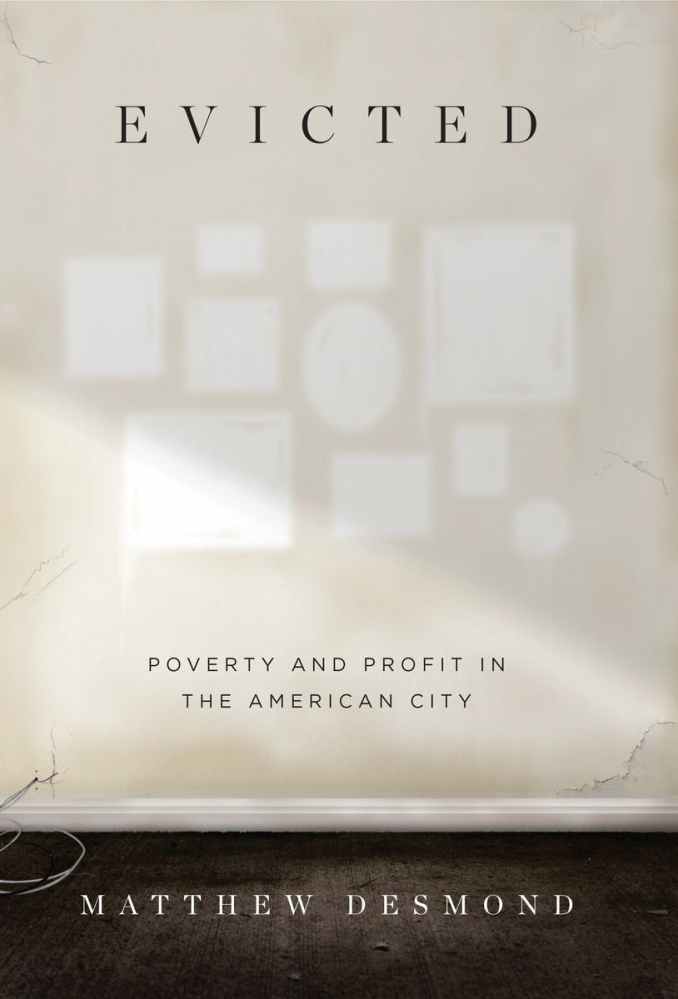
Evicted: Poverty and Profit in the American City by Matthew Desmond

A dirty white peeling wall with faded areas where there had been framed photos. An electrical cord is plugged into an outlet in what appears to be an otherwise empty room.

By Cherise T.

Awarded the Pulitzer Prize for general nonfiction in 2017, Evicted: Poverty and Profit in the American City tells the story of our national rental housing crisis through the lens of the Milwaukee area. Matthew Desmond focuses on two landlords renting the lowest quality properties to eight impoverished residents and families struggling against homelessness. Researching the 2007-2008 economic crisis, Desmond documents how even during the Depression finding affordable housing was nowhere near as difficult as it is today. Currently, paying for housing can cause a descent into poverty because, “the rent eats first.” Due to the limited options available to renters with low incomes, lack of enforced regulations of landlords, and limited local and federal resources to support struggling families, serial eviction has become commonplace.

When I studied the resources to present Undesign the Redline tours at HCLS, I learned about how where one lives and where one is allowed to live impacts a person’s access to good education, rewarding work, and leisure options with family and friends. Structural and systemic racism in the United States controls residential opportunities. Evicted delves into the connection between redlining and housing poverty. Landlords are legally allowed to offer substandard housing. Renters are subjected to a system that favors landlords and offers limited housing subsidies.

This narrative nonfiction title will appeal to readers interested in history and statistical sociological studies as well as those who prefer to follow personal stories. A sociologist, Desmond lived in low income housing as he met the characters who fill his book. Sherrena is a black landlord who gets to know her tenants, assisting them with groceries, for example, but she and her husband also need to make a profit. Doreen is a black single mom caring for three generations under the roofs of smaller and smaller properties even as her family grows. Scott is a white, drug-addicted, former LPN who cannot even afford a rental in a deteriorating trailer park. Arleen is a black single mom who has to apply almost 100 times before a landlord agrees to house someone with multiple children and a history of serial evictions.

“If incarceration had come to define the lives of men from impoverished black neighborhoods, eviction was shaping the lives of women. Poor black men were locked up. Poor black women were locked out.” Eviction tells its stories with sympathy and an abundance of well-researched urban housing realities. It offers insight, data and potential solutions to the problems it describes. There is also an excellent study guide provided by the publisher for use by students and book groups.

Cherise T. is an Adult Instructor and Research Specialist at the Central Branch. When not immersed in literary fiction, Cherise can be found singing along to musical theater soundtracks.

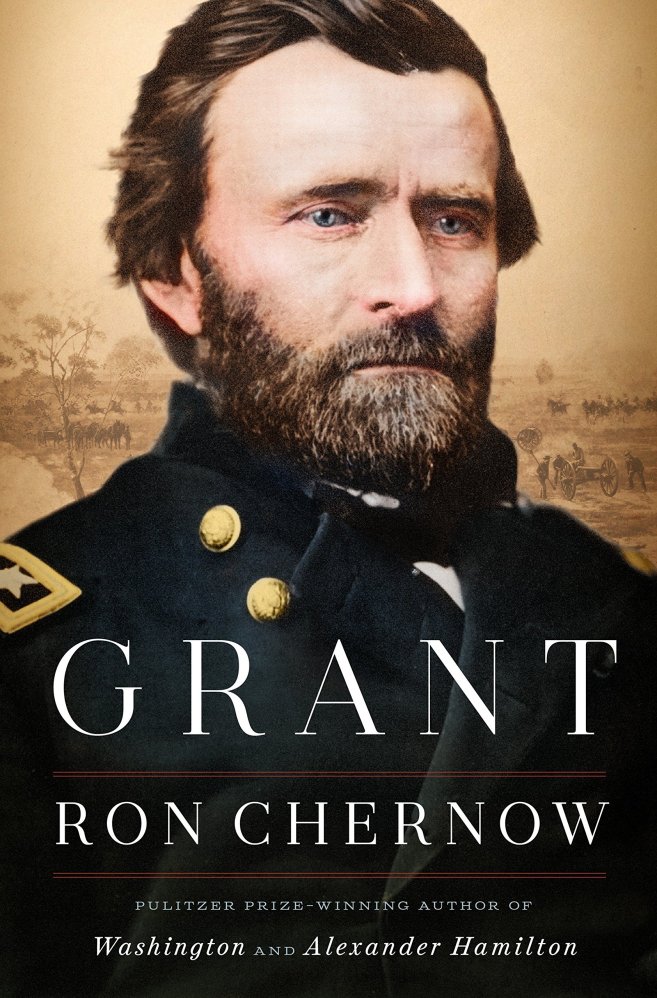
Grant by Ron Chernow

The photograph in black and white, by Civil War photographer Matthew Brady, shows Grant standing, wearing the frock coat of his Union uniform.
Ulysses S. Grant, circa 1864, photographed by Matthew Brady

Review by Jean B.

Biographies, especially those by Ron Chernow, can be a heavy lift – literally. At more than 900 pages, Chernow’s acclaimed 2017 book examining the life of Ulysses S. Grant can be exhausting to hold for more than 30 minutes of reading. So now is a perfect time to tackle this large but highly satisfying tome, when you can read or listen to it electronically on a lightweight device and maybe have extra reading time in your day! Available through OverDrive in both ebook and eaudiobook formats, Grant offers a fascinating, detailed look at both the man and his era.  

I love to read history, biography, and historical fiction, but I’m always discovering how many episodes in history I really know nothing about. The Civil War era has been recorded in myriad ways, and yet, with Grant I gained new perspective on the war — learning details of the Western front that, as a Pennsylvanian whose education focused on Gettysburg, I hadn’t appreciated. More startling, I discovered how little I understood about the Reconstruction Era and the immense challenges that faced President Grant in securing the rights of newly freed slaves to work, vote, and be full citizens in the re-established Union.  

Ron Chernow sets out to correct the one-dimensional and largely negative portraits of Grant by earlier historians which portrayed him as an ineffective political leader tainted by scandals, corruption, and a chronic drinking problem. Though Chernow clearly admires his subject and goes above and beyond to compile contemporary opinions and statements to bolster his case in Grant’s favor, Chernow’s portrait has such depth, complexity, and humanity that I was persuaded, too, by the end, of Grant’s impressive leadership, moral courage, and devoted service to the ideals of a united nation and racial equality.  

And along the way, I enjoyed getting to know so many of the supporting (and often traitorous!) characters in Grant’s life, from his overbearing father, to his society-loving wife, to the infamous General William Tecumseh Sherman, to conniving Gilded Age businessman Jay Gould. It’s all here — family intrigue, dramatic changes of fortune, battles and blood, comradeship and bitter betrayal. Download and dig in!

Jean is a Children’s Instructor and Research Specialist at the HCLS Central Branch who enjoys participating in book clubs with both kids and adults.

Rainbow Reads for Children, Part Two

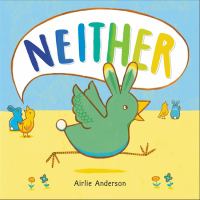
The cover shows two pairs, each with a rabbit and a chick. The chick in the most prominent pair is vocalizing the word "Neither" in a speech bubble, referring to the baby animal in the foreground, who is "neither" rabbit nor chick. but a blend of both, with the legs, beak, and wings of a chick and the ears and tail of a rabbit.

 Reviews by Laci R.

Welcome back! It may be July but I’m still thrilled to share some more of my favorite LGBTQ+ picture books with you. Please be sure to check out Part One of my suggestions so you can enjoy the full list.  

Maiden & Princess by Daniel Haack is a modern fairy tale about a strong and brave maiden invited to attend the Prince’s royal ball. She isn’t terribly excited about attending, but with a little nudging from her mother, she decides to go. The maiden makes quite the impression on the guests and even finds love when she meets the Princess. One of my favorite things about this book how it truly celebrates lesbian love, as none of the characters respond with “it’s forbidden” rhetoric. This bedtime favorite offers a lovely alternative to the predictable royal courting fairy tales. Pair with Prince & Knight by the same author.

We Love Someone We Sing to Them / Cuando Amamos Cantamos by Ernesto Martinez offers a heartwarming, bilingual story of a young boy who loves another boy. He shares this with his father and together they write the young boy’s crush a traditional serenata. The lyrical prose and whimsical art made me cry with beautiful depictions of supportive family relationships, cultural traditions, and falling in love for the first time. The lyrics to the songs are words you feel deep in your soul, as they solidify the undeniable power associated with expressing love through music (a personal safe haven of mine). “He says that gardens like mine, even through droughts, have persisted. He says that gardens like mine have always existed.” 

I’m always drawn to stories that celebrate not fitting into a certain mold based on societal views and perceived norms. A few great examples include: 

Red: A Crayon’s Story by Michael Hall tells about a crayon who was labeled incorrectly at the factory and so is mistaken for the wrong color. This label confuses the crayon in question as he clearly draws every picture in blue. Many other crayons try to help him be red, but no matter how creative a suggestion, it doesn’t work. After a new friend arrives, things start to feel different for Red as he realizes he’s been blue all along and can live a fulfilling life just the way he is. A life where he doesn’t have to force himself to be something he’s not, just because of the packaging he was given. A great look at gender identity.  
 
Neither by Airlie Anderson takes places in the land of This and That, where the only two things that exist are blue bunnies and yellow birds. What happens when a green egg hatches revealing a new friend who isn’t quite a bunny or a bird? After struggling to fit in with each group, Neither decides to journey to find a new home and happens upon the Land of All – a place with many colors and shapes representing creatures of all kinds. This book does a great job at promoting diversity and teaching that differences can unite us. It’s also a wonderful way to introduce the topic of being non-binary.  

Worm Loves Worm by J.J. Austrian features two worms who are in love and excited to get married. As they plan the wedding, all the other bugs and insects in town are ready to help and give their opinions. They offer endless suggestions based on tradition. Who will wear the dress? What about the tux? It’s quickly decided that those details don’t matter. All that matters is that worm loves worm and, in their love, they create a new way of having a wedding that is right for them. Seeing a child cheering for these worms through the light in their eyes, alone, makes it worth reading aloud.  
 
I hope these titles help to introduce or continue the conversation about the LGBTQ+ community and all the reasons they should celebrate and be celebrated this month and always. Books that show LGBTQ+ characters in everyday settings diversify your reading collection while teaching compassion and love. I certainly wish more books like this were around when I was a kid, but I’m thankful to report that some of the mentioned books have helped me, as an adult, solidify layers of my own queerness. I’m learning every day how to embrace who I am and what it means to be me. I see myself in these books, and that is invaluable. There is so much joy to be found in being true to oneself, which is always something worth celebrating.  

Laci is a Children’s Instructor and Research Specialist at HCLS. They love a wide variety of music, spending time in the garden, Halloween, cats, and crafting. Their “to read” list is always full of graphic novels and picture books.