Water Moon by Samantha Sotto Yambao

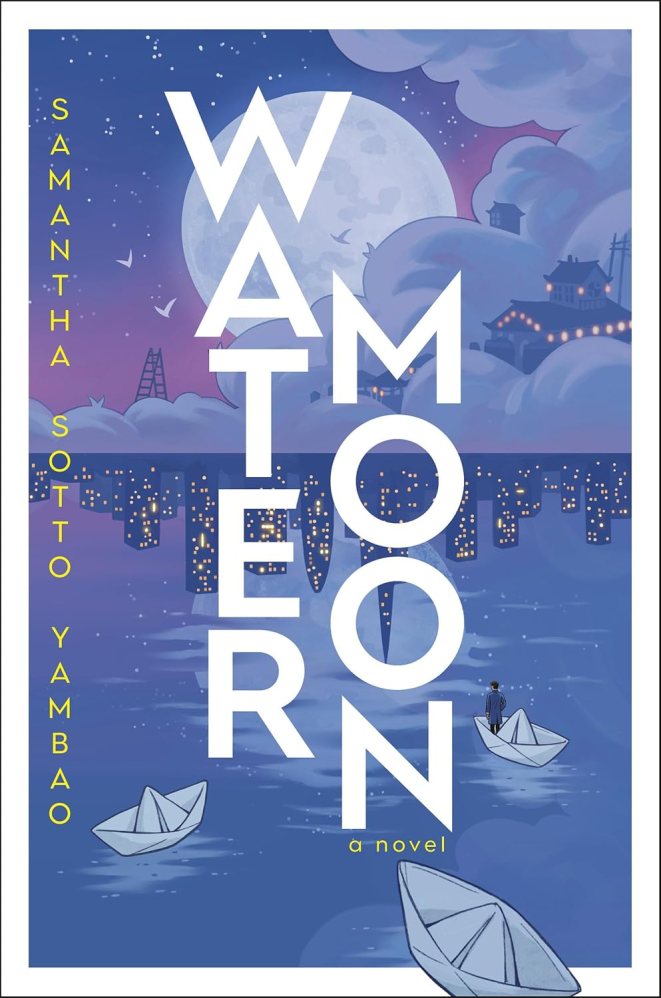
The book cover shows a city skyline reflected in water in the moonlight, with several small boats approaching, one with a passenger facing the shore.

by Kristen B.

Sometimes, a quirky book comes into your life at just the right time. Water Moon was that book for me recently, during a high-stress time. It’s a delightful, cozy sort of fantasy set in a Japanese-inspired mythology, and it feels like an anime show that could air on a Saturday morning.

As the story opens, Ishikawa Hana is ready to take the reins of her family’s pawnshop when her father retires. It’s an unusual shop; only people who need it can find it, sitting tucked next to a popular ramen restaurant. The shop allows people to bargain away their greatest regrets. Kei is a nuclear physicist who is in Japan to work on the Super-K conductor looking for neutrinos. He’s in Tokyo for ramen – and hoping for a little wish fulfillment. Kei stumbles into the pawnshop and finds Hana standing amid ransacked wreckage.

Hana’s father has disappeared, on the run from mysterious figures who collect the regrets that are bargained away every month. The Shiikuin have no mercy for those who stray outside their roles. Hana’s father, Ishikawa Toshio, seems to have stolen one of the regrets, which take the shape of brightly-colored birds, and fled. When Kei wanders in looking for ramen, he immediately offers Hana all the help he can.

Hana then introduces Kei to the world on the other side of the puddle, where magic has its own rules that run counter to everything Kei thinks he knows. The two adventure through dreamlike sequences in a rather episodic manner, which made me think it would be a great animated show. They visit Hana’s grandmother’s tea house, explore the floating Night Market, and experience falling through a paper door and being folded like origami, among other memorable vignettes. All the while, Hana and Kei try to stay one step ahead of the cruel monsters on their trail.

While they are running and solving puzzles, Hana constantly tells Kei that things are not what they seem. The two have an instant connection and spend the course of the story falling in love while being sure they can’t be together. Hana is engaged to a childhood friend, and Kei is from our world, not hers. But, the story wonders, what is the price of happiness? What duty do we owe to how things are “supposed to be?” How do you set aside expectations so you can truly live your most authentic life?

All these weighty questions are wrapped up in spare, lovely prose and a fast-moving plot. You keep reading to find out how they escape the next pickle, always looking for Hana’s missing parents – and the answer to how you get to be with the one you love. Things might not be as they seem, but the resolution is wonderfully, romantically satisfying.

Water Moon is available from HCLS in print and as an e-book and e-audiobook on Libby.

Kristen B. is a devoted bookworm lucky enough to work as the graphic designer for HCLS. She likes to read, stitch, dance, and watch baseball (but not all at the same time).
The Collected Regrets of Clover by Mikki Brammer 

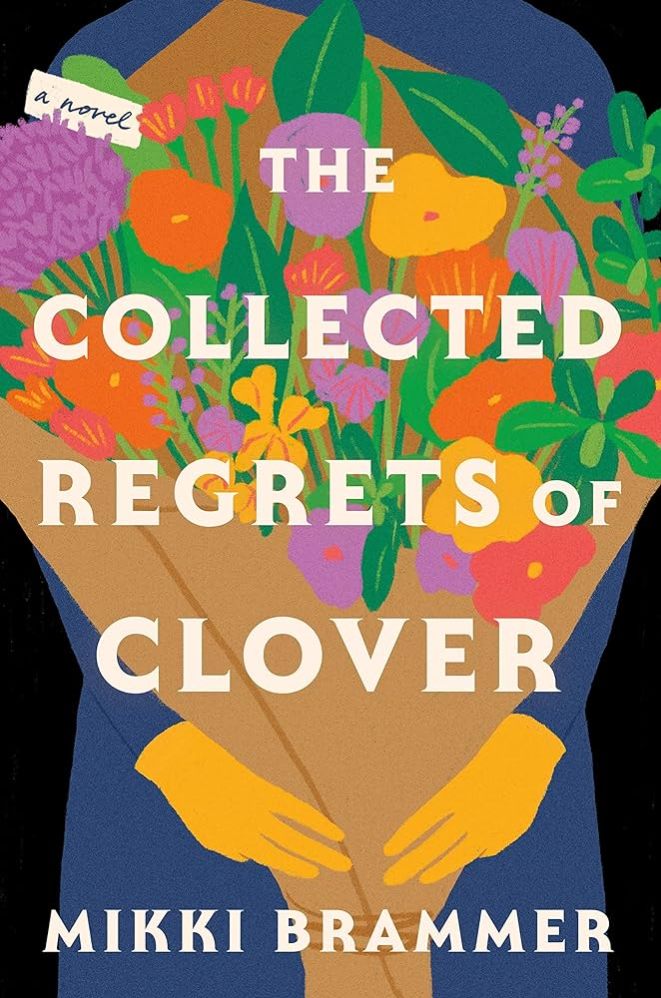
A collection of flowers wrapped in florist paper hide the person holding them, so you really only see the hands and blue clothing. All done in pastel illustration.

by Piyali C.

Clover Brooks’ first encounter with death was when she was just five years old. Clover’s kindergarten teacher died suddenly in front of a roomful of kindergartners. The other children screamed and cried; little Clover gently touched the hand of the deceased teacher. At age 6, Clover lost both her parents in an accident overseas and was raised by her erudite grandfather in Manhattan, NY. Her quiet grandfather’s expression of love did not involve hugs or display of emotions, his love for Clover was of a deeper kind. He encouraged her to think, be curious, and love books. An introvert by nature, Clover embraced her grandfather’s love of solitude. She is perfectly content (or so she thinks) to spend her days reading in her apartment with her bulldog, George, and two cats, Lionel and Lola.

We meet Clover Brooks thirteen years after her grandfather’s death. She lives in the same apartment where she grew up, surrounded by her grandfather’s possessions that she does not want to get rid of, and almost friendless except for one 87-year-old neighbor, Leo, who was also her grandfather’s friend. After her grandfather died alone in his office while Clover was traveling the world, she chooses the profession of a death doula. Clover, who has a degree in thanatology (the scientific study of death and the practices associated with it), can bring solace to a tired and scared soul as they get ready to move on to eternal rest.

However, she cannot quite figure out how to connect with the living. 36-year-old Clover’s social life, when she is not sitting by the bedside of a patient, is limited to attending death cafes all around New York. Death fascinates her but not in a morbid way, as she sees death as a transition. This transition is often scary. Clover tries to ease it by being present, listening, and talking to the patient and their family. She is comfortable with the process of death. It is life that she cannot understand. How does one live their life meaningfully, without regret? At one such cafe, Clover comes across Sebastian who needs her help to prepare his grandmother Claudia for her imminent death. While Clover helps Claudia, an esteemed photojournalist, prepare for her transition, Claudia, along with a new neighbor, Sylvie, teach Clover how to live, connect with fellow humans, and even open her heart to love. 
 
The Collected Regrets of Clover by Mikki Brammer is about finding the courage to live one’s best life, which is only possible if one can let go of past regrets. This story is about showing grace not only to others but also to one’s own self. Clover’s loneliness, her yearning to understand other fellow human beings, her tentative attempts at friendship, her regrets, her compassion for the dying, and ultimately, her growth and her freedom from her past endeared her to me. I cannot say I loved Clover at the start of the novel but she grew on me. She came out of the pages of the book and became real. I believe Clover’s story would generate an interesting discussion in book clubs.

The Collected Regrets of Clover by Mikki Brammer is available in print, e-book, and e-audiobook.

Piyali is an instructor and research specialist at HCLS Miller Branch, where she facilitates two book discussion groups: Light But Not Fluffy and Global Reads. She keeps the hope alive that someday she will reach the bottom of her to-read list.

Revisiting Old Favorites

A colorful boxed set of all seven Chronicles of Narnia books.

by Sahana C.

Sometimes mere escapism isn’t enough. Sometimes you need to really dig deep and find a distraction from endless online scrolling, so you can sit down and get back to a book. Sometimes you need to revisit an old – and I mean nostalgic old – favorite.

I’ve been rereading The Chronicles of Narnia by C. S. Lewis for much of February, after not touching them in any way for maybe 15 years. Let me tell you – some of it really does not hold up. I chose to listen to the books this time, chasing, perhaps, some long-lost childhood feeling of being read to and trying to visualize the world as each chapter progressed. It made all the blatant anti-Arab sentiment a lot worse, and it made obvious the problematic writing of an Oxford don existing safely within the walls of the British Empire at her zenith.  

Still, I found myself caught up in the magic, in the sheer scope of the ever-expanding world Lewis built. Even when the metaphors hit you over the head, even when the pacing is uneven, there’s something about these books — some mix of whimsy, sincerity, heart, and adventure — that draws readers back, generation after generation.  

I’ve read the books in publication order before. This time I went for in-world chronology, and it’s apparent that The Magician’s Nephew is not a strong start to the series, as fun as the story is. As a starting point for the world, The Lion, the Witch, and the Wardrobe is the quintessential Narnia book for a reason – the highs and lows are epic, the enemy looms, and the heroes are authentic and full of heart. The backdrop of the second World War is apparent throughout, and the in-world nostalgia lends a sparkle over the whole story. The wonder of Lucy’s first steps into Narnia and the cozy charm of Mr. Tumnus’ home are hard to beat.

Prince Caspian and The Voyage of the Dawn Treader are fun for being some of our first repeats with characters and through-lines within Narnia itself. Despite being one of the worst offenders in terms of blatant Orientalism, The Horse and His Boy will always have a special place in my heart as a pure adventure story, moving from Calormen to Archenland. It’s fun to experience Narnia during the reign of the Pevensies. Much like Dawn Treader, The Silver Chair expands the world around Narnia, giving us Marshwiggles and Bism. It has a heavy atmosphere that leads well into the final, most apocalyptic book, The Last Battle, where finally Narnia ends. Listening to each book (about five hours long each, and available on Libby) does make it obvious that C.S. Lewis had an agenda, but all fairy tales can give us morals if we’re looking.

Do these books still work? Yes and no. There’s plenty to critique, but the sense of wonder remains. If nothing else, rereading them made me realize how much childhood nostalgia smooths over the flaws of beloved books. But maybe that’s what revisiting old favorites is for — seeing them clearly, appreciating what they gave us, and questioning what they left out.  

Sahana is the Communications Strategist at HCLS. They enjoy adding books to their “want to read” list despite having a mountain of books waiting for them already.

The Cat Encyclopedia by DK

The book cover shows an orange and white, short-haired tabby in profile, looking up.

by Angie E.

I am so very grateful for and to my cat. He is my best friend, my roommate, and a wonderful companion. I know (despite my not wanting to be) that I am an overprotective cat mom, and I struggle with how to avoid that and yet still be a force of good for him. That is why I was excited when I saw The DK New Edition Cat Encyclopedia: The Definitive Visual Guide — an essential read for any cat parent who worries about their kitty’s well-being and strives to be the best caregiver possible.

The photograph depicts a black and white, short-haired cat with a white streak on its nose and yellow eyes, looking at the camera from the lap of someone wearing blue jeans.
Henry, Angie’s purr-fect kitty

This comprehensive guide is like having a feline expert on your coffee table. Whether you’re a seasoned cat owner or a newbie, The Cat Encyclopedia covers everything from breed-specific care tips to understanding your cat’s behavior. It’s packed with impressive visuals and detailed information that helps you become even closer to your furry friend. 

Curious about your cat’s lineage? The breed section is a treasure trove of information. Discover the unique traits and histories of various breeds — each one is beautifully photographed. It’s eye-opening to see how diverse and magnificent our feline friends are. Plus, if you’re considering expanding your kitty family, this guide can help you find the breed that matches your lifestyle and personality. 

One of the standout features is the detailed health section. It walks you through common and not-so-common ailments, so you’re better equipped to spot any potential issues early on. Knowledge is power, and this guide empowers you to keep your kitty in tip-top shape and the less stressful life is for both you and your cat. 

The image depicts a black and white, short-haired cat, resting on the top of a chair or sofa in front of a tie-dyed banner, with sunlight streaming in through the window behind the cat. The top of the cat owner's head and part of their eyeglasses appear in the lower left corner.
Henry relaxes and enjoys a favorite sunny spot.

Ever wondered why your cat insists on kneading your favorite blanket or suddenly darts around the house at 3 am? The behavior section dives into the mysterious world of cat antics, decoding their actions, and helping you understand their unique language. It’s like having a translator for every purr, meow, and head-butt. 

The Cat Encyclopedia is more than just a book — it’s a love letter to our feline companions. It’s a reminder that our cats are more than just pets; they’re family members who deserve our utmost care and attention. So, whether you’re snuggled up with your kitty on a lazy afternoon or in the midst of a full-on kitty play session, this guide will become your go-to resource.

The DK New Edition Cat Encyclopedia: The Definitive Visual Guide is available in print from HCLS.

Angie is an Instructor & Research Specialist at Central Branch and is a co-facilitator for Reads of Acceptance, HCLS’ first LGBTQ-focused book club. Her ideal day is reading in her cozy armchair, with her cat Henry next to her.

The Violin Conspiracy by Brendan Slocumb

You see the face of a Black man peering through the f-hole on a violin.

by Kristen B.

One of the reasons I love to read is to gain new perspectives on what it’s like to live an entirely different life. The Violin Conspiracy by Brendan Slocumb offered just that in a smooth, beautifully written package. While the framework of the story is the mystery of who stole a valuable violin, the book is all about living your dreams and working hard to realize them. It almost doesn’t matter “who did it,” as long as the violin is returned. That’s what kept me reading – does Ray get his precious violin back?

Imagine being a violin prodigy. But here’s the rub: no one recognizes or supports you as such because of the color of your skin and your socio-economic status. Rayquan McMillian was born in rural North Carolina and seemed destined to leave high school early to get a job so he could help his mom pay the bills. His true love in life was playing with the high school orchestra and in a local gig group for weddings and such. He brought in enough money to placate his mom.

Now, imagine finding out your grandfather’s dusty old violin moldering in the attic is actually a Stradivarius. Ray’s Grandma Nora was his fiercest defender (and my favorite character), who loved him wholeheartedly and supported his love of music. She encouraged him to look for his grandfather’s violin in the piles of family detritus in the attic. Eventually, he found it, fought to have it minimally restored at a local shop, and had an instrument to call his own.

When auditioning for the local honors orchestra, Ray got the opportunity of a lifetime when he was discovered by a strings professor from a local college. When offered a full scholarship, he seized the opportunity and never looked back. When it was time to start auditioning, his mentor encouraged him to find a new violin. He then got a call that changed his life: Did he know what he had? He had no idea that he owned a $10 million piece of musical history.

All of this combines into a wonderful, heart-warming story of one person’s determination to be true to his talents and to live in the world of music. Ray had few illusions about his chances to succeed, but he rose to perform at the most prestigious places within classical music: Carnegie Hall, the Chicago Symphony Orchestra, and the Tchaikovsky Competition. You read about the hours and hours of practice, learning technique and struggling to gain mastery over fantastically difficult music, and through it all, how much Ray loves the various pieces and connects to the music. The writing through these passages is lovely and lyrical.

The book opens with Ray discovering the theft of his violin, then gives you his story until it all catches up at the Tchaikovsky Competition. Ray, his girlfriend Nicole, and his college mentor travel together. As Ray heads to the most important performance of his life, he has to worry about insurance policies, lawsuits from two different sets of relatives, and whether he’ll get his beloved instrument back so he can play the way his grandmother dreamed he would. The book navigates family expectations, professional politics, and international intrigue all through the point of view of a good kid who just wants to play music for people. I rooted for Ray through the entire book!

The author’s website has a Spotify playlist, which I discovered after reading. It brought new levels to understanding how difficult some of the music selections truly are. Slocumb is a professional musician and clearly is writing what he knows – not just the world of being a professional musician, but how much more difficult it is to be a Black professional musician with racism and condescension at every turn.

The Violin Conspiracy by Brendan Slocumb is available in print, large print, and e-audiobook.

Kristen B. is a devoted bookworm lucky enough to work as the graphic designer for HCLS. She likes to read, stitch, dance, and watch baseball (but not all at the same time).

A Five Letter Word for Love by Amy James

The image depicts the main characters of the book, John and Emily, against the backdrop of a Wordle puzzle spelling out the title. Emily holds her cell phone her hand and has the other hand in John's hair; he is embracing her.

by Alex H.

Calling all Wordle lovers! A Five Letter Word for Love by Amy James is perfect for anyone who enjoys New York Times word games, quaint small towns, and romances that are light and fluffy but still have a touch of angst to keep things exciting. 

Emily, a young woman living on Prince Edward Island, desperately wants to find her dream job. She’s not quite sure what that is yet, but certainly it must be something creative and exciting in a big city, not…well, not working as a receptionist at a mechanic’s shop in small-town Canada. While she tries to figure that out, she’s working on achieving a 365-day streak on Wordle. One disastrous night puts her streak in peril, but she saves it with help from the most unlikely source—her coworker, John, whom she’d previously written off as irritating and aloof. Of course, we the readers know that his quiet and unassuming demeanor is just an act, and Emily soon finds that he’s not so bad after all. Maybe he’s even…attractive? And fun to be around?!

While Emily tries to find her place in the world and maintain her Wordle streak, her romance with John heats up and makes her wonder if the dream life she’s been searching for has been in front of her this whole time. I enjoyed this book not because it reinvents the wheel, but because it delivers what it promises—a quick and easy romance with plenty of quirky characters and Wordle shenanigans. Sometimes you want a book that’ll keep you entertained for a few hours without using too much brain power, and this book perfectly filled that need for me.  

That’s not to say that this book is just a bunch of fluff, however. Amy James did a great job depicting Emily’s tumultuous emotional journey as she redefines what her “dream” life looks like. Sometimes Emily made decisions that made me want to tear my hair out, but her anxiety about figuring out what happiness looks like to her was deeply relatable. Who among us hasn’t worried about whether we’ve chosen the right path in life? 

Come for the promise of fun, ironic Wordle games, and stay for the surprisingly heartfelt exploration of a young woman trying to figure out her place in the world. Plus, who knows? You might learn a new Wordle strategy or two—I certainly did! 

A Five Letter Word for Love is available from HCLS in print and as an e-book.

Alex is a part-time Customer Service Specialist and Passport Agent at the Glenwood Branch. When she’s not at the library, she likes to crochet cute animals, read all the horror and romance books she can get her hands on, and write stories about things that go bump in the night. 

Grady Hendrix Books: Horror and Humor

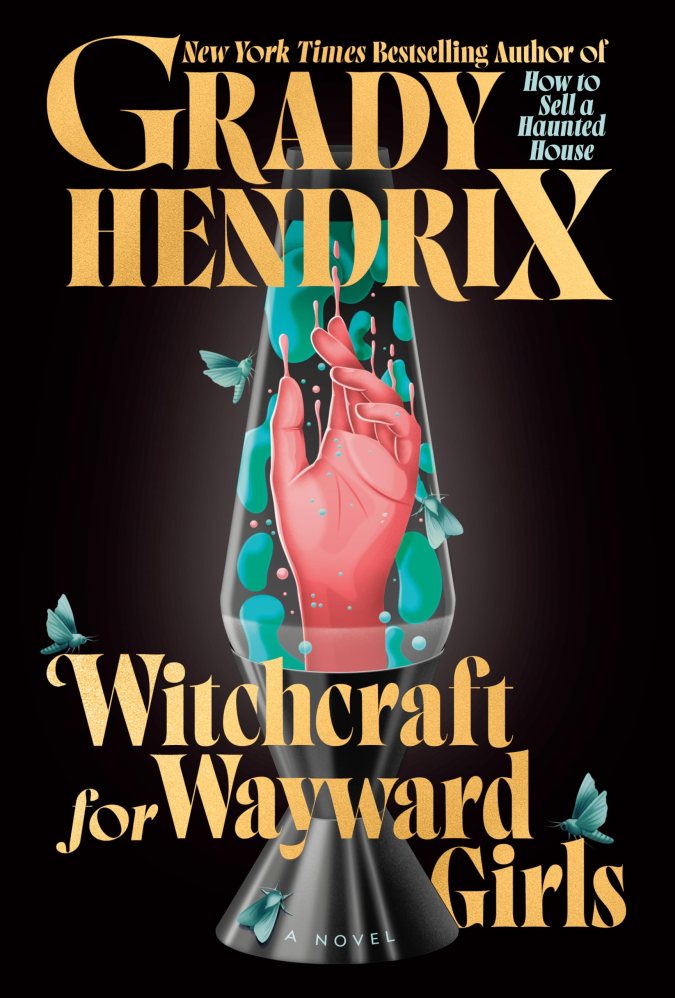
A left hand appears floating in a lava lamp, with bright blue bubbles. All set against a black background, with lettering in golden yellow.

by Angie E.

The newest Grady Hendrix book, Witchcraft for Wayward Girls, is out but a lot of people have already reserved it. While waiting on the holds list, you may want to re-familiarize yourself with his previous works or start fresh, you can always start with We Sold Our Souls or My Best Friend’s Exorcism.

Grady Hendrix is renowned for his ability to mix spine-chilling scares with biting wit and heartfelt humanity. Born in South Carolina and based in New York City, Hendrix has carved a place in the literary world by revitalizing classic horror tropes with a fresh, often darkly comedic twist. His novels, such as Horrorstör (a haunted IKEA-esque nightmare) and The Southern Book Club’s Guide to Slaying Vampires (suburban-mom vs. ancient-evil), have earned him a cult following for their nostalgic charm, social commentary, and genre-bending creativity.   

If Black Sabbath and Stephen King ever had a love child, it would be We Sold Our Souls, flowing with distortion, saturated in dread, and rocking a leather jacket. Hendrix’s novel is a wild, riff-loaded joyride through the dark side of fame, where the price of stardom isn’t just your soul… it’s way messier. Kris Pulask, once a guitarist for the 1990s metal band Dürt Würk, is a down-and-out hotel night manager. When her ex-bandmate emerges as a superstar solo act, Kris uncovers a menacing plot involving Faustian deals, creepy contracts, and a conspiracy that makes Spinal Tap’s exploding drummers look tame.

Hendrix cranks the amp to 11, mixing gnarly horror with a love letter to metal’s rebellious spirit. Kris is a hero you’ll root for (think Alien’s Ripley with a Gibson SG) in a quest that is equal parts hair-raising and headbanging. Don’t let the gore and guitar solos fool you, though; beneath the blood-splattered surface lies a sharp critique of sellout culture. Hendrix nails how the music industry (and capitalism in general) chews up artists and spits out hollowed-out souls. It’s smart, savage, and uncannily uplifting, like a mosh pit that leaves you bruised but grinning. 

And if you’re left wanting more and Witchcraft for Wayward Girls is still on hold, there is also My Best Friend’s Exorcist. The Exorcist meets Clueless in Hendrix’s loving ode to the 80s, with a John Hughes-level devotion to teen angst. Hendrix nails the era’s aesthetic like a crimped hair goddess: think demonic possession via Jell-O Pudding Pops, exorcisms with soundtracks by Whitesnake, and a villainous priest who probably shops at Spencer’s Gifts. The horror is gruesome, but the heart is pure ’80s cheese. 

Hendrix’s work frequently explores themes of community, resilience, and the everyday fears of modern life, all while delivering page turning plots and memorably offbeat characters. A long-time horror enthusiast, he also wrote the nonfiction bestseller Paperbacks from Hell, a fond deep dive into the wild world of 1970s and ’80s horror paperbacks. In 2023, he snagged the Bram Stoker Award for Superior Achievement in a Novel for How to Sell a Haunted House, proving his gift for turning even the most absurd ideas into emotionally resonant tales. You can’t go wrong, really, with any of his books.

Angie is an Instructor & Research Specialist at Central Branch and is a co-facilitator for Reads of Acceptance, HCLS’ first LGBTQ-focused book club. Her ideal day is reading in her cozy armchair, with her cat Henry next to her.

Victoria Christopher Murray & Harlem Rhapsody

A woman in green sits reading a book with a a green toned street-scape behind her. Otherwise, the cover is orange with Harlem Rhapsody in deep red.

For adults.
Tue, Feb 18 | 7 – 8 pm
HCLS Elkridge Branch
Register at bit.ly/Author_Murray
Victoria Christopher Murray discusses her historical fiction novel Harlem Rhapsody, which transports readers into glittering 1920’s Harlem. Readers follow Jessie Redmon Fauset, the heartbeat of its literary revolution, as she discovers and nurtures icons like Langston Hughes, Countee Cullen, Nella Larsen, and Zora Neale Hurston.

In the 1920s, Harlem flourished as a place of Black pride. As the novel follows Fauset’s career, the reader is privy to both the brilliant creativity happening at this time while simultaneously understanding the experience of a Black woman who had to combat incredible sexism and racism to succeed.
With almost three million books in print, NAACP Image Award-winning author Victoria Christopher Murray is one of the country’s top Black contemporary writers. As the co-author with Marie Benedict of the breakout hits and New York Times bestsellers The Personal Librarian and The First Ladies, she traced the lives of Belle de Costa Greene, J.P. Morgan’s personal librarian, and the Black civil rights activist Mary McLeod Bethune.

MORE ABOUT THE HARLEM RENAISSANCE
by Emily B.
Every February we celebrate Black History Month, but did you know that January is International Creativity Month? This intersection of Black history and creativity makes this time of year perfect to celebrate Black artists. One of the most important Black artists of the 20th century is Jacob Lawrence, best known for chronicling contemporary and historical African American life in the United States.
Born in Atlantic City, New Jersey in 1917, Lawrence was a self-proclaimed, “child of the great migration.” His parents were two of six million Black Americans who fled the racist, Jim Crow south in search of freedom and opportunities in Northern cities.

Lawrence’s family relocated to Harlem when he was 13. Though young, he was able to experience firsthand the Harlem Renaissance, a period of great cultural revival for African Americans that lasted from the 1910s through the mid-1930s. Lawrence described his art style as “dynamic cubism.” His work stood out from more traditional cubist works through his use of angular forms and bold colors, which represented the strong and resilient spirit of the African American community. His use of vibrant colors continued in his later works, like 1977’s The Swearing In.*

His most notable work, The Migration Series, encompasses sixty panel paintings depicting The Great Migration. Influenced by his parents’ plight and the art scene in Harlem, Lawrence began the ambitious
project at only 23 years old. He worked simultaneously on each panel to ensure the colors and style remained harmonious throughout the entire project. Thanks to funding from the Works Project Administration, a New Deal government agency, Lawrence was able to fully realize his artistic vision.
Soon after completing the Migration Series panels, the Museum of Modern Art (MoMA) in New York and The Phillips Gallery in Washington, DC purchased the panels, making Lawrence the first Black artist to have his work purchased by MoMA. Today, the two museums continue their shared custody of The Migration Series.

To view each panel from The Migration Series and learn more about Jacob Lawrence’s life and his works, visit: lawrencemigration.phillipscollection.org or borrow Jacob Lawrence: The Migration Series by Leah Dickerman. Young readers may enjoy Jake Makes a World: Jacob Lawrence, a Young Artist in Harlem by Sharifa Rhodes-Pitts.

*A framed art print of The Swearing In is available to borrow from the Art Education Collection at Central and Glenwood Branches.

National Gallery of Art: Black Art & Artists in the Collection
For adults.
Wed, Feb 12 | 3 – 4 pm
Online
Find more information at bit.ly/NGA-BlackArt
Witness the enduring mark Black artists have made on American art — from 19th century painters Joshua Johnson and Robert Seldon Duncanson to modern and contemporary artists Faith Ringgold, Alma Thomas, and more. Presented by The National Gallery of Art. This class is a part of the Museum@TheLibrary series.

In One Person by John Irving

The book cover, a black and white photograph, shows a woman reaching with both hands behind her bare back to fasten, or possibly unfasten, her brassiere.

by Angie E.

John Irving’s In One Person is a moving and powerful exploration of identity, sexuality, and the quest for acceptance. At its heart is Billy Abbott, a bisexual man reflecting on his life. The novel chronicles Billy’s life from age 13 in the 1950s to his late 60s in 2010. Rather than following a strict chronological order, Irving skillfully weaves the narrative, shifting between pivotal moments in Billy’s journey to create a more authentic, lifelike portrayal. 

From Miss Frost, the enigmatic librarian who plays a pivotal role in Billy’s awakening, to Richard Abbott, his stepfather and a source of guidance and support, each character is richly drawn and adds depth to the narrative. Irving’s portrayal of these relationships is nuanced, highlighting the importance of connection and the impact of those who accept and understand us. 

Irving does not shy away from addressing the prejudices and challenges faced by the LGBTQ+ community. Through Billy’s eyes, readers witness the AIDS crisis, shifting attitudes towards sexuality, and the enduring struggles for acceptance. In One Person’s exploration of these themes is both heart-wrenching and hopeful, offering a candid look at the progress made and the work that remains. 

Fans of John Irving will recognize his signature style: the blend of humor and tragedy, the richly detailed settings, and the intricate plotting. Irving’s ability to create a world that feels both specific and universal is on full display, making Billy’s journey relatable to readers from all walks of life. 

When I first read In One Person I was incredibly drawn to how Billy goes to the library (thus meeting Miss Frost) seeking novels about “crushes on the wrong people.”  She starts him out with Wuthering Heights and Jane Eyre, but expresses less confidence in giving him Henry Fielding’s Tom Jones, something I both love and laugh at at every time. Anyone who has ever had a crush on the “wrong person” will probably crush, even if just for a bit, on this too.

In One Person by John Irving is available from HCLS in regular print and large print.

Angie is an Instructor & Research Specialist at Central Branch and is a co-facilitator for Reads of Acceptance, HCLS’ first LGBTQ-focused book club. Her ideal day is reading in her cozy armchair, with her cat Henry next to her.

The Addams Family by Barry Sonnenfeld 

The image shows the Addams Family assembled before a full moon under a dark sky, in front of their home.

by Alex P.

The ooky, spooky Addams Family has charmed America for almost a hundred years in countless forms and adaptations, from Charles Addams’s original New Yorker comics to Tim Burton’s new TV series on Wednesday Addams. The 1991 film, though, has always struck me as the adaptation that captured the demented energy of the original comics the best. It’s the kind of delightful culmination of talent and influences that is truly lightning in a bottle.

The film is the directorial debut of Barry Sonnenfeld, but you’d never be able to tell from its bold camerawork, blocking, and mise-en-scène. (It must have helped that he was director of photography for the Coen Brothers’ first three films.) Before I saw the film, I assumed it must have come from the dynamic duo of director Tim Burton and Danny Elfman, but Sonnenfeld both channels their era-defining aesthetic influences and adds a faster pace and kookiness that are all his own. Every set in the film is so full of detail that the Addams mansion becomes its own character. The impossible layouts and mountains of cobweb and clutter allow it to feel like a live-action cartoon. 

Gomez’s brother, Fester, returns to the Addams Family after having suddenly disappeared decades earlier in the Bermuda Triangle. But Fester is not Fester: the reunion is a scheme cooked up by Addams’s lawyer as a way to repay loan shark Abigail Craven. Craven’s adopted son Gordon resembles Fester remarkably, so he’s sent into the mansion during a séance to access the eccentric family’s vast riches. The bulk of the action follows Fester as Gomez wants to reminisce about growing up together, while Fester tries his hardest to keep up with the Addams’ odd and morbid customs. 

Those customs are perfectly presented in the spirit of Charles Addams’s one-panel comics. The Addams Family lives a macabre mirror image of the traditional American household, captured in this earnest and glorious interpretation. The film has aged perfectly, thanks to the simplicity of the characters and costuming, the labyrinthine sets, and the practical effects for, for example, the disembodied hand, Thing. The cast is also a once-in-a-lifetime assemblage. The late Raul Julia leads as Gomez Addams, and his chemistry with Morticia (Anjelica Hudson) is indelible. The momentum of the film is carried by the glee the pair shares in the perverse and morbid, and Julia in particular thrills with expressive and kinetic energy. Christopher Lloyd is cast against body type as Fester Addams, and though his role is peripheral, the seven-foot-tall Carel Struycken plays a perfect Lurch.

The influence Charles Addams’s characters have had on American culture is monumental; it’s arguable that he created goth culture. Accordingly, every generation has had several adaptations competing to be their favorite. For me, though, Sonnenfeld’s celebration of these characters is the one that defines them and transcends its era. 

The Addams Family is available on DVD and for streaming through Kanopy

Alex Pyryt is a DIY Instructor & Research Specialist at HCLS Elkridge Branch.