

by Kristen B.
F. Scott Fitzgerald’s masterpiece, The Great Gatsby, has always struck me as a story about selfish people doing terrible things, in the service of nothing much at all. It’s one of the books that most of us first encounter as assigned reading in high school or college. However, I find myself returning to it and continuing to be fascinated, as well as a bit repulsed. The slim novel packs of a lot of punch and has proven itself worth revisiting and even re-imagining.
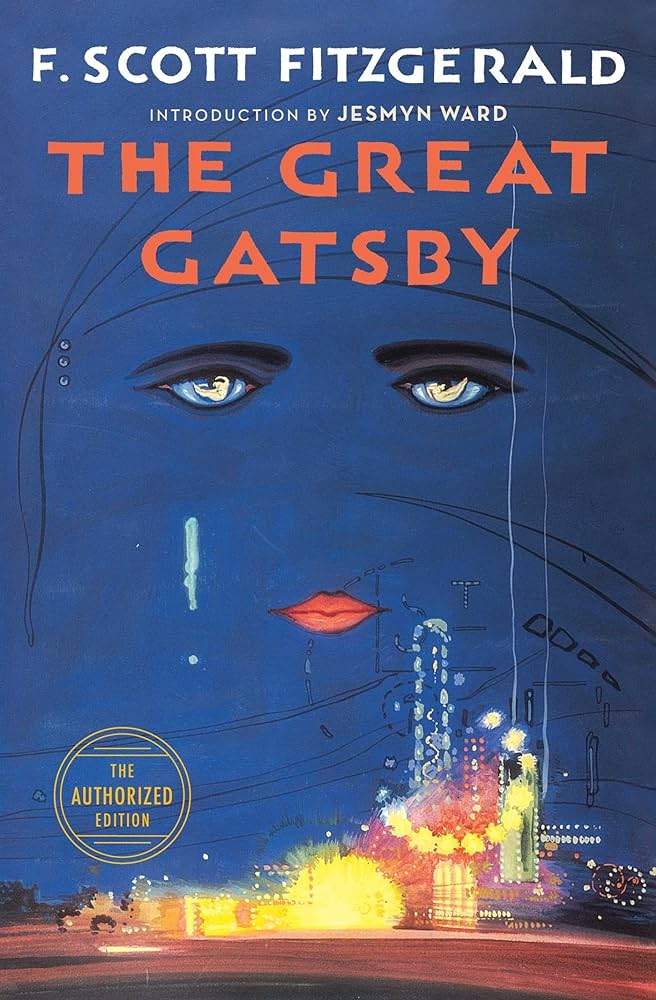
In high school, we were given the dark blue cover with a lit-up city-scape and disembodied eyes looming above it all (see above). It haunts me. The jazz age fable recounts a tale of obsession and excess, capturing the essence of the 1920s. It also plays with some quintessential idea of the American Dream, but one that’s gone a little seedy and unappealing at the edges. After all, everyone seemingly aspires to the life of the rich and famous, spending summers in East or West Egg, driving fast cars, and attending Gatsby’s extravagant parties along with the up and coming, dreadfully naive Nick Carraway. But (again, but), there’s a cost.
The story takes place during one hot summer in New York, fitting for seasonal reading. The pivotal scene happens when the exhausting weather drives the main characters, Gatsby and Nick, Daisy and Tom Buchanan, and Daisy’s friend Jordan Baker into the city, hoping for respite and entertainment at The Plaza. From there, all the carefully maintained charades and illusions come apart, leading to unresolved tragedy. The book ends with a deep yearning for what might have been, if only other choices had been possible.

What brought me back to Gatsby recently was The Chosen and the Beautiful by Nghi Vo. She is one of my current favorite authors (see The Singing Hills novellas), who turned this well-known story on its axis. The retelling stars professional golfer Jordan Baker and her lifelong friendship with Daisy, as opposed to newly-minted businessman Nick Carraway and his bewilderment with Jay Gatsby. Plus, the subtle (and not-so) metaphors of Fitzgerald’s text became all too real with the inclusion of magical realism. They really do float about in white linen in the opening scenes. Tom Buchanan continues to provide the White, patriarchal establishment’s status quo against which all their boats beat back so fruitlessly, but he is even less appealing through the female gaze. While everyone is still privileged to the point of carelessness, the feminine emphasis makes the book slightly more sympathetic and tragic.
It’s still a good idea to have the original under your belt before enjoying the other variations. I recently (finally) watched the 2013 movie, starring Tobey Maguire and Leonardo DiCaprio in a Baz Luhrmann production. It certainly does the story justice, and in some ways conveys the outrageous excesses better than the book with all the lush visuals and big scenes. The text and the film complement each other well. As is true for most Luhrmann movies, the soundtrack was amazing.
If you’re looking to refresh your memory of the story, without perhaps reading the original, consider the graphic novel adaptation by K. Woodman-Maynard. It does a good job of mixing the bare bones of the story with some of Fitzgerald’s more luscious prose. The illustrations and the placement of the words within the images makes some of the more subtle, interpersonal nuances more obvious.
The Great Gatsby, the ultimate tale of reinvention and breath-taking chutzpah in the name of love and ambition, is one of the cultural touchstones of the American literary canon. It’s worth retelling, to reconsider what else it can convey to audiences almost a century after it was published. If you aren’t familiar with it, summer is a great time to devote some time to those books that you have always meant to read.
Kristen B. is a devoted bookworm lucky enough to work as the graphic designer for HCLS. She likes to read, stitch, dance, and watch baseball (but not all at the same time).
 CHAPTER CHATS