In the late 80s, when I first discovered the novels of Jacqueline Susann and Jackie Collins, I used to place paper bag covers over them to hide the title information and, I suppose, my shame in reading them. Nowadays, in the age of e-books, where no one has to know or can see what you’re reading, I am not at all shy about sharing my love of these two authors.
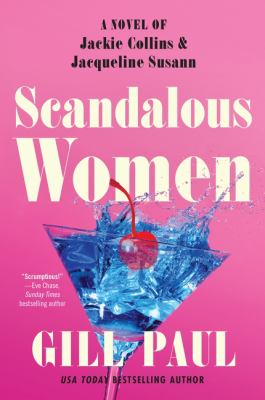
Scandalous Womenbrings to life the dynamic and groundbreaking careers of both iconic ladies. Set in the 1960s, the story follows these trailblazing and vibrant women as they navigate the male-dominated world of publishing, facing rampant sexism and societal backlash for their bold, provocative works.
Nancy White, a young editorial assistant becomes the unlikely link between these two literary powerhouses. As Jackie and Jacqueline strive to top the bestseller charts, they form an unexpected friendship, sharing their struggles and triumphs in a world that often seeks to silence them. Though there is no real world evidence to suggest they were friends in real life, Gill Paul has said that she loves to imagine that they could have been.
Paul weaves together the personal and professional lives of these women, highlighting their resilience, ambition, and the price they pay for their success. Scandalous Women is written in the style and spirit of both authors and is a fun, yet ultimately serious look at writing as a woman in the 1960s. The way she captures their spirit, especially Susann’s, is pitch-perfect and is one of the reasons the book stays with you long after you finish. The good news is, if you like Gill Paul, she has written several other novels, just as compelling and enjoyable to read.
To see Jaqueline Susann discuss literature (and that meshes well with what Scandalous is trying to say) click here:
Angie is an Instructor & Research Specialist at Central Branch and is a co-facilitator for Reads of Acceptance, HCLS’ first LGBTQ-focused book club. Her ideal day is reading in her cozy armchair, with her cat Henry next to her.
As the weather heats up and tensions in America never seem to ebb, I am reminded of the Spike Lee masterpiece (or “joint’ as he prefers to creatively call them), Do the Right Thing. I am surprised by the number of people I speak with who have not seen this film. I am a fan of Lee; I find him humorous, I like his style and his honesty. I also like how much he likes the New York Knicks, despite the fact that they are a fairly disappointing sports franchise. I’m not really sure why I appreciate his devotion to the Knicks, but perhaps I wish I sat courtside at the Washington Wizards’ games (they’re still my Baltimore Bullets).
Visually the movie is very well done. The whole film takes place on a hot summer day in Brooklyn, New York in the late 1980s. Having spent much time in a southwest Baltimore small business cluster, it seemed pretty true to life and almost stereotypical. The setting is replete with the animosity, resentment, struggle, and misunderstandings of an American multiracial neighborhood. It’s a contentious place. Moreover, it reminds me of just how hot a city feels on the East Coast in summer and how riots often happen on scorching days. Lee creates and presents this masterfully, and the tensions are palpable. Someone I know that spent time in a similar environment, and is rather conservative-minded, claimed that the movie is “spot on.” I concur.
There is the Italian family who owns the pizza shop (Sal’s) for generations, the Asian family that owns the small corner store, (neither of whom presumably live in the neighborhood), the black and Hispanic residents, the white “gentrifying” guy that just bought the brownstone, etc. The scenes with Danny Aiello, Spike Lee, et al. filmed looking at the camera and enumerating racial epithets are raw, stripped down, and very powerful. By the way, you’ll recognize many great actors in the film, giving great performances.
One of my favorite scenes, which is famous, involves the character thatwould be me. A young white man carrying his mountain bike, with longish hair, stubble, and running shoes accidentally steps on a black character’s “brand new white Air Jordans.” Then, a very telling exchange and slick commentary on race relations in the U.S. ensues. Like all great comedic moments, it is also tragic.
There are several references to athletes and race throughout the film. In fact, Lee dons a Jackie Robinson jersey and wears Air Jordan sneakers himself. What’s more, one subtle detail is also clever – the white “gentrifier,” who accidentally mis-steps on the character’s shoes which he “paid $100 for,” is wearing a Larry Bird Boston Celtics jersey shirt. As a side note, if you’re interested in watching an outstanding documentary, check out Magic and Bird: A Courtship of Rivals. Even if you’re not into basketball or sports in general, it is a compelling story about race in America and the relationship of two kindred spirits. As a blonde kid with floppy hair, Larry Bird was my guy in the NBA for sure; however, he had no interest in being the “white savior” America desired. But I digress.
Lee’s examination of his own beliefs and experiences, neighborhood, and America is real art. I would go so far as to say it’s a must-watch for Americans. In sum, Do the Right Thing is a micro-examination of inner-city race relations and how they can easily boil over in the sweltering heat. After watching this film you may ask yourself, how could they not?
Eric is a DIY Instructor and Research Specialist at Elkridge Branch. He enjoys reading, films, music, doing nearly anything outside, and people.
“My only quibble with this absorbing, thoughtful, and sometimes painfully honest memoir is with the title; McCarthy is anything but a brat. He is certainly an unlikely movie star, and the story of how this diffident and insecure young man found himself at the center of the culture in the 1980s—and then decided to walk away from it all—makes for a fascinating read.”
Perhaps you’ve seen Andrew McCarthy on the talk show circuit, or just remember him from his 80s films. I am a fan of his work in Less than Zero, Pretty in Pink, and St Elmo’s Fire. Moreover, and you may scoff, but I do realize the genius that is found in Weekend at Bernie’s. I’m a fan of McCarthy’s acting, and perhaps his general on-screen demeanor in these “period pieces.” He played thoughtful, “emo” characters before it was nearly a trope in myriad indie films (to be sure, I still love the sensitive emo characters). For example, I’d contend that Timothy Chalamet is successful in a way I’m not sure was possible in the recent past with more rigid gender roles.
Several years ago, I read some of McCarthy’s travel writing and liked his style. The piece was about Los Angeles and was personal for him, and he spiced it up with personal anecdotes about his memories. For fans of 80’s films and McCarthy, Brat is like a greatest hits collection.
The book opens with him abruptly leaving the Pretty in Pink Hollywood premiere to slam drinks at the bar across the street. McCarthy briefly gets into his middle-class upbringing, childhood, his time at NYU studying acting, before landing his first role and dropping out to pursue Hollywood acting full time. The remainder of the book is about the roles and the experience of his meteoric rise in Hollywood during the decade. McCarthy lived in New York for the duration of his Hollywood fame, which I found surprising, but makes sense now. He laments the fact that he didn’t pursue the theater, instead of accepting some of the roles he was offered.
He includes some interesting stories about his experiences in Hollywood and some of the characters he encountered. I would not describe this as a tell-all book, but rather a memoir of a person experiencing and observing the strange world of American film and celebrity but never really feeling terribly comfortable in it. John Hughes described him as a “wimp,” which seems like a nasty thing to say. His experience at a Paramount anniversary party with Hollywood legends and young up and comers, where he realizes he could not and had no desire to be Tom Cruise, is hilarious because we all know how their respective careers progressed. McCarthy includes many pictures, and this one of the entire group at the Paramount party is telling.
Artists who have a tough time with the nature of celebrity interest me generally. I appreciate what it’s like to want to be noticed, appreciated, and recognized, but then not wanting all that attention. I’m terrified of someone trying to take my picture as I try to live my daily life. McCarthy has accepted his status as an 80s star and a member of the “brat pack,” even though this was a media term. He’s not seen some of these people since the respective films were completed.
If you’re a fan of so-called “brat pack” films, or 80s movies, John Hughes films, or just looking for a book not concerning current affairs, it’s a pretty good read. I acknowledge my bias on this subject, but I enjoy McCarthy’s writing style and his reflective and analytical nature. Perhaps this comes through in his acting? Andrew McCarthy does seem like someone I’d know, or someone I’d like, but perhaps this is how celebrity works. Briefly reflecting on his days at NYU, McCarthy said that after class he’d hang out in the “post-bohemian cross culture” of Washington Square Park, observe all the interesting people, buy two joints off a Rastafarian for a buck apiece, then go home and watch the Rockford Files. This sounds like a nice afternoon to me, or perhaps a celebrity dream date.




 CHAPTER CHATS