
By Julie F.
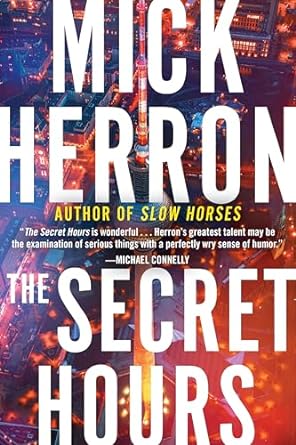
The Secret Hours opens with a thrilling pursuit: Max, a retired academic living in remote Devon, experiences a home invasion. The reader is privy to Max’s thinking in this first scene; he’s calm and collected enough to evade capture, at least immediately, and it’s clear that he has some background with the intelligence services. Max is now on the run, and the reader’s task is to figure out how his story matches up with the other tale author Mick Herron is telling – a look into what, at first, seems like ancient history.
In 1994, a newly-minted MI5 agent, Alison, is sent to cold war Berlin by David Cartwright to oversee and report back on the work of a somewhat abrasive, difficult agent named Miles. Cartwright is second-in-command in the Service and Alison isn’t sure why he distrusts Miles. In the present day, decades later, Alison is telling the civil servants on the nearly-defunct, investigative Monochrome commission the story of her sojourn in Berlin – how agents died and how the situation was rife with betrayals. The reader gradually comes to realize that her story might have something to do with Max and his pursuers. Of course, all the threads come together at the end and we get a glimpse of the manipulators behind the curtain who pull them for their own benefit. Herron’s unpredictability is one of his strong suits; the good guys don’t always come out on top, so it’s interesting to learn whether those maneuvering behind the scenes will get their comeuppance.
Mick Herron is a master – of character development, of mood and theme, and of plotting above all. I’ve loved the Slough House books in varying degrees, but this book – which is really Slough House-adjacent, involving none of Jackson Lamb’s present-day agents but clarifying many important questions from prior books – is utterly fantastic. If the acclaimed Apple TV series tackles this novel, it will be fascinating to see how they handle the flashbacks and resolve them in the modern storyline that features Lamb and his motley crew.
The tagline from Lee Child on the book cover says it better than I could: “Great Britain has a long, rich history of how-it-really-works espionage fiction, and Mick Herron – stealthy as a secret agent – has written himself to the very top of the list.” I’ve reread Slow Horses already, but as I’ve worked my way through the series, I’ve become convinced that there are so many little details and asides that are easily missed yet turn out to be consequential later on. I rarely re-read series (just because there is so much new fiction out there to discover), but this is one that is worth a second go – not just The Secret Hours, but all nine of the Slough House novels to date, as well as the excellent collection, Standing by the Wall: The Collected Slough House Novellas.
My favorite quote, from Miles to Alison: “You want to serve your country, right? What did you think that involved, dressing up and playing parts? This job is about betrayal. About persuading people to betray other people. Their countries, their friends, those they work for. And in return, we betray them too in the end” (295). It’s worth noting that, despite what he says about playing parts, the narrator tells us at the end that “for a moment they were back in their old lives, the ones that had turned out to belong to other people, or at any rate, to no longer belong to them” (349). Everyone has a hidden identity or motive; everyone is playing a part.
If you’re already a Slough House aficionado, good news: the wait will be up next year. Soho Crime currently plans to publish Clown Town, the tenth book, on September 2, 2025. And if you need something between now and then and have run through the entire series, Herron wrote two standalone novels that, like The Secret Hours, are set in the world of MI5 and MI6 concurrent to the adventures of Jackson Lamb’s Slough House crew: Reconstruction and Nobody Walks.
Julie is an instructor and research specialist at HCLS Miller Branch who finds her work as co-editor of Chapter Chats very rewarding. She loves gardening, birds, crime and espionage fiction, all kinds of music, and the great outdoors.

 CHAPTER CHATS