Mon, Feb 24 | 7 – 8:30 pm HCLS Miller Branch For adults. Register here.
Jeffrey Boutwell discusses his new book,Boutwell: Radical Republican and Champion of Democracy, a biography of family member George S. Boutwell – perhaps the most consequential American political figure you’ve never heard of. During his career from 1839 to 1905, George Boutwell was Governor of Massachusetts, served in the U.S. House of Representatives and the Senate, was treasury secretary for Ulysses Grant and Commissioner of Revenue for Abraham Lincoln, helped create the Republican Party in the 1850s, and forty years later opposed Republican Presidents William McKinley and Teddy Roosevelt over their plans to annex the Philippines following the Spanish-American War.
Boutwell was instrumental in framing the Fourteenth and Fifteenth Amendments, initiating the impeachment of Andrew Johnson, and investigating white vigilante violence against Black people in Mississippi in the 1870s. For seven decades, George Boutwell sought to “redeem America’s promise” through racial equality, economic equity, and the humane use of American power abroad.
Jeffrey Boutwell is a writer and historian living in Columbia, Maryland, after a 40-year career in journalism, government, and international scientific policy. He began his career as a reporter and editor with the famed City News Bureau of Chicago and was a book reviewer for the Chicago Sun-Times. After two years in the Windy City, Boutwell moved to Berlin and then to England, where he received an M.Sc. in Economics and Politics from the London School of Economics. He received a Ph.D. in political science from the Massachusetts Institute of Technology in 1984. He has written and spoken widely on issues ranging from nuclear weapons arms control to Middle East peace to environmental issues.
A friend recently told me she recently checked out and watched the 1949 film The Heiress and that she was oddly enthralled and affected by it.
“That’s based on a Henry James novel called Washington Square.” I said excitedly. “You should read it sometime! It’s absolutely heartbreaking.” Her face grew a bit stricken as she said, “Oh, Lord, no! I can’t do that.” She sounded like I had just suggested an unexpected root canal, and I had to wonder if maybe she had had a bad experience with Henry James at some point in her reading life. Maybe I should say a particularly bad experience, as she would not be alone in her feelings on him. Biographer Susan L. Mizruchi writes that a law professor she knew once confided in her, “I never read a James novel that I did not want to hurl across the room when I finished.”
It is kind of true: Henry James can be off-putting to a lot of readers, especially in his writing style. He appears stuffy and unapproachable in nearly all known pictures of him. You might even wonder: what could he possibly have to say to today’s readers? Despite all this, I unapologetically love Henry James. I named my tuxedo cat after him and have read almost everything he ever wrote. I buy all my favorite titles of his in every imaginable edition, just to see the different ways covers treat his novels and to read yet another introduction (or afterword).
I’m determined to sell someone besides me on Henry James. It’s not that he doesn’t already have his fans (though probably not in the same number as Dickens or Austen), or that I’m the first person to ever hear of or love him. Joseph Conrad, a contemporary of James, once said: “His books stand on my shelves in a place whose accessibility proclaims the habit of frequent communion.” Kim Gordon of Sonic Youth is also a fan of Henry James and well-deserving of a read with her terrific Girl In A Band (reviewed here).
Washington Square remains my favorite of his and is the book I would give to anyone who believes that Henry James is as dry as day-old toast. In her slim biography on Henry James, literary critic Rebecca West writes, “The book so beautifully expresses the woe of all those people to whom nothing ever happens, who are aware of the gay challenge of life but are prevented by something leaden in their substance from responding. It’s a work of genius and a story of how a plain and stupid girl was jilted by a fortune hunter when he discovered that she would be disinherited by her contemptuous father on her marriage. It has in it a wealth of feeling.” Even critics of James often say that Washington Square is his most accessible title.
I remember when I discovered him back in college, Washington Square touched me profoundly. James could see right through the veneer of proper society and heavy clothing to the heart that beats in anyone who has ever been manipulated or spurned in the name of love…or lack of it. And he had a feel for emotions and social observations that were ahead of their time. Whether it’s the 19th century or the 21st, the power of emotions can bring down even the most staid of persons and are something all people from all times can understand.
But if I can’t sell you on Henry James with any of the above, consider, for a moment, this passage, both lovely and far from uptight, that I have held on to many times in my life: “Don’t melt too much into the universe, but be as solid and dense and fixed as you can. We all live together, and those of us who love and know, live so most. We help each other—even unconsciously,”
Angie is an Instructor & Research Specialist at Central Branch and is a co-facilitator for Reads of Acceptance, HCLS’ first LGBTQ-focused book club. Her ideal day is reading in her cozy armchair, with her cat Henry next to her.
There are many ancient inns on the bank of the river Thames, providing their patrons with more than just ale and cider. Patrons looking for music go to The Red Lion at Kelmscott; for deep contemplation, they go to the Green Dragon at Inglesham; the Stag at Eaton Hastings is the place for gambling. But if they are looking for stories, they go to The Swan at Radcot, the most ancient inn of them all and only a day’s walk from the source of the Thames. On a dark winter’s night, sometime in the mid-nineteenth century, a seriously injured man enters The Swan with the body of a four-year-old girl in his arms whom he found floating in the river. Before he can give any explanations, he collapses in the arms of the storytellers at the inn. The innkeeper’s son Jonathan catches the body of the girl before the man falls. The child, presumed dead, is kept in a separate room while everyone gets busy looking after the man, who is still breathing, but just barely. Rita Sunday, the resident nurse of the village, is summoned immediately. She first tends to the injuries of the man, who we learn later is a photographer named Daunt, and then goes to look at the little girl’s dead body. Rita checks her pulse and her breathing and, finding none, she holds the hands of the girl and sits with her awhile, lamenting the death of one so young in such mysterious circumstances. In her hand, however, Rita suddenly feels a flutter of life! The girl, who had no pulse, comes alive.
The thread of the story unspools at this point just like the surge of the Thames roaring outside the inn. Like tributaries that feed the powerful river, each of the characters in this tale veers off to run his or her own course, only to come together to enrich the main body of the story. The narrator takes us on the journey of life with each of her characters and explains how their actions and decisions converge to solve the mystery of the little girl. The river, with its myriad turns and crossings and innumerable tributaries, becomes a powerful character in itself within the plot, always present in the background propelling the story forward with its mighty surge. There are so many intriguing questions that the reader wants answered. Who is the mystery girl who came back from the dead? Is she the kidnapped daughter of the wealthy Vaughan family? Is she the granddaughter of the black farmer Robert Armstrong, whose wayward son Robin married a woman and then left her alone with their little daughter, Alice? Or is the four-year-old girl the sister of 44-year-old Mrs. Lily White, as she adamantly claims? How is that possible? Who does she belong to and why won’t she speak?
The storyteller of this tale, which is fortified with folklore, magic, science, and myth, is one of the best, sweeping readers in the turbulent current of her fast-paced, hypnotic plot and then delivering them safely back to their own worlds to attend to their own rivers. “And now, dear reader, the story is over. It is time for you to cross the bridge once more and return to the world you came from. This river, which is and is not the Thames, must continue flowing without you. You have haunted here long enough, and besides, you surely have rivers of your own to attend to?” (460) Before leaving us, though, she makes sure each tangle of the plot is smoothly and expertly untangled, each question satisfactorily answered. Once Upon a River is yet another testament to the power of stories and storytelling that has captivated and transformed lives through centuries. This title is also available as an ebook and eaudiobook from Howard County Library System. In my opinion, this novel is best enjoyed in your cozy reading spot on a cold winter’s night, snuggled in your favorite blanket with a cup of hot chocolate by your side.
Piyali is an instructor and research specialist at the Miller Branch of HCLS, where she co-facilitates both Global Reads and Strictly Historical Fiction.
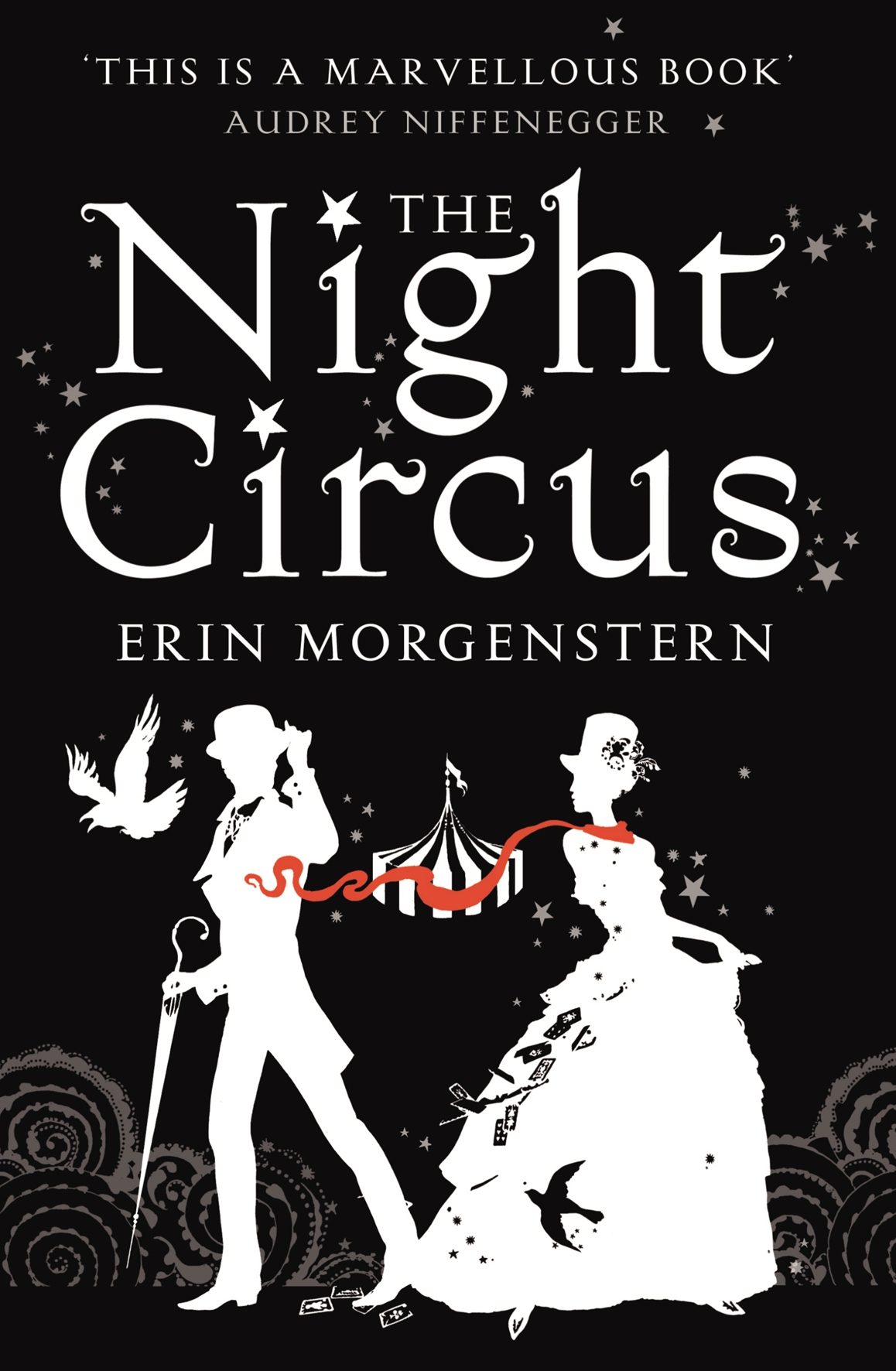
The Night Circus, Erin Morgenstern’s debut bestselling novel, follows the story of “Le Cirque des Rêves,” a mysterious circus that opens at nightfall and closes at dawn and within its gates anything seems possible. French for “Circus of Dreams” – the circus mixes the dream world with reality as it hosts a unique and potentially deadly magical competition within its black and white striped canvas walls. The magicians challenge each other by making each new tent more fantastical than the last.
This 19th century historical fantasy is a well-crafted story of rivals with fully developed characters that draw you into a surreal world of vision and artistry. The author employs first person, second person, and third person perspectives while writing, inviting the reader directly into the narrative. The book is written with lush descriptions that leave you hungry for more…literally and figuratively, as some of the most tantalizing banquets are described in mouth-watering detail. The smells, sights, tastes, and sounds are lavish beyond imagination.
I experienced this novel via the audiobook, which is read by Jim Dale. His other audiobook credits include J.K. Rowling’s Harry Potter series. He is a skillful narrator who excels at making distinctive voices for each character. His portrayal envelops the listener in this circus of dreams. The Night Circus is available in print, audiobook, ebook, or eaudio. Explore this world of magic, illusion, manipulation, love, and loss by visiting hclibrary.org
“You think, as you walk away from Le Cirque des Rêves and into the creeping dawn, that you felt more awake within the confines of the circus. You are no longer quite certain which side of the fence is the dream.”
The Night Circus, Erin Morgenstern
Kimberly is a DIY Instructor and Research Specialist at the HCLS Elkridge Branch. She enjoys reading, photography, crafting, and baking.



 CHAPTER CHATS