
Everyone Give It Up for America’s Favorite Fighting Frenchman: Lafayette

by Angie Latham Kozlowski, Co-Chair, Franco-American Memorial Committee, Col. Thomas Dorsey Chapter, National Society Daughters of the American Revolution

Revered Revolutionary War figure Gilbert du Motier, the Marquis de Lafayette, left France at age nineteen to aid America’s battle for independence from the British Monarchy. He was determined to fight for the American cause against the wishes of his father-in-law and the prohibition of France’s King Louis XVI. On December 7, 1776, while in Paris, Lafayette received a commission of Major General in the Continental Army, which was approved by the Continental Congress on July 31, 1777. As Lafayette began making travel plans, he purchased a ship with an experienced crew, along with twelve handpicked fellow French officers, and absconded to Spain. The ship was called the “Victoire,” and it set sail for America on April 20, 1777.

Lafayette risked his life in notable battles such as Brandywine and Yorktown, earning admiration from Americans and fellow soldiers alike. His enlightened views on equality and zealous support for American independence endeared him to General George Washington, who reportedly came to treat Lafayette as a son. Lafayette’s steadfast commitment to the American cause and his ideals of liberty cemented his legacy as one of the Revolution’s most beloved figures.

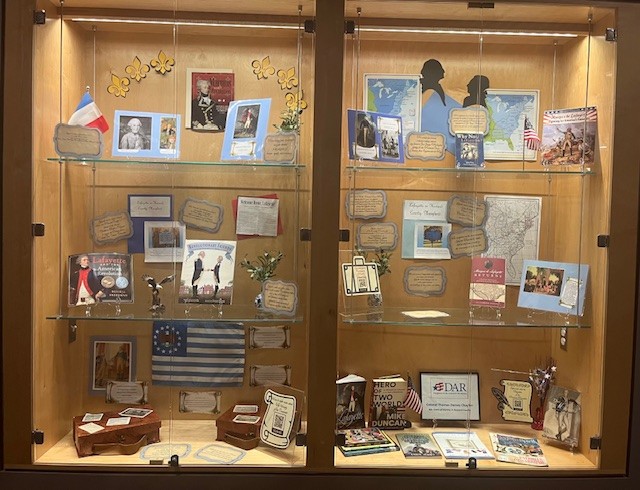
The photograph is of the display cases in the Miller Branch hallway, which contain documents, maps, photographs, books, and artifacts related to Lafayette and his visit to America.

Celebrating Lafayette’s Bicentennial as Guest of the Nation

In 1824, President James Monroe invited the 67-year-old Lafayette, the last surviving major general of the Continental Army, to return to America as the “Guest of the Nation.” His year-long Farewell Tour rekindled the nation’s gratitude and admiration. To commemorate the 200th anniversary of this historic visit, the Bicentennial of Lafayette’s Farewell Tour began in New York City on August 15, 2024. The tour retraces Lafayette’s original route and celebrates his profound impact on the young America.

Lafayette and his entourage visited Howard County with a stop in Lisbon on December 29, 1824, en route to Frederick. There is a commemorative Lafayette Tour marker, with an inscription that notes that an arch was erected by the community to welcome him.

The photograph is of the display cases in the Miller Branch hallway, which contain documents, maps, photographs, books, and artifacts related to Lafayette and his visit to America.

Explore Lafayette’s Legacy at the Miller Branch Library

The Bicentennial celebration recreates Lafayette’s tour as it unfolded in 1824 and 1825. The community can learn more about Lafayette and his return to America from the Colonel Thomas Dorsey Chapter of the Daughters of the American Revolution General Lafayette’s Farewell Tour Exhibit at HCLS Miller Branch this December.

Visit the exhibit to learn more about Lafayette’s extraordinary life, his role in America’s fight for independence, and the enduring significance of his Farewell Tour.
Revolution or Counter-Revolution?

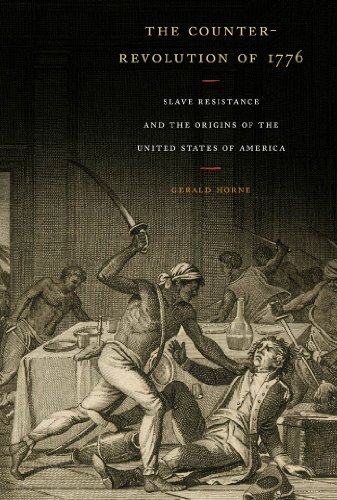
Black and white print of slave revolt with a man wielding a sword and disarray around a table.

“Above all, he was flabbergasted by their constant prating about liberty while continuing the enslavement of tens of thousands” 
Gerald Horne (writing about Samuel Johnson’s feelings about the colonists) 

If you’ve ever wanted more information on the events leading up to the American Revolutionary War, Gerald Horne’s got you covered. His 2014 book, The Counter-Revolution of 1776: Slave Resistance and the Origins of the United States of America, will help you fill some of those gaps.  

Horne argues that the strongest driver of the revolutionary war was the African slave trade. He further claims that the American Revolution was not, in fact, a progressive victory for the good guys, but rather a regressive counter-revolution to the constant revolutions of the rapidly growing number of enslaved Africans on the continent and in the Caribbean. Through a mountain of primary source material, Horne documents the macro- and micro-events in the mainland colonies, Jamaica, and Barbados in the years leading up to 1776. 

In my opinion, Horne’s only flaw is his love of outrageously long and convoluted sentences. Horne is clearly of the Miltonian school of prose and sometimes seems to be attempting unmatched feats of sentence length: 

Perhaps, rather than seeing these men as having novel conceptions of allegiance to London or even as ungrateful hypocrites, it might be better to see them as ‘premature’ U.S. patriots; that is, economic logic was impelling them like a swift river current toward secession; while London was seeking to restrain their business dealings driven by the luscious bounty of African enslavement, Paris and Madrid had burst the dam and were more than willing to encourage settlers’ shady bargains, and, thus, these mainland men chose not to fight this trend but embrace it, along with the pretty profits it delivered (160).

Nestled within that labyrinthine sentence is the heart of the book: colonists were driven to war with England by the economic logic of slavery. The book is well-researched, well-argued, and compelling. In many cases, Horne uses the colonists’ own words to illustrate how the immense wealth they could accumulate from the enslavement of Africans drove them to madness. Horne writes, “Africans, in short, were a major antagonist, but mainlanders were reluctant to curb the seemingly ceaseless flow of Africans who were arriving, which was raising searching questions in London about their judgment, if not their sanity” (154). In my opinion, this book provides crucial historical context and should be required reading. 

Ben’s suggested pairings: 

Stony the Road: Reconstruction, White Supremacy, and the Rise of Jim Crow by Henry Louis Gates, Jr. Gates deals with the same theme of powerful men doing whatever they can to keep unjust systems in place.  (also available as an ebook and eaudiobook)

We Were Eight Years in Power: An American Tragedy by Ta-Nehisi Coates. Coates touches on many of the same themes as Horne. The sections on the “invention of racecraft” will be particularly interesting to readers of Horne’s work.  (also available as ebook and eaudiobook)

How to Be an Antiracist by Ibram X Kendi. Kendi’s book provides the reader with suggestions for how to move forward. (also available as ebook and eaudiobook)

Ben Hamilton works at Project Literacy, Howard County Library’s adult basic education initiative, based at HCLS Central Branch. He loves reading, writing, walking, and talking (all the basics).