Raising Hare: A Memoir

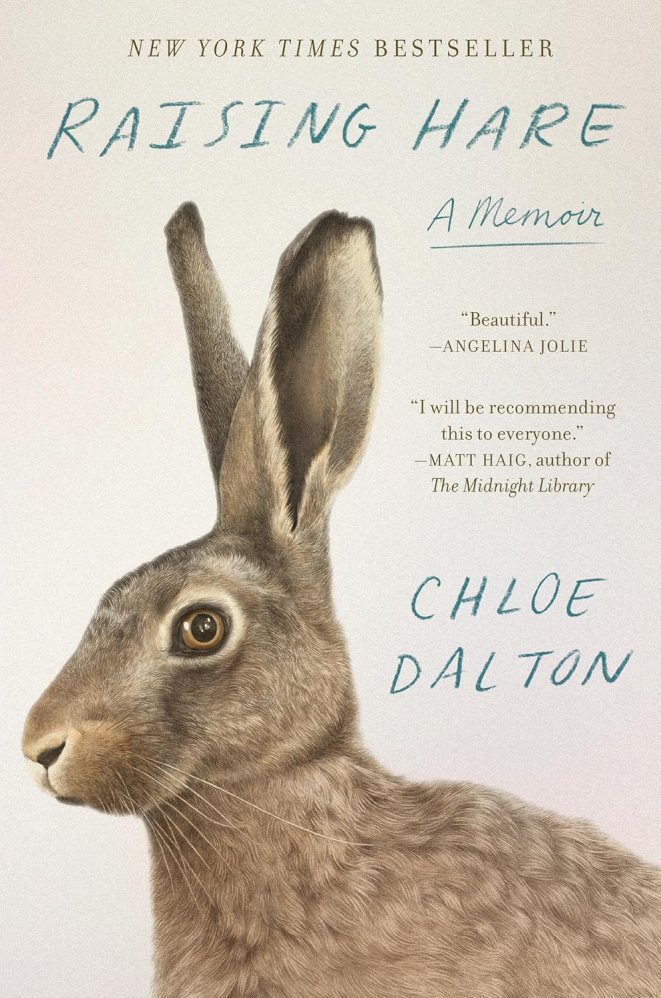
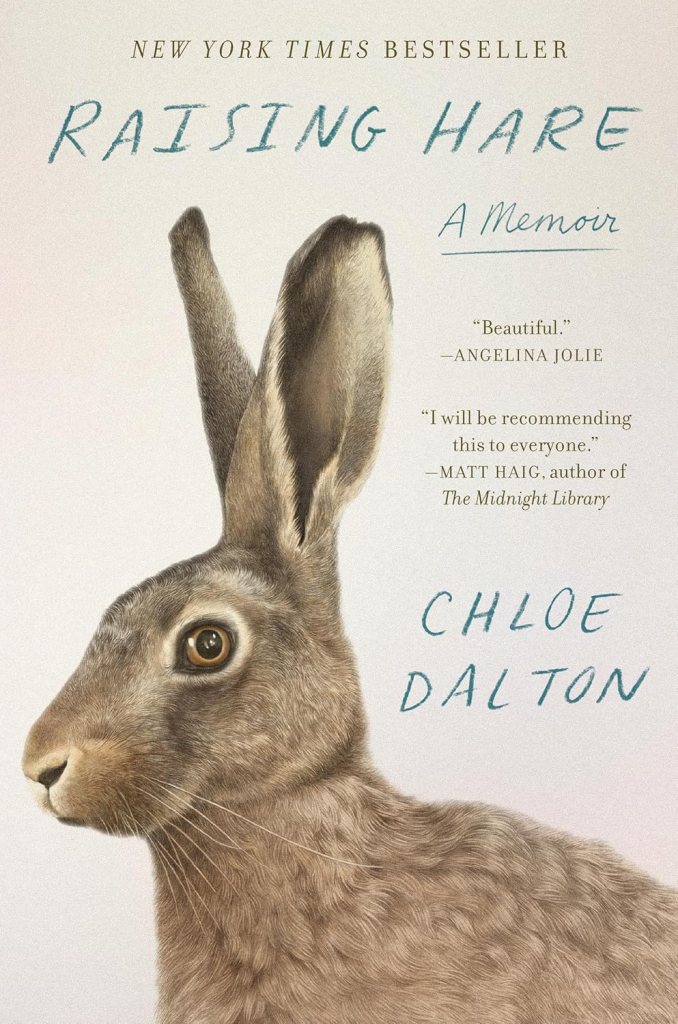
The book cover is a colored illustration of a hare in profile, with its ears alert and its whiskers extended. The viewer sees one golden-brown eye staring back at them.

By Julie F.

Chloe Dalton, the author of Raising Hare: A Memoir, is a writer, political adviser, and foreign policy specialist who decided to escape London during the pandemic. In February 2021, while still getting used to the lay of the land and the run-down home she purchased in the dead winter landscape, she discovers a leveret (a baby hare) in her garden. Not knowing anything about the species, but determining that the mother is not close and may not return, she brings it in and sets about trying to keep it alive.

There is a lovely, intimate prologue from the perspective of the mother hare that offers one explanation for how the leveret, which she has carefully hidden from predators, might have come to be separated from her. Dalton is clearly the kind of person who listens to the landscape and tries to discern what it wants to communicate. She tries very hard to ensure that the leveret stays wild. She bottle-feeds it and then offers it porridge oats, but then she plans to release it into the wild. Although the leveret ventures into her garden, and then eventually over the garden wall, it never becomes fully wild (nor fully tame), and it returns again and again–delivering the next litters of baby leverets in the garden, and even later in the house, where she feels safe and they grow up feeling even safer, having been born on the floorboards.

The memoir is a lovely meditation on what is tame and what is wild, the tenuous but loving connection between humanity and nature, and how slow, deliberate observation can teach us so much about a species. Dalton knew next to nothing about hares when she began and is surprised to learn that there’s not that much information out there; most of what she learns is gleaned from the poet William Cowper, whose period of depression in 1774 was relieved when he was gifted a three-month-old hare and later acquired two more, all of whom he adored. She says, “I doubt that Cowper imagined his poems might be used as a guide to raising a leveret nearly 250 years later, but his words were in many ways the most useful of any I found” (53). This is particularly true in relation to feeding and shelter; though Cowper kept his leverets in pens at night, she didn’t keep the leveret locked in, “never want[ing] it to feel trapped inside, nor barred from coming in” (53).

This is a tour-de-force–beautifully written, resonant, humorous, and charming at times, but full of emotional and philosophical heft. I can’t say enough good things about it, and it’s such an accomplished first book from a thoughtful, skilled, and talented author. If you enjoy audio, the narration by Louise Brealey is also accomplished and is a beautiful accompaniment to the text (if you like to listen as you read along as I did). The illustrations by Dublin-based artist Denise Nestor are also full of wonder and beauty. Near the end of the book, she talks about the impact of the hare on her life, and her description is a wonderful summation of the emotions you feel while reading her story. I’ll conclude with her words, because my own are inadequate in comparison:

“She has taught me patience. And as someone who has made their living through words, she has made me consider the dignity and persuasiveness of silence. She showed me a different life, and the richness of it. She made me perceive animals in a new light, in relation to her and to each other. She made me re-evaluate my life, and the question of what constitutes a good one. I have learnt to savour beautiful experiences while they last–however small and domestic they may be in scope–to find the peace to live in a particular state of feeling, and to try to find a simplicity of self. The sensation of wonder she ignited in me continues to burn, showing me that aspects of my life I thought were set in stone are in fact as malleable as wax, and may be shaped or reshaped. She did not change, I did. I have not tamed the hare, but in many ways the hare has stilled me” (275).

Raising Hare: A Memoir is available in print and as an e-book and e-audiobook from Libby.

Julie is an instructor and research specialist at HCLS Miller Branch who finds her work as co-editor of Chapter Chats very rewarding. She loves gardening, birds, crime and espionage fiction, all kinds of music, and the great outdoors.

Animal Fun on the Summer Reading Lists

The photograph shows a tiger bathing in a pool of water.
Photo by Jakob Owens on Unsplash.

By Eliana H.

Happy Summer! I’m hoping that you are enjoying lots of fun activities so far this summer, including some of our classes and events. When you’re ready for some quieter fun, of course we always encourage you to dive into a good book. Our Summer Reading Adventures last all summer long, so here are a few suggestions to check out and regain your momentum if the first burst of reading excitement has passed for your student. In particular, these are titles that many an animal lover will be excited to explore. 

K-1: 

Wutaryoo by Nilah Magruder 

The illustration shows the title creature, Wutaryoo, facing a group of animals in what looks like a conversation, against a green-blue sky. The animals include an elephant, a giraffe, a fox, a rabbit, a bird, a buffalo, and a wolf.

In this book, Wutaryoo is a mysterious creature. She doesn’t know her name, so when other animals come up and say “Wutaryoo?” it sticks. Since she can’t answer their question, Wutaryoo asks it back. And each animal tells her their story, of what kind of creature they are and how that type of creature came to be. More than anything, Wutaryoo wants to know her own story, who her people are, and where she came from. So, Wutaryoo sets off on a long journey to try to find out. She walks and swims and climbs and digs. She encounters even more different kinds of creatures and seeks answers for herself. Where does she go, and what does she learn? You’ll have to read the book to find out! 

2-3: 

Horace and Bunwinkle by PJ Gardner 

The illustration shows a dog and a pig, back-to-back, in front of a barn and a fence against a blue sky with fluffy white clouds. A female mallard is perched on one of the fenceposts.

Horace is a very proper Boston terrier who hates dirt and the outdoors. So when his person, Eleanor, moves to a farm called the Homestead, he is NOT excited. Just as he starts to come to terms with this new home, Eleanor adopts a piglet as Horace’s little sister and calls her Bunwinkle. The two couldn’t be more different, and they can’t understand each other at all. Eventually they begin to bond, especially when they start to watch a pet detective show together. Soon they discover a real mystery in their neighborhood when animals start to disappear! Can Horace and Bunwinkle, along with their friends, solve the mystery before it’s too late and one of them disappears?! Read along as Horace, Bunwinkle, and the whole cast of furry and feathered friends – each of whom has LOTS of personality – work together to figure it out. 

4-5: 

Rewilding: Bringing Wildlife Back Where It Belongs by David A. Steen, illustrated by Chiara Fedele 

The picture shows a beige tree with green leaves against a pale pink background, surrounded by animals, including a wolf, a tortoise, a buffalo, and a beaver.

Anyone with much interest in animals will know that, unfortunately, many are endangered. Whether due to habitat loss, over-hunting, or other human activities, people have made it impossible – or nearly so – for some animals and plants to thrive in the places they used to live. This book shares efforts that have been made around the world to help various wildlife make a comeback in the areas where they previously flourished. From toads to lynxes to carnivorous plants, learn about how people have worked to change the circumstances they face and support their success. Beautiful, realistic illustrations help readers envision the flora and fauna being described, and a “What Can You Do?” section at the end inspires action to accompany the learning. 

Eliana is a Children’s Research Specialist and Instructor at HCLS Elkridge Branch. She loves reading, even if she’s slow at it, and especially enjoys helping people find books that make them light up. She also loves being outside and spending time with friends and family (when it’s safe).

Humans and their Fuzzy Friends in the Snow

by Rebecca R.

What’s your favorite thing to do when it snows? I love the quiet calm of the first snow of the season. To prepare for that fluffy white stuff to fall from the sky, I read a few snow-forward books for kids and I want to share them with you!

Here are a couple of books from the perspective of animals who love the snow (and some who have to be convinced to love it).

The book cover is a cartoon of the dog, Claude, on skis on the ski slopes, with snow falling and snow-covered purple mountain in the background. Claude is wearing a red sweater with a white dog-bone motif and a red beret, with red ski boots and a black and white spotted dog collar.

Claude in Claude on the Slopes, written and illustrated by Alex T. Smith, sees snow for the very first time and is so excited to have a snow adventure! He goes to the Snowy Mountains Winter Sports Center with his best friend Sir Bobblysock, where they make some snowballs, discover sledding on a tea tray, and try skiing. Sir Bobblysock (who is actually a striped sock) enters a snowman building contest and wins with his snowy sculpture of “One Sock and His Dog.” They meet Sidney Snood who helps them learn how to make a mountain rescue in case of an avalanche. Mr. Snood then teaches Claude how to ski. It takes Claude a little while to really get into it, but as he gains his confidence, he is ready to take on the tallest mountain! He gets up to the top and finds Sir Bobblysock (who is having hot chocolate at the bottom of the mountain) through his binoculars. He shouts “Helloooooo Sir Bobblysock” so loudly that the snow starts to shift a bit under his skis. Can you guess what happens next? To follow more of Claude’s adventures, check out other titles in the “Claude” series.

The cartoon on the book cover depicts a brown bear in a snow drift, with snow on top of his head and his arms crossed. A white duck in a red hat and sweater and a yellow duckling are adjacent.

Like Claude, Duck is so excited that there is a lot of snow outside in All Right Already! A Snowy Story, written by Jory John and illustrated by Benji Davies. He wakes up his friend and next door neighbor Bear to tell him the good news. Bear doesn’t want to go out because it’s too cold, but Duck pushes him out the door anyway and shows him all the fun things to do in the snow. He wants to sled, play tag, and make a “snowbear” and a snow angel. Bear reluctantly begins to share in the snow fun with Duck but he gets wet and cold. Bear sneezes and runs inside. Turns out he now has a cold, and Duck attempts to take care of him but asks too many questions until “all right already!” – he’s done too much. Duck heads home and catches Bear’s cold. What will Bear do when Duck is sick? Have fun in the snow, but take care of yourself and your friends too!

The book cover depicts a street scene, with a taxi, car, and two delivery trucks moving through the snow, shops with pedestrians and a dog walking on the sidewalk in front, and birds perched on overhead power lines above the row of shops. The title "My Winter City" appears as if it was a sign above one of the shops. Snow is falling heavily over the scene, against a blue-white sky.

Humans are adventurous when it comes to exploring our snow-covered surroundings as well. In My Winter City, written by James Gladstone and illustrated by Gary Clement, a boy, his dad, and his dog travel through their city streets in a snowstorm to get to a big sledding hill. The boy notices all the differences the falling snow has on his environment, such as how he can see his breath in the cold and how icicles form. As they make snow angels (like Duck and Bear), he describes the feeling of the snow as “resting on light powder pillows.” The wonderful illustrations echo the visuals, making the reader feel as though they are experiencing this snowy day and all its wonders.

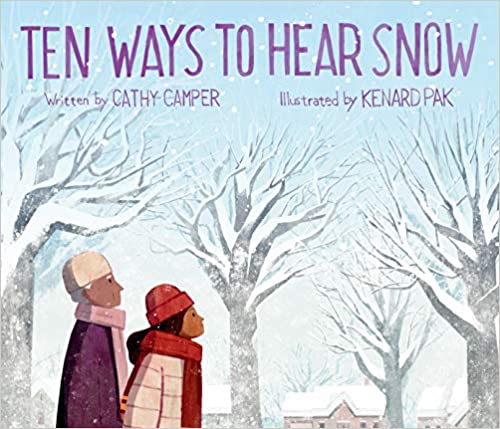
The picture depicts a girl and her grandmother, out walking in a wintry setting, with four bare white trees in the background and some buildings in the distance. The grandmother wears a purple coat and pink scarf and hat; her granddaughter wears a pink coat with a red scarf and hat.

Ten Ways to Hear Snow, written by Cathy Camper and illustrated by Kenard Park, offers another treat for our senses. Lina walks through her neighborhood to her grandmother’s house after a snowstorm. As Lina walks through her quiet neighborhood, she focuses on what she is hearing, the “snyak, snyek, snyuk” of the snow underfoot. She thinks about her grandmother, who is losing her eyesight, and wonders about how she experiences the world. Lina reaches her grandmother’s house, where they cook and talk about how they “hear” snow. Read on to experience the quiet strength of this vivid story.

The book cover depicts many crystal-white snowflakes in different patterns, shapes, and sizes, against a black background. The title is lettered in blue, pink, orange, yellow, and turquoise letters.

Do you ever wonder how all these snowflakes are formed? Find out in Curious About Snow by Gina Shaw. This nonfiction book explains how snow develops, shows you what snowflakes look like under a microscope, and introduces various snowy weather-related events. Maybe Claude should have read this book before venturing out!

Enjoy your time out there, everyone, and remember to come inside at some point for a good story and some hot chocolate.

Rebecca is the Assistant Branch Manager of the HCLS Glenwood Branch. She enjoys creative art projects and taking long walks with her puppy.