

by Sahana C.
I’ll admit to some bias here: I was an anthropology major as an undergraduate. That’s part of why this book called to me – I recognized so many of the names, and it felt familiar. This might not be everyone’s cup of tea, but stick with me.
It’s the 1920s, and so much culture is up in the air, so much of the world is more accessible than ever, and there is so much burgeoning diversity in America that it seems to require classification. Of course, those doing the classifying are the people in power. They’ll do whatever they can to keep that power in place, even if it means creating dangerous, harmful institutions with staying power.
Enter Franz Boas, affectionately termed as Papa Franz, and the father of American anthropology. That man singlehandedly taught almost every single major American anthropologist and mentored the founding polycule behind cultural relativism. He basically invented the field as he went along, and his students are credited with many of the ground-breaking, society-forming theories and practices that are foundational to modern academia. The fact that a whole discipline grew up around one dude and his ducklings is remarkable.
And King takes us through it. The heroes of the story are the aforementioned Boas, Ruth Benedict (one of the most published of the Boasian circle, Papa Franz’ right hand and one of Mead’s lovers), Margaret Mead (a popularizer of anthropology as a social science – though the term popularizer was used as an insult in her time, I think it’s quite complimentary), and Zora Neale Hurston (yes, *that* one).
Each of them, purely by happenstance, lived between worlds, slightly outside of social norms. They were all square pegs in a world of round holes, and that, alongside a pervasive curiosity and belief in people, led them to anthropology as a discipline. Boas was a German Jew and an immigrant with limited English. Benedict was 1) a woman, 2) almost certainly a lesbian by modern definitions, and 3) partially deaf. Mead was 1) a woman, 2) bisexual, and 3) polyamorous before it was cool (and as such, was involved with so many of the leading figures in anthropology). And Hurston was a Black woman who realized that her private schooling put her in a different world than the people back home, that her language had changed entirely by virtue of her access to “elite” spaces, as she moved between her school life, her fieldwork, and the Harlem Renaissance.
Armed with a passion for data and a desire to understand rather than merely classify people into archetypes, Boas and his disciples pushed back against so many of the long-held cultural assumptions about race as strict category, about eugenics, and about unjust and immoral legislation like Jim Crow and Japanese internment. They coined the term and practice of “cultural relativism,” understanding of culture through its own lens rather than the lens of a foreigner.
There is a bit of hero worship and a bit of fluffy, “these were the coolest, wokest, most progressive people to live!” vibe in the book that King does little to combat. But truthfully, much of the impressive and progressive thinking did actually belong to the people listed above. They had massive roles in shaping modern understandings of culture, race, and society. So, it is easy for me to forgive the embellishment on King’s part – these people were undeniably impressive for both their time and ours.
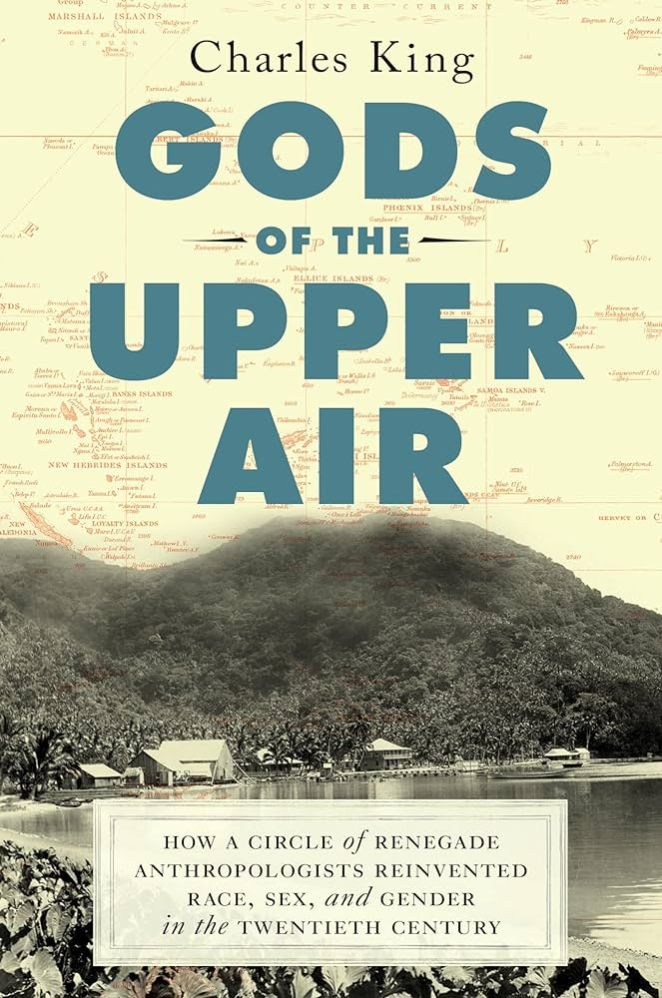
Gods of the Upper Air is available in print and e-audiobook. If you are at all interested in learning about how society began the move away from eugenics and towards a more relative understanding of the inherent value our differences hold, how understanding our differences helps to puzzle out how we are the same, and what makes us human, this book will help you start.
Sahana is an Instructor and Research Specialist at the Savage Branch. They enjoy adding books to their “want to read” list despite having a mountain of books waiting for them already.
 CHAPTER CHATS