
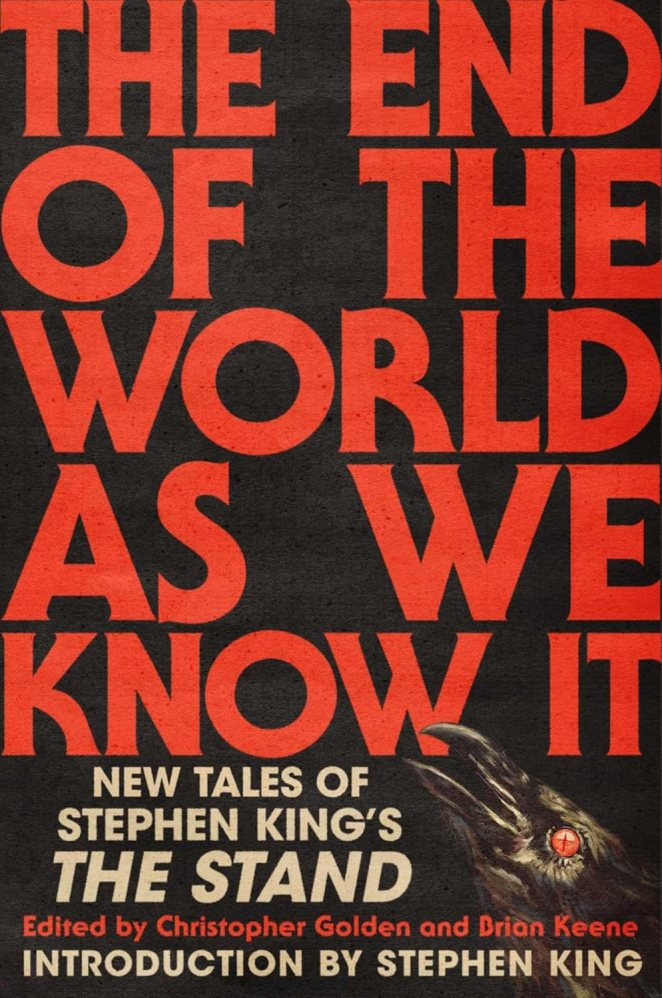
The End of the World as We Know It

The book cover has a raven with a reddish-orange eye in the lower right corner, with its open beak extended up and looking directly at the viewer.

by Angie E.

In a year that feels like it’s testing every emotional fault line, some readers crave escape through lighthearted rom-coms or cozy mysteries. But for others, especially those feeling raw, anxious, or on edge, those stories can feel like a slap in the face. When the world feels broken, sometimes the only thing that makes sense is reading about the end of it. Two recent releases offer radically different but equally powerful takes on apocalypse: one fictional, one factual, both deeply human. 

For the first time ever, Stephen King has authorized other writers to expand the world of The Stand, his iconic 1978 novel about a pandemic that wipes out most of humanity and pits survivors in a battle between good and evil. Edited by Christopher Golden and Brian Keene, The End of the World as We Know It features 36 all-new stories from a dazzling lineup of authors: Wayne Brady, Caroline Kepnes, Tananarive Due, Paul Tremblay, Alma Katsu, and many more. 

The stories span the initial outbreak, the migrations to Boulder and Las Vegas, and even decades beyond the original novel’s timeline. They’re terrifying, philosophical, and sometimes heartbreakingly tender. For readers who feel like they’re living through their own version of The Stand, this anthology offers catharsis, community, and a reminder that even in collapse, there’s room for hope. 

The book cover shows a shooting star seemingly exploding above a cityscape in shades of blue and yellow, against the backdrop of a night sky and many stars.

If The End of the World As We Know It is a fictional dive into the apocalypse, Everything Must Go by Dorian Lynskey is its nonfiction counterpart, a sweeping, witty, and surprisingly comforting cultural history of how we’ve imagined the end across centuries. Lynskey explores everything from religious prophecies to pandemic fiction, climate collapse, rogue AI, and nuclear dread. He name-checks everything from The Road to Children of Men, The Twilight Zone to The Purple Cloud, weaving together pop culture, science, and philosophy into a rich tapestry of our collective anxieties. 

What makes this book so compelling is its insight: apocalyptic stories aren’t just about destruction, they’re about transformation. They reflect our fears, but also our longing for clarity, justice, and rebirth. For readers struggling in 2025, these books offer more than just entertainment. They offer validation and say: You’re not alone in feeling like the world is ending. And they do it without sugarcoating or false cheer. Instead of asking you to pretend everything’s fine, they invite you to sit with the chaos—and maybe even find meaning in it. 

Angie is an Instructor & Research Specialist at Central Branch and is a co-facilitator for Reads of Acceptance, HCLS’ first LGBTQ-focused book club. Her ideal day is reading in her cozy armchair, with her cat Henry next to her.

Our next chapter starts soon when the blog moves to the newly redesigned hclibrary.org. All the same great reviews and news, plus more library information!

Apocalypse and Heartbreak: Atmospheric Tales of Horror

Deep red slats of wood with title set in single word lines, emphasizeing Cabin, End, World.

by Angie E.

Good horror scares me, but great horror breaks my heart and mind, seeping into me and playing in my head like a found footage trope.  I find solace in horror somehow, and I know I’m not alone because others feel this way, too, even if they are quiet about it (“Why do anxious people love scary movies?”).

The first horror fiction I ever read was The Mist by Stephen King (e-book on Libby), which first appeared in a 1980 anthology called Dark Forces (an outstanding collection of stories I cannot recommend enough). It is hard to come by these days, but you can check interlibrary loan. Director Frank Darabont took The Mist and gave it an unimaginable, twisty, emotionally devastating ending – hence the heartbreak.

The Cabin at the End of the World by Paul Tremblay evokes similar feelings of heartache, and, like The Mist, captures themes such as faith and trust and how both can be warped by strangers we have the fortune (or misfortune) to meet under trying circumstances. Do we take a chance on others, or ourselves, or possibly a mash-up of both? A contributor to the website Bloody Disgusting sums up what could easily be said about both Tremblay’s and King’s novels, saying that a complete lack of faith can be just as insane as a fanatical sense of faith.

The novel invites readers into the lives of Eric and Andrew, a couple vacationing at a remote cabin with their young daughter Wen. Tremblay’s sensitive storytelling allows us to witness their love and vulnerability, amplifying the impact of the anguish that unfolds. Their journey takes an unexpected turn when a group of mysterious strangers appear at their door, whose mission (they say) is to save the world from an impending apocalypse. Their ominous beliefs shatter the tranquility of the cabin, leaving the family trapped and frightened. 

The strangers demand an impossible choice: sacrifice one of their own to stop the apocalypse. As fear and uncertainty overcome them, the bond between Eric, Andrew, and Wen deepens, revealing the strength of their love and the resilience of the human spirit. You’ll find yourself empathizing with the family’s plight, feeling their fear, and grappling with the moral dilemmas they face. 

Ultimately, The Cabin at the End of the World is not just a horror story; it’s an exploration of family ties, sacrifice, and the will to protect those we love. Like The Mist, The Cabin at the End of the World has a haunting film based on it: Knock at the Cabin. Both novel and film create an air of mystery and seclusion, but they do so subtly, evoking different atmospheres. 

Knock at the Cabin may appear superficial, but it carries a sense of abruptness, brevity, and vagueness distinct from Tremblay’s novel. The former hints at the story’s initiation and leaves us questioning, “Who’s there?” The Cabin at the End of the World explicitly suggests apocalyptic themes. Both titles succeed in unique ways, captivating the audience with their enigmatic allure. 

I could go on about both Tremblay and King, but I won’t. If you also seek out heartbreak in your reading, though, consider the following: 

  1. Frankenstein by Mary Shelley: Published in 1818, this classic Gothic horror novel tells the tragic story of Victor Frankenstein and his creation. The creature’s isolation, rejection, and search for acceptance evoke profound empathy from readers. 
  1. Dracula by Bram Stoker: From 1897, the epistolary novel delves into themes of loss, love, and the consequences of immortality. The tragic fate of some characters, such as Lucy Westenra, leaves a lasting impact on readers. 
  1. The Road by Cormac McCarthy: This post-apocalyptic novel from 2006 depicts the journey of a father and his young son through an ashen landscape. The bleakness and desolation of their surroundings combined with the father’s love and determination to protect his son create an emotionally compelling narrative. 
  1. Beloved by Toni Morrison: While not typically thought of as a horror novel, the 1987 Pulitzer Prize-winning work incorporates ghostly, supernatural elements. Set in the aftermath of slavery, the book explores the haunting effects of past trauma, loss, and the desperate longing for freedom. 

These masterpieces blend elements of horror with deep emotional resonance, leaving readers with a poignant sense of heartbreak and empathy for the characters’ experiences. 

Angie is an Instructor & Research Specialist at Central Branch and is a co-facilitator for Reads of Acceptance, HCLS’ first LGBTQ-focused book club. Her ideal day is reading in her cozy armchair, with her cat Henry next to her.