AI and the Future of Work and Business with Adam Davidson

Adam Davidson wears a pink button down shirt and has his arms crossed. He stands in front of a large yellow smiley face.
Adam Davidson

Wed, Jan 24 | 7 – 8 pm online
For adults. Register here.

Adam Davidson is an expert at demystifying complex topics, and he applies these skills to the most crucial issue of our time: the rise of AI. This talk is geared towards curious laypeople—from college students to business decision-makers—who know that AI is likely to transform their careers and business and need a clear framework to understand this new revolutionary technology. AI, he explains, will create massive new winners and, yes, a bunch of losers, as it rewrites our economic rules.

Davidson is the co-founder of NPR’s Planet Money podcast and a staff writer at The New Yorker, where he covers economics and business. Previously he was an economics writer for The New York Times Magazine. He has won many of journalism’s most prestigious awards, including a Peabody for his coverage of the financial crisis. All of his work has been focused on making the complex, confusing, sometimes depressing news about the economy it clear to a broad audience.

His work has appeared in The Atlantic, Harper’s, GQ, Rolling Stone, and other publications. He has served as a technical consultant in Hollywood, including to Adam McKay, co-writer and director of the Academy Award-winning film The Big Short.

Career Success Month
Jan 22 – Feb 23, 2024
Find a full listing of events here.
Maryland public libraries launch a new year with a month of programs on entrepreneurship and job advancement. During this month, classes focus on financial skill building and digital knowledge to navigate our rapidly changing work environment. These impactful, results-driven classes and programs occur in a mixture of in-person, virtual, and hybrid formats.
Hosted at library branches throughout Maryland and sponsored by the Maryland State Library Agency, these programs provide information from subject-matter experts.

Examples include:

  • Design thinking for entrepreneurs
  • How to work the gig economy
  • The joy of owning a small business in retirement
  • Learning Canva
  • Mindfulness at work
  • Speed mentoring
  • Resume building and interview preparation

World AI Week

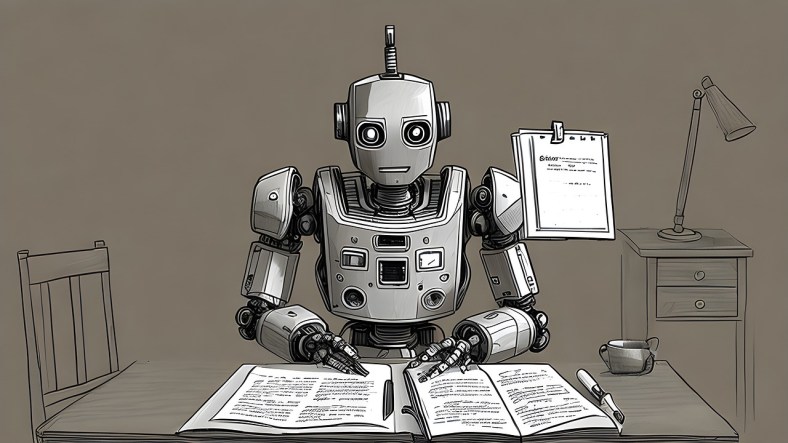
The image shows a robot seated at table, reading written materials placed in front of it. A chair is off to the side of the table and a smaller table with a lamp is in the background.

by Sahana C.
There has been a lot of controversy around artificial intelligence floating around in the public subconscious this year, good news and bad working in tandem. On one hand, AI could be used to clean the ocean! On the other, writers and actors alike have been striking because of strange clauses in studio contracts involving AI. This tangle, this never-ending back and forth, coupled with fearmongering from generations of sci-fi media like Ex Machina, is exhausting after a certain point. And I understand that for a lot of people it’s frightening. The thought that we’re creating something so quickly that forefathers of the industry are asking to slow it down, that we are launching something we don’t fully understand the implications of or the ethical implications of, it all compounds. But the easiest way to fight fear of an unknown thing is to be informed, and it seems like AI is here to stay. So we need to be learning about it and using it too.

Artificial intelligence is utterly pervasive, showing up through things like ChatGPT, and while it can be used for writing papers (though it usually doesn’t do the best job and is fairly obvious), it can also be used as an editor, as a practice interviewer, as a summary tool. Google has started to introduce it slowly into its Drive suite. Adobe has introduced it into Lightroom and Photoshop to help photographers and editors make their edits in a much timelier fashion. There are countless uses, all of which can help us make more polished versions of our crafts.

We have to be careful about overstepping in the arts; it’s not acceptable that AI compiles works from artists to create art, and it should not be used to replace creatives. Artificial intelligence isn’t a creative force and while it can perhaps produce a result, a person is almost always going to make better art.

AI is a tool, one that we can use. It doesn’t have to be scary robot overlords of lore. It’s something to be aware of, and most importantly, to combat disinformation. It’s something to explore, just so we know enough to be educated.

October 9-14 is World AI Week, hosted in Amsterdam this year, where they will be making announcements about innovation in AI. We’ll hear about the ways industry is hoping to use artificial intelligence, and some of the leaders in this field will be able to interface directly with the users. It’s an important week for learning, and we’ll be paying close attention.

If you are interested in learning more about AI more generally, you can go to Gale Courses with your library card and take “Introduction to Artificial Intelligence” for free. At Byte-sized Intelligence: Lunch and Learn on October 10 (see box), we debrief you about the basics of artificial intelligence and any updates we’ve learned on the first day of World AI Week. And of course, if you, like me, process the world most effectively through literature, our collection has plenty for you to sink your teeth into.

Byte-Sized AI: Lunch & Learn
Tuesday, Oct 10 | 12 – 1 pm
Savage Branch
For adults. Register at bit.ly/HCLS_bytesized
Explore one of the most exciting and rapidly evolving fields in technology! Anyone who is interested in learning about AI, regardless of technical background or experience, can join the discussion about recent advancements.

Sahana is an Instructor and Research Specialist at the Savage Branch. They enjoy adding books to their “want to read” list despite having a mountain of books waiting for them already.

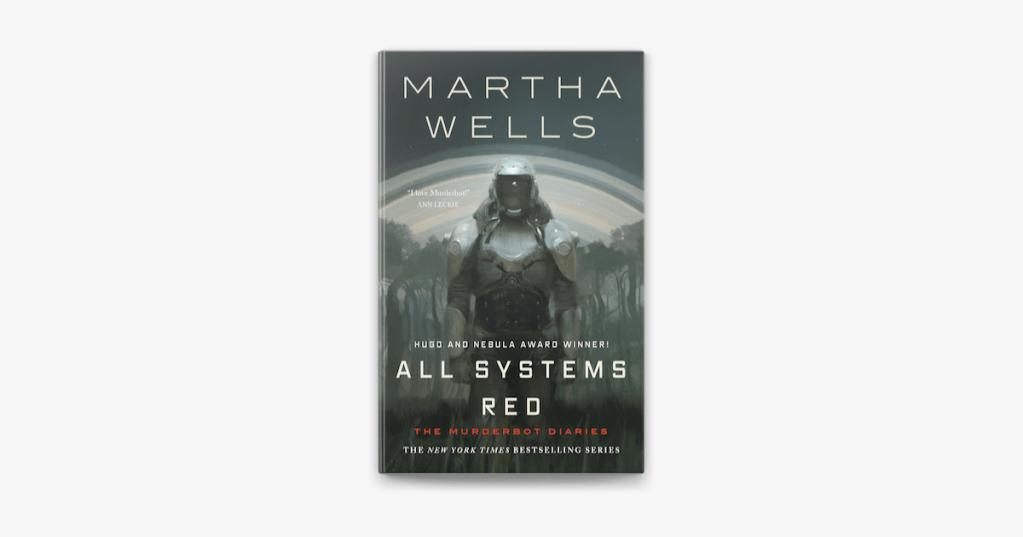
The Murderbot Diaries by Martha Wells

The cover has a grey palette, showing a space-armored figure with a closed helmet with a lit arch behind them.

by Tony B.

Ever wondered what an intelligent security robot would do without a functioning governor module? Murder? Watch Netflix? Save innocent lives? Contemplate sentience?

The Murderbot Diaries, a series by Martha Wells, explores answers to all these questions. Free of their governor module, the eponymous Murderbot leads us through their adventures with corporate warfare, angry megafauna, the (mostly) human experience, and the need for a nice quiet spot to watch interstellar tele-novellas. The first four novellas operate as a one long story arc, even with each book being a complete story, about why Murderbot has named themself in such a way and the repercussions from that particular episode. Along the way, Wells introduces Dr. Mensah and her family, who become important, along with ART – another high functioning artificial intelligence.

Originally a normal Security Unit (SecUnit for short) deployed by The Company, a security bond corporation, Murderbot hacks and destroys their controlling governor module which normally would zap the brain of any SecUnit displaying less-than-utterly-obedient behavior. Now free to do whatever they want, MurderBot inexplicably keeps working for the corporation but with newfound access to the wider net of media with which to distract themselves. 

The Murderbot Diaries are full of dry wit and snarky observations of the human condition, notably that humans tend to put themselves in a lot of unknowing danger. Compound that with galactic dangers and MurderBot ends up as one very busy SecUnit. The series now has six installments (four novellas and two novels) that follow Murderbot and a recurring cast of characters.

MurderBot’s interaction with risk-averse humans is one of the driving issues, beginning in All Systems Red. To MurderBot, the clash between how humanity is portrayed through their favorite space soap operas and how humans actually behave is a constant dissonance which leads to a healthy distrust of the human condition. Hence their thoughts along the lines of, “freedom to be treated like a real human? No thanks.”

Seeing sci-fi action through the lens of a non-human thought process is interesting, where priorities are generally “protect the weak humans from whatever stupid situation they find themselves” and less “be the hero.” SecUnit often ends up being a hero in the end despite themself and equally isn’t sure how to feel about it. MurderBot experiences emotion rather strongly at times but codes, to some degree, as being on the autism spectrum. They have a difficult time expressing those emotions and processing others’ emotional states, as well as the confusion at not always being able to control emotions that well up within them.

As a series, I give it a 9/10. Obvious tropes are usually immediately made fun of a la “oh that’s what the space soaps would do.” MurderBot also reminds me heavily of the 2015 movie CHAPPiE, about a robot who gains independence, but who is perhaps more impressionable in relation to humans than MurderBot ever is.

The Murderbot Diaries, a Hugo and Nebula award-winning series, consists of the following books, available from HCLS in these formats:

The seventh book, System Collapse, is due to be published in November 2023.

Tony is a Customer Service Specialist at HCLS Elkridge Branch. He has a degree in history and a renewed interest in science fiction.

Byte-Sized Intelligence: A Crash Course on AI

The image shows a robot seated at table, reading written materials placed in front of it. A chair is off to the side of the table and a smaller table with a lamp is in the background.

by Sahana C.

Thursday, April 20 at 7 pm
In person; Savage Branch
Register

Libraries have come a long way – from a time when including a table of contents was the most innovative, revolutionary advancement in conducting research to the advent of search engines. How we interact with information, how we keep ourselves informed, and how we use the tools at our disposal have all evolved.  

Artificial intelligence (AI) is the next wave of that evolution. Though it’s the subject of many science fiction novels, its real-world applications are wildly interesting. Artificial Intelligence refers to the development of computer systems that can perform tasks that would typically require human intelligence. These tasks may include speech recognition, image analysis, and decision-making. AI is already being used in a variety of fields, from healthcare to transportation, and its potential applications are only growing. 

Savage Branch is having a crash course and conversation about the fascinating world of AI on Thursday, April 20. We plan to explore the basics of AI, looking at what it is, how it’s used, and its potential impacts on society. Whether you’re a tech enthusiast or just someone who’s interested in staying up-to-date on the latest technological advancements, there’s something for you! 

In our AI class, you’ll learn about the different types of AI and their real-life examples. For example, machine learning is a type of AI that allows computer systems to learn and improve from experience, without being explicitly programmed. Deep learning is another type of AI that uses neural networks to process and analyze large amounts of data. We’ll also explore natural language processing, which enables computers to understand and interpret human language. 

But it’s not just about the technical aspects of AI. We’ll also delve into the ethical considerations surrounding AI, such as bias and privacy concerns. As AI becomes more integrated into our daily lives, it’s essential to evaluate the potential impact on society and address these issues. 

Our AI class is designed for anyone who wants to learn about this exciting and rapidly evolving field, regardless of technical background or experience. Our experienced instructors guide you through the basics of AI in a clear, structured, and informative manner. Don’t miss this opportunity to explore one of the most transformative technologies of our time. 

The possibilities of Artificial Intelligence appear to be limitless. And what’s more – some of this blog post was generated by AI. I asked it to analyze my other writing to create a blog post on this class in my style, and I think it did a decent job. Did you catch anything that felt off? If you want to learn more, to discuss how this is possible, or just play with the possible applications, join us at Savage on April 20 to learn more. 

Sahana is an Instructor and Research Specialist at the Savage Branch. They enjoy adding books to their “want to read” list despite having a mountain of books waiting for them already.