Top Ten Most Challenged Books

The banner reads, "Banned Books Week Oct. 5-11, 2025, Censorship is so 1984. Read for your Rights," with the word "censorship" crossed out in red.

The Top 10 Most Challenged Books of 2025 list is available now on the ALA website.

The American Library Association condemns censorship and works to defend each person’s right to read under the First Amendment and to ensure free access to information. Every year, ALA’s Office for Intellectual Freedom (OIF) compiles a list of the Top 10 Most Challenged Books in order to inform the public about censorship in libraries and schools. The lists are based on information from confidential reports filed by library professionals and community members, as well as news stories published throughout the United States.

Because many book challenges are not reported to the ALA or covered by the press, the data compiled by ALA represent only a snapshot of censorship attempts in libraries.

The 2024 data reported to ALA’s Office for Intellectual Freedom (OIF) shows that the majority of book censorship attempts are now originating from organized movements. Pressure groups and government entities that include elected officials, board members and administrators initiated 72% of demands to censor books in school and public libraries. Parents only accounted for 16% of demands to censor books, while 5% of challenges were brought by individual library users. The 120 titles most frequently targeted for censorship during 2024 are all identified on partisan book rating sites, which provide tools for activists to demand the censorship of library books.

The most common justifications for censorship provided by complainants were false claims of illegal obscenity for minors; inclusion of LGBTQIA+ characters or themes; and covering topics of race, racism, equity, and social justice.

Since 2021, ALA has tracked a sharp spike in censorship attempts in libraries. In 2024, ALA recorded the third highest number of book challenges since tracking began in 1990: ALA documented 821 attempts to censor library books and other materials in 2024 across all library types, a decrease from 2023, when a record high 1,247 attempts were reported. ALA recorded attempts to remove 2,452 unique titles in 2024, which significantly exceeds the average of 273 unique titles that were challenged annually during 2001–2020.

Looking for the most challenged books from previous years? Check out the Top 10 Most Challenged Books Archive for lists and data going back to 2001, as well as the 100 most challenged books of past decades.

Banned Books Week: Read for Your Rights

The banner reads, "Banned Books Week Oct. 5-11, 2025, Censorship is so 1984. Read for your Rights," with the word "censorship" crossed out in red.

by Sahana C.

This year’s Banned Books Week feels important. The weight of headlines, especially about libraries across the country facing cuts, having collections challenged, and seeing their communities divided, creates an opportunity to reflect on what we gain by taking our time with banned and challenged books.
The American Library Association’s 2025 theme is direct: “Censorship Is So 1984. Read for Your Rights.” It’s a bold reminder that the freedom to read is not just about what is on the shelves.

The reference to George Orwell’s 1984, an often-banned dystopian novel that depicts the role of censorship in rewriting history, speaks to the struggles that public libraries have faced recently. Our community values intellectual freedom, diversity of opinion, and freedom of expression, and the theme reminds us that speaking up is more urgent than ever. It’s said each year, but we’ve seen historic levels of book challenges, especially for books that center the voices of LGBTQ+ people, Black and Brown communities, and those navigating complex identities. Books are being pulled from shelves not because they’re harmful, but because they make some people uncomfortable. But that discomfort is often the beginning of growth – learning that “different” isn’t automatically “wrong.”

Public libraries were built on the radical idea that knowledge belongs to everyone. We’re not just warehouses of books; we’re places where curiosity is nurtured, differences are respected, and freedom is practiced daily. This Banned Books Week we invite you to stand with us. Borrow a banned book. Join a discussion. Ask questions. Speak up. Share your story. Remind your neighbors that free access to ideas is not a luxury – it’s the foundation of democracy.

In Orwell’s 1984, censorship is used to control truth and rewrite history. This Banned Books Week, we push back. We read boldly. We resist silence. We protect stories, especially the ones that are under threat of erasure.

Here’s a curated list of nonfiction titles that are frequently challenged.

Sahana is the Communications Strategist at HCLS. They enjoy adding books to their “want to read” list despite having a mountain of books waiting for them already.

Banned Books Week: Sep 22 – 28

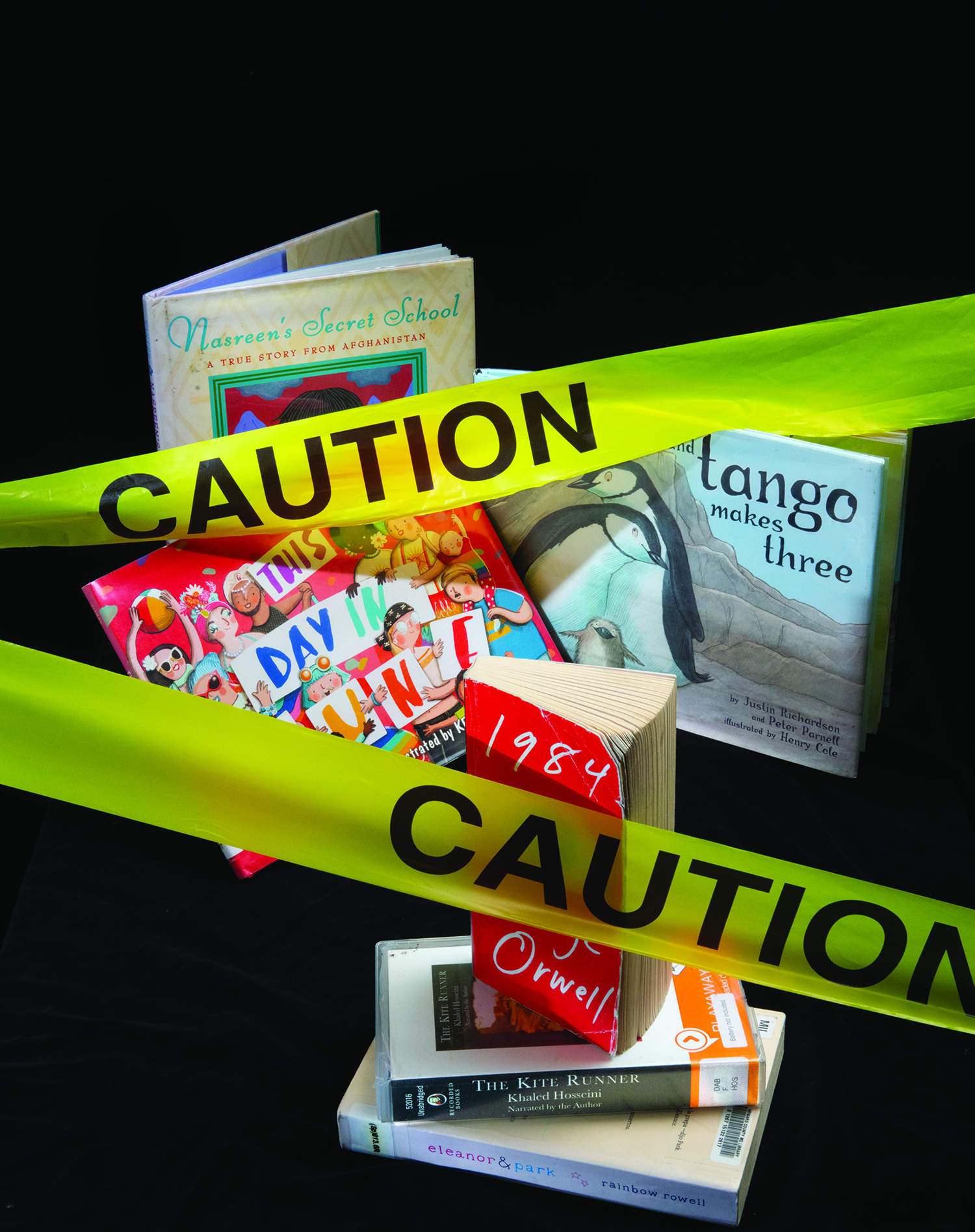
Yellow caution tape stretches across an arrangement of books, all of which are perennially on the challenged book list. They include 1984 by George Orwell, The Kite Runner by Khaled Hosseini, and Tango Makes Three.

by Sahana C.

Howard County Library System is your place to learn, grow, and connect. As a library, one of the best ways we know to bolster learning, to encourage growth, and to promote connection happens through books. It’s why we have such a vast range of topics, themes, identities, and authors represented in our collection. It’s why we have so many different book clubs across all our branches, and so many ways to access them. It’s why you’ll see the On the Road to Kindergarten van in your neighborhood and at schools with books to borrow. While the library is not just about books (we’re proud of all our resources and collections), our books are a large part of what brings us closer to our community.

In recent years, the challenges and objections to different titles in libraries across the country have made major headlines, including the state of Maryland. We now live in a state with a Freedom to Read Act, which asserts intellectual freedom as lawful and denounces censorship plainly, which is not the case nationally. To highlight stories that are challenged or censored, the American Library Association (ALA) celebrates Banned Books Week each year. Banned Books Week started in 1982 as a response to book challenges and has turned into a national celebration of literature.

To celebrate Banned Books Week this year, visit your local library branch and check out the displays and resources about different titles that have been challenged. And, for even more immersion, hop online each day of Banned Books Week at noon for our virtual Banned Books Read-a-thon. With a new title each day, we will discuss a work that has been banned or challenged in some form, and read an excerpt of the text.

The ALA’s theme for Banned Books Week 2024 is “Freed Between the Lines,” and it asks readers everywhere to consider the ways that books can help us explore new ideas, understand the world around us, and find freedom. It encourages us to delve deeper and be unafraid to be creative with our understandings of the books we read.

Banned Books Week Read-A-Thon
For adults. Register to receive the link.
Learn about the history and significance of Banned Books Week, then listen to a reading from a frequently challenged book. You can join every day or just for the ones that interest you.
Mon- Fri | 12 – 1 pm | online
Mon, Sep 23
1984 by George Orwell

Tue, Sep 24
Eleanor & Park by Rainbow Rowell

Wed, Sep 25
Looking for Alaska by John Green

Thu, Sep 26
The Kite Runner by Khaled Hosseini

Fri, Sep 27: Children’s picture books
Nasreen’s Secret School: A True Story from Afghanistan and The Librarian of Basra: A True Story from Iraq, written and illustrated by Jeanette Winter.
This Day in June, written by Gayle E. Pitman and illustrated by Kristyna Litten.
And Tango Makes Three, written by Justin Richardson and Peter Parnell and illustrated by Henry Cole.

Sahana is an Instructor and Research Specialist at HCLS Savage Branch. They enjoy adding books to their “want to read” list despite having a mountain of books waiting for them already.

Celebrate Banned Books Week: September 18 – 24

The banner image depicts a rainbow-colored series of birds launching into flight against a backdrop of open books.

by Sahana C.

Banned Books Week is a party. We celebrate our unfettered access to whichever books we choose.

The national theme of Banned Books Week stands firm in its message against censorship. When it began in 1982, Banned Books Week was not a protest, but a reaction to an increasing number of book challenges. Banned Books Week is a space away from the intensity of media speculation and divisive press coverage.

The picture depicts the places where book challenges take place: school libraries, public libraries, schools, and academic/other. In the upper right hand corner is a graphic of rainbow-colored birds launching into flight, and the entire background is a faint depiction of open books.

The American Library Association’s Office of Intellectual Freedom tracked almost 1,600 books that were challenged in 2021 alone, but Banned Books Week is not when those challenges are contested. It is, in the words of the official website, a time for, “shared support of the freedom to seek and to express ideas, even those some consider unorthodox or unpopular.”

The ALA is one of the loudest proponents of this effort as it supports the declaration from libraries to wholly commit to combat disinformation, promote the perspectives of historically excluded groups, and increase access to information. This is the mandate of public libraries, written into the mission statement of Howard County Library System: “We deliver high-quality public education for all.”

It is our responsibility to provide access to materials that encourage conversation and provoke thought; every addition to our collection is a choice, and decisions are never neutral. HCLS continues this practice with its Brave Voices, Brave Choices initiative. We have committed to not hiding hard conversations from our community. Discussions about appropriateness usually center the idea of balance, meaning we amplify the voices of people from historically excluded, marginalized, and unheard communities. Libraries cannot be neutral in this effort toward radical inclusion.

The picture is a rainbow-colored infographic of words and phrases cited in 2021 censorship reports as reasons for book challenges. In the upper right corner is a graphic of rainbow-colored birds launching into flight, and the entire background is a faint depiction of open books.

Kelvin Watson, director of libraries in Broward County, Florida, put it well: “Claiming neutrality endangers us as an institution by resulting in an unconscious adoption of the values of the dominant political model and framework… (w)e cannot be neutral on social and political issues that impact our customers because…these social and political issues impact us as well.” While a policy of neutrality appears to be equal, it is not equitable – it does not allow for different facets of our community to see themselves represented meaningfully, without stereotype, by people who share their life experiences.

We, as a library, stand to protect the brave voices who write, publish, and lead us into a more equitable future. We, in turn, make the brave choice to stand against the idea that we can be neutral in the battle against misinformation. The library is a steward of knowledge, led for and by the community it serves.

So, join the party! Everyone’s invited.

Sahana is an Instructor and Research Specialist at the Savage Branch. She enjoys adding books to her “want to read” list despite having a mountain of books waiting for her already.

Banned Books Week (Sep 26 – Oct 2)

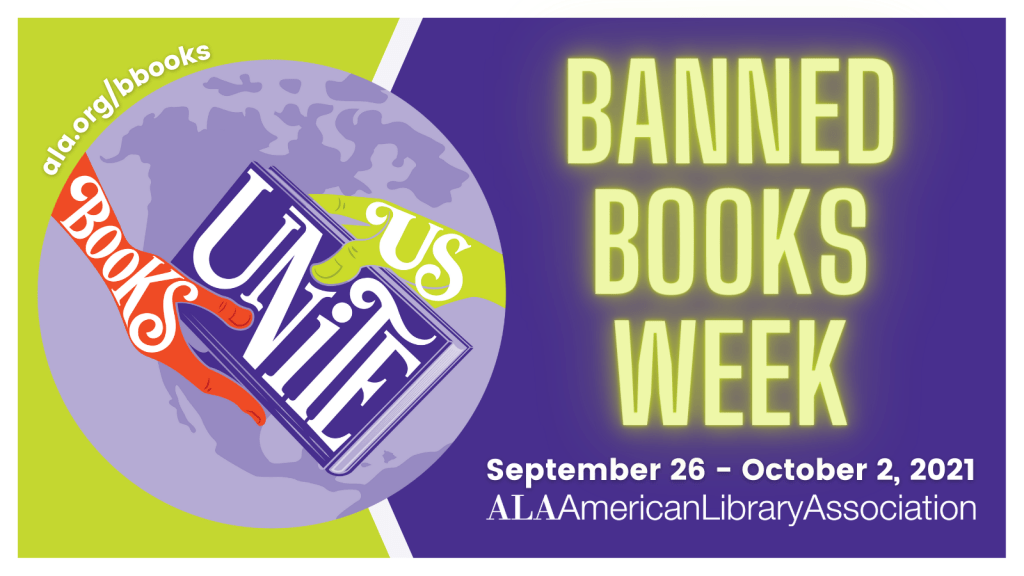
The illustration shows two hand clasping a book with the Earth the backdrop, with the text across the hands and book reading, "Books Unite Us." The rest of the text reads, "Banned Books Week. September 26-October 2, 2021. ALA American Library Association. The illustration is in shades of purple, lime green, and orange.

by Jean B.

 “Any time we eliminate or wall off certain narratives, we are not getting a whole picture of the world in which we live…we limit our vocabulary, which complicates how we communicate with one another.”  

– Jason Reynolds, the acclaimed Maryland author named Honorary Chair for Banned Books Week

A library may be held together with walls, but it’s the doors and windows that really matter — doors open for all people and windows that illuminate all perspectives. During Banned Books Week, we celebrate the freedom to read and the commitment by libraries, publishers, teachers, writers, and readers to promote access to materials that the ALA Freedom to Read Statement says, “enrich the quality and diversity of thought and expression.” Established in 1982, Banned Books Week responds to efforts across the country to challenge and censor books and focuses attention on how restricting access to information, ideas, and stories harms American cultural and political life.   

In a time when divisions cut across our nation like fault lines, the 2021 Banned Books Week theme reminds us that books can be a force for unity, even – or especially – when they convey a wide variety of views and experiences, including those that are marginal, unconventional, or unpopular. The freedom to read strengthens our ability to communicate with one another.

In a democracy, we trust individuals to learn and decide for themselves.  But to make informed choices, citizens require free access to all viewpoints and all kinds of ideas in the process of self-education. Where can people go for free access to ideas and information? Their public library! As essential institutions of democracy, public libraries implement intentional collection policies to ensure the breadth and inclusivity of materials available to their communities. For Howard County Library System, this translates into a collection that reflects a wide range of voices, including controversial and conflicting ideas.  

As the HCLS Board of Trustees affirms, while, “anyone is free to reject for [themselves] books or other materials of which [they] do not approve, [they] cannot exercise this right to restrict the freedom of others.” The freedom to read strengthens our citizenship. Each year, the American Library Association (ALA) publishes a list of the ten most frequently challenged or banned books across the nation. This snapshot reflects only a small percentage of the challenges that take place in schools and libraries.  The ALA estimates that 82 – 97 percent of requests to remove materials are unreported. As this list illustrates, the challenges come from all directions and perspectives. The freedom to read protects all points of view.

So this year, in honor of Banned Books Week, open the library door and explore our extensive collections.  Look through the windows of stories into all different kinds of lives, familiar and unfamiliar.  Explore HCLS’ Brave Voices, Brave Choices campaign to discover a wide range of experiences in our own community. It’s all free to you, and you are free to choose.

Jean B. is a Children’s Instructor and Research Specialist at the Central Branch and loves reading books for all ages when she isn’t enjoying the outdoors.