Mon, Feb 24 | 7 – 8:30 pm HCLS Miller Branch For adults. Register here.
Jeffrey Boutwell discusses his new book,Boutwell: Radical Republican and Champion of Democracy, a biography of family member George S. Boutwell – perhaps the most consequential American political figure you’ve never heard of. During his career from 1839 to 1905, George Boutwell was Governor of Massachusetts, served in the U.S. House of Representatives and the Senate, was treasury secretary for Ulysses Grant and Commissioner of Revenue for Abraham Lincoln, helped create the Republican Party in the 1850s, and forty years later opposed Republican Presidents William McKinley and Teddy Roosevelt over their plans to annex the Philippines following the Spanish-American War.
Boutwell was instrumental in framing the Fourteenth and Fifteenth Amendments, initiating the impeachment of Andrew Johnson, and investigating white vigilante violence against Black people in Mississippi in the 1870s. For seven decades, George Boutwell sought to “redeem America’s promise” through racial equality, economic equity, and the humane use of American power abroad.
Jeffrey Boutwell is a writer and historian living in Columbia, Maryland, after a 40-year career in journalism, government, and international scientific policy. He began his career as a reporter and editor with the famed City News Bureau of Chicago and was a book reviewer for the Chicago Sun-Times. After two years in the Windy City, Boutwell moved to Berlin and then to England, where he received an M.Sc. in Economics and Politics from the London School of Economics. He received a Ph.D. in political science from the Massachusetts Institute of Technology in 1984. He has written and spoken widely on issues ranging from nuclear weapons arms control to Middle East peace to environmental issues.
“A vibrant and captivating look at five trailblazing women.” —Arlington Magazine
Hear the story of The Swans of Harlem directly from former dancer Sheila Rohan, a founding member of the Dance Theatre of Harlem. These ground-breaking dancers performed for the Queen of England, Mick Jagger, Stevie Wonder, at the White House, and beyond. But decades later, almost no record existed of their history. Out of a sisterhood that had grown even deeper with the years, these Swans joined forces again—to share their story with the world.
Rohan toured extensively in the United States, the Caribbean and Europe, performing as soloist in several works in the repertoire, including Geoffrey Holder’s Dougla, Arthur Mitchell’s Rhythmetron. She was soloist and Ballet Mistress with the Nanette Bearden Contemporary Dance Theatre and toured China and Korea with the Myung Sook Chun Dance Company, a modern dance troupe. She performed the role of Rosa Parks in Gordon Parks’ televised ballet Martin and, as a choreographer, assisted legends such as Louis Johnson and Walter Rutledge.
Karen Valby’s book, The Swans of Harlem: Five Black Ballerinas, Fifty Years of Sisterhood, and Their Reclamation of a Groundbreaking History, tells the captivating tale in vivid detail, steeped in the glamour and grit of professional ballet. The Swans of Harlem offers a riveting account of five extraordinarily accomplished women, a celebration of both their historic careers, and the sustaining, grounding power of female friendship, and a window into the robust history of Black ballet, hidden for too long.
The Swans of Harlem: Five Black Ballerinas, Fifty Years of Sisterhood, and Their Reclamation of a Groundbreaking History is available in print and large print formats, and as an e-book and an e-audiobook on Libby/OverDrive.
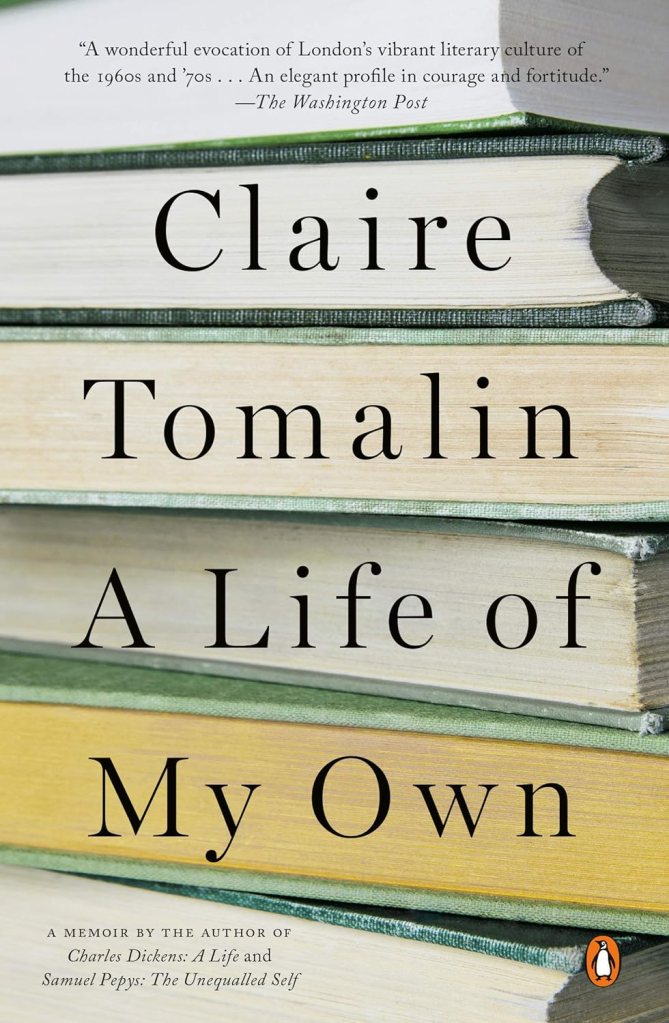
British author Claire Tomalin, acclaimed for her biographies of British writers, tackles autobiography in A Life of My Own, which recounts her life and work through the mid- to late-twentieth century among memorable, clever people. Born in 1933, she was the second daughter of a French father and an English mother, two brilliant parents (a scholar and a gifted pianist and writer of music) who ended up despising one another. Both of them loved Tomalin, though, and she was encouraged and well-educated despite their disastrous relationship. Her years at grammar school, boarding school, and eventually at Newnham College at Cambridge were clearly an adventure, but also a “calm and generally cheerful life” (73). Given the era, of course, there were moments of hardship and difficulty. Although “the war made everything odd” (33) and her mother lived in very straitened circumstances due to the divorce, Tomalin frequently mentions her gratitude to various individuals and for the opportunities she pursued. Her early years were a happy and secure life overall.
Still, hers is not a life without heartbreak. Tomalin lost her charming but somewhat errant husband, journalist Nick Tomalin, to a missile strike in the Golan Heights when he was reporting on the 1973 Arab-Israeli war. Her description of the loss is matter-of-fact but so very tragic, including one of the saddest sentences I’ve ever read:
“I had now to telephone Beth, Nick’s mother, and give her the news that the son she loved more than her own life had been killed” (201).
Tomalin’s grief plays out while surrounded by loving and supportive friends and family, and she goes on to forge an amazing career and raise her and Nick’s children, including their disabled son Tom, but the reader gets a profound sense of the isolation she sometimes felt as a widow bereft too early in life.
It was actually the second tragedy she deals with, the loss of her brilliant daughter Susanna, that made me put the book down for a while even though I was close to finishing; it seemed like too much for one woman to bear. But when I came back to her story, I was glad to read that Tomalin found the means to cope, developed her career as an author, editor, and biographer, maintained many friendships with the literati, and found love later in life with playwright and novelist Michael Frayn (I read his book Headlong years ago and highly recommend it. You can request it via interlibrary loan).
You get a wonderful sense of the milieu in which she and Nick (and later she and Michael Frayn) thrived. As literary editor at The New Statesman, she counted Martin Amis and Julian Barnes among her deputies. She lectured in front of John Updike about his work with next to no notice that he would be in the audience (“A nightmare”) and had a delightful encounter with Saul Bellow. Alan Bennett, Christopher Hitchens, Cecil Day Lewis, V.S. Pritchett, and Beryl Bainbridge are just a few examples of the famous figures in British literature and culture she met, edited, worked with, socialized with, and befriended. And, of course, she wrote her notable biographies: Samuel Pepys, Katherine Mansfield, Jane Austen, Nelly Ternan, Charles Dickens, and Mary Wollstonecraft, among others.
But it is still as a wife, mother, and daughter that the reader gains the most intimate and profound sense of Tomalin’s character and personality. She has been devoted to her son Tom all his life, inspired by his example, and proud of how independent he is despite his disability. She was equally devoted to her parents as they were approaching the end of life, and faults herself for not devoting enough time to them, her mother in particular – a genuine, relatable feeling that many women undergo in mid-life.
Now in her nineties (as is Frayn), she talks about how her “seventies and eighties have been easy” (330), describing a life of gardening, writing and editing, traveling, public speaking, concerts, opera, and films. With six surviving children and ten grandchildren between them, the joyful tone of the last chapter had me hoping for many more years for this erudite pair of writers. A delightful memoir despite the sadness; a life of her own, and a life well-lived.
Claire Tomalin is the author of the following biographies available from HCLS:
The Invisible Woman: The Story of Nelly Ternan and Charles Dickens (audiobook on CD)
Julie is an instructor and research specialist at HCLS Miller Branch who finds her work as co-editor of Chapter Chats very rewarding. She loves gardening, birds, crime fiction, all kinds of music, and the great outdoors.
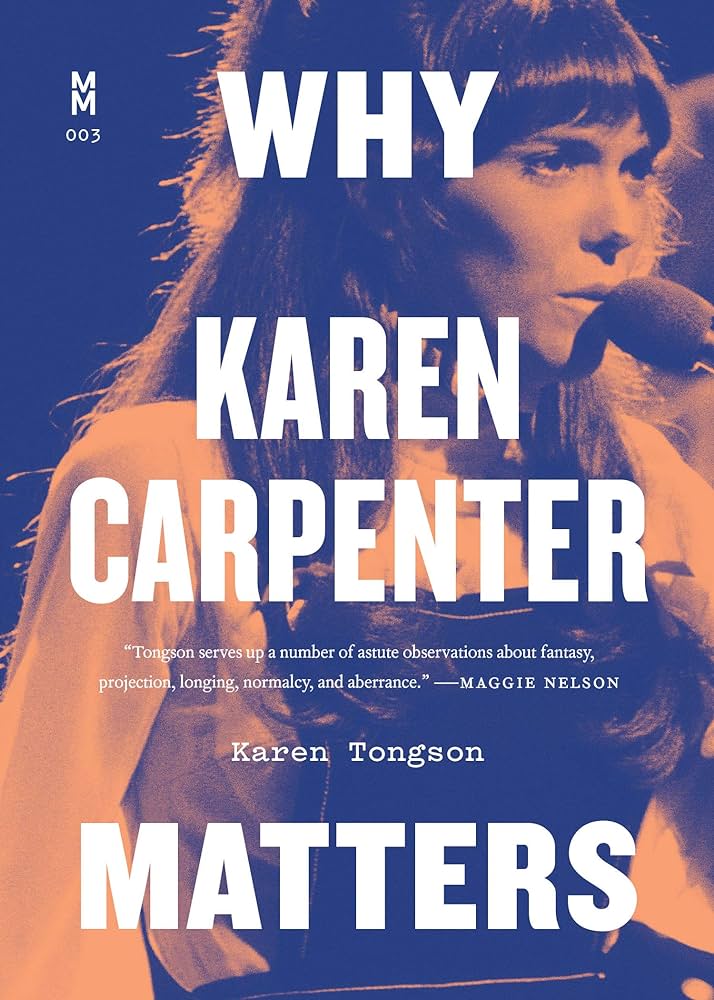
In Why Karen Carpenter Matters, the author writes about something she calls “the Karen effect,” being “the capacity to make you feel something, to make you believe in a spiritual undoing and trembling beneath the polished arpeggios and vacuum-sealed harmonies.” She speaks for many fans, I am sure, in describing the distinct sound of one of the most gifted vocalists of all time.
Author Karen Tongson (named after the singer) is a Filipino-American cultural critic, writer, and queer studies scholar. In this moving and often riveting half memoir/half biography she intertwines cultural analysis and personal anecdotes, creating a rich mix of insight and emotion into the life of Karen Carpenter.
The Carpenters’ music was immensely popular in the Philippines and other parts of Asia during the 1970s and beyond. Their songs had a significant impact on Filipino culture, and Tongson grew up with a deep appreciation for their music.“To be corny is to be mawkishly old-fashioned; tiresomely simple and sentimental,” Tongson writes, explaining part of the reason of her love for Karen Carpenter, who ultimately became the tether to the Philippines.
Tongson also navigates the sensitive topic of Karen’s eating disorder with grace, shedding light on the societal pressures that contributed to Karen’s tragic struggle. She emphasizes that Karen’s story is not just one of personal struggle, but a reflection of the larger issues women faced during that era, and still to this day, a powerful reminder of the need for compassion and understanding.
One of the most striking aspects of Why Karen Carpenter Matters is its examination of the intersection of race, gender, and music. Tongson studies the ways in which Karen Carpenter’s voice transcended cultural boundaries and challenged stereotypes, making her an unexpected icon in the LGBTQ+ community. Karen’s voice, as the writer beautifully describes, became a “sonic balm” for those who found solace and identity in her music.
I have loved the Carpenters since I was a kid and find Why Karen Carpenter Matters to be one of the most authentic and soulful nonfiction reads ever, not just on Karen Carpenter, but on any person or subject. I can still feel sad when I hear a song of hers on the radio or my music streaming, but that doesn’t take away the power or comfort or loveliness of one of the most sincere voices I have ever heard in music. From all accounts written about her, from everything friends of hers have said, Karen was a fun and funny woman, sweet and a genuine person.
For more about the Carpenters: Carpenters: The Musical Legacy is an enchanting journey through the timeless melodies of Karen and Richard Carpenter. There are lots of fascinating tidbits about recording sessions and songs chosen for albums and what Karen and Richard thought about their music and about music in general.
Lead Sister: the Story of Karen Carpenter is not owned by HCLS, but is well-worth tracking down through Marina. A 2023 release, it takes a more artistic look at her life and how much more there was to her in her musical life than that magical voice. Karen herself once said that she thought of herself as a drummer who sang, not a singer who played the drums. I think she would like this book a lot.
Angie is an Instructor & Research Specialist at Central Branch and is a co-facilitator for Reads of Acceptance, HCLS’ first LGBTQ-focused book club. Her ideal day is reading in her cozy armchair, with her cat Henry next to her.
“What really surprised me was how well people who knew him still talk about him,” Matthew Hild tells Closer magazine about his experience with writing his new book Arrow Through The Heart: The Biography of Andy Gibb. “People remember him as the kindest and sweetest person. They all said he had a vulnerability about him that didn’t prepare him for being a star.”
Born in Manchester, England, Andy was the youngest brother of the Bee Gees. He began his solo career in 1977 with the single “Words and Music,” which reached the top of the charts in Australia, New Zealand, and the United Kingdom. In 1979, he was nominated for the Grammy Award for Best New Artist.
Despite Andy’s own achievements as a musician and singer, with hits like “I Just Want to Be Your Everything,” “Shadow Dancing” and “Thicker Than Water,” he spent much of his life struggling to be his own person, separate from the gigantic success of The Bee Gees. This constant insecurity and his heartbreak over the end of his relationship with Dallas star Victoria Principal are thought to have led to Andy’s battle with substance abuse and depression which, over time, destroyed his health and damaged his reputation.
By early February of 1988, it seemed as if he had made inroads in beating his addiction; he started working on a new album. Less than a month later, though, things took a turn when he complained of chest pains and was admitted to the hospital. On March 10 Andy died from myocarditis, an inflammation of the heart muscle.
Hild shares that Andy Gibb and Karen Carpenter once shyly held hands during a Broadway production of The Pirates of Penzance in New York City. They had been introduced through a mutual friend of theirs, Olivia Newton John, and though Andy and Karen never dated, they stayed in touch. Reading about the fragile nature they had in common and that touching moment in the theater just hit me so hard as I read Hild’s words.
Their music had been a huge part of my childhood and early teen years, as had the Bee Gees, and their music still means so much to me today. Both singers were known for their gentle and caring sides and for having lovely voices. Both lost their lives way too soon.
Andy’s voice, even more gentle and sweet than his older brother Barry’s, had always spoken to my heart. Even now I remember how I felt the first time I heard the sincerely passionate “I Just Want to Be Your Everything” in Harmony Hut at Security Square Mall and can still smell the print from the many issues of Teen Beat Andy adorned.
It was this part of me that resurfaced last week as I browsed the new non-fiction section at Central and spotted the cover of Arrow Through The Heart. I gasped and immediately pulled the book off the shelf, startled to see it and its serious treatment of a singer often relegated to “teen idol” status in pop culture history. As tragic of Andy’s story is, I am so glad Matthew Hild decided to put this book out into the world. It’s not sensational or salacious in nature at all and gives a voice to an underrated singer and lost soul.
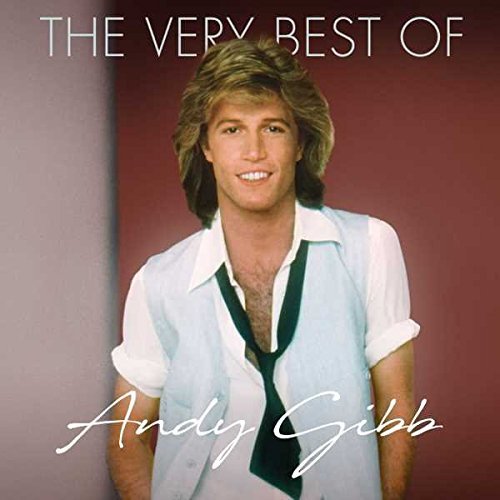
You can listen to Andy Gibb, free, on Hoopla, where you’ll findThe Very Best of Andy Gibb as well of other albums, including: Shadow Dancing, After Dark and Flowing Rivers.
As music critic Amy Hanson writes about The Very Best of Andy Gibb on allmusic.com: “Laugh if you must, dismiss if you’re so inclined, but no matter what anyone may argue, it cannot be disputed that Andy Gibb realized many of his aspirations across this LP and, in so doing, became a vital part of the late ’70s music scene.”
Angie is an Instructor & Research Specialist at Central Branch and is a co-facilitator for Reads of Acceptance, HCLS’ first LGBTQ-focused book club. Her ideal day is reading in her cozy armchair, with her cat Henry next to her.
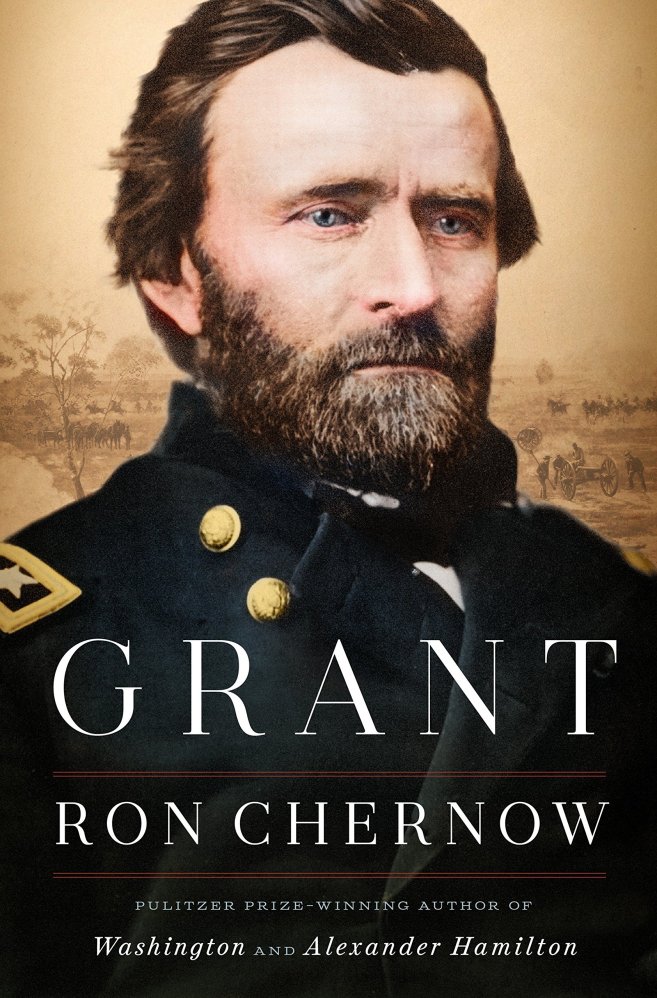
Ulysses S. Grant, circa 1864, photographed by Matthew Brady
Review by Jean B.
Biographies, especially those by Ron Chernow, can be a heavy lift – literally. At more than 900 pages, Chernow’s acclaimed 2017 book examining the life of Ulysses S. Grant can be exhausting to hold for more than 30 minutes of reading. So now is a perfect time to tackle this large but highly satisfying tome, when you can read or listen to it electronically on a lightweight device and maybe have extra reading time in your day! Available through OverDrive in both ebook and eaudiobook formats, Grant offers a fascinating, detailed look at both the man and his era.
I love to read history, biography, and historical fiction, but I’m always discovering how many episodes in history I really know nothing about. The Civil War era has been recorded in myriad ways, and yet, with Grant I gained new perspective on the war — learning details of the Western front that, as a Pennsylvanian whose education focused on Gettysburg, I hadn’t appreciated. More startling, I discovered how little I understood about the Reconstruction Era and the immense challenges that faced President Grant in securing the rights of newly freed slaves to work, vote, and be full citizens in the re-established Union.
Ron Chernow sets out to correct the one-dimensional and largely negative portraits of Grant by earlier historians which portrayed him as an ineffective political leader tainted by scandals, corruption, and a chronic drinking problem. Though Chernow clearly admires his subject and goes above and beyond to compile contemporary opinions and statements to bolster his case in Grant’s favor, Chernow’s portrait has such depth, complexity, and humanity that I was persuaded, too, by the end, of Grant’s impressive leadership, moral courage, and devoted service to the ideals of a united nation and racial equality.
And along the way, I enjoyed getting to know so many of the supporting (and often traitorous!) characters in Grant’s life, from his overbearing father, to his society-loving wife, to the infamous General William Tecumseh Sherman, to conniving Gilded Age businessman Jay Gould. It’s all here — family intrigue, dramatic changes of fortune, battles and blood, comradeship and bitter betrayal. Download and dig in!
Jean is a Children’s Instructor and Research Specialist at the HCLS Central Branch who enjoys participating in book clubs with both kids and adults.







 CHAPTER CHATS