

By Julie F.
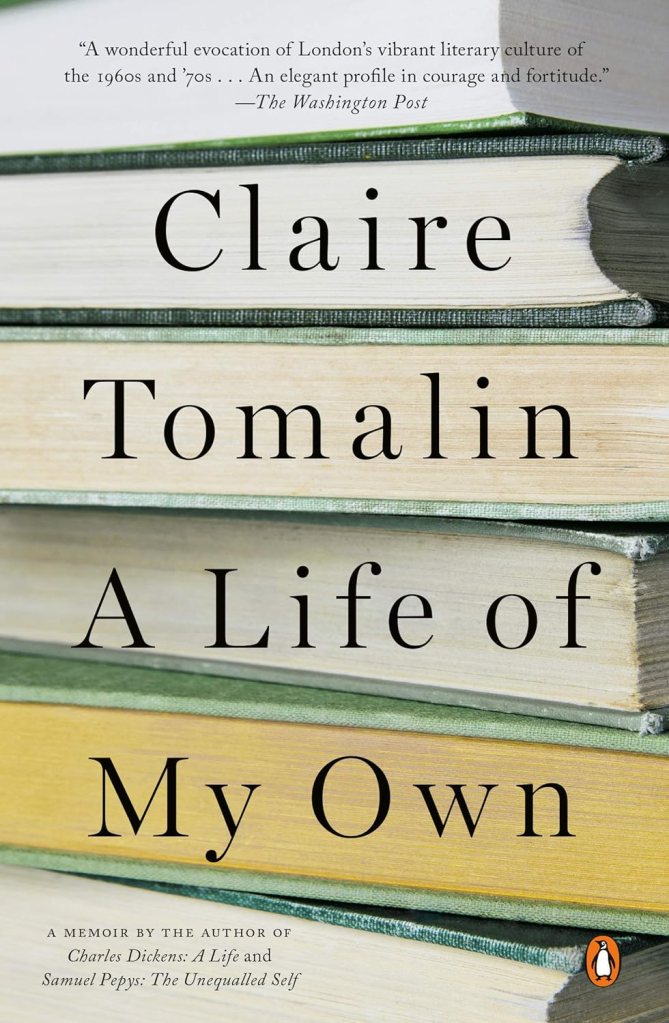
British author Claire Tomalin, acclaimed for her biographies of British writers, tackles autobiography in A Life of My Own, which recounts her life and work through the mid- to late-twentieth century among memorable, clever people. Born in 1933, she was the second daughter of a French father and an English mother, two brilliant parents (a scholar and a gifted pianist and writer of music) who ended up despising one another. Both of them loved Tomalin, though, and she was encouraged and well-educated despite their disastrous relationship. Her years at grammar school, boarding school, and eventually at Newnham College at Cambridge were clearly an adventure, but also a “calm and generally cheerful life” (73). Given the era, of course, there were moments of hardship and difficulty. Although “the war made everything odd” (33) and her mother lived in very straitened circumstances due to the divorce, Tomalin frequently mentions her gratitude to various individuals and for the opportunities she pursued. Her early years were a happy and secure life overall.
Still, hers is not a life without heartbreak. Tomalin lost her charming but somewhat errant husband, journalist Nick Tomalin, to a missile strike in the Golan Heights when he was reporting on the 1973 Arab-Israeli war. Her description of the loss is matter-of-fact but so very tragic, including one of the saddest sentences I’ve ever read:
“I had now to telephone Beth, Nick’s mother, and give her the news that the son she loved more than her own life had been killed” (201).
Tomalin’s grief plays out while surrounded by loving and supportive friends and family, and she goes on to forge an amazing career and raise her and Nick’s children, including their disabled son Tom, but the reader gets a profound sense of the isolation she sometimes felt as a widow bereft too early in life.
It was actually the second tragedy she deals with, the loss of her brilliant daughter Susanna, that made me put the book down for a while even though I was close to finishing; it seemed like too much for one woman to bear. But when I came back to her story, I was glad to read that Tomalin found the means to cope, developed her career as an author, editor, and biographer, maintained many friendships with the literati, and found love later in life with playwright and novelist Michael Frayn (I read his book Headlong years ago and highly recommend it. You can request it via interlibrary loan).
You get a wonderful sense of the milieu in which she and Nick (and later she and Michael Frayn) thrived. As literary editor at The New Statesman, she counted Martin Amis and Julian Barnes among her deputies. She lectured in front of John Updike about his work with next to no notice that he would be in the audience (“A nightmare”) and had a delightful encounter with Saul Bellow. Alan Bennett, Christopher Hitchens, Cecil Day Lewis, V.S. Pritchett, and Beryl Bainbridge are just a few examples of the famous figures in British literature and culture she met, edited, worked with, socialized with, and befriended. And, of course, she wrote her notable biographies: Samuel Pepys, Katherine Mansfield, Jane Austen, Nelly Ternan, Charles Dickens, and Mary Wollstonecraft, among others.
But it is still as a wife, mother, and daughter that the reader gains the most intimate and profound sense of Tomalin’s character and personality. She has been devoted to her son Tom all his life, inspired by his example, and proud of how independent he is despite his disability. She was equally devoted to her parents as they were approaching the end of life, and faults herself for not devoting enough time to them, her mother in particular – a genuine, relatable feeling that many women undergo in mid-life.
Now in her nineties (as is Frayn), she talks about how her “seventies and eighties have been easy” (330), describing a life of gardening, writing and editing, traveling, public speaking, concerts, opera, and films. With six surviving children and ten grandchildren between them, the joyful tone of the last chapter had me hoping for many more years for this erudite pair of writers. A delightful memoir despite the sadness; a life of her own, and a life well-lived.
Claire Tomalin is the author of the following biographies available from HCLS:
- Charles Dickens: A Life (also available in e-book and e-audiobook formats)
- The Young H.G. Wells: Changing the World (also available in e-book format)
- Jane Austen: A Life (e-book)
- Thomas Hardy
- The Invisible Woman: The Story of Nelly Ternan and Charles Dickens (audiobook on CD)
Julie is an instructor and research specialist at HCLS Miller Branch who finds her work as co-editor of Chapter Chats very rewarding. She loves gardening, birds, crime fiction, all kinds of music, and the great outdoors.
 CHAPTER CHATS