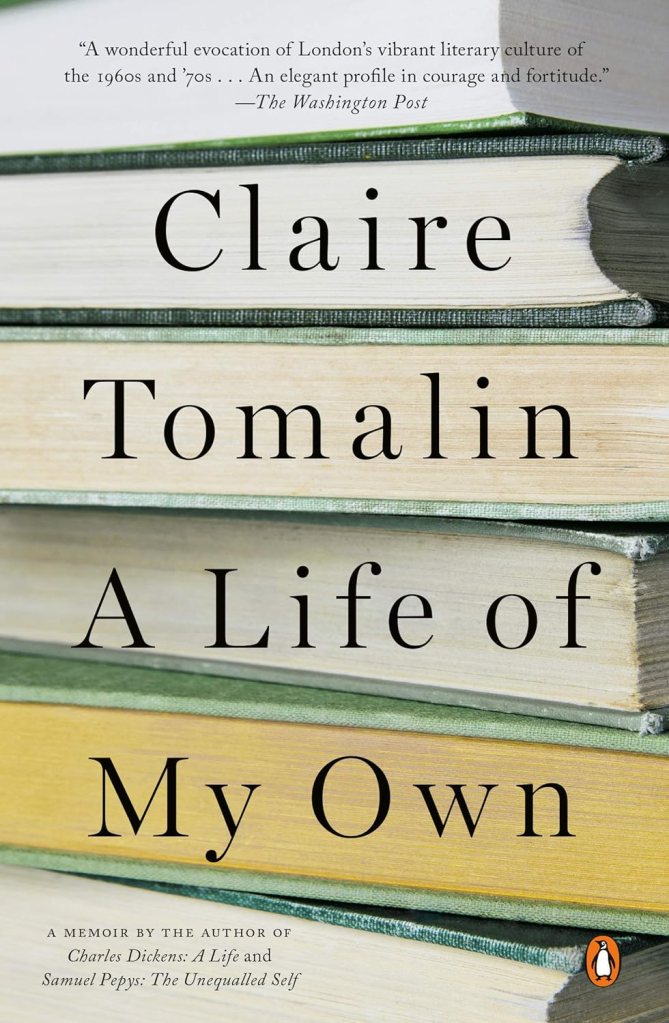
A Life of My Own by Claire Tomalin

The book cover is a photograph of stacked hardcover books in shades of green, yellow, and white.

By Julie F.

British author Claire Tomalin, acclaimed for her biographies of British writers, tackles autobiography in A Life of My Own, which recounts her life and work through the mid- to late-twentieth century among memorable, clever people. Born in 1933, she was the second daughter of a French father and an English mother, two brilliant parents (a scholar and a gifted pianist and writer of music) who ended up despising one another. Both of them loved Tomalin, though, and she was encouraged and well-educated despite their disastrous relationship. Her years at grammar school, boarding school, and eventually at Newnham College at Cambridge were clearly an adventure, but also a “calm and generally cheerful life” (73). Given the era, of course, there were moments of hardship and difficulty. Although “the war made everything odd” (33) and her mother lived in very straitened circumstances due to the divorce, Tomalin frequently mentions her gratitude to various individuals and for the opportunities she pursued. Her early years were a happy and secure life overall.

Still, hers is not a life without heartbreak. Tomalin lost her charming but somewhat errant husband, journalist Nick Tomalin, to a missile strike in the Golan Heights when he was reporting on the 1973 Arab-Israeli war. Her description of the loss is matter-of-fact but so very tragic, including one of the saddest sentences I’ve ever read:

“I had now to telephone Beth, Nick’s mother, and give her the news that the son she loved more than her own life had been killed” (201).

Tomalin’s grief plays out while surrounded by loving and supportive friends and family, and she goes on to forge an amazing career and raise her and Nick’s children, including their disabled son Tom, but the reader gets a profound sense of the isolation she sometimes felt as a widow bereft too early in life.

It was actually the second tragedy she deals with, the loss of her brilliant daughter Susanna, that made me put the book down for a while even though I was close to finishing; it seemed like too much for one woman to bear. But when I came back to her story, I was glad to read that Tomalin found the means to cope, developed her career as an author, editor, and biographer, maintained many friendships with the literati, and found love later in life with playwright and novelist Michael Frayn (I read his book Headlong years ago and highly recommend it. You can request it via interlibrary loan).

You get a wonderful sense of the milieu in which she and Nick (and later she and Michael Frayn) thrived. As literary editor at The New Statesman, she counted Martin Amis and Julian Barnes among her deputies. She lectured in front of John Updike about his work with next to no notice that he would be in the audience (“A nightmare”) and had a delightful encounter with Saul Bellow. Alan Bennett, Christopher Hitchens, Cecil Day Lewis, V.S. Pritchett, and Beryl Bainbridge are just a few examples of the famous figures in British literature and culture she met, edited, worked with, socialized with, and befriended. And, of course, she wrote her notable biographies: Samuel Pepys, Katherine Mansfield, Jane Austen, Nelly Ternan, Charles Dickens, and Mary Wollstonecraft, among others.

But it is still as a wife, mother, and daughter that the reader gains the most intimate and profound sense of Tomalin’s character and personality. She has been devoted to her son Tom all his life, inspired by his example, and proud of how independent he is despite his disability. She was equally devoted to her parents as they were approaching the end of life, and faults herself for not devoting enough time to them, her mother in particular – a genuine, relatable feeling that many women undergo in mid-life.

Now in her nineties (as is Frayn), she talks about how her “seventies and eighties have been easy” (330), describing a life of gardening, writing and editing, traveling, public speaking, concerts, opera, and films. With six surviving children and ten grandchildren between them, the joyful tone of the last chapter had me hoping for many more years for this erudite pair of writers. A delightful memoir despite the sadness; a life of her own, and a life well-lived.

Claire Tomalin is the author of the following biographies available from HCLS:

Julie is an instructor and research specialist at HCLS Miller Branch who finds her work as co-editor of Chapter Chats very rewarding. She loves gardening, birds, crime fiction, all kinds of music, and the great outdoors.

Norfolk, Archaeology, and a Touch of Crime: The Ruth Galloway Mysteries

The cover of The Crossing Places shows a black owl with yellow eyes atop a black perch, against a turquoise background.

By Julie F.

London native and Brighton resident Elly Griffiths has had a phenomenal (and very busy!) career since publishing the first Ruth Galloway mystery, The Crossing Places, in 2009. The author of three children’s books, the Stephens and Mephisto historical mystery series, and the Harbinder Kaur mystery series, she is the winner of the 2020 Edgar Allan Poe award for Best Novel for the first Kaur mystery, The Stranger Diaries. She also won the Dagger in the Library award from the Crime Writers’ Association, which is a prize for a body of work by a crime writer that users of libraries particularly admire.

Although all of her work is acclaimed, the Ruth Galloway novels are especially beloved by her devoted readers. Ruth is a forensic archaeologist who teaches at the University of North Norfolk, where her best friend, Shona, is married to the head of Ruth’s department. Over the span of thirteen novels, Ruth nurtures a passion for the work that consumes her academic life but also spills over into her personal life and a second job as an adjunct to the North Norfolk police constabulary. Like many police officers, DCI Harry Nelson is haunted by the one case he couldn’t solve – that of a missing five-year-old, who was taken from her parents’ home ten years ago and is now missing, presumed dead. When bones are discovered on the beach near Ruth’s home, DCI Nelson calls on Ruth to help the police date and identify them. An Iron Age discovery ensues, another child goes missing, and Ruth finds herself pulled into a case that has ramifications both past and present. The Crossing Places is an excellent start to a series where following the quirky, familiar characters we learn to love doesn’t overshadow the intensity of the mystery; Griffiths is skilled at developing both character AND plot.

Through the course of the series, Ruth has chilling adventure after adventure: she carbon-dates bones found on the site of an old children’s home in the process of being demolished; she attends the scene of the discovery of a downed World War II plane which presumably has the skeleton of the pilot intact; and a jaunt to Italy at the request of a fellow archaeologist needing help with his own most recent discovery results in a kind of working holiday. As the books progress, her relationship with DCI Nelson, both professional and personal, goes through a series of ups and downs that has the reader rooting for both the cranky but decent old-school DCI and the strong-willed, independent archaeologist.

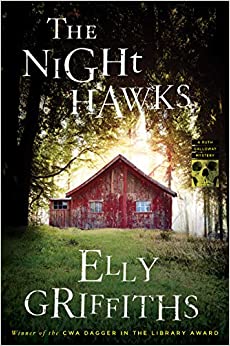
The cover of The Night Hawks shows a backlit red house with a triangular roof, with dark trees above and green grass in the foreground.

The most recent novel, The Night Hawks, has the titular group of treasure hunters combing the beach in North Norfolk when they come across a body – and a cache of Bronze Age weapons, which is of real interest to Ruth and a new university colleague. DCI Nelson speculates that the body, which is not from antiquity, might be that of an asylum seeker who washed overboard in a storm, but the death is quickly linked to a murder-suicide at a nearby house, Black Dog Farm. The name ties into local legend about a huge, spectral black dog who haunts the area, adding an element of the paranormal to an already complicated mystery.

Both The Crossing Places and The Night Hawks are worthy additions to a compelling series, but I can recommend every entry – I’ve read and enjoyed every story involving DCI Nelson and his team, and Ruth and her colleagues, for well over a decade now. I’m still looking forward to more suspenseful mysteries from them – in a recent interview, Elly Griffiths said she is hard at work on the fourteenth Ruth Galloway novel, The Locked Room. Fans of Louise Penny, Ann Cleeves, and other writers of character-driven police procedurals will find much to enjoy and admire about this suspenseful series.

Julie is an instructor and research specialist at HCLS Miller Branch who finds her work as co-editor of Chapter Chats very rewarding. She loves gardening, birds, books, all kinds of music, and the great outdoors.
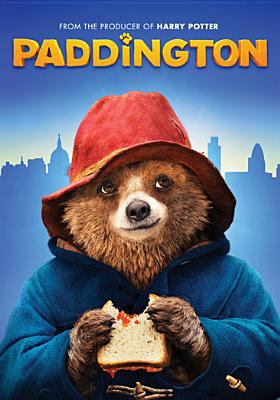
We could all use a little Paddington

The film poster depicts Paddington bear in his red hat and blue coat, eating a jelly sandwich, against a blue background of the London skyline.

By Khaleel G.

I must confess a librarian’s sin: I always mix up Paddington the bear with Corduroy (who is also a bear). Three decades after first reading these books, I only remembered a cute lil’ guy, riding up an escalator, getting into good-hearted mischief. Yet over the past few years, I’ve read amazing reviews of the two Paddington films. Critics said these are some of the best family movies ever made – high praise! But like the thousands of movies, novels, albums, memoirs, histories, and graphic novels I’ve been recommended, I filed these films away in the bursting file cabinet in my mind, labeled “To Check Out, Sometime Later.”

Well, I wish I hadn’t waited so long. These films operate not only as delightful living cartoons, but they’re optimistic, contemporary, and totally absurd in that specific UK comedy way. The director, Paul King, is most famous for having worked on The Mighty Boosh, a British comedy show from the 2000s best described as visual and narrative anarchy. Here, though, he turns what might be a humdrum kids’ book adaptation into a compelling and confoundingly fun romp. 

The premise is simple, but sorta weird, as you see it happen with real actors (and a small, talking animal).  Our protagonist bear (from “Darkest Peru”) is sent north by his auntie and ventures into London alone, with a small tag around his neck reading, “Please look after this bear. THANK YOU.” Upon arriving at Paddington station, he meets the Brown family, who take him in for the night, dubbing him “Paddington” (since they can’t pronounce his name in roars of Bearish). They hope to find a new home for him, the one promised decades ago by an explorer his aunt and uncle met, who extended his hospitality should they ever visit London. Thus, the film properly begins. 

Paddington is shown in his blue coat and red hat, riding an escalator with a small white dog with a jeweled collar.

This is when Paddington sets itself apart from its PG peers. We’re introduced to the Brown family through a Wes Anderson/Royal Tenenbaums-style montage; these carefully shot sequences detail their unique personalities. Like young Judy, who suffers from an incurable case of “embarrassment,” worried about introducing her middle school crush to her family. Or the younger Jonathan, who can’t tell his school chums that he just loves steam engines. Mrs. Brown illustrates children’s books, but can’t come up with a hero, while Mr. Brown is a work-weary insurance investigator, very dry and worried. They’re just as strange as an immigrant bear with a floppy red hat, and each Brown family member discovers and accepts this over the course of the story.

Of particular note is Hugh Bonneville, who played the regal father in Downton Abbey, as Mr. Brown, who doesn’t much like the idea of living with a bear (alluding to issues around immigration and housing, a surprisingly contemporary twist). Before long, Bonneville warms to the little scamp, as they search across London for that welcoming explorer, getting into some Monty Pythonesque escapades.

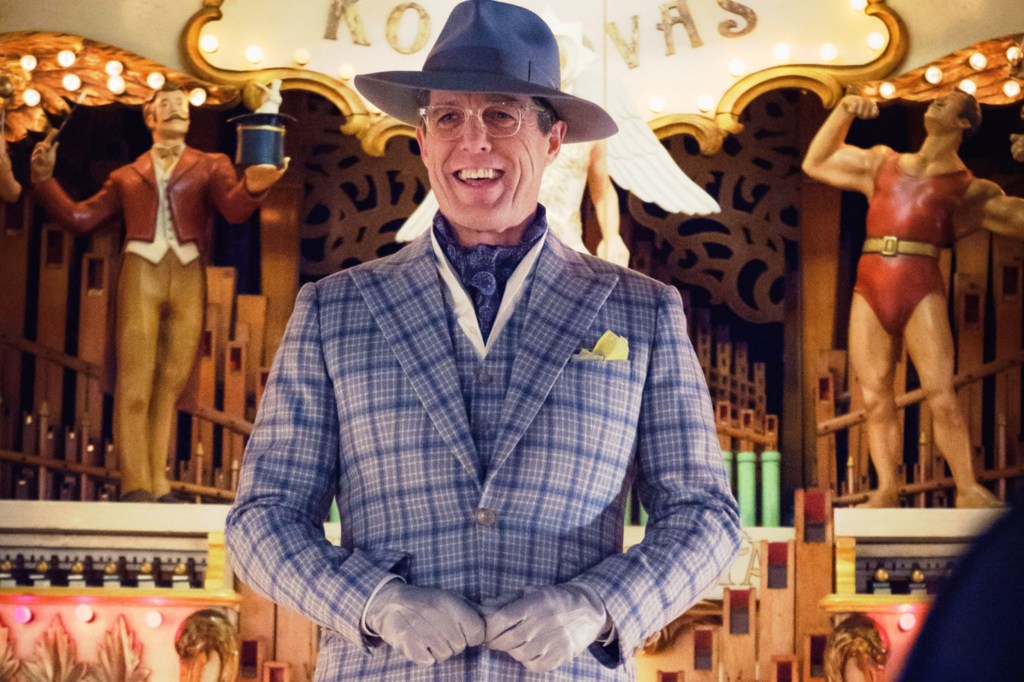
Joining him is Nicole Kidman, as a mad taxidermist intent on capturing Paddington, and boy! she really gives it her all! I haven’t seen a “serious, dramatic” actor lean so hard into being a goofy yet menacing villain in a long while – though in the second film, Hugh Grant one-ups her. He plays a washed-up actor turned thief, dressing in all sorts of costumes to steal what he needs, while performing many ridiculous accents. If you can believe it, he claims this to be his finest work. On top of that, we get delightful supporting performances by BBC regulars, like Jim Broadbent, Peter Capaldi, and Brendan Gleeson, each stealing their scenes with panache.

Hugh Grant is depicted in a blue and grey checked suit with ascot, and a blue wide-brimmed fedora, in front of a carnival-themed calliope.
Hugh Grant, depicted in Paddington 2.

I could go on and on about these films! I haven’t even mentioned the Rube Goldberg stunt scenes. Paddington makes some simple mistake, usually based on a misunderstanding of technology or culture, and sets off a chain of chaos. In one scene, he begins by trying to clean out his ears (a gross-out gag for the kids), but ends up flooding the Brown family’s bathroom to the ceiling, as he floats in the tub. It’s pure Looney Tunes stuff, but the combination of CG with real-world props makes it seem grounded in reality…a reality where people don’t think it’s strange that a bear can talk, but a reality all the same.

So, whether you have kids to entertain, have a fondness for British wackiness, or just want to see a very polite but confused bear bungle about London spreading chaos and also understanding, you must see Paddington and Paddington 2. I cannot recommend these two movies enough, as a spirit-lifting way to spend two evenings.

Paddington and Paddington 2 are available on DVD (rated PG), as well as the original Paddington adaptations for younger kids; the Paddington books are available in print; Corduroy is also available in print (if you want to get two fictional bears confused).  

Khaleel has worked at the Miller Branch since 2015, though he’s been back and forth between HCLS and high school, college, and graduate school since 2003.