Sorry, Bro by Taleen Voskuni

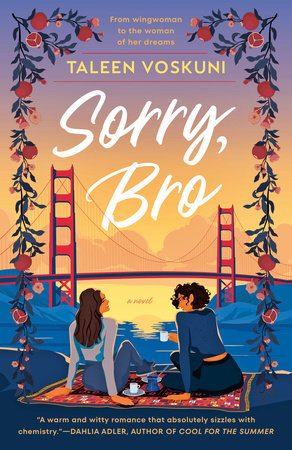
An illustrated cover shows a from-behind veiw of two women on a blanket looking a sunset and the Gold Gate Bridge. Flowering vines frame the cover. The title is in white scrpt above the bridge.

by Lenae R.

I always find it fun to read books set in familiar places. It’s delightful to recognize street names and to have memories evoked by local scents and flavors. The cover of Sorry, Bro seemingly promised me these with its Golden Gate Bridge set against a golden sunset (be still, my born-and-raised Californian heart!), a frame of pomegranate-laden vines, and a description hinting at the revelations uncovered by its Armenian protagonist, Nareh. My family lived overseas in the Caucasus region for several years, and its mention tripped a longing for the culture and people we fell in love with there. I was sold.

To be clear, Sorry, Bro isn’t a cultural saga, per se. Its cover teases, “From wingwoman to the woman of her dreams,” and I was all-in for the juiciness of a friendship-turned-romance. It opens hilariously in a German restaurant, where we are introduced quickly to Nareh’s main predicaments: the anxiety that carries her through her days; a boyfriend, Trevor, who is equal parts outrageous and dull; and the pressure she manages as an only child who lost her father several years earlier.

Trevor departs to Europe for a business trip before the second chapter, creating space for Nareh to process whether she wants to continue their relationship. She spontaneously decides to do this by committing to attend “Explore Armenia,” a month of events dedicated to celebrating Armenian history and culture. Nareh’s mother hopes she will meet a promising Armenian man to marry, and Nareh is hungry – for an out from Trevor and the satisfaction of making her mother proud.

It’s a rom-com premise that, certainly, seems formulaic in many ways. What sets Sorry, Bro apart is how it poignantly, often painfully, brings us along for Nareh’s reckoning with her bisexuality (she isn’t out to her family or community) and her Armenian roots. As a first-generation Filipino on my mother’s side, so many of Nareh’s reactions resonated with me: the comfort and thrill of language, food, and references to the homeland tinged with the shame and awkwardness of a child raised in the diaspora. How does one settle into, own, and embrace a culture they seemingly move in and out of? Tagging along with Nareh as she considers this question proved endearing and thought-provoking.

Nareh’s closeted sexuality is entwined with this journey of self-discovery and identity. Her attraction to women is something she hasn’t felt comfortable sharing as she imagines how it will impact the acceptance she has from her loved ones. So many in the queer community can empathize with her struggle. Her deepening connection with Erebuni, the wingwoman from the cover, challenges the evasions that have kept her safe but stifled.

Rest assured that Nareh’s journey is as fun as it is stirring. Author Taleen Voskuni writes deliciously, balancing sincerity and sarcasm with thoughtfulness. Nareh’s chemistry with Erebuni crackles on every page. You’ll be cheering for her throughout and Googling Armenian eateries by the last page.

Lenae is an instructor for the HiTech summer program. Besides reading, her great loves are spending time with her family, watching Star Wars shows, and visiting new coffee and bookshops (Charm City Books in Baltimore is her favorite)!

Try the The Grapes of Wrath 

An old fashioned pen and ink drawing shows loads trucks along a country road. The book cover appears as speckled, cotton rag paper that has yellowed with age. A coffee cup and pot sit beneath the title and author.

by Eric L.

I recently read, or perhaps re-read, The Grapes of Wrath. If I was assigned this masterwork in school, I skipped it or watched the film (which is also great). Either way, both were wasted on my young mind. The 15-year-old me could not have begun to empathize with these people. Not to mention we were probably still in the Reagan/Bush 1 era, and I feel this sort of thinking had gone out of vogue. No political statement intended; except for some small bumps, those were fairly prosperous economic times for many middle-class folks. 

I was assigned and recall avoiding Of Mice and Men, and I can’t even remember that film. I’ve also seen East of Eden, but only because James Dean was in it. That said, I’m familiar with John Steinbeck: his reputation and the themes he’s known for (California and its workers). Maybe a decade ago, I read Travels with Charley: In Search of America, the autobiographical story of his travels with his dog (Charley). It was quite good, and I recommend it.  

I digress. Coming in at just under 500 pages, with an overarching theme of extreme poverty to the point of starvation, The Grapes of Wrath is a masterwork of American literature. And it’s a story that is timeless, sadly. I read a lot of books, mostly good ones, but it’s easy to forget what it is to read a great book. Although you should be reading all sorts of books and anything that you like, not all books are great, I’m sorry to say. 

In broad strokes, this novel concerns humanism and details the need for a social safety net in America. However, I would not describe the book as a polemic because it’s subtle and it humanizes nearly all the characters who are constantly being dehumanized. The Grapes of Wrath was published in 1939 during the Great Depression, and it painstakingly details the problems people faced when fleeing the dust bowl. It tells the story of the Joad family, who leave Oklahoma after being forced off their land, as they go in search of work and a better life in California.

In many ways this seems like a common trope. The progression of technology changing the way people can meet their needs has certainly been written about again and again (although I’m a sucker for these sorts of stories). Steinbeck deftly illustrates the greed, self-preservation, and dehumanization of others that undergird the whole system. For example, the Joads do not think about traveling to California independently; instead, they are lured there by people looking to exploit their labor.  

One of the saddest aspects of the book is the Joads’ optimism. They obstinately believe that all they need is some work, which they’re more than willing to do. Their naiveté and failure to appreciate the omnipresent power imbalance in America is both admirable and maddening. However, Steinbeck illustrates this often as a criticism of the American ethos. Tom, the main character and oldest son, begins to realize, with the help of the Preacher turned humanist thinker, that the game is not as fair as they all believed. Tom’s rebellion throughout the book provides a counterpoint to the acceptance of less and less by starving people. 

The truly tragic part is the control the owners, banks, and corporations wield over society. For example, their ability to use the law to enforce their rules is despicable. They are terrorizing people who just want to eat and labeling anyone “red” who speaks for labor. 

My favorite part of the book, and the most impressive, is how Steinbeck intersperses the linear story of the Joads’ journey with vignettes about the time, the land, or the people in the abstract. The passages are amazing and can stand on their own. Steinbeck’s technique is strong and unique, and I can’t think of another book written quite like this (although I’m sure one probably exists). I wonder if Steinbeck’s intent is to break up the difficult and moving chapters with something beautifully written. The Grapes of Wrath has poetic moments, particularly when he portrays the kindness and generosity of poor people.  

The Grapes of Wrath is a tough book; by no means a feel-good read, but a plea to recognize our shared humanity. Perhaps it’s also a piece of propaganda for a labor movement and a social safety net. I think any reader would be hard pressed to be unmoved by this classic.

Available in many formats: print, large print, e-book, audiobook on CD, e-audiobook, and Playaway.

Eric is a DIY Instructor and Research Specialist at Elkridge Branch. He enjoys reading, films, music, doing nearly anything outside, and people.

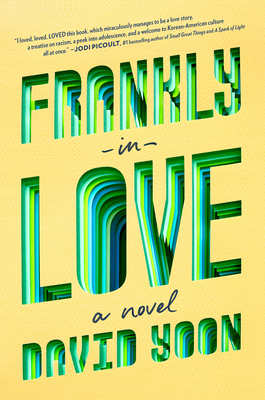
Frankly in Love

The book cover is yellow with the title, Frankly in Love, and the author's name, David Yoon, set on a diagonal, in a stylized, gradated green font with a visual illusion of falling into the cover.

Review by Piyali C.

Frank Li is a senior in high school, growing up in Southern California. He is a first generation Korean American, trying to find his identity in this world. Is he considered Korean, even though he does not speak the language and has never visited that country? Is he fully American and does the world consider him so? He has grown up accompanying his immigrant parents to their monthly gatherings with other Korean families and hanging out with other first-generation Korean children, who, like Frank, are struggling to find where they belong. They call themselves Limbo. Some of the Korean children have embraced the country where they were born, while others retain the culture and language of the country from which their parents emigrated.  There is a big divide even between the first- generation Korean Americans. Frank is very aware of his parents’ blatant racism and knows he is doomed if he dates any girl outside his ethnicity. As luck would have it, he falls in love with Brit Means. Brit is beautiful, smart, kind – and she is white. Frank has to conspire with fellow Limbo, Joy Sung, who is in the same predicament. They decide to pretend-date each other to make their parents happy while continuing to see their respective partners of choice. But how long can this ruse last?

The protagonist of the book is an eighteen year old, and the book primarily explores his self identity and where he belongs,. However, I feel this book provides valuable insight, for adult readers along with teens, into the immigrant community in this country (or anywhere) where the immigrants struggle to find the balance between holding on to the culture of their birth country while trying to assimilate in their adopted country. The struggle becomes extremely poignant for first generation Americans, as is highlighted in this novel. 

David Yoon does a tremendous job of exploring the issues of race and identity in this novel while keeping the narrative light.  The voice of the narrator, a somewhat confused, sometimes lovelorn, and mostly empathetic senior in high school, is authentic. While we live Frank Li’s life vicariously and shudder at the blatantly racist comments that his parents utter, we also examine our own biases regarding race and racial identity. Told in a partly eloquent, partly colloquial voice, this book really satisfies the need for a light yet thought provoking read.

YA Fiction. Available through CloudLibrary and Libby.

Piyali is an instructor and research specialist at HCLS Miller Branch, where she co-facilitates both Global Reads and Strictly Historical Fiction.

20th Century Women

review by Eric L.

A group of people stand on a beach with the ocean behind them. 20th Century Women is in basic type above their heads. A gold banner at the top announces that the movie has been nominated for an Academy Award

The story centers around a middle-aged single mother, Dorothea (Annette Bening), raising a fifteen-year-old son, Jamie (Lucas Jade Zumann). Dorothea owns a large old house (under slow renovation) wherein she rents rooms to Abbie (Greta Gerwig) and William (Billy Crudup). Abbie is a twenty-something, artistic, feminist photographer interested in the nascent punk rock scene; William is a forty-something hippie and handyman mechanic. The other character often in the house is Jamie’s seventeen-year-old female friend Julie (Elle Fanning), with whom he has a complicated relationship.

The thrust of the film is that the overly analytical Dorothea decides to enlist Abbie and Julie to help raise Jamie, in lieu of another man. The different ages and experiences of the characters in the film create the tension. People of different ages and backgrounds attempting to understand and relate to each other is always fraught with problems, irrespective of the setting. Different characters narrate the background of each character as they are introduced and understood, which is very well done with dialogue and images.

The washed out, sunny Southern California setting and the wardrobe selection create a strong visual aesthetic for the film. There are also wonderful scenes of a punk rock club and a seemingly out of place, psychedelic style to the car travel scenes.

I enjoyed the film very much, but perhaps that’s because it “reflected” aspects of me back. However, it’s my opinion that many people will feel the same about it. It’s “indie” and “artsy,” but has a mass appeal due to the characters deftly portrayed in the film. I would describe it as feel-good, but not overly sentimental or trite.

The film is rated R and does include some sexual content.

DVD Fiction. Available to view through Kanopy.

Eric is a DIY Instructor and Research Specialist at HCLS Elkridge Branch. He enjoys reading, films, music, doing nearly anything outside, and people.