The Hardest Job in the World: Providing for Loved Ones and Their Caregivers

By Maryam S.

Caretaking for elderly adults with limited mobility demands physical strength, mental flexibility, and proper education, as I have learned from personal experience. A caretaker is not there only as a nurse but also as financial and emotional support. When my octogenarian loved one was diagnosed with an incurable illness, her amazing medical team showed up for her in the hospital but left me on my own to figure out how to tend to her needs once she was discharged.

I received numerous messages from the close circle of my kindhearted friends who kept reminding me to make sure I was taking care of myself, too. As one put it: caregiving for an elderly adult is the hardest job in the world. It’s a marathon, not a sprint. Those were the words of wisdom I wish I had taken to heart before caregiving started taking its toll on me. I experienced setbacks numerous times. One day I would be more hopeful for her, but the next day would push me back to the verge of despair.

While still at the hospital, her case manager found a rehab facility to keep my patient as long as she needed – but after visiting and seeing the sad reality of how the rehab center functioned, I realized that I would not be able to forgive myself if I made that choice. I told myself: lets see how much I can expend from myself in terms of taking some time off from work to manage my patient’s house as well as her medical needs to ultimately try to make her life as comfortable as possible.

A large bowl of healthy soup surrounded by individual ingredients sits on a grey wooden table. The title information appears in bold red and orange stripes above the bowl, "The Cancer Fighting Kitchen: Nourishing Big-Flavor Recipes for Cancer Treatment and Recovery"

For nutrition, I took from my experience of cooking from different recipes around the world. At Howard County Library System, a large selection of cookbooks for special diets with medical conditions not only made my personal daily goals more enjoyable, they helped me share the idea behind each meal with my patient, who could see these efforts help her feel better despite having a very small appetite. One I can recommend is The Cancer-Fighting Kitchen: Nourishing, Big-Flavor Recipes for Cancer Treatment and Recovery by Rebecca Katz with Mat Edelson. A considerable number of self-help books about caretaking and related topics gave me a broader view of how to react in different situations (see list below).

During many sleepless nights while watching my patient, I found an opportunity to work on my delayed handmade projects. While working quietly on my crafts, e-audiobooks from Libby, cloud library, and Hoopla became my late-night companions. The handmade world was like a sweet scent of cinnamon and cardamom sprinkling over the world, as opposed to the unpleasant smell of medications, pain, sadness, and uncertainty. I learned that I had to fill my own cup first; you can’t pour from an empty cup. For me, I needed to work on my art and being creative, doing exercise, writing, singing – essentially any hobby that can keep the hands and mind occupied.

Hoopla with its various fitness channels also helped me to do my daily workout without being interrupted by unrelated advertisements on social media. I had limited time for myself every day and I had to keep my spirit and physical health in a better condition in order to help my patient. Technology became a useful tool to bring some discipline to my loved one’s daily recovery routine. I found workout videos online from the different universities for the public view to help a loved one practice healthy movement at home.

During this journey, I also learned about the Howard County Office on Aging and Independence, who offer classes and group conversations for caregivers dealing with elderly adults with dementia, cancer, and other conditions. These events are free of charge and encourage caregivers to participate and take benefit from the services of this department. During my conversations with them, I learned how to reach a representative once I face questions that my patient’s medical team may not be available to answer.

I share my experiences for those who may be going through similar experiences. You are not alone. You have so many good resources through HCLS, along with other resources that life provides for you. We all gain a lot of experiences in life by trying different things for ourselves and for our families. We lose and we gain over and over – because it’s all about the patient that we spending our time with. It’s something that doesn’t happen to everyone but happens to many. I call it becoming more.

October is Mental Health Awareness Month, and here are some of many resources available at the library that helped me in my mental health journey while caregiving:

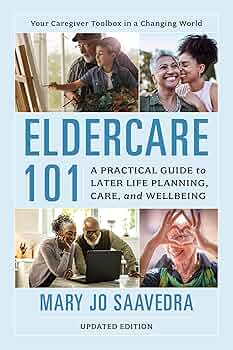
Eldercare 101: a Practical Guide to Later Life Planning, Care and Wellbeing by Mary Jo Saavedra

It’s OK That You’re Not OK by Megan Devine

The Art of Dying Well: A Practical Guide to a Good End of Life by Kathy Butler

The American Cancer Society New Healthy Eating Cookbook by Jeanne Besser

Life After the Diagnosis: Expert Advice on Living Well with Serious Illness for Patients and Caregivers by Steven Z. Pantilat, MD

Maryam S. is a customer service specialist at HCLS Miller Branch. She loves traveling near and far and loves to cook and bake from new recipes.
Beyond Words

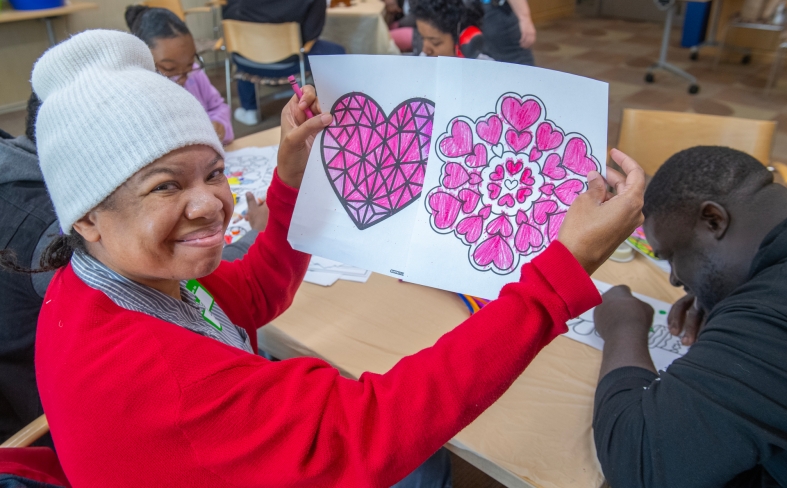
A Beyond Words participant wearing a white hat and red sweater displays two coloring sheets with pink hearts in a geometric pattern, part of the Valentine's Day theme for the February classes.
Beyond Words is a vibrant and inclusive monthly class designed to spark joy and ignite the imagination of participants with developmental and intellectual disabilities.

By Peg P.

Beyond Words, a new class at HCLS Miller Branch and now at East Columbia too, began with a simple question from a frustrated mom of a teen. After scanning the multitude of offerings on our Teen Monthly Calendar, she asked, “What classes do you have that would be appropriate for my son?” While I explained that her son was welcome at any Teen class, I understood what she meant, as the young man had a moderate developmental/intellectual disability and we had no specifically designed offerings for him at the time.

This was actually something that had been percolating in my mind for a while as I frequently see customers and their caregivers using our computers to play games, watch videos, etc. It always takes me back to the days when I was a caregiver in a group home for adults with developmental disabilities, when it was difficult to find free developmentally/intellectually appropriate opportunities for the group.

Two participants play the game Connect Four at the Motor Skills Station.

In order to do this right, I knew that I needed to get some input from the community as to what they would like to see in terms of monthly classes, so I reached out to a few of our “regular” customers and caregivers for ideas. Together, we came up with the idea to have five stations that participants could rotate through – Motor Skills, Arts & Crafts, Movement, Cognitive Skills, and a Sensory station. The activities would change each month according to a theme and would be differentiated and/or have appropriate accommodations based on varying skill level or needs. For instance, arts and crafts supplies include markers, acrylic paint pens, crayons, egg-shaped palm crayons, a variety of different brush handle sizes, etc., not only to accommodate creative choice but also to ensure that folks with limited motor ability can still participate.

Two instructors look on as participants color at the Arts and Crafts table.

We have two different monthly classes at Miller Branch to accommodate customer availability. Our adult classes (18 and up) take place on second Tuesdays from 10 am – 12 pm. Teen classes are on fourth Wednesdays from 5 – 7 pm, when the teens are out of school and can attend with their parents or other caregivers. It also gives folks a way to socialize with others of their own age group.

I’m happy to say that Beyond Words has been a great success and has helped to partially fill an often-overlooked need within our community. Participants and caregivers have nothing but good feedback about this class and are thrilled that it has expanded for adults at the East Columbia Branch, creating more opportunity for folks to attend (thanks to the efforts of Adult Instructor Sharon Pruitt-Young, who opted to mirror our program at Miller).

There are many parts of my job as a Teen Instructor that bring me great joy, but nothing else comes close to the way I feel after a Beyond Words class. The experience really is magical, and I feel incredibly lucky to be a part of it. Special thanks to Stephanie and Michele at HCLS Miller Branch for their input and making this possible.

Peg Prentice is a Teen Instructor & Research Specialist at HCLS Miller Branch. She is a consummate nerd who has played Dungeons & Dragons for 40+ years, loves science (especially if there are fire and explosions involved), has an insatiable appetite for obscure factoids (Did you know that wombats’ poop is cube-shaped?), and was usually the last one picked for kickball. 

Loving Stories in Picture Books

By Eliana H. 

During this time of year, we are bombarded by messages trying to convince us to buy things for “that special someone.” Flowers, chocolate, jewelry, and more. Not everyone celebrates Valentine’s Day, but I hope we all have people we love. Research shows that a loving bond with a caregiver helps young children thrive. Share these picture books about love with your little one, or any other stories you like, to help develop that bond. For more tips from The Basics about maximizing love and managing stress, visit https://thebasics.org/brain-boosts/maximize-love-manage-stress/

I Am Love: A Book of Compassion by Susan Verde, illustrated by Peter H. Reynolds (ages 5-11) 

The cover depicts a barefoot child in a blue top and pants with a pink jacket, and blue and pink hair, with arms outstretched in front of a heart that is comprised of gold stars.

With simple words and watercolor illustrations, this book gently invites readers to think about how they can show love. The author and illustrator work seamlessly together to show how we can support ourselves and each other with specific, concrete loving actions. Heart-opening yoga poses and a heart meditation accompany the author’s note at the end of this title.  

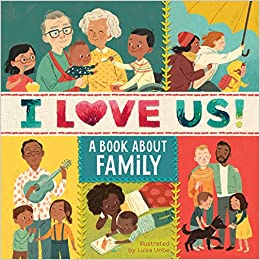
I Love Us!: A Book About Family by Theodore Henry, illustrated by Luisa Uribe (ages 0-3) 

The cover shows a variety of different multicultural families interacting while doing various activities - running through the rain under an umbrella, playing with a dog, drawing, making music, and eating.

A wonderful read to share with your youngest loved ones, I Love Us! shows various families participating in loving activities together. After you read, talk about the things you love about your family and what it does. A mirror at the end lets you and your little one imagine yourselves in the story! But if you want to complete the family tree activity on the final page, please do it on a separate page and not in a library copy of the book. 

Love the World by Todd Parr (ages 2-6) 

The book cover, in bright pink with yellow, blue, and green lettering, depicts the Earth with a heart superimposed for the "O" in "World," and anothe heart in the center of the "O" in "Love." Two children in brightly colored outfits are shown leaning into the frame from either side of the title with their hands outstretched, and a brown and white dog with a red collar pops up at the bottom. Small red and yellow hearts are scattered across the cover.

If you’ve ever read a Todd Parr book before, you will immediately recognize his unique style. With brightly colored illustrations and simple, rhyming text, Parr invites readers to love activities that support the community and specific parts of themselves. Throughout the book, in full-page spreads, we are reminded to “Love yourself. Love the world!” Invite your little one to talk about all the things they love after reading this volume. 

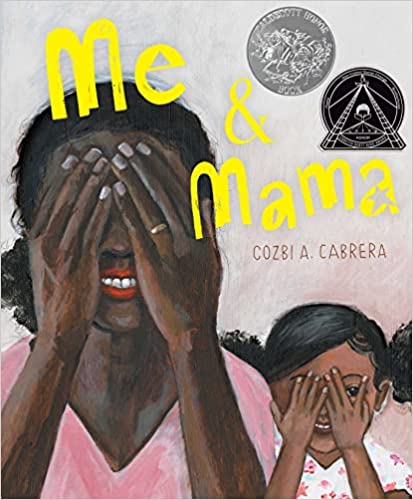
Me & Mama by Cozbi A. Cabrera (ages 4-8) 

The cover shows a girl and her mama playing peek-a-boo, both wearing shades of pink. The little girl is "peeking" out from behind her hands with a little grin on her face, but the mama's eyes are completely covered although she, too, is smiling.

This quiet, beautiful book celebrates the special bond between a little girl and her mama. As she says on the first page, the little girl wants, “to be everywhere Mama is.” She shows readers things that are hers and her mama’s before bringing us along on a walk in the rain. As day ends and she falls asleep, the little girl remembers parts of the day, especially “me and Mama.” 

When a Grandpa Says “I Love You” by Douglas Wood, illustrated by Jennifer A. Bell (ages 3-7) 

The cover depicts two anthropomorphized bears; the grandpa bear wears blue checked pajamas and square glasses, and the baby bear is in pale red pajamas, holding a flashlight. The two look as though they are in a tent and the grandpa is making shadow puppets. There is a wooden chair to the right of the frame, holding up the tent.

Many grandfathers don’t say “I love you” in words, although some certainly do. Even those that aren’t saying it out loud display their love for grandchildren through their actions. A wide range of animal pairs show grandfather-grandchild relationships in the illustrations of this book, all participating in a variety of activities that demonstrate loving feelings they share. Follow a reading with a discussion of the ways that we can show love to a special person. 

When Aidan Became a Brother by Kyle Lukoff, illustrated by Kaylani Juanita (ages 4-7) 

The cover depicts Aidan in a rainbow-colored coat and yellow pants, on the shoulders of his Dad and being kissed by his pregnant mom, who is wearing a white dress. A white cat looks up at them from next to Aidan's mom, and there are flower blossoms and petals floating across the cover.

When Aidan was born, everyone thought he was a girl. It took some time, but Aidan’s family all adjusted to make sure his life fit who he is. Now Aidan’s mom is expecting a baby, and Aidan knows that being a big brother is an important job. He helps his parents get things ready for his new sibling, but he also worries that he won’t be a good big brother. Thankfully, Aidan’s parents remind him that loving someone is the most important part of that job. 

Eliana is a Children’s Research Specialist and Instructor at HCLS Elkridge Branch. She loves reading, even if she’s slow at it, and especially enjoys helping people find books that make them light up. She also loves being outside and spending time with friends and family (when it’s safe).