The American Library Association condemns censorship and works to defend each person’s right to read under the First Amendment and to ensure free access to information. Every year, ALA’s Office for Intellectual Freedom (OIF) compiles a list of the Top 10 Most Challenged Books in order to inform the public about censorship in libraries and schools. The lists are based on information from confidential reports filed by library professionals and community members, as well as news stories published throughout the United States.
Because many book challenges are not reported to the ALA or covered by the press, the data compiled by ALA represent only a snapshot of censorship attempts in libraries.
The 2024 data reported to ALA’s Office for Intellectual Freedom (OIF) shows that the majority of book censorship attempts are now originating from organized movements. Pressure groups and government entities that include elected officials, board members and administrators initiated 72% of demands to censor books in school and public libraries. Parents only accounted for 16% of demands to censor books, while 5% of challenges were brought by individual library users. The 120 titles most frequently targeted for censorship during 2024 are all identified on partisan book rating sites, which provide tools for activists to demand the censorship of library books.
The most common justifications for censorship provided by complainants were false claims of illegal obscenity for minors; inclusion of LGBTQIA+ characters or themes; and covering topics of race, racism, equity, and social justice.
Since 2021, ALA has tracked a sharp spike in censorship attempts in libraries. In 2024, ALA recorded the third highest number of book challenges since tracking began in 1990: ALA documented 821 attempts to censor library books and other materials in 2024 across all library types, a decrease from 2023, when a record high 1,247 attempts were reported. ALA recorded attempts to remove 2,452 unique titles in 2024, which significantly exceeds the average of 273 unique titles that were challenged annually during 2001–2020.
Looking for the most challenged books from previous years? Check out the Top 10 Most Challenged Books Archive for lists and data going back to 2001, as well as the 100 most challenged books of past decades.
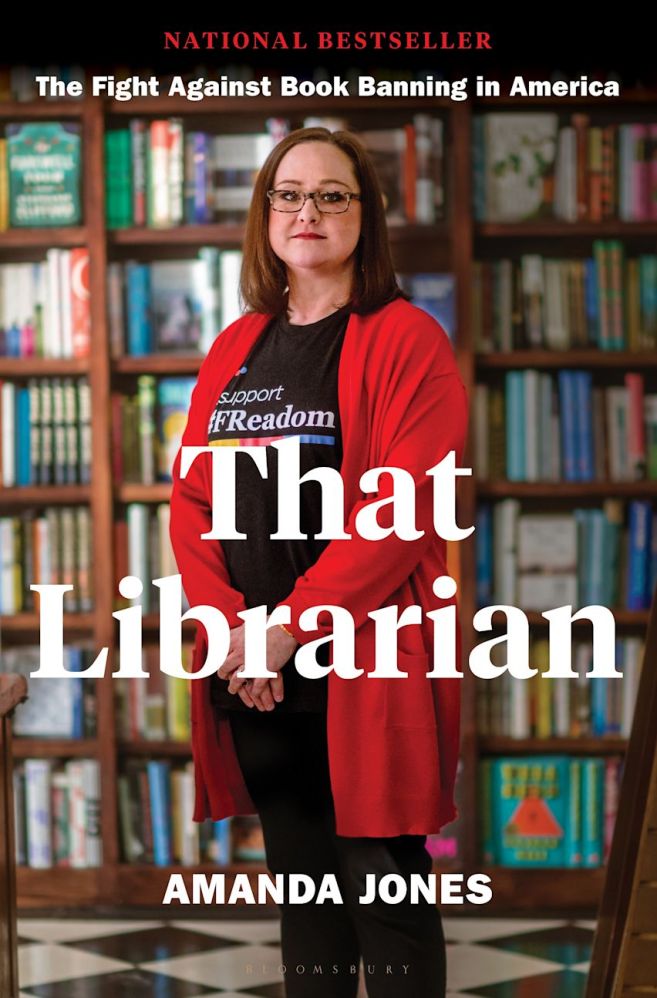
On July 19, 2022, educator and school librarian Amanda Jones spoke up against censorship at a Livingston Parish Library Board of Control meetingin Louisiana. Her speech focused on inclusivity, the freedom to read, and the importance of representation of diverse thoughts, beliefs, experiences, and community in a public library’s collection. Little did she know that her speech about her public library’s collection would result in a storm of bigotry, hatred, and vitriol against her, on a personal level. What followed can only be termed a nightmare. Members of nationalist, White Christian groups started bullying Amanda Jones mercilessly on social media, accusing her of grooming children and putting sexually graphic content in the hands of children.
Jones writes about how she was affected: how the defamation took a toll on her health and her personal life, and how she found inner strength with the support and loveof her family, friends, and wider community members locally and nationally. She rose above the fray of pettiness of the individuals who bullied her for her speech and her fight to preserve intellectual freedom. She fought her way through, stood up straight, and discovered her strengths and weaknesses in the process. She did not ask to be a hero, but she fought back, instead of backing down, when she was so wrongfully attacked by ultra-conservatives for defending everyone’s freedom to read. She made mistakes, but she eventually learned to respond with meticulous fact-gathering, background-checking and analyzing, and most importantly, with grace. All that she learned at library school about curating information came in handy in her campaign against ignorance and bigotry.
It was an excellent read, especially because I believe in everyone’s right to read whatever they want to with all my heart. Like Amanda Jones, I believe that representation matters. Kids, and everyone, deserve to see themselves in the materials they read. It is the responsibility of parents to monitor what their child is reading, not the library’s. There is a due process in place to ask a library to reconsider any material in the collection, and customers should avail themselves of that if they want to request libraries to remove materials – but one individual (or a group of them) who does not agree with the content should not take priority over the need for representation.
My only criticism of this book is not its message but that some ideas were repetitive. It seemed like some of the chapters were written as essays and the same idea was repeated, and the repetition took the edge off the author’s important message. I would rather have the message of intellectual freedom being reiterated than not.
Piyali is an instructor and research specialist at HCLS Miller Branch, where she facilitates two book discussion groups: Light But Not Fluffy and Global Reads. She keeps the hope alive that someday she will reach the bottom of her to-read list.
Banned Books Week is a party. We celebrate our unfettered access to whichever books we choose.
The national theme of Banned Books Week stands firm in its message against censorship. When it began in 1982, Banned Books Week was not a protest, but a reaction to an increasing number of book challenges. Banned Books Week is a space away from the intensity of media speculation and divisive press coverage.
The American Library Association’s Office of Intellectual Freedom tracked almost 1,600 books that were challenged in 2021 alone, but Banned Books Week is not when those challenges are contested. It is, in the words of the official website, a time for, “shared support of the freedom to seek and to express ideas, even those some consider unorthodox or unpopular.”
The ALA is one of the loudest proponents of this effort as it supports the declaration from libraries to wholly commit to combat disinformation, promote the perspectives of historically excluded groups, and increase access to information. This is the mandate of public libraries, written into the mission statement of Howard County Library System: “We deliver high-quality public education for all.”
It is our responsibility to provide access to materials that encourage conversation and provoke thought; every addition to our collection is a choice, and decisions are never neutral. HCLS continues this practice with its Brave Voices, Brave Choices initiative. We have committed to not hiding hard conversations from our community. Discussions about appropriateness usually center the idea of balance, meaning we amplify the voices of people from historically excluded, marginalized, and unheard communities. Libraries cannot be neutral in this effort toward radical inclusion.
Kelvin Watson, director of libraries in Broward County, Florida, put it well: “Claiming neutrality endangers us as an institution by resulting in an unconscious adoption of the values of the dominant political model and framework… (w)e cannot be neutral on social and political issues that impact our customers because…these social and political issues impact us as well.” While a policy of neutrality appears to be equal, it is not equitable – it does not allow for different facets of our community to see themselves represented meaningfully, without stereotype, by people who share their life experiences.
We, as a library, stand to protect the brave voices who write, publish, and lead us into a more equitable future. We, in turn, make the brave choice to stand against the idea that we can be neutral in the battle against misinformation. The library is a steward of knowledge, led for and by the community it serves.
So, join the party! Everyone’s invited.
Sahana is an Instructor and Research Specialist at the Savage Branch. She enjoys adding books to her “want to read” list despite having a mountain of books waiting for her already.
“Any time we eliminate or wall off certain narratives, we are not getting a whole picture of the world in which we live…we limit our vocabulary, which complicates how we communicate with one another.”
– Jason Reynolds, the acclaimed Maryland author named Honorary Chair for Banned Books Week
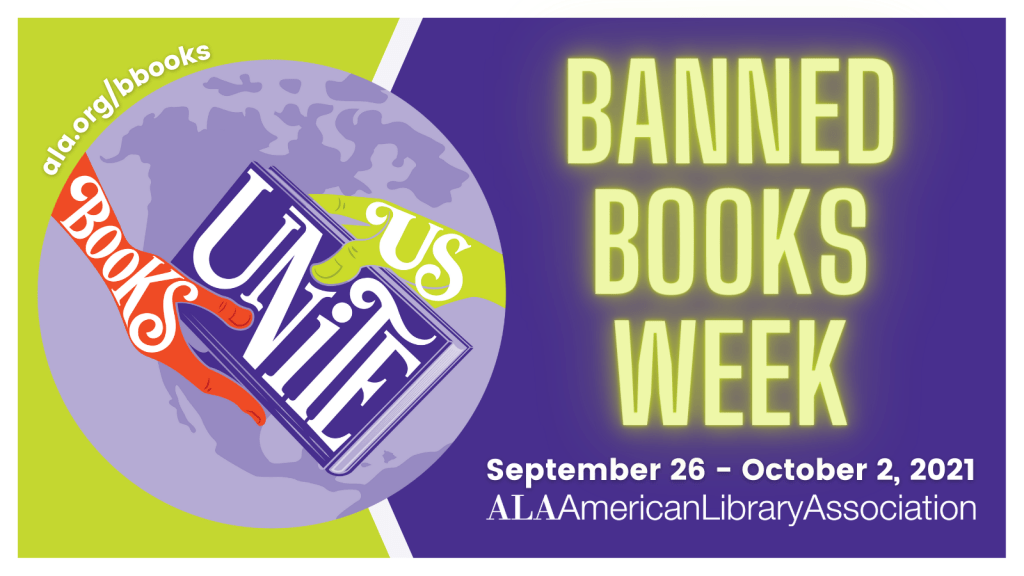
A library may be held together with walls, but it’s the doors and windows that really matter — doors open for all people and windows that illuminate all perspectives. During Banned Books Week, we celebrate the freedom to read and the commitment by libraries, publishers, teachers, writers, and readers to promote access to materials that the ALA Freedom to Read Statement says, “enrich the quality and diversity of thought and expression.” Established in 1982, Banned Books Week responds to efforts across the country to challenge and censor books and focuses attention on how restricting access to information, ideas, and stories harms American cultural and political life.
In a time when divisions cut across our nation like fault lines, the 2021 Banned Books Week theme reminds us that books can be a force for unity, even – or especially – when they convey a wide variety of views and experiences, including those that are marginal, unconventional, or unpopular. The freedom to read strengthens our ability to communicate with one another.
In a democracy, we trust individuals to learn and decide for themselves. But to make informed choices, citizens require free access to all viewpoints and all kinds of ideas in the process of self-education. Where can people go for free access to ideas and information? Their public library! As essential institutions of democracy, public libraries implement intentional collection policies to ensure the breadth and inclusivity of materials available to their communities. For Howard County Library System, this translates into a collection that reflects a wide range of voices, including controversial and conflicting ideas.
As the HCLS Board of Trustees affirms, while, “anyone is free to reject for [themselves] books or other materials of which [they] do not approve, [they] cannot exercise this right to restrict the freedom of others.” The freedom to read strengthens our citizenship. Each year, the American Library Association (ALA) publishes a list of the ten most frequently challenged or banned books across the nation. This snapshot reflects only a small percentage of the challenges that take place in schools and libraries. The ALA estimates that 82 – 97 percent of requests to remove materials are unreported. As this list illustrates, the challenges come from all directions and perspectives. The freedom to read protects all points of view.
So this year, in honor of Banned Books Week, open the library door and explore our extensive collections. Look through the windows of stories into all different kinds of lives, familiar and unfamiliar. Explore HCLS’ Brave Voices, Brave Choices campaign to discover a wide range of experiences in our own community. It’s all free to you, and you are free to choose.
Jean B. is a Children’s Instructor and Research Specialist at the Central Branch and loves reading books for all ages when she isn’t enjoying the outdoors.
When you hear the words “banned book,” what’s the first thought that comes to mind? Is it a particular title? Do you stay away from these books or welcome them onto your bookshelf? Is your child allowed to read these books?
I’m always intrigued by a title that has made it onto the banned/challenged books list. Often, the reason is something that should really involve a personal decision on the suitability for any child. Instead of immediately turning away from a title, representation on the banned books list can be cause to look deeper and open up a valuable conversation.
Reasons for a book to be banned include: racial themes, alternative lifestyles, LGBTQIA+, profanity, violence, negativity, sex, magic and witchcraft, unpopular religious or political views, or any theme deemed unsuitable for a particular age group.
I have chosen a few children’s books to highlight:
Hop on Pop by Dr. Seuss Found in many personal collections, this Dr. Seuss book depicts rambunctious kids hopping on their father as he tries to relax. This book was challenged because it depicts violence against fathers and was thought to encourage such behavior. Parents grew concerned that the silly rhyming story would cause children to destroy their homes, and some even stated that their local library should pay for any resulting damages. Dr. Seuss is no stranger to the banned books list, due to racist depictions of people through wording and exaggerated facial features. However, it’s a bit more far-fetched to ban a story that is just so naturally zany.
Where The Wild Things Are by Maurice Sendak You’ve likely read this story and may even have it memorized. This classic makes the banned books list for many reasons. Some find it psychologically damaging and traumatizing for young children due to the explosive emotions that Max seemingly can’t control. Child abuse is also listed as a reason, due to Max’s mom sending him to bed without any dinner as a punishment. In addition, witchcraft and supernatural elements continue to check the boxes for reasons to be on a banned books list. However, I see this book as an opportunity to discuss how actions have consequences, imagination knows no bounds, and emotions can often be bigger than us and difficult to control.
The Family Book by Todd Parr Todd Parr is certainly not someone you would ever expect to see on a banned books list. His vibrant, emotive, and inclusive books are customer favorites. This title has all the great things you look for in Parr’s books, but not everyone agreed with the depiction of diverse families. Having two moms or two dads caused a lot of people to complain. Sadly, any mention of LBGTQIA+ characters, themes, or elements is often a cause for parents to call for banning books. Instead, I suggest using that time reading together to celebrate diverse love and educate your child about all the wonderful representations of the rainbow- and families!
Junie B. Jones series by Barbara Park Even a well-loved series isn’t safe from the banned books list. Junie B. Jones certainly has her own way of talking and expressing herself. This results in a lot of technical grammatical errors with phrases like “runned speedy quick” and “did a shrug.” Junie’s speech patterns landed this series on the banned books list as parents were worried it could encourage young readers to mimic her ways.
The Giver by Lois Lowry This is my all-time favorite book. I read it in middle school and immediately loved it. Every re-read results in the same feeling and, honestly, that’s rare to find. Concern for this book consists of a variety of reasons. “Twisted” and “lewd” content, occult themes, violence, infanticide, euthanasia, sexuality, and suicide are all reasons this story has made its way onto the banned books list. Some expressed that this was the very kind of book that leads a person to have no concern for humanity. The themes in this book offer room for a lot of heartfelt, thoughtful, and meaningful discussion. The Giver is beautiful and haunting, and it makes me feel deeply and fully.
I mentioned the reasons a book might be banned. What about the reasons not to ban a book? Something that isn’t liked by one shouldn’t be taken away from everyone. Books are truly among our best teachers, having a broad impact that can change the world, Censorship isn’t protection from the difficult realities of the world, rather it’s a practice in inefficacy and privilege.
Everyone should read banned books, including children. Many of the most frequently banned books either are celebrated classics or future classics. I encourage you to read banned books with your child, to look deeper, and to maintain a safe space for conversation.
Laci is a Children’s Instructor and Research Specialist at HCLS. They love a wide variety of music, spending time in the garden, Halloween, cats, and crafting. Their “to read” list is always full of graphic novels and picture books.
“The novel, the story. the poem, are still subjected to a paradox with a long history: Fighting the written word acknowledges its power” (53). – from Freedom of Speech: Mightier Than the Sword by David K. Shipler
It’s easy to think of Banned Books in terms of the classics, many of which are read in high school and challenged at that level: Beloved, The Adventures of Huckleberry Finn, and Slaughterhouse-Five are three that spring to mind even before I look at a list. In fact, you can even listen here to Benedict Cumberbatch reading Kurt Vonnegut’s famous letter to the Drake County School Board after they banned and burned his masterpiece. Sherlock Holmes himself in support of our First Amendment!
What other forms, you might ask? Award-winning musicals and plays, from Sweeney Todd to Shakespeare’s own Twelfth Night, have been censored and banned in recent years. The Defender Database of the Dramatists Legal Defense Fund has a comprehensive list of theatrical challenges and bans nationwide, and works “to educate everyone about the subjective and transient standards that have been employed by censor[s].”
Another form of censorship you may not have considered is the banning of books in prisons and jails, which is often arbitrary, with no efficient review mechanisms and no independent oversight outside of the prison system. PEN America has also found that literature about topics including race and civil rights is disproportionally subject to banning; you can read about their findings here and learn more about their Literature Locked Up initiative.
The American Library Association’s Office of Intellectual Freedom provides a continually updated list of resources for those interested in crucial First Amendment issues. To begin, I would suggest reading the Library Bill of Rights and the ALA’s Freedom to Read statement, both of which advocate for our nation to trust individual citizens – not government censors – to make their own best decisions about reading, expression, and the free and open exchange of ideas. After all, as Justice John Marshall Harlan famously wrote for the court in Paul Robert Cohen v. California in 1971, “One man’s vulgarity is another’s lyric.”
Julie is an instructor and research specialist at HCLS Miller Branch. She loves gardening, reading, journalism, and all kinds of music.






 CHAPTER CHATS