
Banned Books Week: Sep 22 – 28

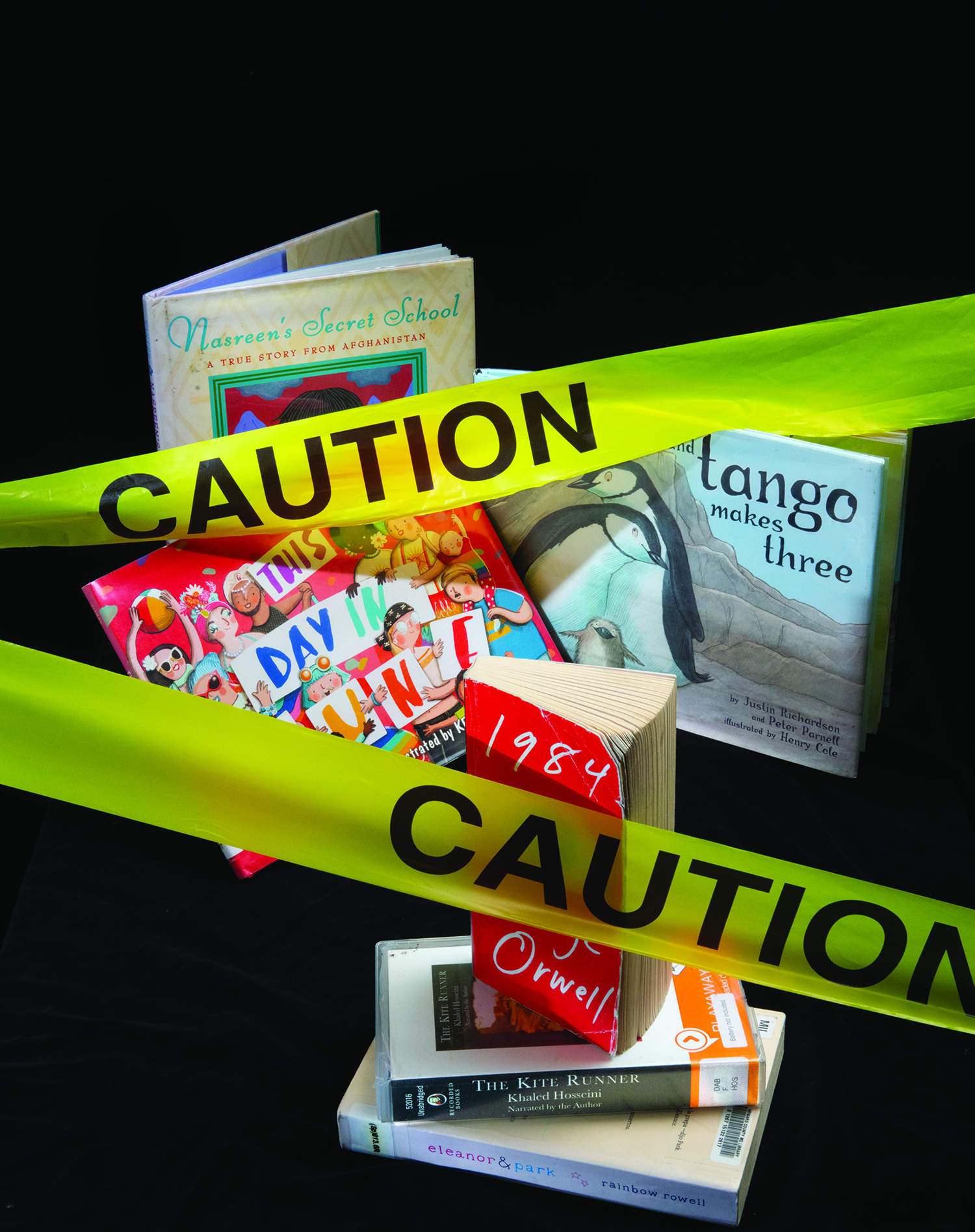
Yellow caution tape stretches across an arrangement of books, all of which are perennially on the challenged book list. They include 1984 by George Orwell, The Kite Runner by Khaled Hosseini, and Tango Makes Three.

by Sahana C.

Howard County Library System is your place to learn, grow, and connect. As a library, one of the best ways we know to bolster learning, to encourage growth, and to promote connection happens through books. It’s why we have such a vast range of topics, themes, identities, and authors represented in our collection. It’s why we have so many different book clubs across all our branches, and so many ways to access them. It’s why you’ll see the On the Road to Kindergarten van in your neighborhood and at schools with books to borrow. While the library is not just about books (we’re proud of all our resources and collections), our books are a large part of what brings us closer to our community.

In recent years, the challenges and objections to different titles in libraries across the country have made major headlines, including the state of Maryland. We now live in a state with a Freedom to Read Act, which asserts intellectual freedom as lawful and denounces censorship plainly, which is not the case nationally. To highlight stories that are challenged or censored, the American Library Association (ALA) celebrates Banned Books Week each year. Banned Books Week started in 1982 as a response to book challenges and has turned into a national celebration of literature.

To celebrate Banned Books Week this year, visit your local library branch and check out the displays and resources about different titles that have been challenged. And, for even more immersion, hop online each day of Banned Books Week at noon for our virtual Banned Books Read-a-thon. With a new title each day, we will discuss a work that has been banned or challenged in some form, and read an excerpt of the text.

The ALA’s theme for Banned Books Week 2024 is “Freed Between the Lines,” and it asks readers everywhere to consider the ways that books can help us explore new ideas, understand the world around us, and find freedom. It encourages us to delve deeper and be unafraid to be creative with our understandings of the books we read.

Banned Books Week Read-A-Thon
For adults. Register to receive the link.
Learn about the history and significance of Banned Books Week, then listen to a reading from a frequently challenged book. You can join every day or just for the ones that interest you.
Mon- Fri | 12 – 1 pm | online
Mon, Sep 23
1984 by George Orwell

Tue, Sep 24
Eleanor & Park by Rainbow Rowell

Wed, Sep 25
Looking for Alaska by John Green

Thu, Sep 26
The Kite Runner by Khaled Hosseini

Fri, Sep 27: Children’s picture books
Nasreen’s Secret School: A True Story from Afghanistan and The Librarian of Basra: A True Story from Iraq, written and illustrated by Jeanette Winter.
This Day in June, written by Gayle E. Pitman and illustrated by Kristyna Litten.
And Tango Makes Three, written by Justin Richardson and Peter Parnell and illustrated by Henry Cole.

Sahana is an Instructor and Research Specialist at HCLS Savage Branch. They enjoy adding books to their “want to read” list despite having a mountain of books waiting for them already.

Teens! Protect Your Bacon!

Six strips of cooked bacon on a black griddle.

By Deborah B.

“Stop! You can’t eat that bacon! It’s bad.” 

You pause and look at the stranger. “It’s bacon. Even bad bacon is good.” 

“No, I mean it’s bad for you.” And with that, the stranger whips your plate of crispy bacon off the table and tilts the contents into an oversized Hefty. You:  

  1. Apologize to the clearly well-meaning stranger and hand over the offending pork. 
  1. Shoot your hand into the bag, fish around, grab a fistful of what feels like bacon, and jam it into your mouth. 
  1. Throw your body atop the table, effectively blocking brunch, or something equally dramatic.

While there may be solid arguments against bacon as a factor in health and wellness, most people – clever teenagers especially – would agree the choice of what to eat should belong to the eater or (maybe) the parents of said eater. Thus, bacon becomes my tasty, non-vegetarian metaphor for censored materials in honor of Banned and Challenged Books Week. 

Banned and Challenged Books Week is an international celebration of the freedom to read and the right to open access of information. Libraries around the globe host events during the last week of September designed to expose and oppose the suppression of ideas, even those many consider unpopular, unorthodox, or downright yucky. HCLS contributes with The First Amendment, a news literacy class exploring the legal protections, exceptions, and precedents of that Constitutional powerhouse.  

The American Library Association launched Banned and Challenged Books Week in 1982, following the verdict in Board of Education, Island Trees Union Free School District No. 26 v. Pico by Pico. In brief, the local school board deemed certain books in their district’s collection “filthy” and removed them. A group of students took issue with this unilateral action and sued. Yes, teens sued the school district and won, albeit narrowly. The Supreme Court ruled that while governing boards had discretion over their collections, that discretion, “must be exercised in a manner that comports with the transcendent imperatives of the First Amendment.”   

So, can books and materials still be banned? Yes, but there should be a formal process, called a challenge, which requires written documentation explaining the nature of the objection. The respective board of the organization or company, be it a library, museum, or even a store, must evaluate the contested material and assess whether to retain, remove, or relocate it. Every year the ALA’s Office of Intellectual Freedom collects and publishes a list of the most challenged books. Most are titles for children and teens. 

Are you listening, teens? People want to take your bacon! How about, instead, an act of quiet rebellion? Read a Banned or Challenged book. Then join the conversation. Here a few examples that may interest you:

Drama by Raina Teglemeier has been challenged repeatedly for “LGBTQ themes. ” Other titles receive similar treatment for “sexually explicit” (Merriam-Webster’s 10th edition for the term ‘oral sex’), racisim, violence, profanity, or religious or political viewpoints. Some are simply considered “unsuited to any age group” (Captain Underpants), which is a catch-all for material considered to have no redeeming value. For the record, the ALA (and HCLS) understands that humor is a matter of opinion. However, we have a problem with stealing those laughs from others who want them. 

Brightly has a list of suggestions to get you started: https://www.readbrightly.com/15-banned-books-every-tween-teen-read/ 

Deborah B. loves certain Banned Books more than others, but is an equal opportunity consumer of pork products.