Global Neighbors Series: Lunar New Year

Paper cut image of a panda.

The staff here at the Miller branch have had such fun highlighting the cultures of the different countries from which many of our community members come through our Global Neighbors Series. Not only have we put in a lot of work to display the different traditions of the countries we have spotlighted but our wonderful community members have volunteered their time and talents as well to exhibit their cultures by performing their traditional dances, music, martial arts, recitation, and crafts for us. Through the Global Neighbors series, our community has had the chance to peek into our neighbors’ lives and celebrate our diversity. We believe the more we know about each other’s cultures, the better we understand each other to create a more cohesive community. 

 We learned about Korea in May, about India in October and we will get a glimpse of the rich cultural heritage of China as we celebrate Lunar New Year with one of the largest demographics in Howard County. Howard County Library System is partnering with Chinese Parent Association of Howard County (CAPA) to bring to you traditional Chinese music and dance, senior choir, Peking Opera, tai chi, wushu (another form of Chinese martial art), Chinese calligraphy, and Chinese paper craft.

We invite you to join us on February 3 at 2 pm at Miller Branch to enjoy the performances by our community members and celebrate Lunar New Year in Global Neighbors Series – China.

Register for the event. Registration is preferred, not required. 

The Three-Body Problem by Cixin Liu

A science fictional cover shows floating object in front of a mysterious pyramid, with strange devices in the background, all done in a monochromatic blue palette.

By Gabriela P.

If you ever find yourself having trouble finding your next book to read, take my advice – choose a science fiction novel. I’m sure most people associate the genre with high-tech futures, robot butlers, and mind-bending math equations, but the most important aspect of the genre comes from the wonder of discovery. Experimentation, analysis, deduction: all keys to jump start intellectual excitement. Even if many of Cixin Liu’s novels may touch on those first, stereotypical themes.

The Three-Body-Problem begins in the middle of China’s Cultural Revolution in the mid-1960s. From the perspective of a persecuted academic, the immediate result is a strong emotional hook. A woman, Ye Winjie, watches as her father is killed during a riot. She is sent to a labor camp and then to a hidden scientific facility, where she begins to use her background training in astrophysics. A test radio signal sent up into space results in an unexpected response eight years later. The alien civilization at the other end are the Trisolarians, from Trisolaris. As the book’s title says, they face a problem. Their world orbits three stars in an unpredictable pattern, continuously destroying civilization and leaving the inhabitants to restart. Earth and Trisosolarians become connected, with Earth being the Trisolarian’s new hope at finding a habitable planet. With 450 years to prepare, humans have to figure out what to do.

This highly inventive book jumps between time periods and across the universe. As the story slowly unfolds, the reader is constantly left to wonder, “where is this going to go next?” Keeping in mind that the book is the first in a trilogy, the scale of Liu’s world-building is astounding. The book is definitely not a quick read, but fans of scientific info-dumps will enjoy those sections. Regardless, the time taken to explore tangents and add description is ultimately fascinating and an experience you’ll remember for years. Or at least, until you read the sequels.

The title is available as a book, an e-book, and an e-audiobook.

Gabriela is a customer service specialist at the Miller Branch. She loves long walks, reading with her dog, and a good cup of coffee.

Ancient History: The Silk Road

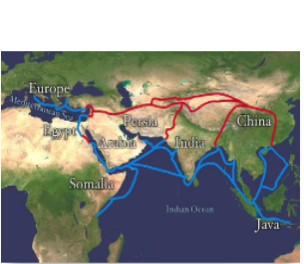
The public domain map in green, blue, and tan shades depicts the Silk Road Route that ran from China through India and Persia and into Europe,, as well as a more southerly route that encompassed modern-day Malaysia and Singapore, the coast along the Indian Ocean, and eastern Africa up to Europe via the Red Sea.
Map of the Silk Road Routes (Public Domain)

Formally established during the Han Dynasty of China, the Silk Road was a vast network of trade routes that was the lifeline of commerce from 130 BCE – 1453 CE. Many different branches comprised this road connecting China, India, and Persia, with Persia being a gateway further into Europe. The main route of the Silk Road was established much before the Han dynasty; known as the Persian Royal Road during the Achaemenid Empire, it connected north Persia (modern-day Iran) to Asia Minor (modern-day Turkey). The Persian Road was maintained with a system of postal stations and gradually expanded into the Indian sub-continent across Mesopotamia and into Egypt.  

Howard County Library System and the Walters Art Museum present a fascinating class that looks at works from the Walters Art Museum that illuminate the expansive story of the Silk Road. 

May 17 from 12 – 1 pm. Register here.  

A manuscript page with Arabic script at the top, featuring a shade tree, bamboo, and a man in a turban studying with writing tools surrounding him. A smaller figure kneels in the bottom right hand cornder.

The term “Silk Road” wasn’t coined until 1877, when German geographer and historian Ferdinand von Richthofen first used it to describe the trade routes. Historians now prefer the term “Silk Routes,” which more accurately reflects the fact that there was more than one thoroughfare. 

Many different goods including gunpowder, precious stones, and ivory were traded along this route; however, it was the exotic silk that gave its name to this road. Many of the goods traded across this route had a great impact on the cultural development of the world. Paper and gunpowder, both developed in China, and the rich spices from India contributed to both European culture and warfare. Similarly, techniques for making glass migrated eastward to China from the Islamic world. However, silk continued to be the most sought-after and expensive commodity, especially in Rome. The Byzantine emperor Justinian (327-565 CE) sent emissaries to steal the closely guarded secret of silk and bring it back to initiate the Byzantine silk industry. In 1453 CE, the Byzantine Empire fell to the Ottoman Empire which closed the Silk Road and cut ties with the west.  

The legacy of the Silk Road is the impact on art, religion, technology, science, and language that fostered a growth and enrichment of world civilization. Unfortunately, disease also traveled along and the bubonic plague of 542 CE was thought to have spread to Constantinople via the Silk Road. Famous Italian explorer Marco Polo traveled overland on the Silk Road to the Mongol Empire ruled by Kublai Khan in 1275 and wrote the epic The Travels of Marco Polo (also available as an eBook from Libby/OverDrive). 

The closing of the Silk Road in 1453 forced traders to explore sea routes and discover new ports. This was the beginning of the Age of Discovery which led to a new era with the rise of seafaring nations. Join us for the class with a docent from The Walters Art Museum to learn more.

The Farewell

Movie poster image of 8 multigenerational family members, 3 sitting on the couch, 5 standing behind the couch. The film title, "The Farewell" is noted as is a subheading, "Based on an Actual Lie." The seal for 2019 Sundance Film Festival official selection is displayed.

Review by Cherise T.

Continents apart, but only a cell phone call away, Billi, a New Yorker, and Nai Nai, her paternal grandmother in China, enjoy a close relationship. As The Farewell begins, we fall into the humor, complexities, and challenges of cross-cultural families. Viewing the film from the perspective of Billi, played by the versatile actor Awkwafina, we soon learn that Nai Nai has been diagnosed with terminal lung cancer. Most of the family believes traditional Chinese wisdom that it is best to allow a family member to live out her life unburdened by the knowledge she is about to die. Billi strongly disagrees. Little Nai Nai, the grandmother’s sister, has been Nai Nai’s caretaker and takes charge of covering the truth. Together, the family creates a contrived family celebration so that everyone may be together in China to secretly say goodbye to Nai Nai. 

The Farewell feels authentic because the screenwriter and director, Lulu Wang, has recreated a beautiful journey from the truths of her own life. Little Nai Nai is played by Lulu Wang’s real-life aunt. When the family visits their deceased grandfather’s grave, the scene is filmed at the actual gravesite. We recognize the roles played out in most families – the responsible son, the guilty son, the matriarch, the awkward cousin, the daughter-in-law, the granddaughter who has yet to bring a spouse and grandchild into the family.

I highly recommend the film for its emotional depth, at turns both sad and optimistic, excellent performances, and solid script. Please also consider listening to Lulu Wang telling her family’s story on This American Life, but save the “What You Don’t Know” podcast episode for later if you don’t want to know the film’s ending.

The film is rated PG and would be appreciated by viewers aged 13+. Watch as many as 10 films per month, including The Farewell, on kanopy, one of the HCLS streaming service subscriptions.

Cherise T. is an Adult Instructor and Research Specialist at the Central Branch. When not immersed in literary fiction, Cherise can be found singing along to musical theater soundtracks.