The Addams Family by Barry Sonnenfeld 

The image shows the Addams Family assembled before a full moon under a dark sky, in front of their home.

by Alex P.

The ooky, spooky Addams Family has charmed America for almost a hundred years in countless forms and adaptations, from Charles Addams’s original New Yorker comics to Tim Burton’s new TV series on Wednesday Addams. The 1991 film, though, has always struck me as the adaptation that captured the demented energy of the original comics the best. It’s the kind of delightful culmination of talent and influences that is truly lightning in a bottle.

The film is the directorial debut of Barry Sonnenfeld, but you’d never be able to tell from its bold camerawork, blocking, and mise-en-scène. (It must have helped that he was director of photography for the Coen Brothers’ first three films.) Before I saw the film, I assumed it must have come from the dynamic duo of director Tim Burton and Danny Elfman, but Sonnenfeld both channels their era-defining aesthetic influences and adds a faster pace and kookiness that are all his own. Every set in the film is so full of detail that the Addams mansion becomes its own character. The impossible layouts and mountains of cobweb and clutter allow it to feel like a live-action cartoon. 

Gomez’s brother, Fester, returns to the Addams Family after having suddenly disappeared decades earlier in the Bermuda Triangle. But Fester is not Fester: the reunion is a scheme cooked up by Addams’s lawyer as a way to repay loan shark Abigail Craven. Craven’s adopted son Gordon resembles Fester remarkably, so he’s sent into the mansion during a séance to access the eccentric family’s vast riches. The bulk of the action follows Fester as Gomez wants to reminisce about growing up together, while Fester tries his hardest to keep up with the Addams’ odd and morbid customs. 

Those customs are perfectly presented in the spirit of Charles Addams’s one-panel comics. The Addams Family lives a macabre mirror image of the traditional American household, captured in this earnest and glorious interpretation. The film has aged perfectly, thanks to the simplicity of the characters and costuming, the labyrinthine sets, and the practical effects for, for example, the disembodied hand, Thing. The cast is also a once-in-a-lifetime assemblage. The late Raul Julia leads as Gomez Addams, and his chemistry with Morticia (Anjelica Hudson) is indelible. The momentum of the film is carried by the glee the pair shares in the perverse and morbid, and Julia in particular thrills with expressive and kinetic energy. Christopher Lloyd is cast against body type as Fester Addams, and though his role is peripheral, the seven-foot-tall Carel Struycken plays a perfect Lurch.

The influence Charles Addams’s characters have had on American culture is monumental; it’s arguable that he created goth culture. Accordingly, every generation has had several adaptations competing to be their favorite. For me, though, Sonnenfeld’s celebration of these characters is the one that defines them and transcends its era. 

The Addams Family is available on DVD and for streaming through Kanopy

Alex Pyryt is a DIY Instructor & Research Specialist at HCLS Elkridge Branch. 

The Artist and the Astronaut

An image of the space station with Earth below

By Nancy T.

Sun, May 5 | 2 – 4:15 pm
Miller Branch
For adults.
Register here.

Spend an unforgettable afternoon at the Maryland premiere of the award-winning film, The Artist & The Astronaut. This cinematic journey delves into the remarkable love story between artist Pat Musick, a civil rights activist, and Apollo astronaut Jerry Carr.

Witness their captivating tale unfold against the backdrop of some of humanity’s most historic moments. Filled with never-before-seen footage of early space exploration and featuring interviews with key figures from that era, this film chronicles the vastly different paths of Pat and Jerry as they navigate uncertain times, ultimately coming together to render some of America’s most enduring art. The Artist & the Astronaut is a testament to the power of curiosity, perseverance, and empathy as agents of change and love.

After the screening, delve deeper into the film’s creation through a Q&A session with the writer and director, Bill Muench. Explore the compelling backstory behind the documentary’s creation, catalyzed by the encouragement of Bill’s wife. Her inspiration ignited his passion to embark on this remarkable endeavor.

Beginning from humble origins with no plan or budget, Bill Muench, a full-time teacher and basketball coach, undertook a six-year odyssey spanning nine states and two continents. His determination to share the untold story of a local Vermont couple led him to interview Apollo astronauts, their spouses, award-winning authors, artists, art historians, and even NASA directors of mission control.
With the collaboration of music legend Todd Hobin, they produced a story that might otherwise have remained untold. Join us as we uncover the extraordinary journey behind the lens, a testament to the power of determination, inspiration, and collaboration.

Interview with Director Bill Muench

How did you manage your time being a teacher and also filming?
Not very well… Ha ha. I never missed a day of school, even though I had to travel to many different states and even make a trip to England. I was really excited to share the process of documentary filmmaking with my students during my last six years of teaching high school.

What was your favorite part of filming/the whole process?
Getting to meet and interview amazing people who had lived fascinating lives—they inspired me to be a better filmmaker as I went on because they deserved to have their story captured in a professional way.

How did you come up with this idea? Did you have a connection with these people? What was your inspiration?
I went to Arkansas with my wife to celebrate Pat’s 90th birthday in 2016… I have been friends with Jerry, the astronaut, and Pat, the artist, since they moved to Manchester, VT in 2007… I knew many of their stories. When we got on the plane to come back to Vermont I said to my wife, “somebody should make a documentary about these two.” She said, “you should do it,” and that is how I got the inspiration to do the film.

Are you proud of how the documentary came out?
When I started working on the documentary, I did it for my own enjoyment—I never dreamed in a million years that it would win awards and I would be able to travel the country and screen the film. It is not about what I did but the stories that the film captures. This was the last interview for many of the participants of this film. I am especially proud of the musical score by Todd Hobin…83 different music drops — all of them original.

Nancy T. is an instructor and research specialist and the display coordinator at Miller Branch. When she’s not in the branch, you’ll find her in the swimming pool, sitting with her cat, or out walking in the fresh air.

Night Film by Marisha Pessl

A red toned cover with a fine circular pattern overlaid on a woman's profile, with the collar of her jacket turned up to frame a square jaw.

by Emily B.

I first read Night Film earlier this year over the course of a long weekend. Though the temperature was hot and the humidity almost unbearable, author Marisha Pessl transported me to a chilly October night in New York City with ease. Night Film is a perfect November book and is best enjoyed as the temperatures cool and the nights grow longer.  

The book opens with the mysterious death of Ashley Cordova, piano prodigy and daughter of infamous horror director Stanislas Cordova. Stanislas, who has a huge cult following, hasn’t been seen outside of his huge upstate New York estate in 30 years. 

Investigative journalist Scott McGrath has long been obsessed with Cordova and the mystique surrounding him and his films. He teams up with two unlikely sidekicks – a drifter and a wannabe actress – to uncover the truth behind Ashley’s death. Along the way, the three encounter a fair share of kooky and offbeat characters who offer insight into the case. 

Pessl peppers newspaper clippings, online forum posts, and other documents throughout the book, making you feel immersed in the investigation. This immersion is taken a step further with the bonus content available on Pessl’s Night Film Decoder website, which includes even more mixed media sources, like video and audio recordings.  

On top of all this, it’s clear that Pessl took her time devising Stanislas Cordova’s filmography. The details included about some of the fictional films are so illustrative and specific – down to the blocking or costumes in his most iconic movies’ scenes. All the descriptiveness surrounding the fictional films culminates in a jaw-dropping sequence about two-thirds through the novel. A sequence that I still find myself thinking about, nearly five months after reading the book.

Night Film is an engrossing, unputdownable read perfect for fans of horror and mystery. It’s a book whose atmosphere and characters stay with you for a long time. 

You can request a physical copy here or check out the e-book and e-audiobook versions on Libby/Overdrive.  

Emily is an Instructor & Research Specialist at the Central Branch. She enjoys puzzling, reading, listening to music, and re-watching old seasons of Survivor. 

Spooky Kanopy Picks

by Emily B.

Did you know you can use your library card to watch eight movies every month on Kanopy? Here are some spooky films to check out this October.

The image depicts a woman on pointe shoes in profile with her arms raised above her head and her head thrown back. The red of her dress runs down her legs and shoes and onto the ground, puddling as if it is blood.

Suspiria (1977) 

An American ballet student discovers that sinister things are afoot at a prestigious German dance academy. The film is regarded as one of the most influential horror films, with its striking visuals and haunting soundtrack.  

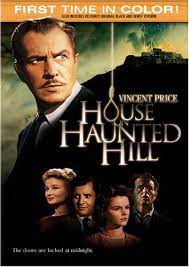
The image depicts a house on a distant hill against the backdrop of a cloudy sky. In the foreground are two men and two women and, superimposed above them, another man looking to the side with a slightly shocked expression and an eyebrow raised. The title of the film has a noose for the "o" in the word "House."

House on Haunted Hill (1959) 

An eccentric millionaire invites five strangers to a party at a haunted house, offering $10,000 to whomever survives the night. Partially inspired by Shirley Jackson’s The Haunting of Hill House, this film has solidified itself as a campy horror classic.  

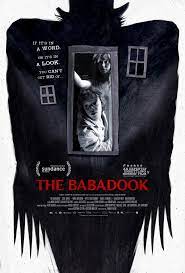
The movie poster depicts a silhouette of the Babadook surrounding an open door and two windows, as if the Babadook is the house containing them. Viewed through the open door are two children, one perched above the other, both looking out as if into the dark.

The Babadook (2014) 

A widow struggles to raise her young son, who is convinced that a character from a pop-up book is real and lurking around their home. 

The movie cover depicts a train in the background, with smoke and fire as if there has been an accident. In the foreground are several people fleeing the carnage, including a man carrying a young child whose face looks back a the train.

Train to Busan (2016) 

A man and his daughter attempt to survive a rapidly-spreading zombie infection that breaks out while they are on the train. This record-breaking Korean film will soon undergo an American remake. 

The movie cover depicts half of a woman's face from the neck up; she wears a coronet of flowers and greenery and appears frightened or distressed.

Midsommar (2019) 

A woman accompanies her boyfriend and his friends on a trip to Sweden for a midsummer festival and chaos ensues. Don’t let the beautiful setting and cheery color palate of the film deceive you – Midsommar is one of the most disturbing horror films I’ve ever seen.

The movie cover image depicts two children standing at the end of a hallway flooded with water. There are doors to their left and high windows to their right all along the sides of the hall. One child looks straight at the camera; the other is looking down and wears a facial-obscuring hoodie.

Dark Water (2002) 

A woman, in the midst of divorce negotiations, moves to a run-down apartment with her young daughter. A mysterious ceiling leak and ghostly appearances ensue. In 2005, an American remake of this Japanese film starring Jennifer Connelly was released.

You can borrow Midsommar, Dark Water, Train to Busan, The Babadook, and House on Haunted Hill on DVD, too.

Emily is an Instructor & Research Specialist at the Central Branch. She enjoys reading, listening to music, and re-watching old seasons of Survivor.

Voulez-vous voir un film ce soir?

The image says "How to use Mango Premiere: film-based language learning," with the Mango logo, an "M" comprised of multicolored squares and triangles in patterns red, blue, yellow, green, black, and white.

By Holly L.

Are you interested in learning French, or another language, but find traditional tutorials tedious?  

Consider Mango Premiere, an online language learning system that offers instruction through film for select languages. While enjoying a movie you can familiarize yourself with your chosen language by studying the dialogue while also focusing on grammar, vocabulary, phrases, and culture.

Customize your learning experience by viewing the film in “Movie mode,” in which you can view the movie with your choice of subtitles (English, the language you are learning, or both at the same time).

The still photograph from the film Around a Small Mountain is labeled "Scene Introduction" and depicts a man and woman standing next to a small convertible on a sunny street. The captions read, in French, "L'homme revient, et Kate l'invite á son spectacle de cirque ce soir-là gratuitement." This is followed by the English translation: "The man returns, and Kate invites him to her circus show that evening for free."s

Choose “Engage mode” for an in-depth scene exploration. In this mode, you begin with a Scene Introduction, an overview of what to expect in the coming scene. Next, you have the option of scrolling through Words You May Encounter and Cultural Notes. After viewing the scene you may click on to a Followup, a detailed breakdown of the scene with grammar and cultural notes. The subtitles are enhanced by phonetic pop-ups and Mango’s semantic color mapping, which demonstrates connections between the learner’s target and native language.

The illustration shows two translations from English to French: "I speak French very well" is translated to "Je, parle très bien français," and "Oh, good morning" is translated to "Tiens, bonjour." Each word is in a different color with a block underneath indicating Mango’s semantic color mapping, which demonstrates connections between the learner’s target and native language.
A visualization of Mango’s semantic color mapping.

While exploring the features of Mango Premiere, I watched Around a Small Mountain (or 36 vues du Pic Saint Loup), a 2009 French drama by director Jacques Rivette (one of the founders of the French New Wave) featuring Jane Birkin and Sergio Castellitto. With a cast of characters whose lives revolve around a travelling circus, the film is very dialogue-driven and I felt that the Engage Mode features helped me achieve a more nuanced understanding of the story.

There are more than 70 languages you can learn on Mango, with movies currently available for the following languages: 

English (for Spanish speakers) 

French 

Spanish (Latin America) 

Italian 

Chinese (Mandarin) 

German 

Hopefully Mango will expand its Premiere services to include films in more languages. I for one may be more motivated to brush up on my Korean language skills if I can do so while watching a fun K-drama

Access Mango and Mango Premiere for free with your HCLS library card.

Holly is an Instructor and Research Specialist at the Miller Branch. She enjoys knitting, preferably with a strong cup of tea and Downton Abbey in the queue.

Native American Heritage Month: Beauty and Sadness

The book cover depicts two feathers facing in opposite directions, sketched in brown ink against a bright orange background, with the title in yellow lettering.

By Eric L.

Native American Heritage Month is almost finished for this year, but you are free to let it go a little longer into December and check out some great related works of art from the library, including the distinguished debut novel by Cheyenne and Arapaho writer Tommy Orange and a modern classic from director Terrence Malick.

There There by Tommy Orange (available in a variety of formats) is not a traditional novel, in that many of the characters don’t interact with one another, nor is it a traditional collection of short stories. Each chapter is a deep character profile explicated from the character’s perspective and written in a small amount of space. There There is beautifully crafted, in my humble opinion, with these very short, somewhat disconnected chapters from a variety of characters’ points of view not being an easy way to tell a story. However, it works really well and I recommend reading it. 

The characters are Native American, or part, in ancestry. Although the larger narrative is about the experience of individual characters, the connecting plot device is an upcoming powwow at the Oakland Coliseum. Some plan to attend, some plan to dance in the ceremony, some are organizing it, others are working on grant-funded projects related to Native Americans, and some plan to rob it. 

I could broadly say that the book talks about identity, or the loss of identity and the confusion experienced by some urban Native Americans. I recall a friend telling me that There There is sad, and to be sure, it is; however, the stories are powerful, engaging, and beautifully written. In other words, it’s not a feel-good read, and it’s tough sometimes. 

Most of the younger characters feel confused and/or apathetic about being Native American in modern America. They’ve not lived, or their parents did not live, on the “rez,” as they call it. I think what makes this a great book is that it doesn’t so much concern the facts of the past, but rather their impact on the present. This is a very interesting and apropos topic in America right now, as some say we need to forget the past and move forward. I’d contend this may be easier for some than others. And perhaps a better understanding of how the past effects the present could benefit all of us. Prior to one part of the book Orange uses the profound James Baldwin quote, “People are trapped in history and history is trapped in them.” 

I did learn some things about modern Native American history – for example, the red power movement and the occupation of Alcatraz Island. The occupation is an interesting moment in the recent past, and illustrative of Orange’s larger commentary about people’s place within America. 

One character has an interaction with a woman on public transportation in Oakland while he is in full dancing regalia on his way to the powwow. She asks him some innocuous polite questions, and he responds in part that he is going to a powwow at the Oakland Coliseum and that she should come check it out. He thinks to himself that she can now tell the story later over dinner about how she saw and spoke with a real Indian on the train today, and that that is as close as most Americans would like to get. 

Margaret Atwood called it “an astonishing debut.” And until I read this praise, I was not aware it was a debut, because it’s that good. I concur with Atwood’s opinion, and it makes me excited for his future books. 

This work brought to mind the film The New World on Kanopy, which if There There concerns the now, then the movie depicts colonial America and indigenous people. I’m a fan of the director Terrence Malick’s films. He makes impressionistic films, and although this may sound pretentious, simply put, it contains beautiful cinematography (mostly nature shots) and sparse dialogue. The Thin Red Line and The Tree of Life, Malick’s popular and award-winning films starring Sean Penn and a bevy of other great actors, are also great (you can borrow these in DVD format). 

The New World concerns the arrival of the English and the settlement of the colony in Jamestown, Virginia. The cast features terrific actors (Colin Farrell, Christian Bale, Q’orianka Kilcher, and Christopher Plummer). It was filmed in Virginia, and Malick employed academics to recreate the villages and the extinct Powhatan language and used native actors. The film is partially based on John Smith’s account of Pocahantas, the verity of which is a bit suspect. Nevertheless, it succeeds in depicting very different groups with clashing motivations, and it’s visually stunning. 

In sum, both these works are beautiful AND sad.

Eric is a DIY Instructor and Research Specialist at the Elkridge branch. He enjoys reading, films, music, doing nearly anything outside, and people.


Authors and Stories For You and Me

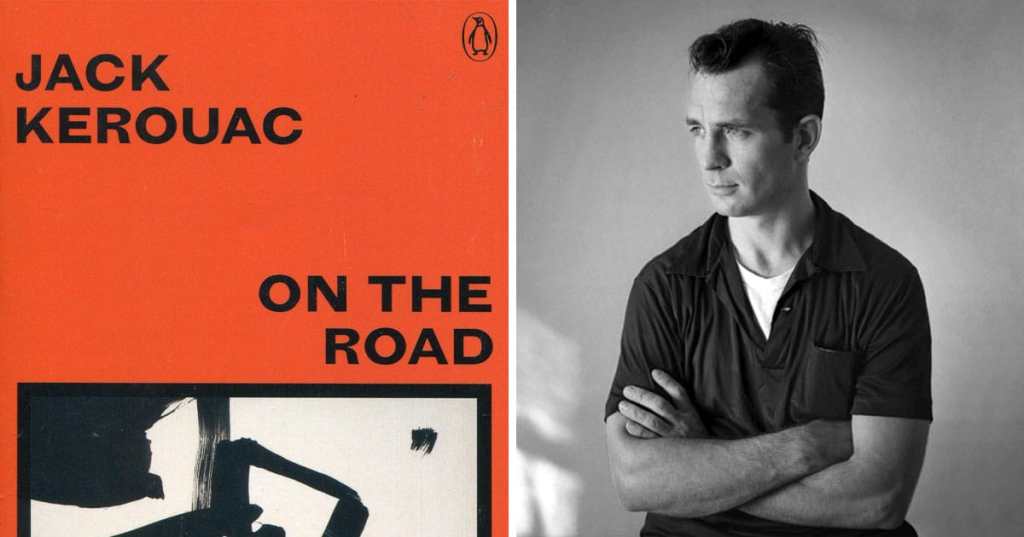
Orange cover of On The Road by Jack Kerouac on the left with a black and white photo of the author on the right with his arms crossed.

By Eric L.

I like books and authors a lot, and periodically I will get on a kick and start reading books by a particular person and then read about the person.  

Jean-Louis Lebris de “Jack” Kerouac has always been one of my favorites, and he was one to celebrate jazz and the outdoors. Kerouac is the person that in theory personifies the “beat generation,” the beatniks, and the counterculture of 1950s America that inspired so many in the 1960s counterculture (which could be argued led to the push for progress in America).  

As a white Catholic from a middle-class background with a deep interest in the counterculture, his work spoke to me. I could feel his guilt for not conforming and appreciate his conservative Catholic hang-ups. His conflicted mind, introspective nature, desire for freedom, and the understanding that he was in some ways the observer and documentarian of counterculture and not so much the progenitor attracted me. 

Revisiting his work over the years, it always changes as the world changes, and more importantly as I change. Thank goodness, I’ve always grown more! I have recently been reading books and articles about Kerouac, re-reading the The Dharma Bums (available in eAudiobook format from Libby/OverDrive) after seeing it quoted in two books I was recently reading. The quote in one was, “Someday I’ll find the right words, and they’ll be simple.” I like this sort of searching and desire for simplicity. 


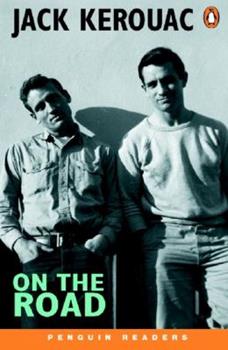
The book cover is a blank and white, bluish-tinted photograph of Jack Kerouac and fellow writer Neal Cassady.
Kerouac and fellow Beat Generation writer Neal Cassady, the inspiration for Dean Moriarty in On the Road.

I also re-watched the recent film adaptations of On the Road and Big Sur, both of which I’d recommend. The former HCLS owns in DVD format; the latter you can borrow using Interlibrary Loan. Some consider Big Sur one of his best novels. It’s the semi-autobiographical account his struggle with fame, depression, and addiction a decade after the publication of his most famous work, On the Road. The raw reality of addiction is sad to be sure, but it’s also a good read and viewing for the description and images of Big Sur. 

To be sure, there’s a lot not to like about Kerouac. The books and film adaptations are misogynistic, self-involved, and privileged in some respects. He drank himself to death at the age of 47, he never found the time know his own daughter, and had become truculent and seemingly illiberal near the end of his life. I could probably find some additional foibles. Conduct an internet search for his appearance on William F. Buckley’s Firing Line in the late 1960s; it’s pretty sad. 

For some reason, many of his contemporaries publicly and negatively commented on him, although John Updike later admitted he was jealous of his fame. James Baldwin described Kerouac’s work as “absolute nonsense, and offensive nonsense at that.” Charles Bukowski, another “beat” writer and poet who is controversial in many ways and the subject of several films, said Kerouac wasn’t that great of a writer, but suggested his fame came from the fact that he looked like a “rodeo star.”  

I’d disagree with Bukowski; there is some poetry in Kerouac’s prose and the performance aspect of it is amazing. Hearing and seeing him read his own work, which was inspired by jazz, is marvelous. His handsomeness certainly did not hurt his celebrity. I was reminded of his style while watching the young Amanda Gorman read and perform her great poem The Hill We Climb at the inauguration.

It was a pretty radical endeavor to hang out in a jazz club in the late 1940s, and I was curious what was so great about this thing called jazz. I now know. Moreover, books concerning his romantic relationships with African Americans and his close relationships with openly gay people were verboten at the very least, and illegal in many places in the US in the 1950s. Moreover, Kerouac’s attraction to and writings about Buddhism interested me very much as a fellow Catholic. 

Kerouac’s explicit mentions of Walt Whitman, Marcel Proust, and other authors piqued my curiosity about these people, and his books gave me a point of reference when reading James Baldwin’s perspective of a similar counterculture from the African American point of view. Really, his work just got me reading, dreaming, and thinking differently than I’d done before. In other words, I’d like to think I was better for it. And I’m fairly certain that these are the reasons why On the Road is still in our reading list section and assigned by English teachers.

I had this conversation with the members of my book group, and they assuaged my guilt a bit for still liking Kerouac. But the times they change, and we change, and maybe Kerouac would’ve changed, too, but maybe not. 

In some cases, there are things that should be left in the past, but I’d contend we shouldn’t dismiss the progressive nature of all art pell-mell. All of us are flawed in some way, and this makes us interesting in my opinion. Indubitably the merits of Kerouac’s work and his reputation are debatable. But Kerouac did reject the conforming ethos of post-war America (something many now want to return to). And personally, he made me feel as though others were attracted to things that don’t quite fit into mainstream American culture. 

My hope is that this bolsters the case for diverse stories, viewpoints, and authors. Everyone needs characters and stories they can relate to and find themselves in. I think it’s a magical feeling to realize there are people that are like you, that feel like you do. So keep reading to find relatable characters and stories. Come by the library and tell us about your interests. We might be able to help, or know someone who can, find the books and authors for you! 

Eric is a DIY Instructor and Research Specialist at HCLS Elkridge Branch. He enjoys reading, films, music, doing nearly anything outside, and people.