
A Message to Our Community from Howard County Library System on Recent Executive OrdersĀ 

You see two figures at the end of a long aisle of book shelves, in front of a window looking out at a summer's day with green trees and a blue sky.
Two men at Howard County Library System. East Columbia Branch

by Tonya Aikens, President & CEO

At Howard County Library System (HCLS), we firmly believe in the dignity of all humans, regardless of their immigration status, gender, race, economic status, religious or cultural background, political ideology, or other identifier. Our libraries are open to all people, no questions asked. 

Following the Executive Orders issued since January 20, many people have asked how they impact libraries. At HCLS, our vision, mission, and values remain unchanged. We continue to pursue a vision of an empowered community where all people reach their potential, and our mission remains as your place to learn, grow, and connect. Our organizational values of community, equity, intellectual freedom, learning, and teamwork serve as our foundation. We steadfastly affirm our unwavering commitment to supporting our community and maintaining the core values that guide our work.Ā Ā Ā 

Specifically, we wish to address three Executive Orders (EO) that impact libraries.  

The recission of EO 14084 (Promoting the Arts, the Humanities, and Museum and Library Services) will impact libraries and cultural institutions across the nation. In Howard County, we are fortunate to serve in a community that believes in and supports the educational and societal value libraries provide. While some library systems are almost exclusively federally funded, less than five percent of our budget is derived from the federal government.Ā Ā Ā 

Importantly, Maryland’s passing of the Freedom to Read Act in 2024 was an intentional act to safeguard the autonomy of libraries that receive state funding by prohibiting the censorship of books based on the author’s background, origin, or viewpoints, as well as partisan disapproval. The bill also ensures protection for school and public library staff who adhere to the state library standards outlined in the bill, shielding library workers from retaliation.  

Regarding EO 13993 (Revision of Civil Immigration Enforcement Policies and Priorities), libraries are unwavering in our commitment to your privacy. We provide resources and services to everyone who walks through our doors without regard to immigration status. At HCLS, it has always been our policy and practice to safeguard community member information. We developed specific guidance for all members of our staff reaffirming that HCLS does not provide community member information to law enforcement or immigration officers unless the request for information is accompanied by a court order or warrant signed by a judge. HCLS does not collect or track community member immigration information and therefore has no information to share. Please note that areas open to the public in our facilities are open to all and immigration officers may enter without a warrant. ICE agents may enter places open to the public, question people in public places, and conduct inquiries according to their statutory powers under 8 U.S. Code § 1357

Regarding EO 13988 (Preventing and Combating Discrimination on the Basis of Gender Identity or Sexual Orientation), the Fairness for All Marylanders Act of 2014 prohibits discrimination based on gender identity in public accommodations. This is interpreted to give transgender people the right to use the bathroom that aligns with their gender identity.  

While Federal policies may continue to change, our priorities remain the same: 

  • Our individuality and our unique gifts and talents make us stronger. At HCLS, our staff and community are encouraged and supported in showing up as their full selves.  
  • Libraries remain vital spaces for learning, collaboration, and connection. We are committed to preserving the resources, programs, and support systems that enable their success.  
  • Our role in the community as a trusted partner and advocate for equitable access is more critical than ever.  
  • We will continue to prioritize programs and initiatives that address the needs and aspirations of those we serve.  

Thank you for helping to ensure HCLS continues to be the place where all people may learn, grow, and connect.Ā 

Celebrating Dr. King

A photo of the top half of the Dr. Martin Luther King, Jr. memorial, taken against a bright blue sky. Dr. King is portrayed looking stern, with his arms crossed, holding rolled up papers.

by Brandon B.

On January 20, we honor the life and legacy of Dr. Martin Luther King, Jr., who made heroic efforts to end segregation and inequality despite tremendous adversity. Dr. King remains a significant figure of the Civil Rights Movement, who fought for peace, equity, and justice for all individuals until his tragic death on April 4, 1968. On November 2, 1983, Ronald Reagan signed legislation, setting the holiday for the third Monday in January. Through peaceful protests, such as the March on Washington, the Montgomery Bus Boycott, and the founding of the NAACP, minorities claimed their rights and privileges as outlined in the United States Constitution.

HCLS offers numerous books, videos, and online resources on the history of the Civil Rights Movement. The 2015 film Selma illustrates how Dr. King, John Lewis, and others led sit-ins and marched across Alabama and throughout the South, fighting for the right to vote. When you visit the Equity Resource Center at HCLS Central Branch, browse for books, CDs, and DVDs that highlight diversity and inclusion.

Martin Luther King, Jr. Day is an opportunity to reflect on Dr. King’s legacy and to serve your community. Consider your favorite community organizations and see what they have planned for the national day of service. If you need suggestions, take a look at local nonprofit organizations, such as the Boys and Girls Club, Meals on Wheels, The Bea Gaddy Family Centers Inc., and in your community.
In the words of Dr. Martin Luther King, “The ultimate measure of a man is not where he stands at times of convenience but where he stands at times of challenge and controversy.” Let us continue Dr. King’s legacy by doing our part to make this world better and allow HCLS to help guide us through the process.

Brandon is a Customer Service Specialist at HCLS Central Branch who loves reading, football, and taking nice long walks around his neighborhood.

I Am Not Your Negro

Review by Eric L.

The title itself should take you back to a time and parlance that we, as a country of ā€œfreeā€ citizens, should have moved past long ago. Sadly, we have not. 

I amĀ NotĀ YourĀ NegroĀ is a great introduction to James Baldwin. Filmmaker Raoul PeckĀ worked on the project forĀ nearlyĀ a decadeĀ (a recent article by Peck in TheĀ Atlantic entitledĀ James Baldwin Was Right All AlongĀ is a great primer).Ā The film offers aĀ potentĀ collage ofĀ civil rights era footage, recent Black Lives MatterĀ protests,Ā interviews,Ā and debates that feature Baldwin speaking (captivating),Ā as well as the narration of excerpts from an incomplete manuscript read by actor Samuel L. Jackson, tentatively entitledĀ Remember This House.Ā Ā 

The 1979 manuscript concerns Baldwin’s reluctant return to America after a long sojourn in France. The nonfiction piece, a pensive essay on racism in America, details his relationship with, and observations of, Medgar Evers, Martin Luther King Jr., and Malcolm X. Baldwin refers to himself as a ā€œwitnessā€ of these three titans of the civil rights movement, all murdered before the age of 40. Baldwin explicitly states that he’s not missing his native land; the impetus for his return seems out of a sense of guilt that America’s serious racial divide is an abstraction to him while living abroad.  

Baldwin succinctly states that ā€œsegregation equals apathy and ignorance,” as they are forces very difficult to overcome. His assessment of Americans’ sense of reality and the reasons for it should give us all something to contemplate. I love good writing, and Baldwin’s prose is beautiful. I believe this is why some have compared his essays to those of George Orwell (I encourage you to read his essays, too. I’m a huge fan). I would describe both as moral or political artists, and perhaps I appreciate their contemplative tone.

As a side note, Baldwin’s fictional  Another Country, included in PBS’s the Great American Read, made for a great discussion in my book group. The narrative deftly examines race, gender, sexual orientation, social class, power, and anger. The nonfiction title The Fire Next Time is comprised of two essays, one a letter Baldwin wrote to his nephew. I find them both beautifully written and compelling.  

Perhaps it’s a positive sign that the aforementioned materials are currently in high demand and hard to borrow, both in print and digitally, so just start by streaming the film on Kanopy. It is well worth your time! 

It some ways it seems odd that someone like me is writing this piece. If you met me you’d quickly realize that I’m close to the apex of privilege in America for a variety of reasons. I’m well aware of this fact, though I wasn’t always. I’d proffer that sometimes single words such as ā€œprivilegeā€ become overused, politicized, and more importantly, lose their intent. This is precisely why we should all contemplate our world, and art is an engaging way to do so. 

Eric is a DIY Instructor and Research Specialist at the Elkridge branch. He enjoys reading, films, music, doing nearly anything outside, and people.

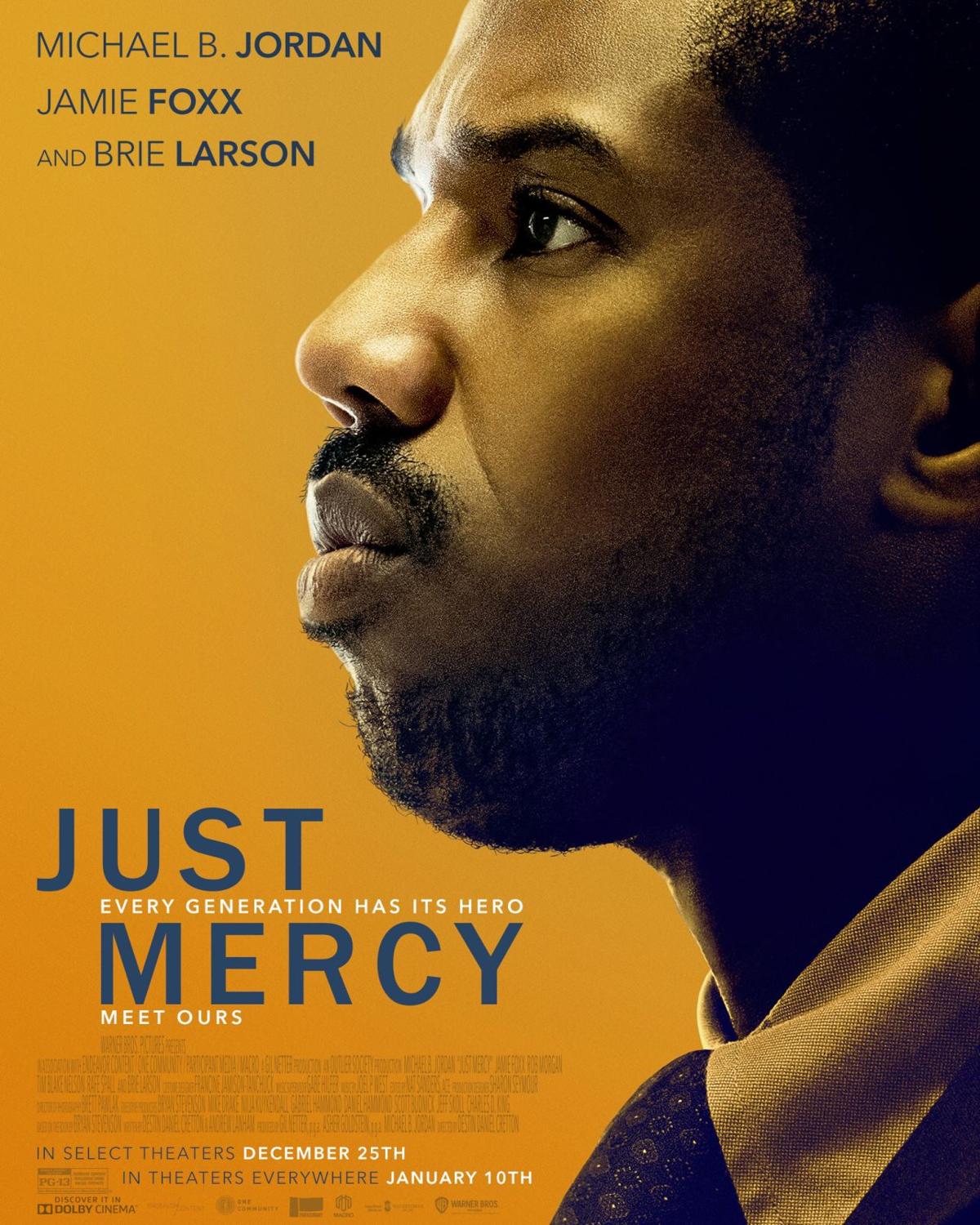
Just Mercy

Michael B Jordan stands tall in a gray suit and blue shirt and tie, looking off into the distance.  Behind him, in muted yellow are scenes from the movie. Just Mercy is written in white, along with names of actors, Michael B Jordan, Jamie Foxx, and Brie Larson

Let me be clear… Just Mercy is a hard and emotionally draining movie to watch. And it needs to be seen. This film tells the true story of a civil-rights attorney, Bryan Stevenson (Michael B Jordan), who works to defend wrongfully convicted death-row inmate Walter McMillian (Jamie Foxx).

In this deeply affecting movie, the repressed and palpable fury that Bryan Stevenson feels sits uneasy with me. Jordan portrays the complexities of emotion in a stirring and emotive way. Stevenson conducts himself professionally at all times, even when the behavior he endures made me want to scream.  My indignation and anger at Stevenson’s mistreatment pales in comparison to the outrage at the injustices that are perpetrated against his clients. This film is honest and frank about sharp truths, and it had an impact on me.

In the United States, we proclaim, ā€œLiberty and justice for all,ā€ but this movie shines light on the harsh reality of systemic injustice. Our system is broken: for every nine people executed by the state since 1973, one person has been exonerated and released. It is an untenable rate of error. I felt uncomfortable after watching this movie and investigating further. However, I think it is important not to shy away from that response.

Sit in that discomfort.

Ask hard questions.

Have the conversations.

Advocate for change.

ā€œAlways do the right thing, even when the right thing is the hard thing.ā€

– Bryan Stevenson

Bryan Stevenson’s book, Just Mercy: A Story of Justice and Redemption, is available as an eBook and eAudiobook on CloudLibrary and OverdriveJust Mercy (Adapted for Young Adults) is also available on eAudiobook on Overdrive.

During the month of June, Warner Bros. has made Just Mercy free to watch through a variety of digital movie services in the US, including Amazon Prime Video, Apple TVFandangoNowGoogle PlayMicrosoft, the PlayStation Store, RedboxVudu,  and YouTube.

Just Mercy is rated PG-13 for thematic content including some racial epithets.

Click here to learn more about Bryan Stevenson’s work with the Equal Justice Initiative.

Kimberly is a DIY Instructor and Research Specialist at HCLS Elkridge Branch.  She enjoys reading, photography, crafting, and baking.