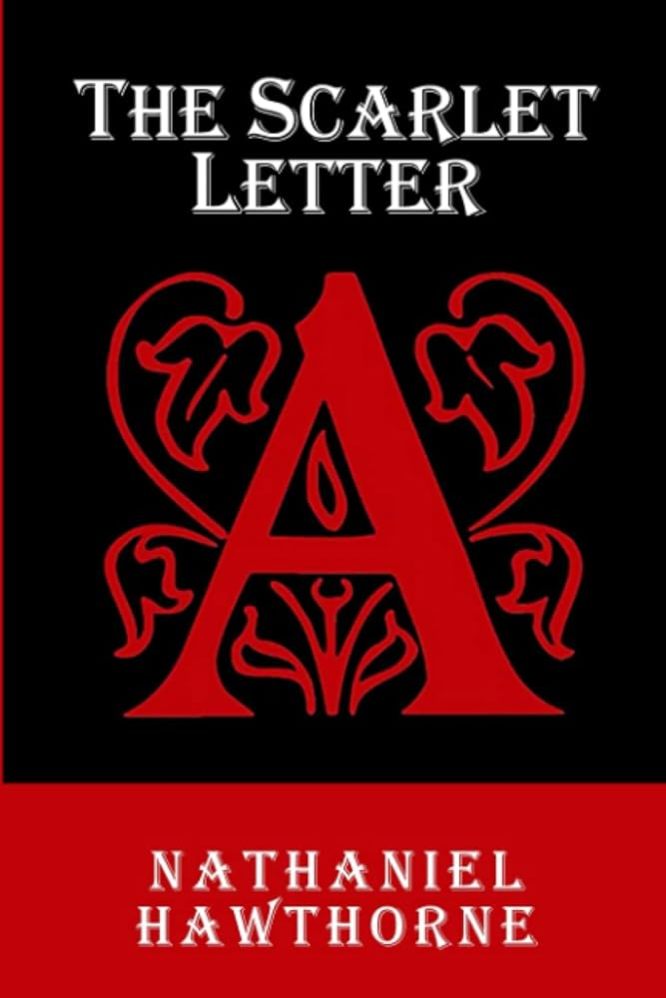
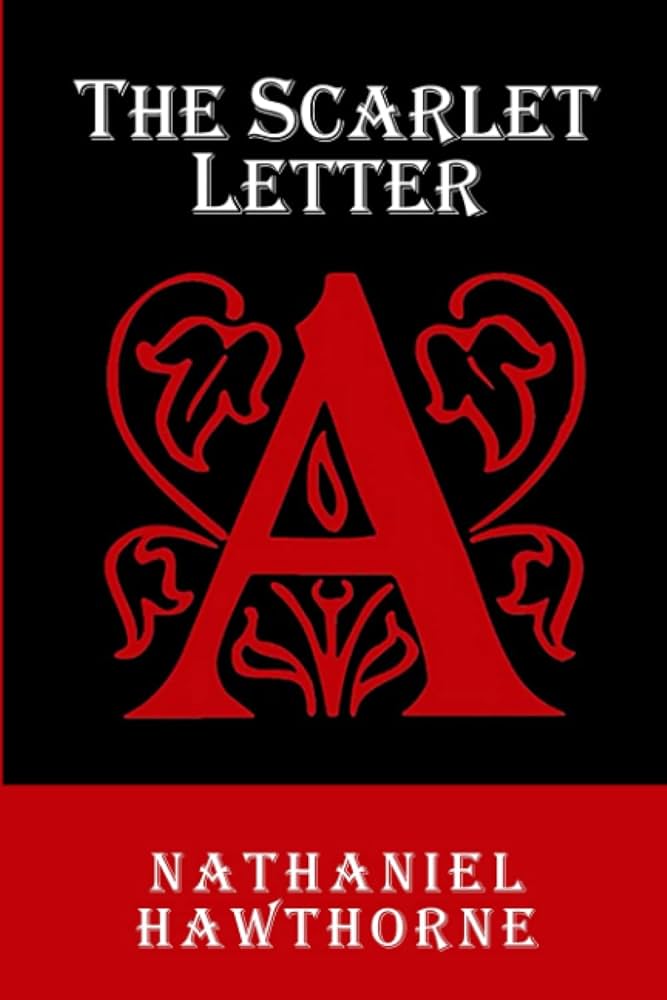
The Scarlet Letter by Nathaniel Hawthorne

An ornate capital letter A in deep red against a black background sits beneath the title in white.

by Angie E.

The poet W.H. Auden once said, “a classic is a book that survives generations because it continues to speak to us in new ways.” Classics persist because they challenge, provoke, and resonate, especially when the world feels uncertain or unjust. Nathaniel Hawthorne’s The Scarlet Letter is one of my favorite books of all time. I can feel some of you wincing but before you scoff, I highly recommend you ignore the opening “Custom-House” chapter and go straight to the good stuff and then, maybe, you’ll see what I mean. 

Not only do I love it a bit more than most people probably would, but my love for it is directly related to my favorite Halloween memory from 1989 when I won third prize in a costume contest my sophomore year at college. Dressed as Hester Prynne with a long dark cloak with a bold red A smack dab in the middle, I kept getting mistaken for Alvin the Chipmunk so when I got to the microphone to clarify what my costume was I said “I’m Hester Prynne.” 

“Who?” Several people yelled out in the crowd. 

“Hester Prynne from The Scarlet Letter. Nathaniel Hawthorne? Puritan times?” 

No one in the audience appeared to have ever heard of any of it so I finally yelled, “I am with child and a woman of sin!” as I waved my baby bunny stuffed animal in the air. It seemed like everyone roared with laughter, most likely because I was painfully shy at the time and I went against type or maybe I just really could not shatter their Alvin the Chipmunk illusions and hopes. My other favorite book is Washington Square by Henry James. I agree with everything James once said of The Scarlet Letter: “It is beautiful, admirable, extraordinary; it has in the highest degree that merit which I have spoken of as the mark of Hawthorne’s best things—an indefinable purity and lightness of conception…One can often return to it.” 

I know The Scarlet Letter is not an easy sell, I really do. For many, the book is tangled up with high school English class, dense prose, and the frustrating ambiguity of Arthur Dimmesdale. It’s often shelved as a classic American novel, a historical piece, or even—bafflingly!—a romance.  I have never been able to see it that way, especially with its eerily Puritan version of #MeToo vibes. To call this story a romance is to fundamentally misunderstand its brutal, brilliant heart. This isn’t a tale of love triumphing over adversity. It’s a forensic examination of power: who has it, who wields it, and who is crushed by it.

Reading it today, in our world of public shaming and relentless scrutiny of women’s bodies and choices, Hester Prynne’s story feels less like a history lesson and more like a reflection. Margaret Atwood has acknowledged The Scarlet Letter as one of the texts she considered while writing The Handmaid’s Tale. In fact, she has acknowledged that her dystopia was built from historical precedents, not fantasy. Hester Prynne’s punishment for adultery and forced isolation echoes the way Atwood’s handmaids are reduced to reproductive vessels under a theocratic regime. 

The central injustice of Hawthorne’s novel has always taken my breath away. One person bears the visible, lifelong mark of their shared “sin,” while the other is celebrated, pitied, and ultimately forgiven for his private struggle. The community’s wrath is laser-focused on the woman, the visible proof of the transgression, while the system effortlessly protects the man. This is not a romance. This is a blueprint for how societal structures (legal, religious and social) are designed to punish women disproportionately. This is where Hester’s story becomes so starkly modern. We may not brand women with a literal scarlet letter anymore, but we have our own versions. 

Hester’s quiet, stubborn resilience is what makes her my hero. She doesn’t crumble under the weight of the ‘A’. She does something far more radical: she reclaims it. She takes the symbol meant to annihilate her and, through sheer force of character, transforms it. She becomes “Able.” She survives, she raises her daughter, she thinks for herself. She endures, not with passive acceptance, but with a powerful, silent defiance. She is not waiting for a man to save her. She is saving herself. 

That’s why I keep returning to this difficult, profound book. It’s not a comfortable read, but it is an essential one. It’s a reminder that the battles women fight over their own bodies and narratives are not new. They are ancient. It’s a testament to the incredible strength it takes to wear a label you didn’t choose and rewrite its meaning through your own grace and power. So, if you haven’t read The Scarlet Letter since you were assigned it in school, I urge you to pick it up again. Don’t read it looking for a love story. Read it looking for Hester. Read it for every woman who has ever been judged more harshly, held to a different standard, or forced to wear a scarlet letter of someone else’s making. 

You might just find, as I did, that it’s one of the most relatable books you’ll ever read. 

The Scarlet Letter by Nathaniel Hawthorne is available in print and large print, e-book and e-audiobook. There’s also audiobook on CD, Playaway and a manga adaptation.

Angie is an Instructor & Research Specialist at Central Branch and is a co-facilitator for Reads of Acceptance, HCLS’ first LGBTQ-focused book club. Her ideal day is reading in her cozy armchair, with her cat Henry next to her.

One Hundred Years of Solitude by Gabriel Garcia Marquez

The Illustrated cover in many shades of green with a yellow snake and a purple bird evokes the tropical setting of the book.

by Kristen B.

My book club (Books on Tap) left for our August summer break on something of an odd note. At a previous meeting, we had a discussion about adapting books to TV shows and movies. I had recently read glowing reviews of the Netflix adaption of One Hundred Years of Solitude, and I proposed reading the Latin American classic. Everyone agreed that it had been awhile since we tackled something, perhaps, weightier, and – per usual for this great group of people – they were game to try.

I had read and loved this book in college, when I was in the practice of reading complicated, challenging material. While I still enjoyed the book this time around, I definitely found it more difficult to read decades later. The full immersion into the Buendia family and the village of Macondo remained the same, enchantingly so. Gabriel Garcia Marquez is credited with inventing modern magical realism, where the odd and inexplicable are part of every day life.

The family was trickier this time around, with the generations sharing names and attributes. I – and my book club folks – got too caught up in trying to keep everyone straight. In talking about it, though, we realized that’s one of the joys of this inter-generational story. It’s as though your grandma or some other older relative is telling you the family history, with asides and doubling back and other random diversions before actually getting to the point. It’s not really necessary that you keep the Aurelianos, Jose Arcadios, and Ursulas straight because the novel moves in circular patterns more than as a linear “and then” plot. We were less thrilled with a rather dated assumption that the patriarchy meant that men could marry whomever they pleased, even barely adolescent girls and despite mistresses.

The particular smaller stories, though, share in all of humanity’s troubles and joys, often humorously so – the insomnia plague, the visiting gypsies who bring the miracles of magnets and ice to Macondo, the coming of the railroad and banana company, the feuds, and the love affairs. All of it mixed into a sort of memory soup filled with revolution, politics, and the destructive nature of colonialism and classism. It’s been called the Great Novel of the Americas, and I would agree with that assessment. There’s something quintessentially Latin American about the story, and absolutely universal about the way it is told. I was reminded of the spider from my family’s camping trip with Scouts that gets a little bit bigger every time the story is recounted, or the number of pies my grandmother would bake during the summer, or any other number of embellishments to tried-and-true chestnuts of familial tales.

If, however, the book doesn’t suit your current reading tastes – as many people found at book club – Netflix recently released the first half of an almost perfect adaptation of the book, with the second season coming soon, hopefully in 2026. Being able to see Macondo and its inhabitants helps keep it all straight, without losing any of the wonder or weirdness of the book. The voiceover of descriptions and commentary are taken directly from the original text, and it’s a perfect way to meld the classic novel with the new medium. The cast does a perfect job of inhabiting the characters and their often exasperated relationships. While the show’s original language is Spanish, the dubbing was not distracting. It’s also a rather frankly spicy (would be R-rated) depiction of various lovers and marriages. I hope it becomes available on DVD or via Kanopy soon, as it’s the perfect complement to the book.

Re-examining classics is always worthwhile to me, because the books may not change but we do as readers. I had memories of enjoying One Hundred of Solitude but couldn’t remember why. The town of Macondo, isolated in the jungle, and the Buendia family once again live in my imagination, and I am glad for it – if for different reasons than when I was in college.

One Hundred Years of Solitude by Gabriel Garcia Marquez is available in translation to English in print and as an e-audiobook. It is also available in Spanish.

Kristen B. is a devoted bookworm lucky enough to work as the graphic designer for HCLS. She likes to read, stitch, dance, and watch baseball (but not all at the same time).

The Beautiful and Damned by F. Scott Fitzgerald

An illustrative cover shows people dressed in formal evening clothing looking over a harbor full of boats.

by Angie E.

As The Great Gatsby celebrates its 100th anniversary, I cannot help but think of how I much prefer Fitzgerald’s The Beautiful and Damned. Anthony Patch, a Harvard-educated layabout with vague literary aspirations, lives off his expected inheritance from his wealthy grandfather. He falls in love with Gloria Gilbert, a dazzling, self-absorbed socialite whose beauty is everything. They marry, expecting a life of ease, but as the years stretch on and Anthony’s grandfather withholds his fortune, their glittering existence falls apart. 

The relationship between Anthony and Gloria Patch is troubled, a slow, mutual unraveling. Their love, filled with glamour, indulgence, and lofty dreams, gradually turns toxic, dragging both of them into emotional and moral decay. The novel explores how two people, when consumed by vanity and selfishness, can end up feeding each other’s worst impulses rather than lifting each other up. They drift through parties, affairs, and petty resentments, their youth and charm wearing away alongside their bank account. Anthony descends into alcoholism and bitterness; Gloria clings to her fading looks. When Anthony finally wins his inheritance through a legal battle, he is a broken man, physically and spiritually ruined. 

Maybe I’m wrong, but I see The Beautiful and Damned as something messier and more personal than The Great Gatsby. At 27, I saw Anthony and Gloria as victims of love gone wrong. At 55, I see them as victims of something much less romantic and whimsical: the delusion that youth and beauty are infinite, that happiness is something you receive or deserve rather than create. When I first read The Beautiful and Damned in the late 90s, on a rainy cozy Sunday (I remember this vividly, somehow), I fixated on the tragedy of what I saw as dramatic love and loss. Despite my not liking either character, I somehow still felt sad. Now, though I still love the writing and the gripping tale itself, Anthony and Gloria, both bright, attractive, and full of possibility, strike me as people who wait for life to happen to them, assuming wealth and happiness are entitlements rather than pursuits. 

Revisiting this novel decades later, I realize Fitzgerald wasn’t just writing about the Jazz Age or the idle rich. He was writing about the human condition, about how easily we mistake privilege for purpose, charm for character, and time for something we can outrun.   

The Beautiful and Damned by F. Scott Fitzgerald is available in print and as an e-book and e-audiobook from Libby.

For more about The Great Gatsby, check out a previous blog post about the original and a variety of adaptations.

Angie is an Instructor & Research Specialist at Central Branch and is a co-facilitator for Reads of Acceptance, HCLS’ first LGBTQ-focused book club. Her ideal day is reading in her cozy armchair, with her cat Henry next to her.

The Great Gatsby: Revised and Reimagined

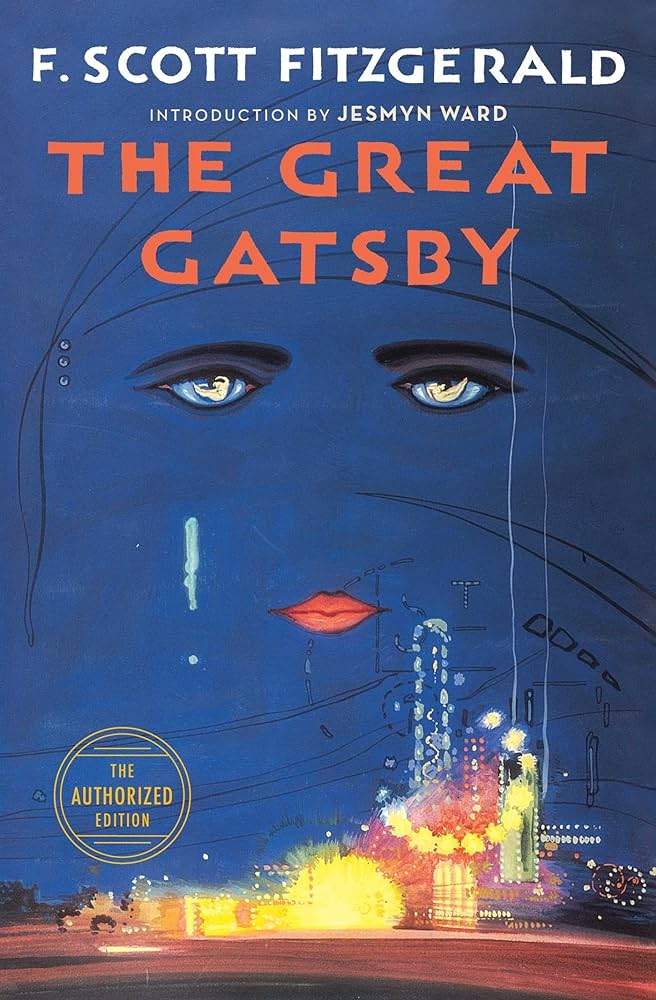
Deep blue cover has disembodied eyes and both above a lit up cityscape.

by Kristen B.

F. Scott Fitzgerald’s masterpiece, The Great Gatsby, has always struck me as a story about selfish people doing terrible things, in the service of nothing much at all. It’s one of the books that most of us first encounter as assigned reading in high school or college. However, I find myself returning to it and continuing to be fascinated, as well as a bit repulsed. The slim novel packs of a lot of punch and has proven itself worth revisiting and even re-imagining.

In high school, we were given the dark blue cover with a lit-up city-scape and disembodied eyes looming above it all (see above). It haunts me. The jazz age fable recounts a tale of obsession and excess, capturing the essence of the 1920s. It also plays with some quintessential idea of the American Dream, but one that’s gone a little seedy and unappealing at the edges. After all, everyone seemingly aspires to the life of the rich and famous, spending summers in East or West Egg, driving fast cars, and attending Gatsby’s extravagant parties along with the up and coming, dreadfully naive Nick Carraway. But (again, but), there’s a cost.

The story takes place during one hot summer in New York, fitting for seasonal reading. The pivotal scene happens when the exhausting weather drives the main characters, Gatsby and Nick, Daisy and Tom Buchanan, and Daisy’s friend Jordan Baker into the city, hoping for respite and entertainment at The Plaza. From there, all the carefully maintained charades and illusions come apart, leading to unresolved tragedy. The book ends with a deep yearning for what might have been, if only other choices had been possible.

An Asian woman's with a short bob, wearing black gloves and holding a cigarette, is posed among white leaves.

What brought me back to Gatsby recently was The Chosen and the Beautiful by Nghi Vo. She is one of my current favorite authors (see The Singing Hills novellas), who turned this well-known story on its axis. The retelling stars professional golfer Jordan Baker and her lifelong friendship with Daisy, as opposed to newly-minted businessman Nick Carraway and his bewilderment with Jay Gatsby. Plus, the subtle (and not-so) metaphors of Fitzgerald’s text became all too real with the inclusion of magical realism. They really do float about in white linen in the opening scenes. Tom Buchanan continues to provide the White, patriarchal establishment’s status quo against which all their boats beat back so fruitlessly, but he is even less appealing through the female gaze. While everyone is still privileged to the point of carelessness, the feminine emphasis makes the book slightly more sympathetic and tragic.

It’s still a good idea to have the original under your belt before enjoying the other variations. I recently (finally) watched the 2013 movie, starring Tobey Maguire and Leonardo DiCaprio in a Baz Luhrmann production. It certainly does the story justice, and in some ways conveys the outrageous excesses better than the book with all the lush visuals and big scenes. The text and the film complement each other well. As is true for most Luhrmann movies, the soundtrack was amazing.

If you’re looking to refresh your memory of the story, without perhaps reading the original, consider the graphic novel adaptation by K. Woodman-Maynard. It does a good job of mixing the bare bones of the story with some of Fitzgerald’s more luscious prose. The illustrations and the placement of the words within the images makes some of the more subtle, interpersonal nuances more obvious.

The Great Gatsby, the ultimate tale of reinvention and breath-taking chutzpah in the name of love and ambition, is one of the cultural touchstones of the American literary canon. It’s worth retelling, to reconsider what else it can convey to audiences almost a century after it was published. If you aren’t familiar with it, summer is a great time to devote some time to those books that you have always meant to read.

Kristen B. is a devoted bookworm lucky enough to work as the graphic designer for HCLS. She likes to read, stitch, dance, and watch baseball (but not all at the same time).

Try the The Grapes of Wrath 

An old fashioned pen and ink drawing shows loads trucks along a country road. The book cover appears as speckled, cotton rag paper that has yellowed with age. A coffee cup and pot sit beneath the title and author.

by Eric L.

I recently read, or perhaps re-read, The Grapes of Wrath. If I was assigned this masterwork in school, I skipped it or watched the film (which is also great). Either way, both were wasted on my young mind. The 15-year-old me could not have begun to empathize with these people. Not to mention we were probably still in the Reagan/Bush 1 era, and I feel this sort of thinking had gone out of vogue. No political statement intended; except for some small bumps, those were fairly prosperous economic times for many middle-class folks. 

I was assigned and recall avoiding Of Mice and Men, and I can’t even remember that film. I’ve also seen East of Eden, but only because James Dean was in it. That said, I’m familiar with John Steinbeck: his reputation and the themes he’s known for (California and its workers). Maybe a decade ago, I read Travels with Charley: In Search of America, the autobiographical story of his travels with his dog (Charley). It was quite good, and I recommend it.  

I digress. Coming in at just under 500 pages, with an overarching theme of extreme poverty to the point of starvation, The Grapes of Wrath is a masterwork of American literature. And it’s a story that is timeless, sadly. I read a lot of books, mostly good ones, but it’s easy to forget what it is to read a great book. Although you should be reading all sorts of books and anything that you like, not all books are great, I’m sorry to say. 

In broad strokes, this novel concerns humanism and details the need for a social safety net in America. However, I would not describe the book as a polemic because it’s subtle and it humanizes nearly all the characters who are constantly being dehumanized. The Grapes of Wrath was published in 1939 during the Great Depression, and it painstakingly details the problems people faced when fleeing the dust bowl. It tells the story of the Joad family, who leave Oklahoma after being forced off their land, as they go in search of work and a better life in California.

In many ways this seems like a common trope. The progression of technology changing the way people can meet their needs has certainly been written about again and again (although I’m a sucker for these sorts of stories). Steinbeck deftly illustrates the greed, self-preservation, and dehumanization of others that undergird the whole system. For example, the Joads do not think about traveling to California independently; instead, they are lured there by people looking to exploit their labor.  

One of the saddest aspects of the book is the Joads’ optimism. They obstinately believe that all they need is some work, which they’re more than willing to do. Their naiveté and failure to appreciate the omnipresent power imbalance in America is both admirable and maddening. However, Steinbeck illustrates this often as a criticism of the American ethos. Tom, the main character and oldest son, begins to realize, with the help of the Preacher turned humanist thinker, that the game is not as fair as they all believed. Tom’s rebellion throughout the book provides a counterpoint to the acceptance of less and less by starving people. 

The truly tragic part is the control the owners, banks, and corporations wield over society. For example, their ability to use the law to enforce their rules is despicable. They are terrorizing people who just want to eat and labeling anyone “red” who speaks for labor. 

My favorite part of the book, and the most impressive, is how Steinbeck intersperses the linear story of the Joads’ journey with vignettes about the time, the land, or the people in the abstract. The passages are amazing and can stand on their own. Steinbeck’s technique is strong and unique, and I can’t think of another book written quite like this (although I’m sure one probably exists). I wonder if Steinbeck’s intent is to break up the difficult and moving chapters with something beautifully written. The Grapes of Wrath has poetic moments, particularly when he portrays the kindness and generosity of poor people.  

The Grapes of Wrath is a tough book; by no means a feel-good read, but a plea to recognize our shared humanity. Perhaps it’s also a piece of propaganda for a labor movement and a social safety net. I think any reader would be hard pressed to be unmoved by this classic.

Available in many formats: print, large print, e-book, audiobook on CD, e-audiobook, and Playaway.

Eric is a DIY Instructor and Research Specialist at Elkridge Branch. He enjoys reading, films, music, doing nearly anything outside, and people.