Bob’s Burgers Movie

An animated family in poses with arms raised in excitement or fright is centered over the silhouette of a burger, all against a bright yellow background

by Angie E.

The Bob’s Burgers Movie throws the lovable and zany Belcher family onto the big screen with all the charm, chaos, and condiment-fueled comedy fans adore. Between Tina’s erotic friend-fiction fantasies, Gene’s musical ambitions (this time with a burger-themed rock opera, obviously), and Louise’s pink-ear-capped schemes, the Belchers are beefier than ever. Toss in a murder mystery, some off-key original songs, and the eternal struggle to pay rent, and you’ve got yourself a recipe for delicious dysfunction.

Whether you’re a long-time fan or a first-time fryer, this film is a celebration of awkward family love, small business spirit, and burger puns that never quit. It’s heartfelt, hilarious, and just weird enough to make you wonder if your food might burst into song. In a season five episode of Bob’s Burgers, Tina (the eldest of the Belcher children and one of the most lovelorn characters to ever appear in animation) is righteously upset when a friend of hers mentions the girl he likes is way “out of his league.” The scene takes place in a bowling alley (again, the smart writing!) and Tina yells, “Damn it, there are no leagues!” The intercom interrupts to call forth bowling leagues that are entered in a contest. Well, okay, Tina continues, there are bowling leagues, “but there should be no people leagues.”

Bob’s Burgers pulls me in like no other comedy. I absolutely want to live in BB’s world, I want to know all of the characters and walk down the streets of their town and visit their shops and their boardwalk. I want to go to karaoke with Linda, talk about life with Tina and get into hijinks with Louise and Gene. Never have I known a show to be both wholesome and provocative, to be sweet and subversive. Best of all, Bob’s Burgers holds on to  kindness, even in the middle of chaos. One of my favorite quotes from the show, from any show really, is this:

Maybe we all have a little bully inside of us. Maybe when we think people are being mean to us it can make us mean. But even if people are difficult we have to resist, we have to try to be nice. Maybe it will bring out the nice in other people.

HCLS owns the first season of Bob’s Burgers as well as the movie. For more seasons, consider using Interlibrary Loan Services.

And if you want to try your hand at some Bob’s Burgers-inspired cooking, you might want to check this out: The Bob’s Burgers Book: Real Recipes for Joke Burgers.

Angie is an Instructor & Research Specialist at Central Branch and is a co-facilitator for Reads of Acceptance, HCLS’ first LGBTQ-focused book club. Her ideal day is reading in her cozy armchair, with her cat Henry next to her.
Hundreds of Beavers

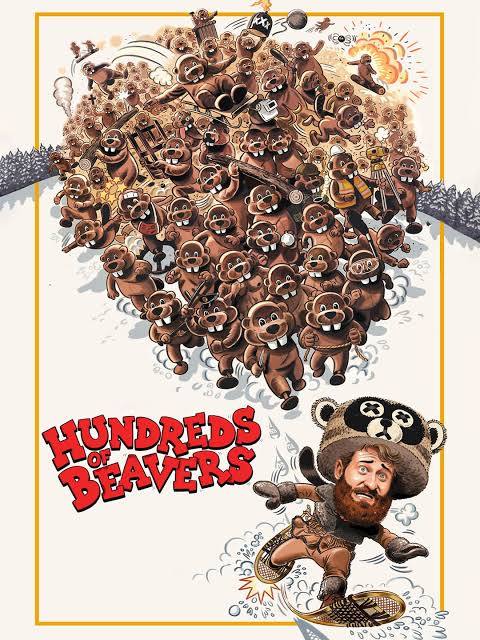
In a style reminiscent of National Lampoon or other madcap movies, the illustration shows a man dressed in a beaver costume fleeing a crowd of beavers. Text appears in red hand-drawn blocky letters.

by Alex P.

When Hundreds of Beavers got released to streaming services last year, it became one of the biggest success stories and most beloved films of the year, and for good reason. As a black-and-white slapstick comedy, awash in practical effects and Adobe After Effects 2D animation, completely devoid of dialogue and produced with only $150,000, it feels remarkably out of place in a cinema landscape dominated by CGI and character-driven dramas. But that very out-of-placeness is what makes its inventive qualities all the more precious. I feel that the poster, which IndieWire called one of the best of 2024, captures this perfectly. Its hand-drawn caricatures and bold red lettering are a direct throwback to the absurd comedies like It’s a Mad, Mad, Mad, Mad World and those by National Lampoon from the 60s and 70s, which make up just some of the film’s many influences. 

The influences are even wider than Hollywood comedies. The first act is a perfect translation of Looney Tunes cartoons to live-action film, before heavily incorporating video game logic in the second act. I particularly like how directly it translates the video game mechanics of survival games like Minecraft or Terraria into film action. We’ve seen a lot of video games adapted into films in the past decade, but they seem to flatten how the games work into standard Hollywood action. Seeing a movie that literally functions and presents itself like a video game as a framework for its action and plot is a bold innovation. Similarly fusing old and new influences, the slapstick feels equal parts Charlie Chaplin and early YouTube sketch comedy. 

Co-writer Ryland Tews stars as Jean Kayak, a 19th century applejack salesman turned fur trapper. The film’s action completely centers around his efforts to trap and kill cute critters (played by people in mascot suits) for sustenance and to trade their pelts for goods. The rigid logic about the tactics to trap each animal (beavers always fall for turds lacquered in castor oil, rabbits will go for anything that resembles a carrot) sets up most of the action as Jean discovers the logic of his world and his trade the hard way. The film’s best quality is the virtuosity with which it immerses you in recurring gags and wild internal logic that feel as well-scripted as a classical symphony. Again, thanks to the heavy use of video game logic, gags that would be throwaways in other movies recur again and again only to culminate in centerpieces where Jean uses everything he’s learned to set up giant, hilarious Rube Goldberg machines. 

In our age of digital proliferation, you’d think independent film would have flourished to a much greater extent than it has. Nearly everyone has a camera and powerful editing software sitting in their pockets. Instead, though, modern film has felt more suffocated than ever, as big studios insulate themselves from big risks by trying fewer crazy ideas and releasing fewer movies. In this era, then, it’s comforting and much needed to see a film made with no money whatsoever that looks amazing and oozes more creativity than most blockbusters and made more than six times its money back solely by word of mouth.  

You can watch Hundreds of Beavers on Kanopy with your library card and PIN. 

Alex Pyryt is a DIY Instructor & Research Specialist at HCLS Elkridge Branch.  

The Addams Family by Barry Sonnenfeld 

The image shows the Addams Family assembled before a full moon under a dark sky, in front of their home.

by Alex P.

The ooky, spooky Addams Family has charmed America for almost a hundred years in countless forms and adaptations, from Charles Addams’s original New Yorker comics to Tim Burton’s new TV series on Wednesday Addams. The 1991 film, though, has always struck me as the adaptation that captured the demented energy of the original comics the best. It’s the kind of delightful culmination of talent and influences that is truly lightning in a bottle.

The film is the directorial debut of Barry Sonnenfeld, but you’d never be able to tell from its bold camerawork, blocking, and mise-en-scène. (It must have helped that he was director of photography for the Coen Brothers’ first three films.) Before I saw the film, I assumed it must have come from the dynamic duo of director Tim Burton and Danny Elfman, but Sonnenfeld both channels their era-defining aesthetic influences and adds a faster pace and kookiness that are all his own. Every set in the film is so full of detail that the Addams mansion becomes its own character. The impossible layouts and mountains of cobweb and clutter allow it to feel like a live-action cartoon. 

Gomez’s brother, Fester, returns to the Addams Family after having suddenly disappeared decades earlier in the Bermuda Triangle. But Fester is not Fester: the reunion is a scheme cooked up by Addams’s lawyer as a way to repay loan shark Abigail Craven. Craven’s adopted son Gordon resembles Fester remarkably, so he’s sent into the mansion during a séance to access the eccentric family’s vast riches. The bulk of the action follows Fester as Gomez wants to reminisce about growing up together, while Fester tries his hardest to keep up with the Addams’ odd and morbid customs. 

Those customs are perfectly presented in the spirit of Charles Addams’s one-panel comics. The Addams Family lives a macabre mirror image of the traditional American household, captured in this earnest and glorious interpretation. The film has aged perfectly, thanks to the simplicity of the characters and costuming, the labyrinthine sets, and the practical effects for, for example, the disembodied hand, Thing. The cast is also a once-in-a-lifetime assemblage. The late Raul Julia leads as Gomez Addams, and his chemistry with Morticia (Anjelica Hudson) is indelible. The momentum of the film is carried by the glee the pair shares in the perverse and morbid, and Julia in particular thrills with expressive and kinetic energy. Christopher Lloyd is cast against body type as Fester Addams, and though his role is peripheral, the seven-foot-tall Carel Struycken plays a perfect Lurch.

The influence Charles Addams’s characters have had on American culture is monumental; it’s arguable that he created goth culture. Accordingly, every generation has had several adaptations competing to be their favorite. For me, though, Sonnenfeld’s celebration of these characters is the one that defines them and transcends its era. 

The Addams Family is available on DVD and for streaming through Kanopy

Alex Pyryt is a DIY Instructor & Research Specialist at HCLS Elkridge Branch. 

Favorite Movies Starring Frances McDormand

Frances McDormand in the movie Fargo, in a bomber style winter hat, sitting at the wheel of a car, looking side-eye to the right.
from Fargo

by Kristen B.

I love going to the movies, sitting in the dark with a tub of popcorn, having a communal moment with a bunch of strangers I will never talk to. I also enjoy watching at home, via DVD or a streaming service, with a big bowl of popcorn (a theme!). My viewing tastes are almost as eclectic as my reading ones: artsy emotional films that wring your heart, thrillers full of car chases and gun fights, animation that leaves a hopeful smile on your face, book adaptations, and grand fantasy epics. Tell me a compelling story, and I am a happy human.

I will see ANYTHING in which Frances McDormand has a role, of any sort or size. She can probably lay claim to most of those film genres listed above. She is a marvelous character actor, disappearing into whatever persona she chooses to inhabit – from a French nun to a pregnant police officer to a mother grieving her missing daughter. I cannot say I’ve seen everything she’s been in because, holy moly, that woman has an immense body of work – including being the voice of God in the Good Omens series. But here’s a quick look at some favorites:

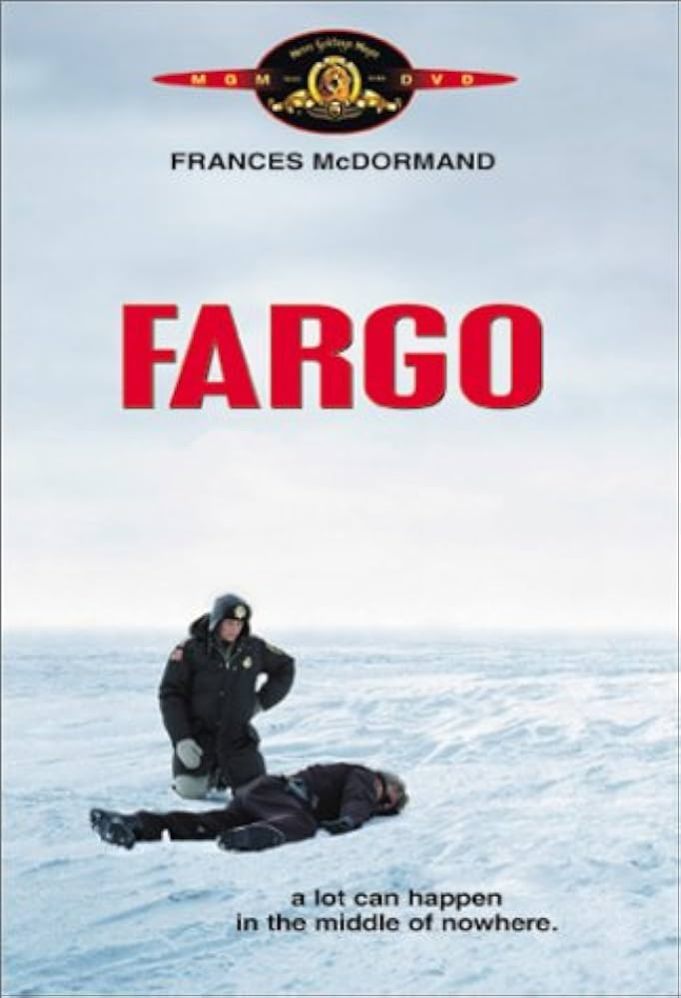
A police officer bundled in winter gear kneels in snow next to a face-down dead body. The scene is white sky over a field of snow. The title appears in red and teaser reads,"a lot can happen in the middle of nowhere."

The Coen Brothers movies defy categorization, and she’s a favorite of theirs, understandable given that she’s married to Joel Coen. Two movies immediately come to mind:

Fargo: Where she plays Margie, the whip-smart local police detective who is investigating what appears to be a random murder. The movie spools into a convoluted tangle of a tale that puts lie to the adage that truth is stranger than fiction. While there might be some real life behind this movie, it’s mostly fiction.

Burn After Reading: The Russians? This movie immediately entered my family’s lexicon of jokes and silly sayings. It might have the most DC vibe of all the Coen Brothers’ movies, and so be a little more relatable to those of us who live in the DMV. A mysterious cache of what appears to be important information pulls gym rats (McDormand and Brad Pitt), the CIA, and a plethora of cameo roles into a darkly funny send-up of the world of international espionage and politics.

Emotional Wringer

McDormand won the Oscar for Best Actress for her role in Three Billboards Outside Ebbing, Missouri. She plays a distraught and deeply angry mother who rents three roadside billboards to draw attention to her daughter’s unsolved rape and murder. She is, quite literally, willing to burn down her life and the town to get answers.

Artsy, Feel-good

A pristine blue sky above summer green tree provide a photo backdrop to a group of people in the bottom third, most of home are dressed in uniforms remiscent of Scouts.

Of all of Wes Anderson’s perfectly composed films, Moonrise Kingdom is probably my favorite. The setting of summer camp on a New England island pairs deliciously with the young lovers Sam and Suzy (as deeply romantic as only 12-year-olds can be), who run away looking for the perfect place to live in harmony. McDormand plays Suzy’s mom, among the many, many stars who inhabit this odd corner of the world. This movie has everything: local theater, police, scouts, dancing on the beach, a lighthouse in a hurricane, and Ed Norton wearing knee socks.

Fun and Funny

Miss Pettigrew Lives for a Day, which co-stars two other favorite actors, Amy Adams and Ciaran Hinds, is one of those movies that I will always be willing to watch. In London on the eve of World War II, McDormand plays the strict governess who has become a social secretary to a wealthy, beautiful socialite involved with three men. Romance and shenanigans ensue for the entire cast. (based on a book)

Children’s Story

In an old house in Paris that was covered in vines, lived twelve little girls in two straight lines, the youngest of whom was Madeline.

If you aren’t familiar with Ludwig Bemelmans lovely, rhyming series of stories for children, you might want to start there. Miss Clavel runs the French Catholic boarding school, where Madeline is the fiercest and funniest of orphans destined to steal hearts everywhere. McDormand plays the straight-faced and exasperated nun in a film that runs rampant through the major tourist attractions of Paris. It’s a lot of fun for children and their grownups, each of whom can identify perfectly with their generation’s main character.

Kristen B. is a devoted bookworm lucky enough to work as the graphic designer for HCLS. She likes to read, stitch, dance, and watch baseball (but not all at the same time).

Mixed Plate: Chronicles of an All-American Combo by Jo Koy

Jo Koy poses against a bright red backdrop, holding his suit jacket out between his pinched fingers and with his

by JP Landolt

My man Jo Koy bombed as the host of the Golden Globes. As I was reviewing some of the clips, my heart fell. This was NOT the Jo Koy I knew. I can’t help wondering where it went wrong, and I felt even worse about the kind of awful press he was getting. Comments like “Who even was this guy?” and “What a loser!” kept popping up in these online clips. I felt myself wanting to defend him and to prove to people that Jo Koy was truly funny. Unfortunately, hosting gigs like that are tough. They can sour (or sweeten) the masses to you, especially as a comic. And goodness me, even I know that a friendly roast of Taylor Swift is a “no-no” these days!  

If you get a chance to watch his numerous Netflix specials and pick up his book Mixed Plate, I believe you’ll gain more of an appreciation for Jo Koy. I am absolutely biased as I am also a “mixed plate” like he is – half Filipino and half white. 

You know, aside from my brother and me, the only Jewish-Filipino person I had ever heard of in the 90s was Rob Schneider, one of our most beloved comedians. I heard of Jo Koy through Filipino friends and family who alerted me to the fact there was a Filipino American comic who was crushing it (thanks for the heads up). He’d been grinding for years and made his way onto “Chelsea Lately” as a panelist. I saw one of his specials on Comedy Central in the early 2010s and would continue to look for Jo Koy material and find random snippets on YouTube. Finally, by 2017, Live from Seattle was on Netflix. I shared this with my husband and he, too, has become a Jo Koy fan.   

My family revels in comedians. We had cassettes of comedians that we’d listen to over and over. In fact, we had the same Richard Pryor cassette that Jo Koy references in this book. In the 90s I loved In Living Color, All That, and any comedy sketch show I could find. And SNL? SNL in the 90s was ripe with talent: Dana Carvey, Adam Sandler, Chris Farley, David Spade, and the rest of them. I remember Eddie Murphy in red leather, George Carlin and his bad words, and today I enjoy Jo Koy, Tiffany Haddish, Tom Segura, and others. When he finally “makes it,” he starts name-dropping his idols who soon become friends. Most surprising (and hilarious) is his friendship with Jon Lovitz!

Other revelations in this book proved to me just how incredible humor is. Some things make you laugh to keep from crying, and others make you laugh until your cheeks are wet with tears! The struggles in this book are so painfully real. There’s the struggle of not being enough, then there’s the struggle of not having enough. Growing up impoverished and mixed can amplify those feelings of not really belonging and simultaneously doing whatever you can to be seen. Jo Koy lived this reality, and I felt it in his words. Humor and shared experiences bring people together. There’s about seven pages of thank you’s at the end of this book, and it’s only a short testament to how much this book was created with love and gratitude. Jo Koy seems to have a happily ever after, and I’m here for it!

Mixed Plate is available from Howard County Library System in print and as an e-book.

JP has worked for HCLS since 2006. She enjoys gallivanting, Jollibee, and all the halo-halo she can eat.

Inspiring Laughter

The author as a child, in a blue dress and hair in pigtails, is holding a microphone and smiling. Title and author type in large yellow block type.

by Carmen J.

Behind the laughter of most comics is a big bag of pain. Laughter, the ultimate defense mechanism, is a way for them to commiserate with their audience. Let me help you forget your pain for even just a few minutes. Let’s laugh at the world’s absurdity. I will take you there. Leslie Jones takes you along for a wildly candid, gritty, and funny ride in her memoir, Leslie F*cking Jones, available in print and OverDrive formats (e-book and e-audiobook).

I devoured this book over one weekend, not only because I’ve enjoyed her work on Saturday Night Live (SNL) and on Supermarket Sweep (!). In 268 well-crafted pages, we are taken on a journey through her childhood (and some truly sad tales of abuse, alcoholism, and chronic family illness) to her rise on the comedy scene (from the early auditions and late-night sets to the hard-fought stand-up crowds). Despite the poignant accounts of her difficult relationships with her father, brother, and the occasional ex-friend and former roommate, there is always a lesson with every anecdote. And you will root for Leslie Jones until the final page.

She’s Leslie F*cking Jones, just like the title says. Read her book. Have fun requesting it over the phone; you may want to reserve yours online.

If you want to see her in action, enjoy this clip of “Black Jeopardy” from SNL that included the beloved late Chadwick Boseman.

Carmen J. is a teen instructor at HCLS East Columbia Branch. Among her favorite things are great books, all things 80s, shamelessly watching The Bachelor, gardening, and drinking anything that tastes like coffee.

What I Read on My Summer Vacation 

You see feet in flip flops (with pink toenails) under a dress hem. Between the feet is a smashed small birthday cake with

by Christie L.

I’m a speed reader. When I told my family that I read four books on a recent getaway, they teased me about whether I remembered any details. One was an advanced reader copy and not widely available for a couple of months. While I may not have encyclopedic recall, I can tell you enough about the other three to entice you to check them out for yourself. 

The first was by one of my favorite authors, David Sedaris. His latest book, Happy-Go-Lucky, (also as an e-book and an e-audiobook) chronicles his adventures in London, New York, North Carolina, and other locations. He begins with a story about going with his sister Lisa to a shooting range in North Carolina where he learns how to shoot a gun while pondering what types of people own them. From there, he jumps to a story about his father. Sedaris spends a considerable amount of the book talking about his father’s declining health and their complicated relationship. He shares deeply personal stories about his father and his sisters – the funny, awkward, and sometimes uncomfortable interactions, including painful questions about whether their dad sexually assaulted their sister Tina. Sprinkled throughout these recollections are other unrelated stories about a speech he thinks about giving to college graduates, the falling-apart house he and his partner Hugh purchase and fix up in France, travels to Eastern Europe, and life in NYC during the pandemic and protests following George Floyd’s murder. As with all of his previous works, one never knows what the next page holds – it may be laugh-out-loud funny, awkward, or thought-provoking. But it will never be boring. 

Next was Happy Birthday or Whatever: Track Suits, Kim Chee, and Other Family Disasters by Annie Choi. She often made me laugh while also giving me some insight into life as the child of Korean immigrants. Choi relates stories about her mother’s obsession with her daughter’s grades so she can go to an Ivy League school, her mother’s collection of knick-knacks, trips to Korea to see extended family, dating non-Koreans, going to Korean school, saving her stuffed animal collection, and defending her vegetarian diet. When she wrote about her mother’s cancer diagnosis and treatment, I could relate. It doesn’t matter who you are – it’s incredibly hard to live across the country from your parents when they struggle with health issues. Choi’s witty and touching memoir transcends cultures and gives us a glimpse into her world – and ours.

A wide horizon of a rural setting at sunset with a viviid red sky. Two figures are walking on the grass.

Finally, I finished the week with God Spare the Girls by Kelsey McKinney, a book I discovered from a Texas fiction list curated by Texas Monthly. As a native Texan who’s also a pastor’s daughter, I was interested in this story that follows two sisters whose father is a pastor and who are expected to be above reproach at all times. But that’s where the similarity ends. Before he retired, my dad served Lutheran congregations in rural Texas, living in parsonages (houses provided by the church) and ministering to folks in our small community. In this story, Luke Nolan is the pastor of an evangelical megachurch who has a secret that could end his career. (Side note: career vs. calling is a philosophical discussion for another time.)

When his daughters find out, they question not only their father but also their faith. Without giving anything away, the book explores double-standards, patriarchy, relationships between sisters and between children and parents, and how faith guides and impacts lives. It’s a fascinating coming-of-age story about two sisters who come to terms with what they really believe and how they will decide to live their lives.

Christie is the Director of Communication and Partnerships for Howard County Library System. She loves walking through the network of pathways in Columbia, sitting on the beach, and cheering for the Baltimore Orioles and Texas Aggies football team.

Elevation by Stephen King

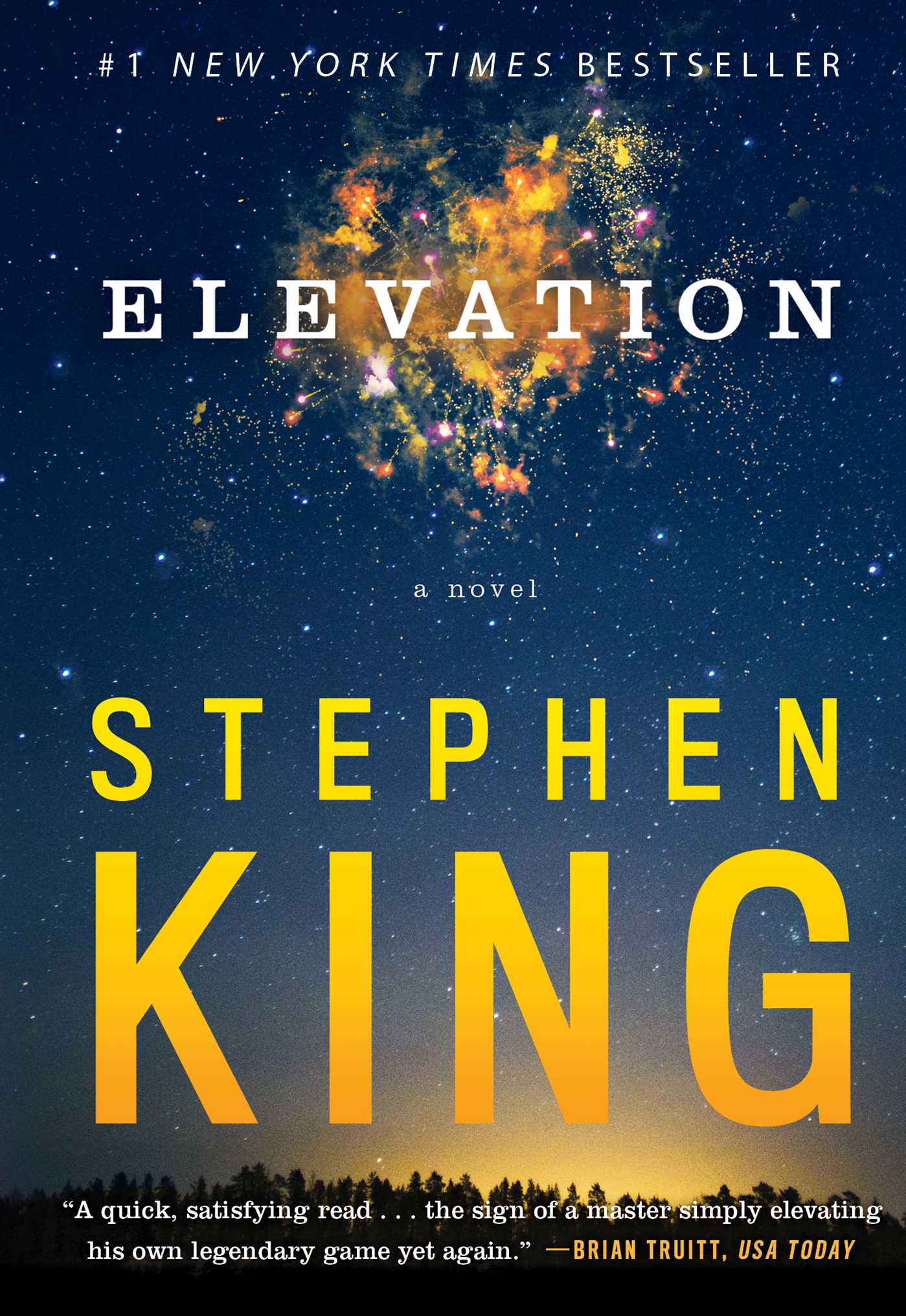
A deep night sky shows a sort of explosion, the tree line at the bottm is also illuminated.

By Gabriela P.

Short on time? So is Scott Carey, the main character of Stephen King’s novella, Elevation. Forty-two years old and in relatively good health despite a disposition towards being heavy-set, Scott discovers he is afflicted with a strange condition where he continuously loses weight but not mass. Eventually, he comes to understand that, soon, he will literally be leaving the physical Earth as his weight plummets. With a divorce in his recent past, a too-large house, and a complacently settled routine in the town of Castle Rock, it takes two new neighbors moving in down the street to spur the unfolding of a moralistic but heartwarming comedy.

Scott’s two new neighbors are women. In his small town, same-sex relationships are at best tolerated…but same-sex marriage becomes a root for tension, gossip, and outright hostility. Scott himself bears no ill-will towards Deirdre and Myra, except a slight annoyance with their dog’s preferences for his lawn. When he confronts the two, he is received coldly, a result of a necessary guard the two have had to put up in the face of prejudice.

Unlike the plot development one might expect from a Stephen King story, Elevation does not dive into the wild undoing of a man and a town, but instead comedically highlights one man’s gradual, though admittedly somewhat naive, social enlightenment. While Scott Carey literally begins to leave the ground, he is also able to figuratively rise above prejudice. To really tug at the heartstrings, readers should consider the irony of strengthening bonds and belonging with an inevitable end.

Also available as eBook, eAudiobook on Overdrive and CloudLibrary, on CD, and in large print.

Gabriela is a customer service specialist at the Miller Branch. She loves long walks, reading with her dog, and a good cup of coffee.

Definitely Hispanic by LeJuan James

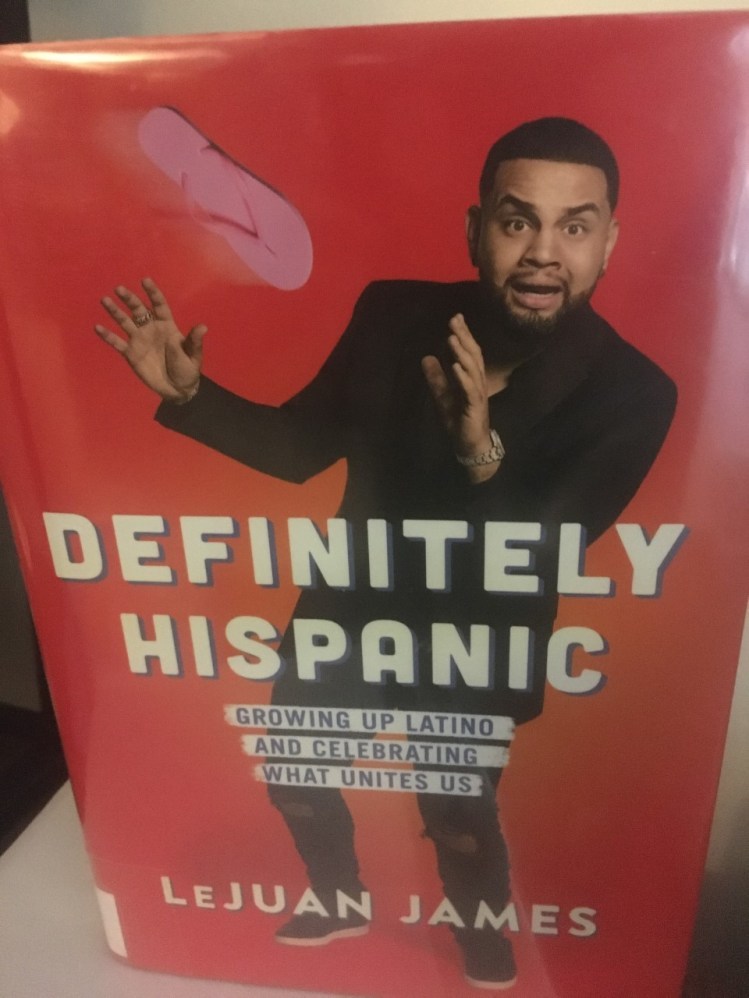
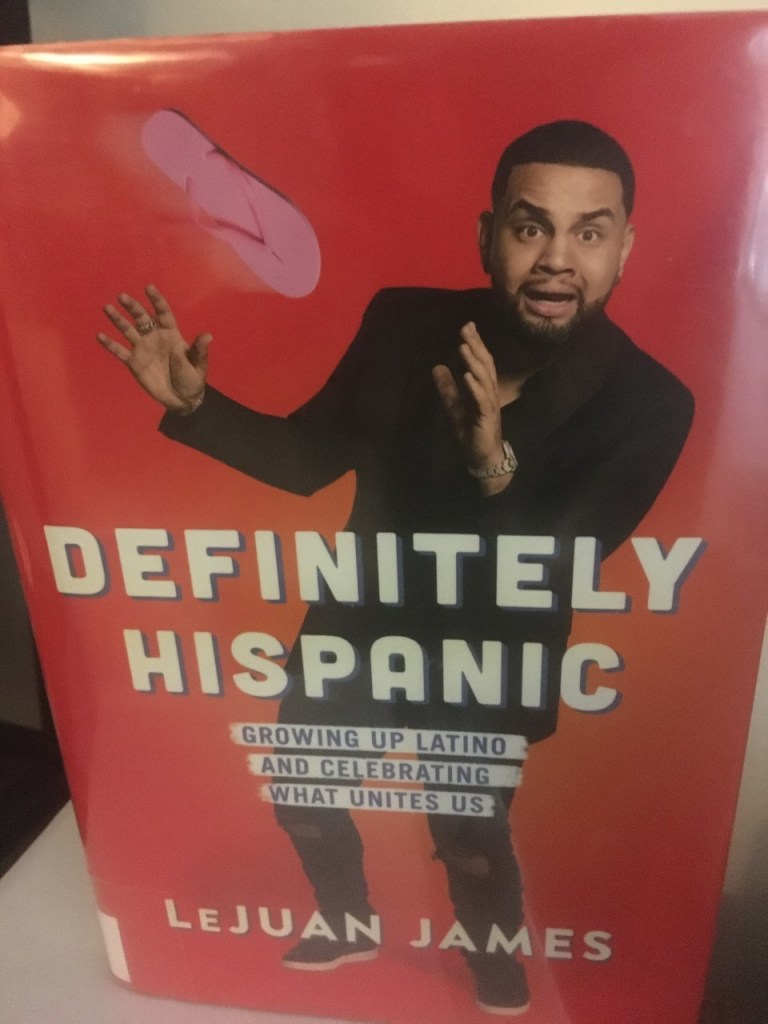
The book cover shows the author in a black suit and sneakers with a startled expression on his face, about to catch a pink flip-flop that is flying towards him through the air. He is posed against a red background.

By Carmen J.

With racial equity at the forefront for the library and the county, a much-needed read on Hispanic life crossed my path recently. 
For those who may not know, I’m Cuban American. I’m in that nice little hybrid world of always exploring my Cuban-ness amidst my American-ness. I’m often torn between both worlds and questioned if I was Cuban enough for not speaking enough Spanish and not having a plethora of Hispanic friends. Yet my childhood and its lasting effects on my family orientation, personality, and work ethic set me apart from some of my “American” counterparts.

Long story long – another lovely Hispanic trait – I’m recommending Definitely Hispanic: Growing Up Latino and Celebrating What Unites Us by comedian and YouTuber LeJuan James (in homage to Lebron James, with his real name: Juan Atiles) for your primer on Hispanic and Latino life. James started as a Vine creator and moved on to YouTube with his hilarious parodies of his parents. The short, family-friendly videos highlight the realities of Hispanic culture in a good-natured format with himself acting out all of his characters (including his mom while keeping his signature beard, no less).

This engaging and honest book of essays brings to light all of the memorable things I appreciated while growing up Hispanic, including celebrating holidays dressed in all of our finery with an open door of family and friends; enduring the family gossipers and “roasting” (such as comments on weight gain or a less-than-becoming outfit) by relatives; escaping spankings via “la chancla” in a thrilling game I’d refer to as dodge-belt; watching telenovelas;  and the comical list goes on and comically on.

James’ musings focus on the funny as well as tender-hearted moments surrounding his nomadic upbringing between the Dominican Republic, Florida, and Puerto Rico. In addition, he beautifully shares the strong influences of his mother and grandmother and their impacts on his work as a YouTuber. The book serves as an education on Hispanic culture, without falling into caricature or stereotypical territory. The essays are detailed and full of heart. They served as a reminder to this Cuban American that the joys of being and growing up Hispanic involve more than language.

I encourage you to check out his short and funny posts on YouTube. Here is one of my recent favorites: 
https://www.youtube.com/watch?v=czUIhnOwAE0

Definitely HIspanic is also available as an ebook and an eaudiobook from Libby/OverDrive and as an eaudiobook from CloudLibrary.

Carmen J. is a teen instructor at HCLS East Columbia. Among her favorite things are great books, all things 80s, shamelessly watching The Bachelor, gardening, and drinking anything that tastes like coffee.

We could all use a little Paddington

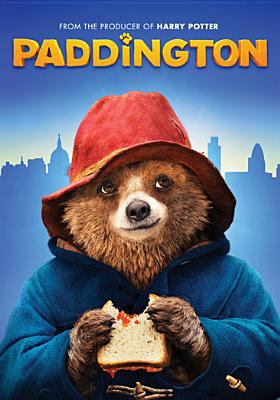
The film poster depicts Paddington bear in his red hat and blue coat, eating a jelly sandwich, against a blue background of the London skyline.

By Khaleel G.

I must confess a librarian’s sin: I always mix up Paddington the bear with Corduroy (who is also a bear). Three decades after first reading these books, I only remembered a cute lil’ guy, riding up an escalator, getting into good-hearted mischief. Yet over the past few years, I’ve read amazing reviews of the two Paddington films. Critics said these are some of the best family movies ever made – high praise! But like the thousands of movies, novels, albums, memoirs, histories, and graphic novels I’ve been recommended, I filed these films away in the bursting file cabinet in my mind, labeled “To Check Out, Sometime Later.”

Well, I wish I hadn’t waited so long. These films operate not only as delightful living cartoons, but they’re optimistic, contemporary, and totally absurd in that specific UK comedy way. The director, Paul King, is most famous for having worked on The Mighty Boosh, a British comedy show from the 2000s best described as visual and narrative anarchy. Here, though, he turns what might be a humdrum kids’ book adaptation into a compelling and confoundingly fun romp. 

The premise is simple, but sorta weird, as you see it happen with real actors (and a small, talking animal).  Our protagonist bear (from “Darkest Peru”) is sent north by his auntie and ventures into London alone, with a small tag around his neck reading, “Please look after this bear. THANK YOU.” Upon arriving at Paddington station, he meets the Brown family, who take him in for the night, dubbing him “Paddington” (since they can’t pronounce his name in roars of Bearish). They hope to find a new home for him, the one promised decades ago by an explorer his aunt and uncle met, who extended his hospitality should they ever visit London. Thus, the film properly begins. 

Paddington is shown in his blue coat and red hat, riding an escalator with a small white dog with a jeweled collar.

This is when Paddington sets itself apart from its PG peers. We’re introduced to the Brown family through a Wes Anderson/Royal Tenenbaums-style montage; these carefully shot sequences detail their unique personalities. Like young Judy, who suffers from an incurable case of “embarrassment,” worried about introducing her middle school crush to her family. Or the younger Jonathan, who can’t tell his school chums that he just loves steam engines. Mrs. Brown illustrates children’s books, but can’t come up with a hero, while Mr. Brown is a work-weary insurance investigator, very dry and worried. They’re just as strange as an immigrant bear with a floppy red hat, and each Brown family member discovers and accepts this over the course of the story.

Of particular note is Hugh Bonneville, who played the regal father in Downton Abbey, as Mr. Brown, who doesn’t much like the idea of living with a bear (alluding to issues around immigration and housing, a surprisingly contemporary twist). Before long, Bonneville warms to the little scamp, as they search across London for that welcoming explorer, getting into some Monty Pythonesque escapades.

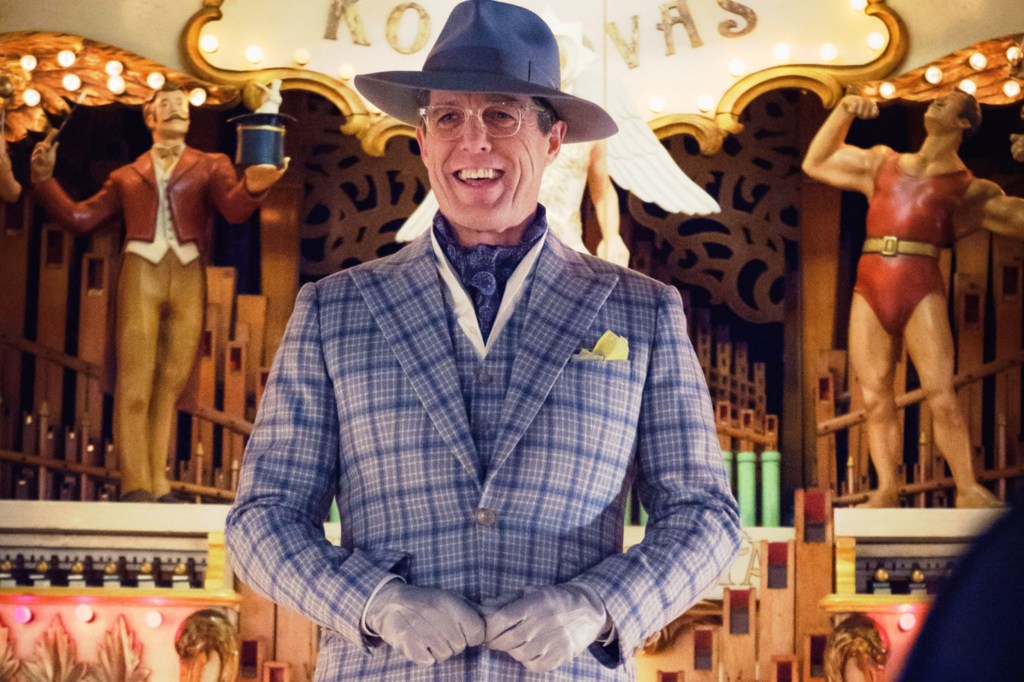
Joining him is Nicole Kidman, as a mad taxidermist intent on capturing Paddington, and boy! she really gives it her all! I haven’t seen a “serious, dramatic” actor lean so hard into being a goofy yet menacing villain in a long while – though in the second film, Hugh Grant one-ups her. He plays a washed-up actor turned thief, dressing in all sorts of costumes to steal what he needs, while performing many ridiculous accents. If you can believe it, he claims this to be his finest work. On top of that, we get delightful supporting performances by BBC regulars, like Jim Broadbent, Peter Capaldi, and Brendan Gleeson, each stealing their scenes with panache.

Hugh Grant is depicted in a blue and grey checked suit with ascot, and a blue wide-brimmed fedora, in front of a carnival-themed calliope.
Hugh Grant, depicted in Paddington 2.

I could go on and on about these films! I haven’t even mentioned the Rube Goldberg stunt scenes. Paddington makes some simple mistake, usually based on a misunderstanding of technology or culture, and sets off a chain of chaos. In one scene, he begins by trying to clean out his ears (a gross-out gag for the kids), but ends up flooding the Brown family’s bathroom to the ceiling, as he floats in the tub. It’s pure Looney Tunes stuff, but the combination of CG with real-world props makes it seem grounded in reality…a reality where people don’t think it’s strange that a bear can talk, but a reality all the same.

So, whether you have kids to entertain, have a fondness for British wackiness, or just want to see a very polite but confused bear bungle about London spreading chaos and also understanding, you must see Paddington and Paddington 2. I cannot recommend these two movies enough, as a spirit-lifting way to spend two evenings.

Paddington and Paddington 2 are available on DVD (rated PG), as well as the original Paddington adaptations for younger kids; the Paddington books are available in print; Corduroy is also available in print (if you want to get two fictional bears confused).  

Khaleel has worked at the Miller Branch since 2015, though he’s been back and forth between HCLS and high school, college, and graduate school since 2003.