The Cartoonists Club by Raina Telgemeier & Scott McCloud

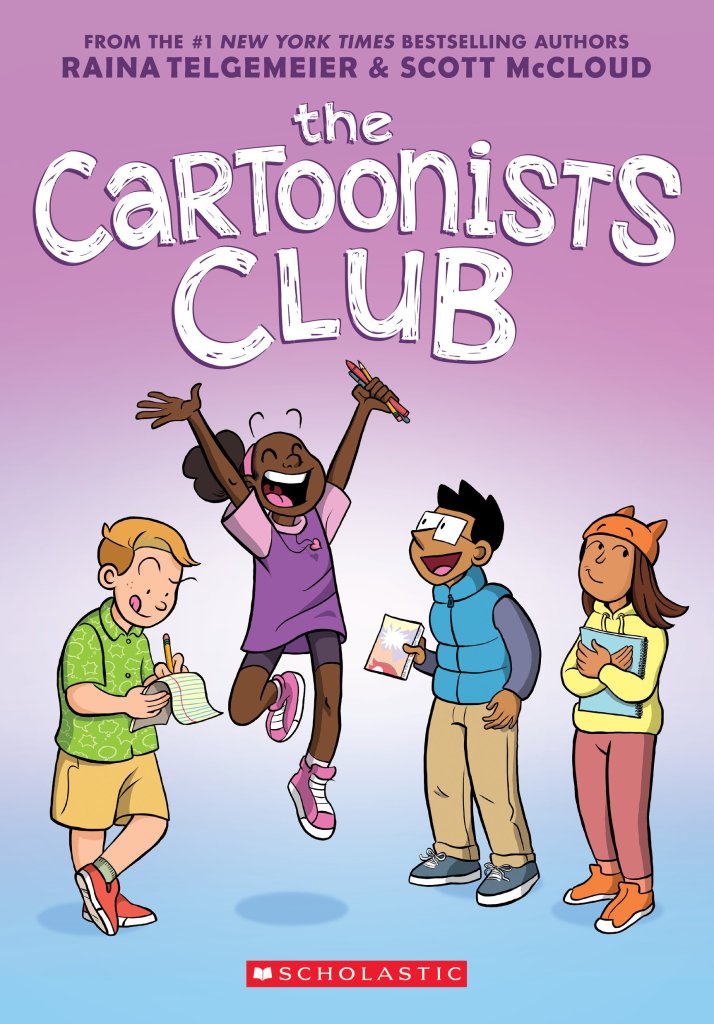
The book cover depicts four middle-grade students holding sketchbooks, pencils, notepads, and other drawing implements; one is jumping into the air excitedly, one is watching with a big smile on his face, one is looking to the side wistfully, and one is concentrating on writing or sketching on a lined piece of notepaper.

By Holly L.

Back in 2020, during the lockdown days of the pandemic, I logged on to a Zoom featuring cartoonist Raina Telgemeier with my then-second grader. As huge fans of Raina’s work, and having read, re-read, and read again, Smile, Sisters, Drama, Ghosts, Guts, and the first four Baby-Sitter’s Club books, the two of us were super excited to hop online with our favorite graphic novelist. Raina was just as friendly and charming as we imagined, with a level of nervousness that seemed exactly appropriate for an introverted artist.

There was some book talk, a Q&A, and, to our delight, a live sketching session. Black marker in hand, she drew several images, but the one that stands out in my mind is of a cover mock-up, rendered in the style of Smile, Sisters, and Guts. It was a big, round sourdough loaf captioned with the title Bread. Raina said that she, like many others during the pandemic, had gotten elbow-deep into making sourdough, so it seemed an appropriate theme for a new book. Because this explanation came across as a bit tongue-in-cheek, we didn’t necessarily expect to see news of an upcoming book in the months that followed. But still, my daughter and I both hoped that we had actually been let in on a secret that afternoon and that Bread would someday make it into print. Months turned into years with no publication news, about Bread or any other Raina book. That is, until June 2024, when Scholastic’s Graphix announced the 2025 publication of The Cartoonists Club by Raina and Scott McCloud. 

Comic fans will recognize Scott as the author of Understanding Comics, widely considered an essential guide to comics as an art form and one of Raina’s all-time favorite books. From Raina’s website

When I was 16, I read Understanding Comics by Scott McCloud, a ‘comic book about comic books.’ It immediately cemented my desire to be a cartoonist–as well as gave me a shape and vocabulary for the scope, philosophy, iconography, and downright magic of comics storytelling. That was a pivotal moment for me, and I speak with a LOT of young readers who have been looking for a similarly pivotal book for them. The Cartoonists Club is the result of almost 5 years of working together with Scott himself, to create what we hope is that book!

The Cartoonists Club follows four young, diverse characters who form friendships through their love of comics. Makayla, Howard, Lynda, and Art are middle school students encouraged by Ms. Fatima, their school media specialist, to form a club centered on their passion for reading and making comics. Makayla has so many ideas but has a hard time turning them into a story. Howard’s passion is drawing, but he is often short on ideas. Lynda fills page after page in her sketchbook but is her own harshest critic.  Art is a maker who just loves to be creative and has enough enthusiasm for the whole group. By featuring characters with different approaches to creativity, the authors establish an inclusive space in the pages of the book where there is no one “right way” to be an artist. In the “Behind the Scenes” section that follows the story, Raina remarks that each of the characters represents different traits possessed by the two authors. 

As the characters learn various techniques of the comic craft, the reader becomes acquainted with what Ms. Fatima calls “The Magic of Comics.” The club members hone their own trademark styles, making individual comics while working as a team in preparation for what will–hopefully–be their big debut at the local mini-con, where they’ve applied to set up a table. The Cartoonists Club is an inspiring and illuminating story of friendship and self-expression that graphic novel and comics fans will enjoy. In addition to the story, the book also features a fun “Behind the Scenes” section, including “A Chat with Raina and Scott,” a Q&A addressing questions (such as “how do you get better?” and “what advice do you have for aspiring comics?”), a comics glossary, a list of Comics Jobs, How We Made This Book, and Resources and Suggested Reading. Although I’m still holding out hope that Bread will someday make it into print, I thoroughly enjoyed this collaborative and entertaining read about the art of comics.

The Cartoonists Club by Raina Telgemeier is available in print and e-book.

Holly is an Instructor & Research Specialist at HCLS Miller Branch. She enjoys reading widely, knitting sporadically, and baking as often as she gets the chance.

National Library Week: Graphic Novels for Kids

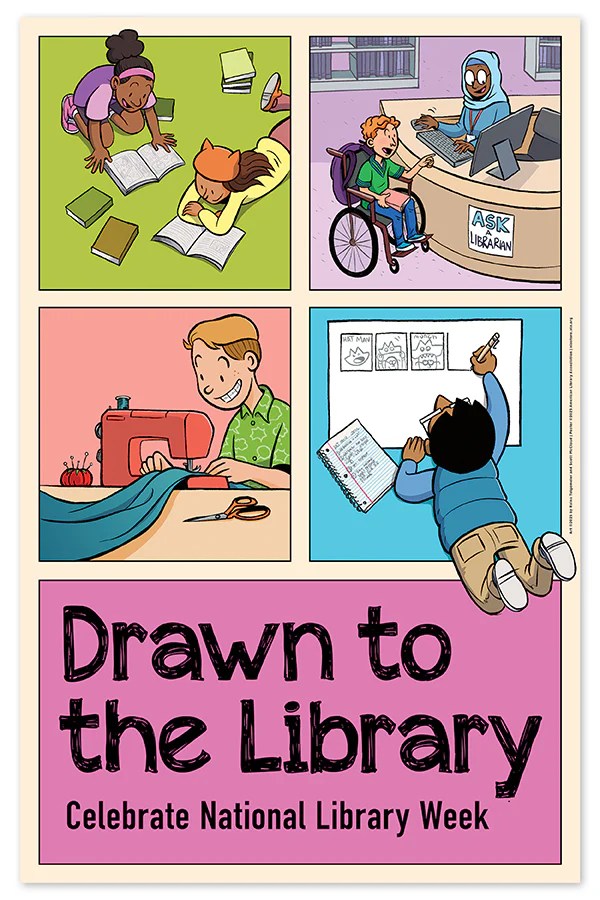
National Library Week Poster shows four different, common scenarios at the library: reading, talking at the desk, using a sewing machine from the library of things, and someone drawing.

by Jean B.

What draws you into the library? Comfortable chairs and aisles of tall shelves, packed with interesting titles? Classes where you can learn or socialize? Play areas for children?

Libraries serve many needs these days and offer access to all kinds of media – not just the weighty tomes of classic literature. For many of our school-age customers, it’s the graphic novels that draw them in. Dogman to Batman, Smile and Guts – these titles possess a magnetic power to pull kids into the library, sometimes to the chagrin of their grown-ups. They ask: “Are graphic novels real reading, if they’re filled with pictures?”

This year’s theme and its honorary chairs, cartoonists Raina Telgemeier and Scott McCloud, affirm the value and power of these stories told through comic-strip panels. In recent years, graphic novels and their creators have received the highest honors in children’s literature, recognizing their artistry as well as the many benefits these books bring to young readers in building literacy.

Reading specialists stress the importance of motivation for a child’s success in learning to read. Kids need to be interested in the stories presented to them to do the work of reading. So if Dogman gets them to keep reading, it’s just as valuable as a classic! For those who may have fallen behind early in the reading process and lost confidence, graphic novels can restore their motivation. The images are appealing, the word bubbles less intimidating than full pages of text, and children can be successful without feeling the books are “beneath them.”

Graphic novels also teach children how to integrate text and visual literacy — an essential skill in today’s multi-modal landscape. When kids tackle a website, advertisement, or YouTube instructional video, they need to absorb both images and text to decipher meaning. That is the world we all now live in, and careful reading of a great graphic novel sharpens this important skill.

At Central Branch, the graphic novel collection literally creates the gateway for entering the children’s department. But in a much broader sense, graphic novels offer a gateway to the vast variety of books and materials readers will find in the library. Once DRAWN IN to reading, the discoveries and stories are limitless!

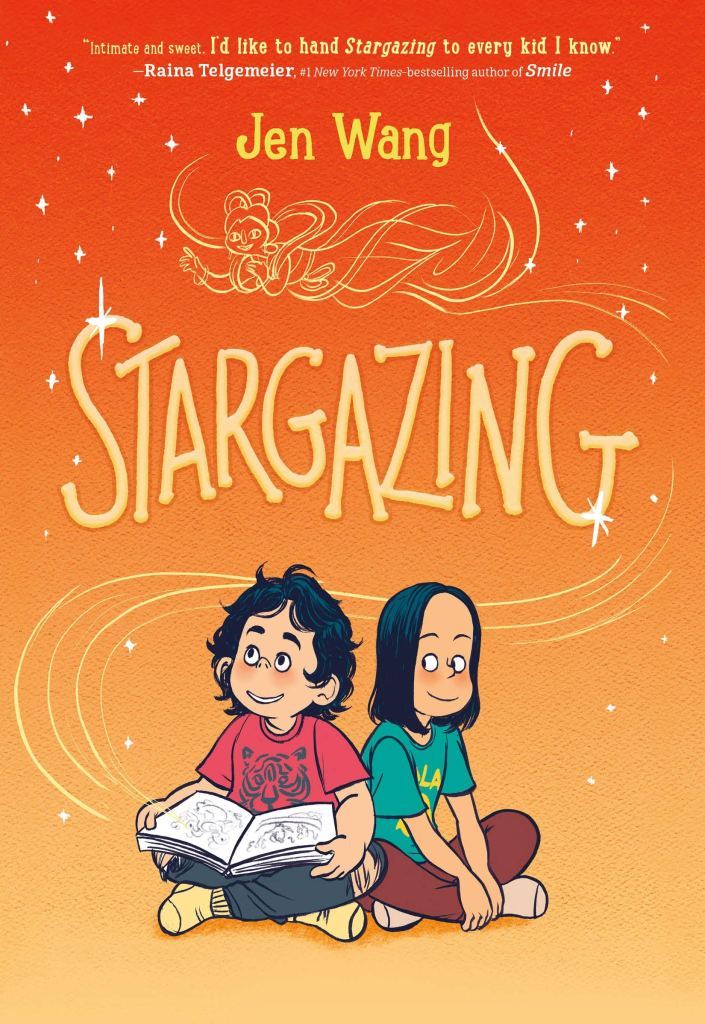
The cover shades from dark orange at the top to a light orange at the bottom, with two kids sitting tailor fashion. The one on the left has a book open, with swirls of a sprite sketch coming from the pages.

Celebrate National Library Week by exploring some of these award-winning graphic novels, all based on real experiences:
El Deafo by Cece Bell
New Kid by Jerry Craft
Mexikid by Pedro Martin
Stargazing by Jen Wang.

Jean is a Children’s Instructor and Research Specialist at HCLS Central Branch. She loves talking about books with people of all ages, but especially enjoys leading the Heavy Medals book club for fourth and fifth graders, exploring award-winning books of all genres. 

Give Yourself The Creeps with Fran Krause’s Comic Collections 

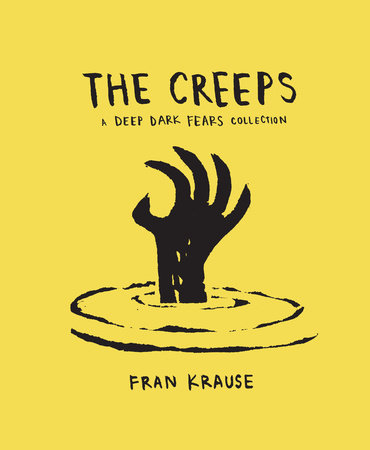
Yellow cover with a black curved hand reaching up from liquid rings.

by Sharon P-Y

Have you ever worried that you’ll trip and fall and inadvertently bite your tongue off? Or that you’ll sneeze so hard with your eyes open that your eyes will pop right out of your head? Do you ever secretly worry that there could be invisible people in your bathroom?  

In Deep Dark Fears and the follow-up collection The Creeps, cartoonist and illustrator Fran Krause brings some of our greatest — and some of our silliest — fears to life in charming ink and watercolor comics. 

Some might recognize the concept from Krause’s popular web comic “Deep Dark Fears,” which continues to run on his Tumblr and Instagram accounts. Readers, sometimes anonymously, submit their occasionally bizarre and often relatable fears for Krause to illustrate, typically in a classic four-panel comic strip. The result is a delightful mix of the macabre and the comical. 

In one comic, Krause depicts a reader’s secret fear that all of life is a simulation. In another, our protagonist admits to wondering if there are hidden cameras in public automatic-flush toilets that snap clandestine photos of every visitor. Finally, in a surprisingly heart-wrenching turn, a particularly memorable vignette follows the ghost of a dead dog who has returned to their owner, who can’t see them, leaving the ghost pup to wonder why they’re being ignored. (If reading that doesn’t send a chill down your spine and make you go and hug your pet, nothing will.) 

There are also the laugh-out-loud funny fears: being told as a kid that the steam rising from the pork dish you were served for dinner is just the pig’s ghost floating away, or that if you eat candy in bed at night, ants will crawl into your ears while you’re sleeping and build a colony in your head. 

Embrace your fears — and maybe even discover a few new ones — and borrow one of Krause’s collections from the Library today. 

Deep Dark Fears is available in print, as is The Creeps.

Sharon Pruitt-Young is an Instructor and Research Specialist at East Columbia Branch. Aside from books, she is passionate about writing, urban sketching, trees, and art of all kinds. 

Comics and Ta-Nehisi Coates

A comic book illustration: shows the Black Panther standing strong and alone in front of a futuristic city-scape.

by Eric B.

I grew up reading comics. In hindsight, it was one of the things I can recall being really into, certainly more than books or sports. I loved the stories, the characters, and the artwork. In the 1980s, the stories became a bit more interesting and complex, giving the characters more depth than in previous periods. My love was bolstered by the fact Steve Geppi, on his way to becoming comic distribution magnate and part-owner of the Baltimore Orioles, owned and operated several comic shops around Baltimore. I won’t reminisce here, but the one I frequented with my brother was a pretty amazing place, created by a guy who quit his job at the post office to own a comic shop. (In other words, he had passion.) 

At any rate, I still occasionally read some comic and graphic novels, my book discussion group has read and discussed a few of the best, and I still enjoy going to my local comic shop to browse (less frequently lately, obviously). The medium has a come a long way, with the work of some talented writers and artists. More importantly, the graphic medium is much more diverse and inclusive these days. HCLS has a great graphic novel collection. Sometimes I look through and find things I’ve not heard of or a book adapted into a graphic novel that I was not aware of previously.

Ta-Nehisi Coates and I are the same age, and he’s from the west side of Baltimore, around where the city meets the county. I, too, hail from west side of Baltimore, spent my first few years just on the county side, and spent a lot of time in those areas. The differences in our respective experiences could probably make for more than a blog post, but nevertheless I’m always happy to see local people do well. (I guess we all like that sort of thing so we can imagine some sort of shared experience.) Commonalities notwithstanding, I’m a fan of Coates’ thoughtful work and was moved by his piece on reparations. He has authored several excellent books of fiction and nonfiction on race, and perhaps you have heard about his “twitter battle” with Dr. Cornel West. 

At any rate, and certainly not to take away from any of these accomplishments, I recalled reading that he was a comics kid. I was elated to read that this intellectual had realized his childhood dream of writing for Marvel Comics, Black Panther in particular. I can only imagine I’d feel the same and felt incredibly happy for him! My first guy was Aquaman, I was blonde and liked the ocean. Next was Spider-man, the flawed character who struggled with pretty much everything in his personal life. That said, I had characters with whom I could relate, which is important, and I was very happy to read Coates had his, too. 

You may have seen the Black Panther character in the Marvel films, but Coates built on the source material created by people of color he had admired as a young person. He writes comics narratives about power, opposing points of view, the African continent, and nature. Coates also recognizes that comics and graphic novels are a collaborative work, and he acknowledges how the great art of Brian Stelfreeze brings a graphic story to life. Coates subsequently moved on to Captain America and wrote about his good reasons for wanting to do so. He mentioned that some may see Cap as the embodiment of nationalism or the character from the films, but he’s much more nuanced and conflicted than that.

I have to feel a sort of kindred spirit with someone that can recognize this in Captain America and comics in general. So, if you have not, read his articles in The Atlantic (available via RBdigital), read his books, and don’t be afraid to read his graphic novels, which are collected as trade paperbacks and available via HCLS

Eric is a DIY Instructor and Research Specialist at HCLS Elkridge Branch. He enjoys reading, films, music, doing nearly anything outside, and people.