5 Graphic Novels to Celebrate Black History Month

by Sharon P-Y

Don’t believe anyone who tells you that comics are just for kids. That’s never been true, and now more than ever, graphic novels are gaining popularity for the creative ways authors can use the format to tell moving, complex, diverse stories for adults.  

These five stories are just a few of the titles that HCLS offers for readers interested in expanding their Black History Month reading list. If you’re not a regular reader of comics or graphic novels, you may find yourself surprised at the storytelling power of words and pictures when they work together.
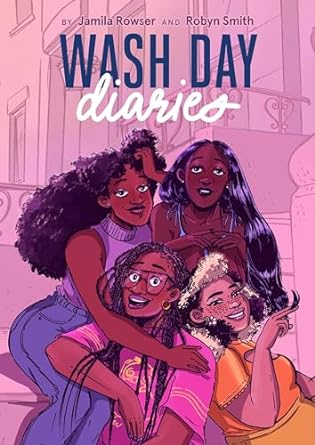
The book cover shows four teenage girls smiling and embracing against a backdrop of stairs on a city street.

Wash Day Diaries 

“It’s wash day. I ain’t going nowhere.” 

So says one of the protagonists of Jamila Rowser and Robyn Smith’s Wash Day Diaries. It’s a ritual that any black girl with natural hair knows well. When it comes time to wash, deep condition, and ‘whatever else’ your hair, it’s prudent to dedicate an entire day to the endeavor. Washing, deep conditioning, detangling, styling—it’s a complex, time-consuming process. In this graphic novel, the only things more complex are the lives of our four heroines: Kim, Davene, Nisha, and Cookie. 

Wash Day Diaries makes a point of accurately and lovingly depicting natural hair and all the ways it can be styled, and that’s part of what makes it stand out. It’s a well-told story that centers the importance of self-care and community, and it makes for a pleasant, uplifting afternoon read. 

(If you’re looking for another graphic novel that delves into the cultural weight of hair in the African American community, check out Hot Comb, a collection of pen-and-ink comics by Ebony Flowers.) 
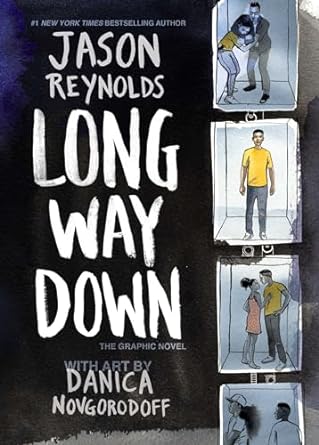
The book cover depicts four photographs showing several people in conversation, alone, struggling with one another, and one ignoring another.

Long Way Down 

Jason Reynolds’ poetic and immensely moving young adult novel Long Way Down revolves around a teenage boy grappling with the effects of gun violence. The story starts with the shooting death of protagonist Will’s beloved older brother. Lost in his overwhelming grief, Will is hell-bent on retaliation, but a visit from seven ghosts, all of whom have some connection to Will or his brother, forces him to make a hard decision about who he wants to be.  

In the original book, Reynolds uses few words to say a lot, and the graphic novel version (also available as an e-book) of his story—told through watercolor illustrations—will leave you reeling just the same.

(Fun fact: Reynolds paid a visit to our East Columbia branch in 2018!)

The photograph depicts author Jason Reynolds speaking from a stage at HCLS East Columbia Branch to a standing-room-only crowd of students and community members.
Author Jason Reynolds speaks to an enthusiastic crowd at HCLS East Columbia Branch.
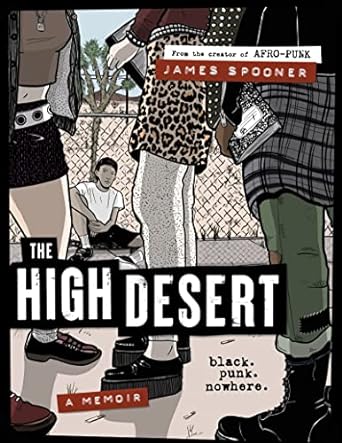
The book cover depicts a teenager seated on the cement of a playground, up against a wire fence, looking up from that vantage point at several other teens, some of whom are carrying schoolbooks or composition books, depicted from the waist down.

The High Desert 

Being a biracial kid in the predominantly white town of Apple Valley, California—as well as a predominantly white punk music scene — isn’t easy. Written by James Spooner, founder of the Afro-Punk website, The High Desert chronicles Spooner’s coming-of-age experience and the birth of his love for punk/alternative music, a connection which blossomed even as Spooner struggled to find his place in a community that was oftentimes racist and even outright violent towards him. Spooner’s graphic memoir is perfect for anyone who’s ever felt like an outsider in the worlds that they love. 
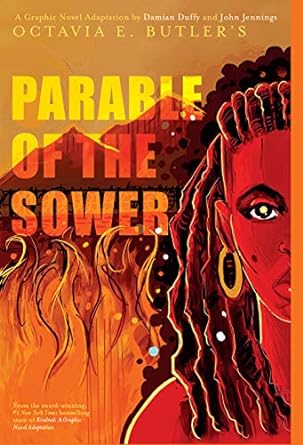
The book cover depicts a partial profile of a woman with braided hair and a golden hoop earring against the backdrop of mountains in shades of orange and gold.

Parable of the Sower 

In another novel adaptation, artists Damien Duffy and John Jennings translate Octavia Butler’s (disturbingly timely) dystopian story into graphic novel form. Parable of the Sower isn’t an easy read, not by a long shot; in Butler’s 1993 novel, a series of simultaneously occurring catastrophes have transformed the country into a virtual hellscape.

Protagonist Lauren Olamina, a teenager at the start of the story, lives in an insular community where she and her neighbors continue to live life as normally as possible while struggling to avoid the widespread violence, exploitation, and corruption taking place outside. When Lauren, who is coming into her own mysterious powers, is forced to venture out into a collapsing society, what follows is a story of hope and new beginnings.  

Be warned: part of what really makes this pick a disturbing one is that it’s set in the year 2024 and, at times, feels all too possible. 

Fans of Octavia Butler should also check out the graphic novel adaptation of Kindred, one of her most beloved novels. It follows a black woman as she is thrown, repeatedly and terrifyingly, back into time — and into the antebellum era, when chattel slavery was the norm.
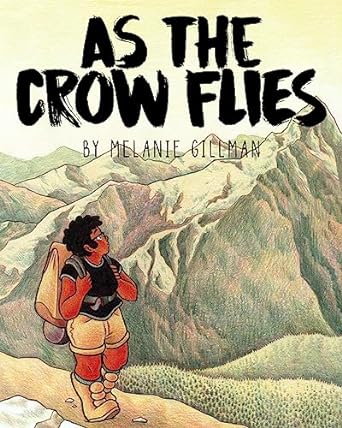
The book cover depicts a teen carrying a backpack and wearing boots, shorts, and a t-shirt, hiking through a landscape that includes mountain ridges in the background.

As The Crow Flies 

Melanie Gillman grapples with what it means to be black and queer in a Christian community—one in which non-white members are few and far between — in another coming-of-age graphic novel, As The Crow Flies

During a week spent at Camp Three Peaks, a religious summer camp, our protagonist, 13-year-old Charlie Lamonte, finds herself questioning her faith and identity, all while embarking on a strenuous expedition up a (literal and figurative) mountain.  As micro-aggressions abound, Charlie finds kinship and a reprieve from her loneliness in fellow outsider Sydney, a young trans girl who’s dealing with her own doubts.  Soft, colored pencil illustrations depict luscious mountain scenery in this former webcomic turned graphic novel. This is one that fans of ‘found family’ stories will enjoy.

Sharon Pruitt-Young is an Instructor and Research Specialist at East Columbia Branch. Aside from books, she is passionate about writing, urban sketching, trees, and art of all kinds. 
Bauder Lecture Series: Nadia Owusu

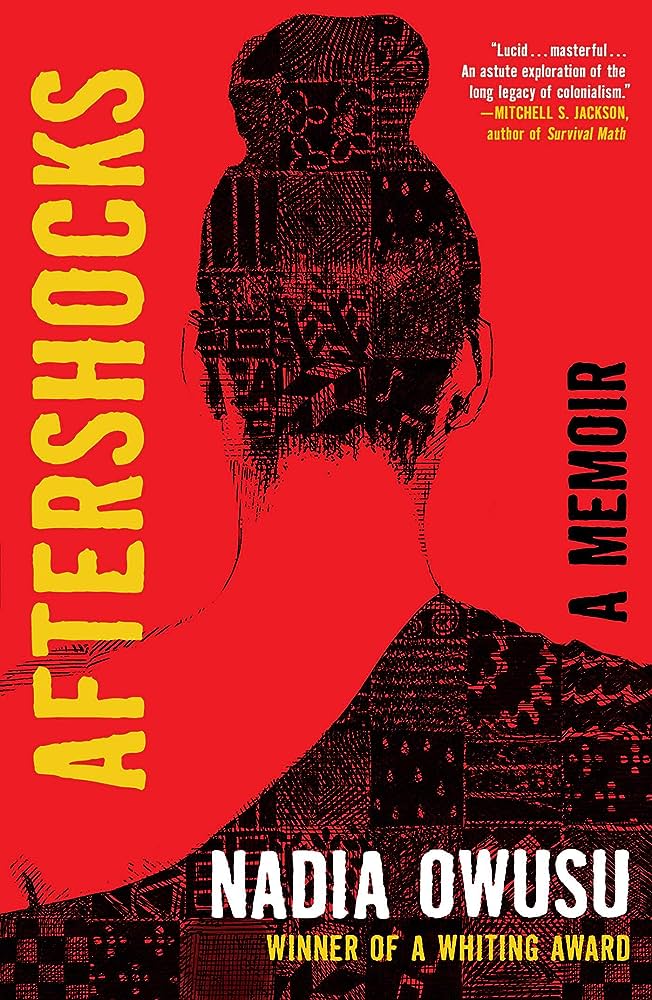
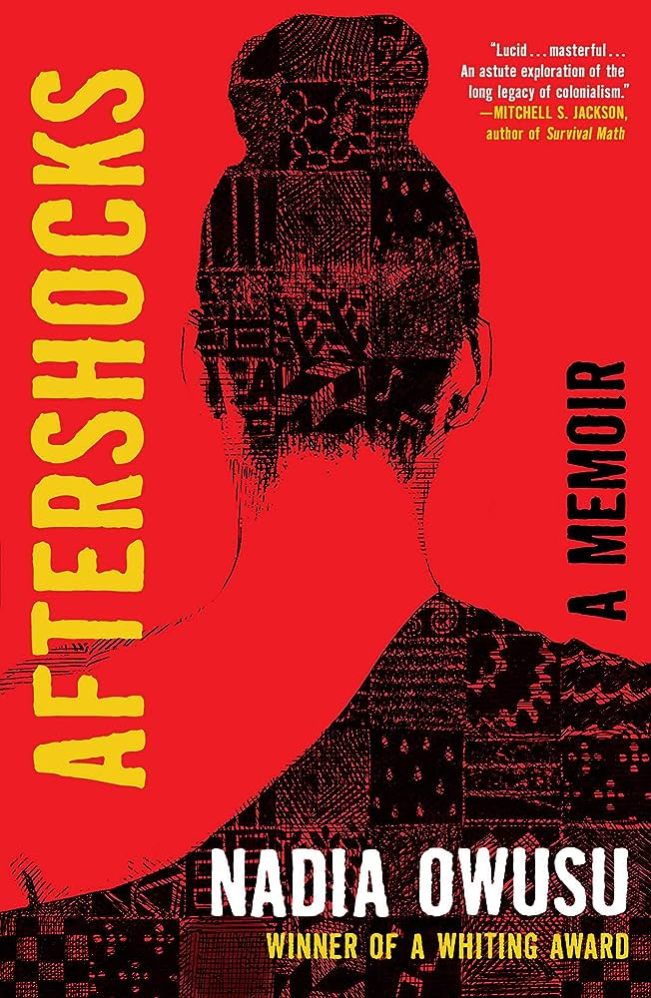
Red cover shows the silhouetted back of a woman with her hair up, her shirt and hair are covered in squares of textures and patterns.

For adults. Registration required.

Thu, Sep 21 | 6 – 7 pm
Howard Community College
Monteabaro Recital Hall (free parking available)
10901 Little Patuxent Pkwy, Columbia

Join us for the annual Bauder Lecture at Howard Community College, featuring acclaimed author Nadia Owusu.

Nadia Owusu is a Brooklyn-based writer and urbanist. Her memoir, Aftershocks, was selected as a best book of 2021 by more than a dozen publications, including Time, Vogue, Esquire, and the BBC, and has been translated into five languages. It was a New York Times Editors’ Choice pick, named one of Barack Obama’s favorite books of the year, and selected by Nobel Peace Prize laureate Malala Yousafzai for her Literati book club.

From the Publishers Weekly review:
The biracial daughter of an Armenian mother and Ghanaian father, Owusu’s early life was fractured by her parents’ divorce and multiple moves necessitated by her father’s U.N. career. Living in Rome at age seven, she was visited by her long-absent mother on the day a catastrophic quake hit Armenia, seeding an obsession with earthquakes “and the ways we try to understand the size and scale of impending disaster.”

Nadia Owusu is the winner of a Whiting Award in nonfiction and has received fellowships from Yaddo and Art Omi. Her writing has appeared in The New York Times, Orion, Granta, The Paris Review Daily, The Guardian, The Wall Street Journal, Bon Appétit, and Travel + Leisure. She teaches creative writing at Columbia University and at the Mountainview MFA program at Southern New Hampshire University, and she is the Director of Storytelling at Frontline Solutions, a consulting firm supporting social-change organizations.

Tope Folarin, a Nigerian-American writer based in Washington, D.C., will be introducing Ms. Owusu and moderating the discussion. He serves as Director of the Institute for Policy Studies and the Lannan Visiting Lecturer in Creative Writing at Georgetown University. He is the recipient of the Caine Prize for African Writing, the Whiting Award for Fiction, and a fellowship from the National Endowment for the Arts, among other awards. He was educated at Morehouse College and the University of Oxford, where he earned two master’s degrees as a Rhodes Scholar. His debut novel, A Particular Kind of Black Man, was published by Simon & Schuster.


The Bauder Lecture by Howard Community College is made possible by a generous grant from Dr. Lillian Bauder, a community leader and Columbia resident. Howard Community College will present an annual endowed author lecture known as The Bauder Lecture, and the chosen book will be celebrated with two student awards. Known as the Don Bauder Awards, any Howard Community College student who has read the featured book is eligible to respond and reflect on the book in an essay or other creative format. The awards honor the memory of Don Bauder, late husband of Dr. Lillian Bauder and a champion of civil rights and social justice causes.  

Aftershocks was selected by the Howard County Book Connection committee as its choice for the 2023–2024 academic year. The Howard County Book Connection is a partnership of Howard Community College and the Howard County Poetry and Literature Society (HoCoPoLitSo). Visit the Howard County Book Connection web page for additional information.

Aftershocks is available from HCLS in print, large print, e-book, and e-audiobook formats. HoCoPoLitSo will also have copies available for purchase at the event.

In partnership with Howard Community College and HoCoPoLitSo.

The Last True Poets of the Sea by Julia Drake

The cover shows line drawings of ocean vegetation floating against a background of blue water. The title is lettered in shades of pink, orange, and yellow.

by Ash B.

Not to be dramatic, but The Last True Poets of the Sea by Julia Drake is one of the most underrated novels I’ve read. It received positive reviews from Booklist, Kirkus, School Library Journal, and Publisher’s Weekly – and yet it still seems like not many people know about it. That’s why I eagerly recommend it whenever I can! 

Violet Larkin is a wild child – partying and doing all manner of things that a 16-year-old girl probably shouldn’t be in New York City. After her younger brother attempts suicide and her own reckless behavior worsens, her family sends her to stay with her uncle for the summer in the small coastal town of Lyric, Maine.  

Descended from a shipwreck survivor who supposedly founded Lyric, Violet is convinced that disaster runs in her blood. As she struggles with inner turmoil, she becomes determined to uncover the long-lost location of that shipwreck and the truth of her family history. With the help of new, unexpected friends, Violet discovers so much more – about herself, about love in all forms, and about surviving the emotional wrecks of life. 

After Violet starts working at the local aquarium in Lyric, the story seems like it might include a very “boy meets girl” romance with her coworker, but it delightfully diverges into something more refreshing. While there is a slow-burn teen romance with a bit of a “twist” love interest, that is far from the focal point of the book. I would say the core of the story is the complexity of mental health and the importance of allowing oneself to be (safely) emotionally vulnerable. The narrative balances the mending of relationships within Violet’s family, the importance of Violet building new friendships in Lyric, and the development of Violet’s relationship with herself. 

It is such a beautiful story of healing and connection. I really appreciated how Violet, an amazingly complex teen protagonist, opened my eyes to how mental illness and trauma can impact and manifest in such different ways depending on each person. For someone such as myself, anxiety typically causes retreating into oneself, isolating, and fearing the outside world. Social anxiety and generalized anxiety can really go hand-in-hand in this way, at least in my experience.  

However, for Violet, her anxiety – the storm she feels inside but doesn’t know how to healthily cope with – is sometimes the catalyst for her extroverted, often-risky behaviors such as partying, (underage) drinking in social settings, and flirting with much older men. Over the course of the novel, I grew to understand why someone like Violet might engage in those types of behavior (that would personally make my anxiety even worse) as a means of trying to avoid their inner struggles. 

This is a YA novel that I think can help so many people, teens and adults alike. It shows the importance of communication, self-love, healthy interpersonal relationships, and being kind to oneself while growing up. It challenges the idea that teens who “act out” are “bad” or “broken,” instead showing the nuanced reasons why unhealthy coping behaviors are used by young people who are struggling. Not to mention that it is beautifully written with crossover appeal for both YA and adult fiction readers. 

The characters of The Last True Poets of the Sea settled into my heart and have made a permanent home there. I read this book for the first time over a year ago and I still can’t stop thinking about it. When a book lingers with you long after you finish the final page, that tends to be a good sign. I loved it so much, I bought my own copy and I’m planning on re-reading it during my own trip to Maine this summer! If you’re interested in a contemporary coming-of-age story, I really hope you give this one a read.

Ash is an Instructor & Research Specialist at Central Branch and is a co-facilitator for Reads of Acceptance, HCLS’ first LGBTQ-focused book club. Their favorite place to read is spread out on a blanket under the shade of the tree. 

Half Sick of Shadows by Laura Sebastian

The cover shows a young woman in profile, in a long sweeping green dress with long hair flowing behind her against the backdrop of a full moon. She has a sword raised and resting over her shoulder.

By Sahana C.

Half Sick of Shadows caught me with its premise. Billed as a feminist version of Arthurian legend, I really wasn’t sure what to expect. King Arthur, the Round Table, and all of the many stories of knights and chivalry are…really not known for their peak feminist content. In fact, the two major women within Arthurian legend, Guinevere and Morgana, both end up being villains and betraying Arthur when he needs them most. But Sebastian lets the reader into a world where, it’s true, there are places that Guinevere and Morgana, and even Lancelot, could betray steadfast Arthur, but she makes sure the origins of the myth are clear. To do that, she introduces Elaine, a minor character in Arthurian lore who plays the leading role in one of Alfred Lord Tennyson’s famous poem, “The Lady of Shalott.”  

Tennyson’s Lady and Sebastian’s Elaine couldn’t be more different in terms of temperament, abilities, and importance, but elements of the poem are woven tightly into the narrative; the Lady falls for Lancelot at first sight, she has some sort of prophetic power, and she believes, deeply, that she is cursed. See, the Lady of Shalott can only see the world through the mirror above her as she weaves. Tennyson opens the poem with great detail about the beauty of the world outside only to tell us that the Lady never sees it. She sits with her back to the window, but cannot escape the draw of the world outside, and as it finds its way into her weaving, she glances at the mirror to ensure accuracy. In fact, in one of the most poignant stanzas of the poem,  

“But in her web she still delights 

To weave the mirror’s magic sights, 

For often thro’ the silent nights 

A funeral, with plumes and lights 

       And music, came from Camelot: 

Or when the moon was overhead 

Came two young lovers lately wed; 

‘I am half sick of shadows,’ said 

       The Lady of Shalott.” (Tennyson)  

Sebastian’s version of the Lady of Shalott, Elaine, is an oracle haunted by a tower in Camelot, just the same, but this Elaine takes control of her future. She is taught to understand her seeing by the Lady of the Lake, she lives among the Fae, and most importantly, she is the last addition to a group of children who grow up in Avalon, balancing between the Fae and the Human worlds. That group of children? Lancelot, Guinevere, Morgana, and Arthur himself. By setting up these friendships so firmly, Sebastian makes the thought of future betrayal gut-wrenching. Because the reader gets to follow her growth, it makes Elaine’s role as oracle and Arthur’s top advisor even more important. And this is the beauty of Sebastian’s story-crafting: Elaine, the fair damsel with no real grit, becomes Arthur’s top advisor and the most important woman in this world. Guinevere is bold and brash and deeply in love with Arthur, but could never be disloyal. And Morgana is the fiercest protector Arthur has on his side, her magic at his service, no matter the personal cost.  

Half Sick of Shadows by Laura Sebastian is well worth a read for those who appreciate historical fantasy, Arthurian myth, and coming-of-age stories, all in one.  It is available in print and eBook format. 

Sahana is an Instructor and Research Specialist at the Savage Branch. She enjoys adding books to her “want to read” list despite having a mountain of books waiting for her already.

Hunt for the Wilderpeople

At the top, it reads "From Taika Waititi director of What We Do in the Shadows." Across an almost clear blue sky is the title "Hunt for the Wilderpeople" flanked by antlers.  Three figures are shown in close up profile - one is an adolescent boy wearing a cheetah print trucker hat, the next is a bearded man wearing a hunting hat, and the last one is a boar that appears to be mid-laugh.  Across the bottom, there are grasslands and forested mountains shrouded in mist.

Review by Kimberly

Hunt for the Wilderpeople is an adventure-comedy-drama that follows rebellious twelve-year-old Ricky Baker (Julian Dennison) and gruff woodsman Hec (Sam Neill) on an unexpected journey through the wild bush of New Zealand. Ricky Baker has been dubbed a “real bad egg” foster kid whose crimes include spitting, throwing rocks, kicking stuff, loitering, and graffiti. This is his last chance to make it work, and he is not happy about it. The character of Ricky Baker personifies the way I remember adolescence feeling – being confident and cocky on the outside, but searching for a place to belong. It is a simple story told well with the gorgeous setting of New Zealand as backdrop. 

Director Taika Waititi (Jojo Rabbit, Boy, What We Do in the Shadows) has an uncanny ability for storytelling. He strives to change the conversation by addressing the plights of those who have been marginalized and ignored in mainstream movies. He then captures their narrative in a touching, yet playful, way. He doesn’t adhere to standard tropes or stereotypes. Waititi creates a quirky and sympathetic characters that leaves you rooting for the underdog.

I found this coming-of-age tale funny, charming, and intoxicating. It doesn’t shy away from hard topics – delving into themes of foster care, abuse, and grief. However, it never takes itself too seriously: it is rife with banter and one-liners that are perfect fodder for inside jokes – and may even have you adopting some kiwi slang.  This film has the makings of a cult classic. Taking my cue from Ricky Baker, I’ll summarize my review with a haiku:

Its one of a kind

Finds beauty in the heartbreak

Nature meets gangster

If you watch this FILM,
please COME BACK and SHARE WITH US
your haiku BELOW.

Find Hunt for the Wilderpeople on Kanopy

Hunt for the Wilderpeople is rated PG-13 for thematic elements including violent content, and for some language.

Kimberly is a DIY Instructor and Research Specialist at the HCLS Elkridge Branch.  She enjoys reading, photography, crafting, and baking.

Red at the Bone by Jacqueline Woodson

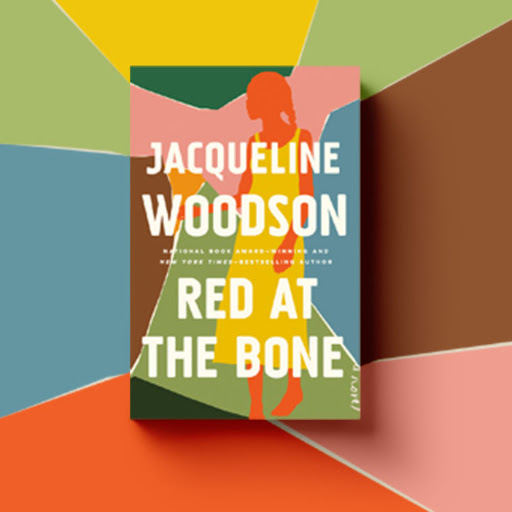
Bright color blocks frame the silhouette of girl, with her figure in red and dress in yellow. The author and title appear in large white text across the middle.

Review by Claudia J.

For the ancestors, a long long line of you bending and twisting

Bending and twisting. 

Memory has a way of blurring the lines between fantasy and reality, making it hard to decipher the truth. It is joyous, painful, and strange all at the same time. Jacqueline Woodson hits at each of those emotions in her latest novel Red at the Bone. She opens her novel at a coming-of-age party for 16-year-old Melody, taking place in her grandparents’ Brooklyn brownstone. Her custom-made dress, full of symbolism and pride – fit for a blossoming woman, was originally meant for her mother, Iris, 16 years earlier. From this fact spirals a series of memories, told from the perspectives of Melody, her parents, and her grandparents at different points in their interesting lives. 

Through these memories, Woodson peels away layers of trauma and triumph of this Brooklyn family. By doing so, she relates her story to the millions of black and brown families experiencing similar burdens. The burden of love. The burden of neighborhoods changing. The burden of your goals vs. the goals set for you. Woodson weaves these characters through themes of identity, sexuality, ambition, pride, and purpose. But, most of all, it tells the story of parenthood and how expectation fights reality in bending and twisting ways.

Red at the Bone is lyrical, reflective, and insightful; a poetic tale of a family that continues to bend and twist its way through life. At a time of reflection and healing, Red at the Bone is a great read to get us through a time of significant change. I truly loved this book and I think you will too.

Available in ebook and eaudio through Libby.

Claudia J. is has worked for Howard County Library System for more than four years. She enjoys writing on rainy days and drinking iced coffee on sunny days.