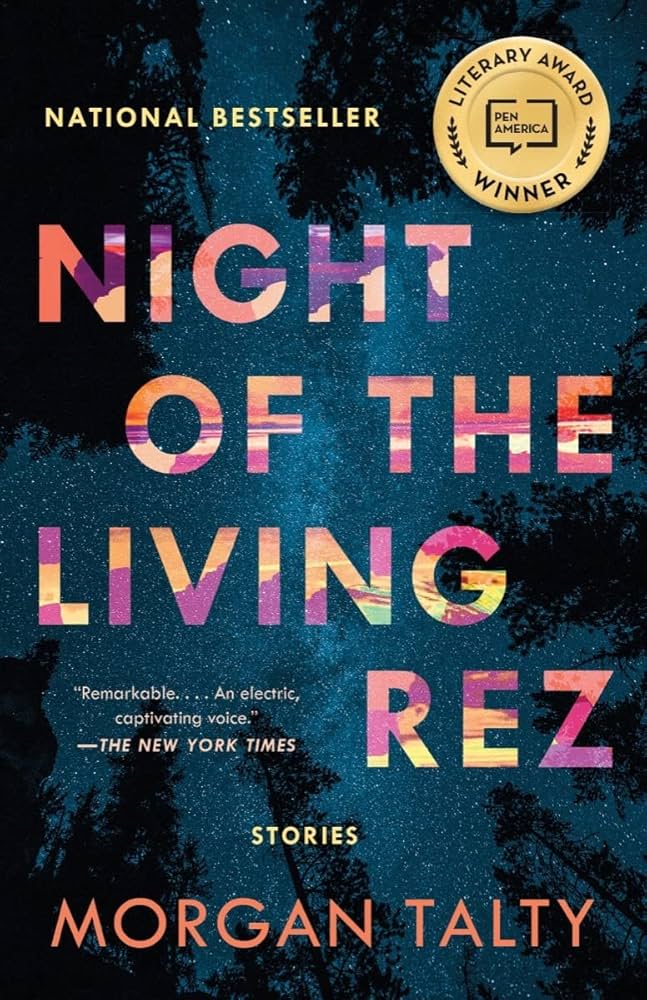
Night of the Living Rez by Morgan Talty

by Kristen B.

My book discussion group (Books on Tap) recently discussed Night of the Living Rez by Morgan Talty. I try to choose books that reflect the time of year, as well as to prioritize authentic voices. This book worked for November because Morgan Talty is a Native American author, and his book collects a series of inter-connected short stories about David and his family and friends on the Penobscot reservation in Maine.

In all honesty, the book is as bleak as any other work that deals with generational trauma and chronic poverty. However, it is laced with gorgeous prose, mostly in scenes describing the local woods and river. Talty has a sense of the poetic that shines through even the most difficult situations – including the description of a car crash that perfectly captures the halting, photo-flash moments of impact and aftermath. Surprisingly, along with the spare dismay of the stories, Talty also offers a pitch-black sense of humor. The sheer absurdity of teenage boys and their antics relieves the otherwise unrelenting sense of nowhere to go and nothing to do that permeates this book. Sometimes it’s true: you have to laugh instead of cry.

Eleven of the twelve chapters are tightly told from young David’s point of view – and his almost complete lack of understanding of what’s happening with the grownups in his life. His relationship to his grandmother is the foundational relationship of the book, as it was for his life. That special love grounds the stories and makes them real, in ways that the cigarettes, drugs, and drinking couldn’t. The love and the bad decisions weave so intimately that the inevitable heartbreak registers as simply, devastatingly true. The tight narrative focus is a fascinating authorial choice, but not until the last section do all the pieces truly come together in any sort of coherent way. It’s worth getting there with adult David, with compassion and forgiveness for the bone-headed youth that he was.

I’m not sure this review is going to convince you to pick up this book, but you should! I was heartened by reactions of the folks in my book club. They found value in the language, the author’s choices of what to share, in the universality of the stories, and in the need to laugh in the face of despair. Night of the Living Rez is a stellar beginning for a new author. I will eventually read Talty’s new novel, Fire Exit, but I need to continue to sit with this volume first.

Night of the Living Rez by Morgan Talty is available in print, e-book, and e-audiobook.

Kristen B. is a devoted bookworm lucky enough to work as the graphic designer for HCLS. She likes to read, stitch, dance, and watch baseball (but not all at the same time).

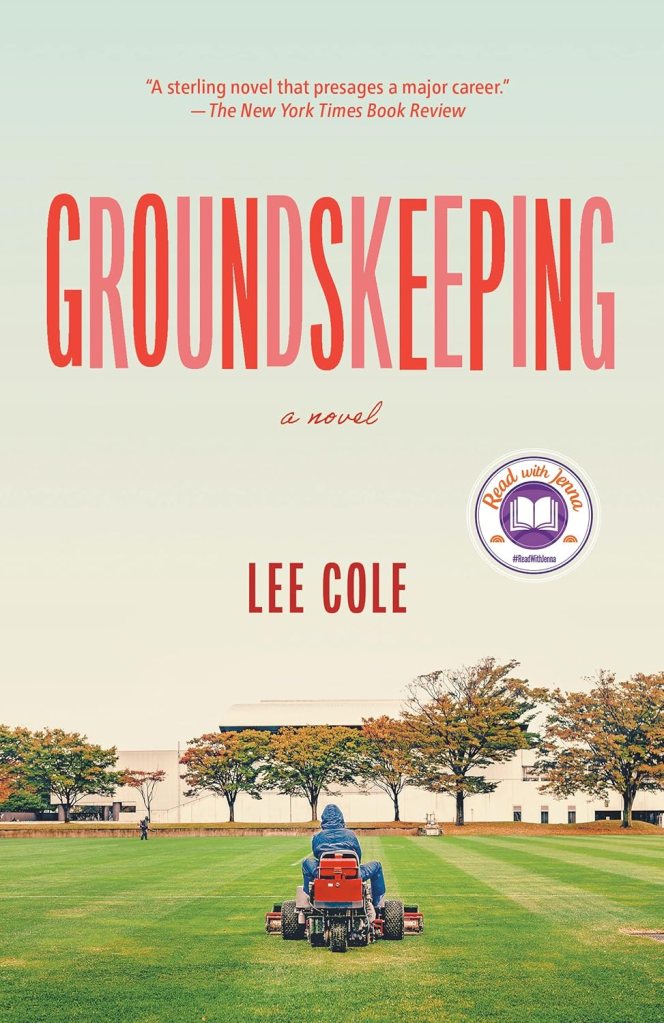
Groundskeeping by Lee Cole

The book cover shows someone in blue jeans and a blue hoodie riding a red lawn mower across a vast expanse of lawn towards trees and a large building. The rider's back is to the viewer as if moving in the opposite direction.

by Kristen B.

Books on Tap (an HCLS book discussion group) recently discussed Groundskeeping, seemingly an ideal title for book clubs: well written, timely, and with just enough spaces in the story to poke at. This debut novel by Lee Cole takes place at small liberal arts college in western Kentucky in 2016. The heart of the story revolves around a coming-of-age journey for Owen Callahan, a rather fatalistic young man with dreams of becoming a writer. After he graduated from a local state college, Owen ended up in Colorado, living out of his car, working odd jobs, and doing drugs. In the manner of a prodigal son, he swallowed his pride at age 28 and moved home into his grandfather’s basement. When we meet him, he has taken a job on the groundskeeping crew at the local college, which pays for creative writing classes.

As the book opens, Owen is lurking in the corner at a friend’s party as the new semester begins. He strikes up a conversation with an attractive young woman, who claims to come from a country that no longer exists. Alma provides the other half of the story’s equation, as the child of Bosnian Muslims who fled to the States when Yugoslavia fell apart. She grew up in northern Virginia, an Ivy League-educated over-achiever who became a published author fairly quickly. She has won a year-long fellowship at Ashby College, where she’s teaching workshops and polishing a volume of poetry.

The attraction that begins at the party blossoms into a true romance, with all the requisite drama and confusion. Owen and Alma are an “opposites attract” couple in almost every sense. He’s wholly from Kentucky and wants nothing more than to make his way out into the world, both physically and professionally. She has all the advantages-economic status, education, literary success, and a path forward, but her family’s history is rooted in trauma and tragedy. Given these fundamental differences, Owen and Alma have the capacity to both hurt and heal each other to staggering degrees.

A wide variety of supporting characters make the spaces and situations believable. Owen’s family sheds light on the disaffected rural Americans who became Trump supporters in the pivotal 2016 election. His uncle rages against opportunities lost while addicted to pain killers. His co-workers at the college provide another set of perspectives, and Alma’s family demonstrates how immigration (in something close to a refugee situation) can be a mixed blessing.

Cole’s language offers a constant recursive flow of Owen learning how to write and how to love, as he journals about the details of his days and discusses writing assignments. Combined with the richness of the characters, this is a more discuss-able book than is immediately apparent. In many ways, the setting is the third main character of the book. The hills, rivers, flea markets, bars, towns, and even the jargon and accents of western Kentucky give the novel a veritable grounding – a ground to keep, indeed.

Groundskeeping by Lee Cole is available in print, e-book, and e-audiobook.

Kristen B. is a devoted bookworm lucky enough to work as the graphic designer for HCLS. She likes to read, stitch, dance, and watch baseball (but not all at the same time).

Sigh, Gone by Phuc Tran

The book cover shows a school picture of the author as a child, against a gray background. He is wearing a white shirt with a collar beneath a peach sweater.

By Holly L.

When I first glimpsed the cover of Phuc Tran’s powerful 2020 memoir, Sigh, Gone, I chuckled at the title. Sigh Gone—hahaha, I get it! As in Saigon. As in Vietnam, the country Tran fled with his family as a little boy in the mid-70s. The unsubtle title perfectly suits the story of, “a misfit’s memoir of great books, punk rock, and the fight to fit in.” In his debut book, Tran tells a compelling coming-of-age story of a book-obsessed punk in small-town Pennsylvania. His case for the transformative power of books struck a chord with me, as a library worker. As an Asian American who also came up in 1980s America, I empathized with Tran’s struggle to fit into a society that was relentlessly calling his American-ness into question.   

Each of the book’s sections is titled with a famous work of literature, the prologue being Oscar Wilde’s The Picture of Dorian Grey. The opener is a scene from Carlisle Senior High School in Carlisle, Pennsylvania, a small town in the Susquehanna Valley. Tran is sizing up the new kid, Hoàng Nguyễn, whose arrival marks Phuc’s demotion as the (meaning only) Vietnamese kid at his school. “@#$% that kid,” he thinks. Rather than seeing Hoàng as a potential comrade, Tran regards him as “a fun-house mirror’s rippling reflection of me…I was filled with loathing.” By this time, as an eleventh-grade Asian kid who had finally achieved “insider status”—acceptance among his punk crew and being better read than any of his classmates—Tran saw Hoàng as only a distorted picture of who he might have been had he not assimilated so well.

The story begins in earnest in 1978 with Tran’s earliest memory. He’s in the eat-in kitchen of his family’s first apartment in the United States, having fled Vietnam three years earlier. While his mother prepares dinner and his father tries to make sense of some bills with his limited grasp of English, Tran asks his dad, “Ba, what’s my name?” The question arises from playground encounter when another kid asked Tran his name and he didn’t know how to reply. Among all the nicknames and endearments he was labeled with by his family, he didn’t know which name to give. Young Tran felt he needed a name, an English name, that would make sense to his playmates. After a minute of consideration, Tran’s dad decided that the actual Vietnamese pronunciation of his name (which sounds more like Fuhp, with a rising tone at the end) would be too confusing to Americans, and he settled on Phuc (sounds like Fook, rhymes with Luke), which Tran adopts, referring to it as an alter ego.

Tran’s story takes us from childhood through adolescence with identity being a central theme. As he forms friendships and battles racist bullies, Tran struggles to define who he is, along with where he and his family fit in a mostly white working-class town. He expresses an ambivalence about his community, “(as refugees) random strangers had saved us. And random strangers were cruel to us, too.” Violence is another thread running through the memoir, inflicted upon Tran by school bullies and members of his own family.

He finds refuge and a means of self-fortification through books (first comics then Western classics) and later, music, specifically punk rock and its rebellious, non-conformist subculture. Tran’s scuffed Doc Martens and rotation of band T-shirts represent an identity of his choosing, not one imposed upon him by society. As Tran’s reinvention into honor-roll skate punk becomes complete, we see a growing alienation from his family, whose notions of success and assimilation don’t align with his own. One exception being Tran’s second-hand store hauls, approved of by his thrift-conscious father.

Some reviewers criticized Tran’s memoir as lacking in nuance and maturity, but I loved how he channeled the voice of his teenage self in all its egocentric, pained, misunderstood glory. In the best scenes I felt like I was right there, hanging out with his crew, cheering them on when they successfully fled the cops on their skateboards during their annual “Running of the Pigs.” By the end of the book, I felt a kind of pride in this self-made young man, considering how far he had gone, what he had endured, and who he had become. I almost wished for another few chapters detailing the adventures that awaited Tran beyond graduation. But that was the end of the story, at least until he writes another memoir. Sigh, gone. 

Sigh, Gone is available from HCLS in print and also in e-audiobook and e-book formats.

Holly Learmouth is an Instructor & Research Specialist at HCLS Miller Branch. She enjoys reading widely, knitting sporadically, and baking as often as she gets the chance.

The Loney by Andrew Michael Hurley

The book cover portrays the title from the bottom to the top, with the "y" at the end of "Loney" splitting into a dead tree branch with a foreboding house in the background, all in white against a black backdrop.

By Julie F.

I took everything that was offered that morning – the warm sunlight, the soft shadows on the fields, the spangle of a brook as it wound under some willows towards the sea – and managed to convince myself that nothing would harm us.

Such naivety makes me laugh now” (173).

Confession: passages like the one above give me shivers. I’ve never been a horror fan. My experience with horror films consists of a mediocre made-for-TV movie called Midnight Offerings at a high school party, featuring Melissa Sue Anderson of Little House on the Prairie fame, and a viewing of The Shining with fellow grad students back in 1992. That’s it. Books, even less. Stephen King? I adore his nonfiction, follow him on Twitter, and used to read his columns in Entertainment Weekly religiously. But I can’t bring myself to tackle Carrie or Salem’s Lot.

Splitting hairs when it comes to genre, though – most librarians do this with aplomb. My brain has always differentiated between horror and ghost stories, and I love a good ghost story. Starting with the Victorian favorites in the genre, the short stories of J.S. LeFanu and M.R. James, all the way to The Woman in Black by Susan Hill and The Little Stranger by Sarah Waters, the touch of the paranormal that wends its way into the life of unsuspecting mortals on this plane thrills and fascinates me. A more recent but equally compelling genre, folk horror, bridges the gap between ghostly folklore and fiction. As noted by editor Dawn Keetley in Revenant, the journal of the supernatural and the weird, “folk horror is rooted in the dark ‘folk tale’, in communal stories of monsters, ghosts, violence, and sacrifice that occupy the threshold between history and fiction.” There are some incredible writers forging creative new work in this genre, and Andrew Michael Hurley is one of the best.

The Loney opens with a group of modern, penitent pilgrims making an annual trip to the title locale, “a wild and useless length of English coastline” (3), where they spend a week at Easter, culminating with a visit to St. Anne’s shrine. It’s 1975, and we are seeing all this through the viewpoint of the teenage narrator, nicknamed “Tonto” by the young, wise-beyond-his-years priest who accompanies the group. Tonto knows that his situation is unusual; his brother Hanny has been mute his entire life, and his excessively devout mother (Mummer) is determined to pray her way to healing for him. For her, religion, and particularly the rituals enacted that comfort her year after year, are the only possibility for a cure.

While staying on the Loney in what could barely be described as a village, a number of disturbing acts take place: an effigy made of animal parts is hung in the woods, Father Bernard is warned to stay away from the pub, and a wooden statue of Jesus that hung in the local church is smashed to bits on Easter morning. Tonto experiences a sense of creeping unease when a gull with a broken wing suddenly takes off in flight. The locals don’t seem disturbed when a dead tree struck by lightning decades ago suddenly sprouts a new branch, or when their apple trees, usually ripe in autumn, are laden with spring fruit virtually overnight. There’s a healing power at work in this weird place that has nothing to do with Mummer’s fervent Catholicism, a power emanating from beliefs and practices that are much, much older than her faith. In the framing story, we learn that Tonto was shaken by everything he learned to the point that, decades later, he’s lost his faith: “Like Father Bernard said, there are only versions of the truth. And it’s the strong, the better strategists who manage them” (294).

The dark, brooding atmosphere permeates the novel, catapulting Hurley into fame as one of the foremost practitioners of folk horror and earning him praise from Stephen King (“An amazing piece of fiction”) and the Costa First Novel Award. He conveys a sense of otherworldly, uneasy time and place that can only result in the darkness of savage nature reclaiming itself: “I often thought there was too much time there. That the place was sick with it. Haunted by it. There was nowhere for it to go and no modernity to hurry it along. It collected as the black water did on the marshes and remained and stagnated in the same way” (31). If you’re in search of an eerie Halloween read that doesn’t spell everything out but stretches the imagination relentlessly – a book that also addresses real questions of faith and family from the eyes of a boy coming of age – then read The Loney.

Julie is an instructor and research specialist at HCLS Miller Branch who finds her work as co-editor of Chapter Chats very rewarding. She loves gardening, birds, crime fiction, all kinds of music, and the great outdoors.

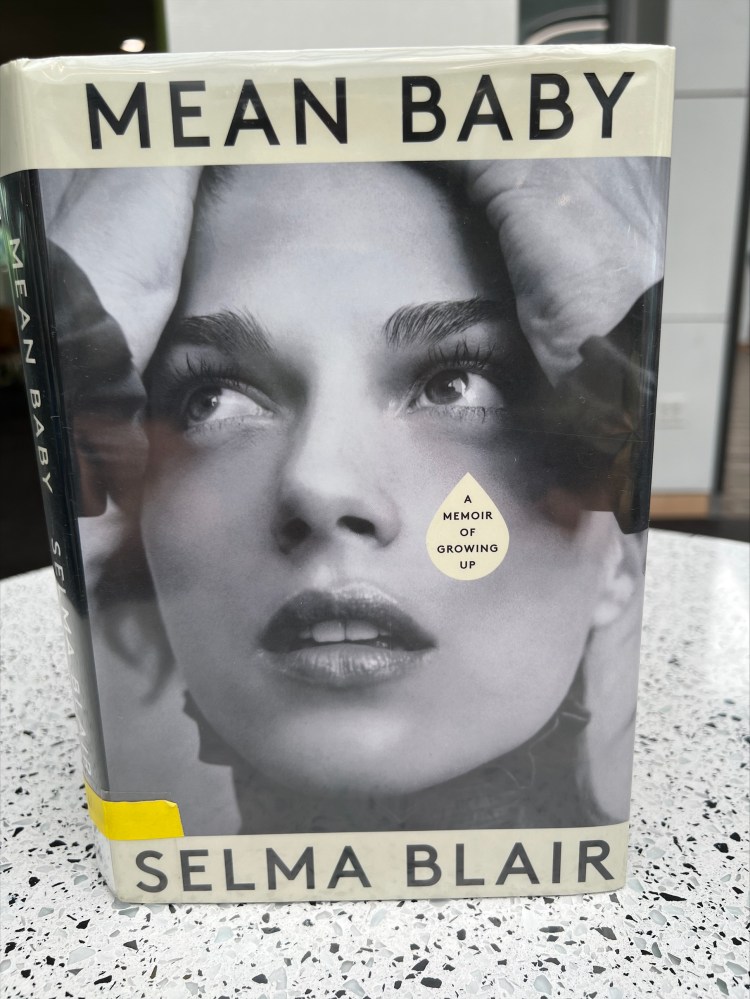
Mean Baby by Selma Blair

The picture shows the book on a marble-topped table. The cover is a picture of author Selma Blair, her hands on the top of her head, looking skyward.

by Carmen J.

You may know the actress Selma Blair from her notorious same-sex kiss in Cruel Intentions or her frenemy role in Legally Blonde. Most recently, she has been a Multiple Sclerosis (MS) advocate, following her diagnosis in 2018. She is also the creator of an ability-inclusive beauty brand, Guide Beauty. And even if you knew none of this or all of this, her 2022 memoir Mean Baby shows us another side of Selma Blair: gifted writer.

Mean Baby takes us on a sometimes-meandering journey of Blair’s childhood marked by trauma, her adventures in the career pursuit of acting, motherhood challenges, addiction battles, family and romantic relationships, and her MS diagnosis and advocacy. Between the pages, you’ll uncover an impressive writer with an eye for exposing the good, the bad, and the ugly of a life well-lived. Although not a light-hearted read nor a page-turner, you will find Blair’s detailed accounts are those to savor and reflect upon. Mean Baby showcases the life of a survivor, thriver, and fighter with the vivid writing of a robust storyteller.  

Mean Baby is available from HCLS in print and large print, and as an e-book and an e-audiobook from Libby/Overdrive.

Carmen J. is a teen instructor at HCLS East Columbia. Among her favorite things are great books, all things 80s, shamelessly watching The Bachelor, gardening, and drinking anything that tastes like coffee.

Everyone in This Room Will Someday Be Dead by Emily Austin

A pale yellow cover features bunnies in many poses and many colors, with the title in a quirky script.

By Sahana C.

This book is cathartic. It feels like therapy, except things get way worse, more cringey, and infinitely harder to handle before the payoff hits, and all of the suffering of the previous two-thirds of the book ease into something manageable and even likable.  

I will not lie – I judged this book by its cover. There was something about the whimsical nature of the rabbits juxtaposed with the bold cursive proclaiming “everyone in this room will someday be dead” that struck me. What room? The very room I was in? I looked around the adult fiction section of the Savage Branch surreptitiously to see who was nearby. I went back up to the front desk, still holding onto the book, and thinking, “Yeah, actually, that’s true.”  

Dear Reader, obviously. This is not a new concept, that everyone, one day, dies. But sometimes, a book like this will bring this into perspective, throw a new light on something you know deep down but don’t consider very often. Emily Austin’s debut novel has moments I’m sure she would categorize as semi-autobiographical (I threw the “semi” in there for her sake, as the main character, Gilda, is truly a disaster), especially since there are moments in the book that I felt were semi-autobiographical and was alarmed at how close Gilda had gotten to my reality.  

Emily Austin was not referring to the Savage Branch when she was referencing her room. She was talking about every room Gilda, a noted hypochondriac, ever walked into. Gilda is a twenty-something lesbian and atheist, well known in the emergency room at her local hospital to the point that the janitorial staff know her by name. When we first meet her, she has just been in a car accident and broken her arm, a more physically obvious issue than the anxiety that normally brought her in for a check-up. In an attempt to get her anxiety under control, Gilda follows a flyer for free therapy to a Catholic church, where she meets Father Jeff and accidentally gets a job instead of therapy.  

From there, Gilda searches for a missing cat, deals with her younger sibling’s deteriorating mental health, tries to keep her old friends, tries to pretend like she’s Catholic, well-meaningly catfishes an old woman, and tries to solve a murder mystery that might not have involved murder, actually, all while trying to stay afloat.  

I read this on a long plane ride, which perhaps compounded the feeling of claustrophobia as Gilda kept tangling herself further and further in her web of lies. It meant that as I was reading an especially cringey section and closed the book for a moment, I couldn’t get up and go for a long walk, like I normally do. I was confined to the middle seat, stuck between two people who were fast asleep and were completely unaware of my distress, and, much like Gilda, all I could do in that moment was keep going. Keep reading and hope that somehow, something was going to get better.

Thank goodness it did, because otherwise, also like Gilda, I probably would have had a nervous breakdown. This book is wholly about the existential dread that comes with being an adult and looking around to realize your general existence is not exactly what you thought it’d be, then figuring out how to cope with that anyway. 

I would like to make it very clear that I do, indeed, like this book. I want everyone to read it, despite how difficult it can be. I’ve been recommending it to everyone, describing it as “anxious queer fiction” and asking friends, “Have you ever felt completely directionless and stuck? Well. Gilda will make you feel better. Because she had it worse.” I think if we all take a moment to reflect, the way Gilda does, on the way things are going, we might not always like what we see, but at least we know that we’re not alone in our discontent.

(And if you really want to feel like you’ve got a community, look at the Goodreads reviews for this book here.)

Everyone in This Room Will Someday Be Dead is available in print and eBook

Sahana is an Instructor and Research Specialist at the Savage Branch. She enjoys adding books to her “want to read” list despite having a mountain of books waiting for her already.

My Teacher Blew Up the Moon: Assassination Classroom by Yusei Matsui

Bright yellow cover has a broad smile and two pinpoint black eyes under the title.

by Khaleel G.

The old saying goes, “Don’t judge a book by its cover” – but what about a title? 

Assassination Classroom is a manga whose title initially repelled me. Even with its bright and simple covers, I looked at a volume, read the back description, and wondered if this was another manga like Death Note. You know, that sort of intensely serious story, full of extended monologues about power and authority, each chapter twisting into the next. Because, after reading Death Note, I was satisfied; I didn’t need another version of that grim-dark comic book. With a title like “Assassination Classroom,” how could this series be anything else?

Well, I couldn’t have been more wrong. Assassination Classroom has an overall story, yes, and it certainly has intrigue: spies and soldiers working in the shadows of government organizations, with alphabet soup names. But mostly, it’s a gag manga. Yes, the manga about a class of teens attempting to kill their omnipotent teacher is, shockingly, mostly about dumb jokes and silly characters learning about themselves. 

One day, the moon suddenly explodes. The culprit makes himself known to the world with a declaration: I will destroy the world in one year’s time, unless I am stopped. He is a monster of superhuman strength and speed, who then demands the world government let him…teach a class of lovable misfits? Did I mention the monster is tentacled, bright yellow, and wears a classical teacher outfit with a robe and square hat? 

In another author’s hands, this premise would be deathly serious in tone. But here, author Yusei Matsui takes all that global turmoil and high stakes and makes it super light-hearted. Koro-sensei (a pun on “to kill” in Japanese) has threatened to destroy the world, yes, but he also wants to actually teach these kids – not only about science, math, and literature, but growing up and being a better person, too. And uh, also firearms, subterfuge, and assassination techniques, as he playfully dodges their barrages of bullets, all while offering praise and critiques.

Over 21 volumes, we meet the students and fellow staff at the school, watching them react to this absurdity. Nagisa, the closest thing to a protagonist we have, was bullied for his small frame, but under Koro-sensei’s tutelage, he learns how to accept himself and be confident. Mr. Karasuma is a military officer charged with overseeing Koro-sensei, but as he teaches both gym and martial arts, he softens into a capable instructor. Even Miss Jelavic, a trained assassin disguised as an English instructor, learns that education is a two-way street – as you teach, you learn more than you’d imagine.

Yes, it is corny! Underneath the global plot to destroy a banana-colored octopus, the story is heartfelt and honest. I was fairly effected by the series’ conclusion, despite the tonal clash throughout. The simple and cartoonish art makes the characters more personable, making both the jokes and earnest conversations more meaningful. No one is some “cool” and impervious hero – they’re students and teachers, goofing off while learning how to be better than they are.

In this way, Assassination Classroom resembles a coming-of-age school story, like Ouran High School Host Club (with guns) or Naruto (but far less serious). Its title hides the lightness of plot, how quickly and jovially it moves from school trip to midterms to holiday breaks. The result is a pleasure to read, for its stream of gags and touching moments, for Koro-sensei’s silly faces and his quips of honest wisdom.

Be aware though – this is a title for older teens and adults. The violence of the series is mostly unserious, but the lives of these students and teachers sometimes share the mature themes of the best of Young Adult literature. Bullies, abuse, and family trauma are the dangers in these characters’ lives, not the moon-destroying creature who can move at Mach-20. Still, this is a comedy series first and foremost, and these more “real” themes come forth only in certain moments, and never in a way that I found triggering.

I really enjoyed my time with Assassination Classroom, and was delighted to see how wrong I was to judge this one by its title.
 
Assassination Classroom is 21 volumes and is available in print from HCLS branches.

Khaleel has worked at the Miller Branch since 2015, though he’s been back and forth between HCLS and high school, college, an

Jacqueline Woodson: Brown Girl Dreaming and Another Brooklyn

Reviews by Kristen B.

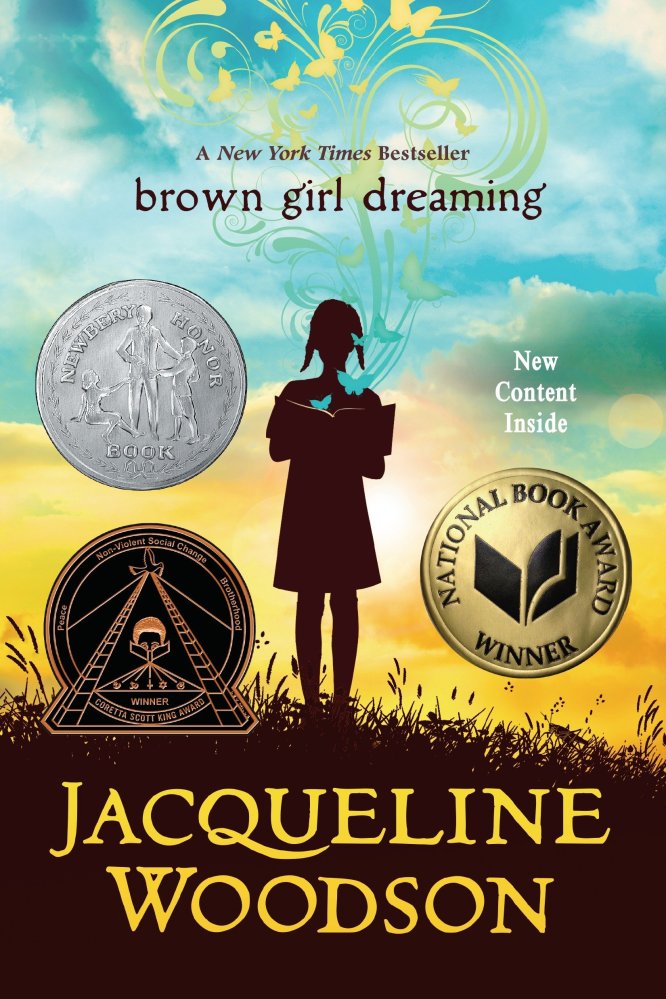
Brown Girl Dreaming may be one of the most beautifully poignant books I’ve ever had the privilege to read. This autobiographical text told in verse relates Woodson’s childhood memories of both Brooklyn, NY and her grandparents’ home in rural South Carolina. I loved the glow of fireflies appearing in the summer dusk, and my heart ached with the understanding that her brother had been lead poisoned by paint in an old tenement. This lovely volume brings us the complete open-hearted bewilderment of a child learning about her world. Dirt driveways and city asphalt combine into a mesmerizing memoir that, while it might be labelled for teens and children, brings truth to all its readers (also available as an eBook and eAudiobook). Woodson received a 2020 MacArthur Fellows Grant.

Woodson continues the coming-of-age theme in her novel, Another Brooklyn. In some ways, I read this as the grown-up version of Brown Girl Dreaming even though its more novel and less memoir. August is returning to Brooklyn for a funeral, and as she travels she can’t help but remember her childhood – the lives of the four fast friends growing up in the 1970s in Brooklyn. The storytelling is still lyrical, if not exactly in verse. The vignettes of the girls’ lives gave me both the feeling of being a young teen again, with all those emotions and upsets, as well as a glimpse of the bigger, national picture that was unfolding around them. Like in the previous book, you get the family nostalgia for an unkind South as well as the hard edges of the northern city. The author does not pull any punches as the girls get older, the problems get thornier, and the solutions ever more doubtful. (also available as an eAudiobook).

These are dreaming books, a little beautiful and a little disturbing, with a haze of remembering to them. But they carry truth, and truth can be hard to hear. Both of these books live on my keeper shelves, and I revisit them periodically. I hope you love them, too.

Kristen B. has worked for HCLS for more than 15 years, and currently hosts the Books on Tap discussion group at Hysteria Brewing Company. She loves reading, Orioles baseball, and baking.

Read While Isolated

The cover depicts an open pocket watch against a black cloth background with small, glowing astrological symbols.

by Piyali C.

At the beginning of the pandemic, I found it difficult to focus on books. It seemed like Emily St. John Mandel’s dystopian novel, Station Eleven was playing out right in front of me. However, when physical distancing became a part of our daily routine, I took to reading so I could escape to other worlds created by authors. The books below are some of the ones that I truly enjoyed as I read them during isolation, borrowed from Howard County Library System.

The Pull of the Stars by Emma Donoghue (available in print, ebook, eaudiobook): A fascinating story of nurse Julia Powers, who works in the maternity ward of a hospital in war- and flu-ravaged Dublin in 1918. She takes care of expectant mothers fallen ill with the raging Spanish flu. With the help of a rebel woman doctor and a young orphaned woman, Nurse Powers tends to the needs of the quarantined pregnant women in her care to the best of her ability under the circumstances.

The Book of Lost Friends by Lisa Wingate: (available in print, ebook, eaudiobook) Told in the alternating voices of Hannie, a recently freed slave in 1875, and Benedetta Silva, a young new teacher in a tiny town in Louisiana in 1987, this story takes us through the Reconstruction era in America with Hannie, as she travels to Texas with two unwilling companions, Miss Lavinia and Juneau June, in the hope of finding her family members who were sold as slaves in different cities and towns. Benny Silva, while trying to engage her unwilling students in their own history, comes across the story of Hannie’s journey in the library of a run-down plantation house. The discovery of this quest brings forth a fascinating story of freed slaves trying desperately to reconnect with family members lost to slavery in 1870’s America.

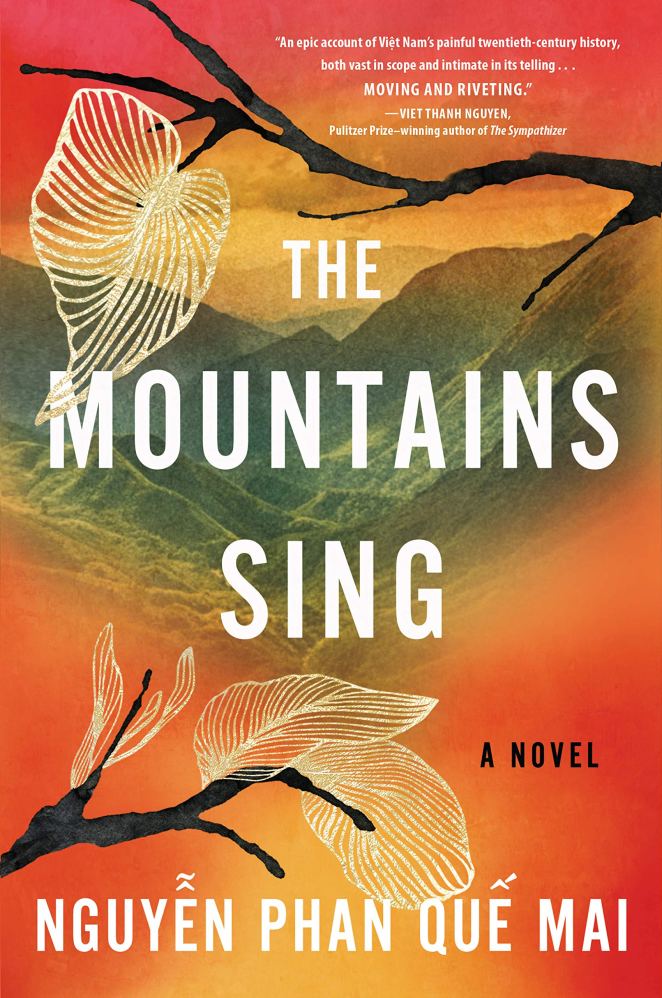
The Mountains Sing by Nguyen Phan Que Mai (available in print, eaudiobook): Drawn from the author’s own experiences of growing up in postwar Vietnam and from interviewing countless people who lived through the horrors of the Vietnam war, Ngyuen Phan Que Mai writes this amazing story of a family torn apart, not only by the war, but also by the subsequent division between north and south Vietnam. While the story talks about the unbelievable horror that wars inflict on human life, it also sings an ode to indomitable human resilience and a desperate mother’s inexplicable courage and determination to keep her children safe.

A Good Neighborhood by Therese Anne Fowler (available in print, ebook, eaudiobook): Valerie is a 48-year-old Black woman, a single mom to Xavier, and an ecology professor who nurtures a deep love for plants and trees. Brad Whitman is an entrepreneur who has risen up in wealth and power from humble beginnings. Brad builds a gorgeous house next to Valerie’s and moves in with his wife Julia, step daughter Juniper and daughter Lily. As a relationship starts to build between Valerie and Julia, an incident regarding Valerie’s favorite tree causes a rift between the two families, resulting in a law suit. But Xavier, Valerie’s 18-year-old son, and Juniper, Julia’s 17-year-old daughter, are also building a beautiful relationship. How much acceptance will an interracial relationship receive, not only from society but also from Brad Whitman? Told from the perspective of the neighbors of both Valerie and Brad, this story explores complicated race relations between Black and White, loss of innocence, coming of age, struggles of women, and much more. 

What did you read during isolation? Tell us in the comments.

Piyali is an instructor and research specialist at the Miller Branch of HCLS, where she co-facilitates both Global Reads and Strictly Historical Fiction.