In Amy Schumer’s recent Netflix comedy special, Emergency Contact, she talks about getting married in terms of finding someone who can stand you. In Really Good, Actually, the debut novel by Monica Heisey, the struggle is indeed real.
Heisey, who has written for Schitt’s Creek, infuses her novel with laugh-out-loud moments from Maggie’s dating escapades and their quirky outcomes. Really Good, Actually reads like a more modern-day Sex and the City. Instead of Carrie and her straight friends wearing Jimmy Choos, Maggie and her more rainbow-minded friends have root beer and roommate-ready budget nights. Like SATC, friendships – including some refreshing intergenerational ones – remain supreme. And while relationships and finding “the one” are hugely entertaining, Maggie proves the relationship we have with ourselves is genuinely unmatched.
Carmen J. is a teen instructor at HCLS East Columbia Branch. Among her favorite things are great books, all things 80s, shamelessly watching The Bachelor, gardening, and drinking anything that tastes like coffee.
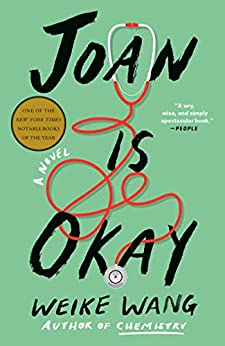
When we meet Joan, the titular heroine of Wang’s novel, the first assessment might be that her story starts where others potentially end. She has everything: she’s in her mid-thirties, living in Manhattan, and a brilliant attending I.C.U. physician. She is ticking off her American Dream checklist, seemingly without a hitch. Having grown up in California with poor immigrant parents, Joan views professional success as a great equalizer. “The joy of having been standardized,” she says, “was that you didn’t need to think beyond a certain area. Like a death handled well, a box had been put around you, and within it you could feel safe.”
But is Joan, or Jiu-an, OK? Of course she says she is. After all, doesn’t she tell her coworkers so everyday, during their brief and polite interactions? Yet they never feel connected with her and would be the first to doubt her response as genuine. While there is concern from some, as when Human Resources reaches out over her excessive shifts, there are also those who delight in her seemingly irreplaceable work ethic. The hospital director calls Joan, “a gunner and a new breed of doctor, brilliant and potent, but with no interests outside work and sleep.” In the first few pages we spend with her, upon receiving news of her father’s death, she flies to Shanghai for the funeral and back in only 48 hours.
Joan’s wealthy older brother, Fang, thinks she needs to give up the Upper West Side for the safety of the suburbs and start a private practice. His wife, Tami, thinks it’s high time Joan gets married and starts a family, because, “a woman isn’t a real woman until she’s had a child.” Her mother fails to connect with her through shopping, and even her neighbor is a habitual overstepper. To everyone in her orbit, Joan is someone who has to be taught how to live.
But as the story progresses, Joan ends up having to reflect on her obsession with productivity as she takes a hard look at her relationships to family and society. “Was it harder to be a woman? Or an immigrant? Or a Chinese person outside of China?,” she asks herself. “And why did being any good at any of the above require you to edit yourself down so you could become someone else?”
The developing Covid pandemic looms over the few months we spend with Joan, which impacts her personally as well as professionally. Wang details the news coming out of Wuhan and elsewhere matter-of-factly — increasing case counts and deaths, border and business closings — sparking a sense of dread in readers who know all too well what’s coming. Joan deadpans: “Some government officials also believed that it was important to keep the American people informed and reminded of where the virus really came from. So, the China virus, the Chinese virus, the kung flu.” Online she starts to see, “clips of Asian people being attacked in the street and on the subways. Being kicked, pushed and spat on for wearing masks and being accused of having brought nothing else into the country except disease.”
Joan is angry. If there is one thing that Wang knows is important for her character, it’s to keep her emotions unmuted to the reader. While cool on the surface, Joan bubbles underneath. Her deeper self only seeps through via dry comebacks that leave others chuckling uneasily.
So Joan probably isn’t OK. She’s a bit awkward, tense, and has complicated relationships with family as well as an affinity for work that others can’t seem to wrap their heads around. But Wang gives us a character so unapologetically true to herself that you can’t help wanting to get to know her, even when it’s pretty clear that she wants nothing more than to be left alone.
Wang’s narrative poses subtle questions about belonging and the definition of “home.” There are moments of unexpected tenderness and reminders of the devastating toll the pandemic had on communities and the individuals within them. And of course, the reader has to ask themselves at the end whether anyone is really OK, and if it’s such a bad thing to be.
Gabriela is a customer service specialist at the Miller Branch.She loves long walks, reading with her dog, and a good cup of coffee.
This book defies genre. Is it a sly satire or a hard-hitting social commentary? Is it a sharp page-turning thriller or contemporary literature at its best? A witty and playful debut or a manual for code-switching? I could not slot it into just one category. It is the book you will be discussing with your friends and neighbors. Right, Linda?
Zakiyah Dalila Harris’s novel debuted as a Most Anticipated Book of 2021 by Time, TheWashington Post, Harper’s Bazaar, Entertainment Weekly, Marie Claire, Bustle, BuzzFeed, Parade, Goodreads, Fortune, and the BBC. Deservedly so. The Other Black Girl is an electric debut about the tension that unfurls when two young Black women meet against the starkly white backdrop of New York City book publishing.
Written with wit and incisive humor, this book delves into the modern corporate atmosphere with its microaggressions, isolation, and manipulations. Working at Wagner Books as the only black editorial assistant, Nella Rogers is very excited when one morning, she looks through a small crack in a cubicle and sees what she calls “the flash of a brown hand.” Enter Hazel-May McCall. Nella finds a confidante in Hazel and someone who finally gets it. But it doesn’t take long for Nella to realize there’s something off about Hazel, even if she can’t quite put her finger on it. And then, shortly after Hazel’s arrival, the first anonymous note arrives on Nella’s desk: “Leave Wagner Now.” Hazel? And if not Hazel, then who? Nella begins searching for answers—and in the process, finds herself at the center of a dangerous conspiracy that runs far deeper than she ever could have known
I thoroughly enjoyed Zakiyah’s sparkling style of writing and her ability to paint office dynamics in nuanced shades of privilege and discrimination, while juggling an un-put-down-able mystery: a mystery that leaves your insides twisted at the end. In her review in The Washington Post, Naomi Jackson says, “One of the pleasures of “The Other Black Girl” is its unapologetic appeal to Black female readers. From references to 90s Black culture to ample servings of hair-related angst, conversations and plot points, Black girls will appreciate how their experiences, perspectives and quirks are centered in this novel.”
We are excited to host Zakiyah on June 23 at 7 pm. Listen to Zakiyah Harris and bring your questions. Register here.
Rohini is the Adult Curriculum Specialist with HCLS. She loves literature and rainy days.




 CHAPTER CHATS