
Banned Books Week: Read for Your Rights

The banner reads, "Banned Books Week Oct. 5-11, 2025, Censorship is so 1984. Read for your Rights," with the word "censorship" crossed out in red.

by Sahana C.

This year’s Banned Books Week feels important. The weight of headlines, especially about libraries across the country facing cuts, having collections challenged, and seeing their communities divided, creates an opportunity to reflect on what we gain by taking our time with banned and challenged books.
The American Library Association’s 2025 theme is direct: “Censorship Is So 1984. Read for Your Rights.” It’s a bold reminder that the freedom to read is not just about what is on the shelves.

The reference to George Orwell’s 1984, an often-banned dystopian novel that depicts the role of censorship in rewriting history, speaks to the struggles that public libraries have faced recently. Our community values intellectual freedom, diversity of opinion, and freedom of expression, and the theme reminds us that speaking up is more urgent than ever. It’s said each year, but we’ve seen historic levels of book challenges, especially for books that center the voices of LGBTQ+ people, Black and Brown communities, and those navigating complex identities. Books are being pulled from shelves not because they’re harmful, but because they make some people uncomfortable. But that discomfort is often the beginning of growth – learning that “different” isn’t automatically “wrong.”

Public libraries were built on the radical idea that knowledge belongs to everyone. We’re not just warehouses of books; we’re places where curiosity is nurtured, differences are respected, and freedom is practiced daily. This Banned Books Week we invite you to stand with us. Borrow a banned book. Join a discussion. Ask questions. Speak up. Share your story. Remind your neighbors that free access to ideas is not a luxury – it’s the foundation of democracy.

In Orwell’s 1984, censorship is used to control truth and rewrite history. This Banned Books Week, we push back. We read boldly. We resist silence. We protect stories, especially the ones that are under threat of erasure.

Here’s a curated list of nonfiction titles that are frequently challenged.

Sahana is the Communications Strategist at HCLS. They enjoy adding books to their “want to read” list despite having a mountain of books waiting for them already.

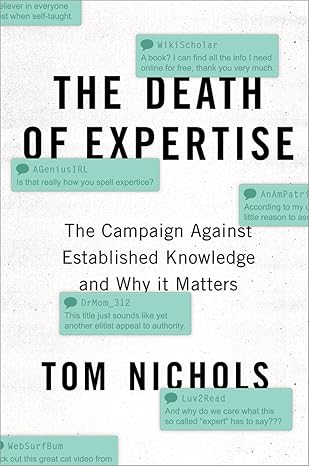
The Death of Expertise by Tom Nichols

The book cover includes seven speech bubbles or fragments of speech bubbles from writers with different user names, such as "DrMom_312" stating, "This title just sounds like yet another elitist appeal to authority" and "WikiScholar" saying "A book? I can find all the info I need online for free, thank you very much." All of them slyly support the premise of the book.

By Julie F.

Tom Nichols is a staff writer at The Atlantic, a professor, and a policy professional; I have followed him on social media and read his opinions for years. In this thoughtful analysis, he considers the death of expertise: the sense that previously acknowledged experts aren’t to be trusted and that the layperson can navigate their own way through a sea of information (and mis/disinformation). Looking at the disciplines of education and journalism, the rise of the internet, and the experts themselves (who consult with and influence policymakers), he traces the ways that citizens in our democracy have decided that they have the expertise to make decisions about a host of issues that were previously deferred to specialists (doctors, professors, and other expert advisors).

Nichols convincingly demonstrates how confirmation bias, the commodification of higher education, anti-intellectualism, and millions of web pages with uncurated, dubious information have enabled this often-misguided attitude. Librarians and library workers, take heart! You will appreciate his deep understanding of the nature of our work. My favorite quotes are from (not surprisingly) his chapter on the internet, called “Let Me Google That For You: How Unlimited Information Is Making Us Dumber”:

“The Internet, however, is nothing like a library. Rather, it’s a giant repository where anyone can dump anything, from a first folio to a faked photograph, from a scientific treatise to pornography, from short bulletins of information to meaningless electronic graffiti” (110).

“Research requires the ability to find authentic information, summarize it, analyze it, write it up, and present it to other people. It is not just the province of scientists and scholars, but a basic set of skills a high school education should teach every graduate because of its importance in any number of jobs and careers” (111).

Although his exploration of these concerns left me a little anxious at times for the future of our republic, Nichols wasn’t as cynical as I’d expected, and at the end of The Death of Expertise: The Campaign Against Established Knowledge and Why It Matters, he sums up similar situations we’ve recovered from in the past, when Americans were “capable of shrugging off their self-absorption and isolation and taking up their responsibilities as citizens” (237). Hopefully, a resurrection in interest in participatory democracy and the education of our citizenry will speed that process along.

The Death of Expertise: The Campaign Against Established Knowledge and Why It Matters is available from HCLS in print and as an e-audiobook from Libby.

Julie is an instructor and research specialist at HCLS Miller Branch who finds her work as co-editor of Chapter Chats very rewarding. She loves gardening, birds, crime and espionage fiction, all kinds of music, and the great outdoors.

Author Works with Jeffrey Boutwell (Feb 24)

Portrait of George Boutwell, looking to the right, with a greying beard. Title: Boutwell Radical Republican and Champion of Democracy


Mon, Feb 24 | 7 – 8:30 pm
HCLS Miller Branch
For adults. Register here.

Jeffrey Boutwell discusses his new book, Boutwell: Radical Republican and Champion of Democracy, a biography of family member George S. Boutwell – perhaps the most consequential American political figure you’ve never heard of. During his career from 1839 to 1905, George Boutwell was Governor of Massachusetts, served in the U.S. House of Representatives and the Senate, was treasury secretary for Ulysses Grant and Commissioner of Revenue for Abraham Lincoln, helped create the Republican Party in the 1850s, and forty years later opposed Republican Presidents William McKinley and Teddy Roosevelt over their plans to annex the Philippines following the Spanish-American War.

Boutwell was instrumental in framing the Fourteenth and Fifteenth Amendments, initiating the impeachment of Andrew Johnson, and investigating white vigilante violence against Black people in Mississippi in the 1870s. For seven decades, George Boutwell sought to “redeem America’s promise” through racial equality, economic equity, and the humane use of American power abroad.

Jeffrey Boutwell is a writer and historian living in Columbia, Maryland, after a 40-year career in journalism, government, and international scientific policy. He began his career as a reporter and editor with the famed City News Bureau of Chicago and was a book reviewer for the Chicago Sun-Times. After two years in the Windy City, Boutwell moved to Berlin and then to England, where he received an M.Sc. in Economics and Politics from the London School of Economics. He received a Ph.D. in political science from the Massachusetts Institute of Technology in 1984. He has written and spoken widely on issues ranging from nuclear weapons arms control to Middle East peace to environmental issues.

Twilight of Democracy (I hope not)

The book cover shows the title, "Twilight of Democracy: The Seductive Lure of Authoritarianism," and the author's name, "Anne Applebaum," accompanied by "Winner of the Pulitzer Prize." The words are in white except for "Authoritarianism," which is in red. The background of the cover is in gradating shades of blue.

By Eric L.

Twilight of Democracy: The Seductive Lure of Authoritarianism is a great read for the current moment. The title of the book should give you a fairly good idea of what the book is about. Anne Applebaum’s area of analysis and expertise seems particularly relevant right now. Sadly, she and I agree that hate and the belief in authoritarians has increased in recent times in America. Applebaum discusses how this is also the case in Britain, Hungary, and Poland (countries with which she has experience). Applebaum’s husband is involved in politics in Poland, which provides her an interesting vantage point into the “power elite” (my term). 

If you’re not familiar with Anne Applebaum, I would encourage you to read some of her articles in The Atlantic. I am mainly familiar with her work through this magazine. She is a journalist, but I would also describe her as a historian who has authored several highly regarded books on Russian history. She is also currently a senior fellow at Johns Hopkins University’s School of Advanced International Studies. I would describe Anne Applebaum’s politics as different than mine, where she is “center right” and I’m not. We may differ on specific policy prescriptions and perhaps views on liberalism and markets, but we agree that hate and authoritarians are both inimical to democracy. 

The book grabs you from the onset by describing a New Year’s Eve party they hosted as the 20th century ended. She details the somewhat raucous party, the guests, and the optimism many attendees shared for liberal democracies in the 21st century. I am younger than Applebaum, but I recall a similar optimism (and perhaps a little worry about Y2K). She then goes on to describe how in the 20 years since this party many of the guests would no longer speak to each other, and how’d she’d cross the street to avoid some of these folks. In our highly polarized and political society we can all share this sentiment to some extent. Perhaps we don’t know Boris Johnson personally, as she does, but we can relate, and her brief biographical sketch of Johnson is indeed indicative of western politics at this moment. 

The book is written by a good journalist, and thus it is engaging and thoughtful. It is very Western-focused, but it does concern more than the United States. The similarities of the things happening in these countries are a bit frightening. Personally, I’m remembering the era during the last century when fascism began to spread in the West. 

She goes into detail through character sketches of some of the people and the trajectory of their political beliefs. Many were former anti-communists and are now hard-right and authoritarian in nature. She points out that these are not poor, rural people, but actually quite elite, wealthy, and well-educated. She subsequently proffers her theories as to why this is the case, including that of a behavioral economist who suggests about one third of the population, irrespective of political beliefs, has an authoritarian “disposition.” This actually does not surprise me. Applebaum also puts words to the belief of many of these folks that things were better in previous times. The section where she delves into the different types of nostalgia is very interesting. 

I don’t agree with everything Applebaum posits, however I’d like to think she’d appreciate that fact. Specifically, I think she discounts corporate power and race issues in America. They’re addressed, but not to my satisfaction. Where I agree with Applebaum is that democracy is messy, it’s problematic, and not everyone is happy. In sum, it’s tough! It’s certainly much easier to be in complete control and get your way all the time. However, I don’t think I have an authoritarian “disposition” and I think getting my way all the time is not good for me psychologically. That said, I hope we’re not in the twilight of democracy.

Twilight of Democracy: The Seductive Lure of Authoritarianism is also available in large print and as an eBook and an eAudiobook from Libby/OverDrive.

Eric is a DIY Instructor and Research Specialist at the Elkridge branch. He enjoys reading, films, music, doing nearly anything outside, and people.

How to Talk to Kids About Voting

by Emily T.

The first (and only) song I’ve ever heard to rhyme both Trump and Clinton into the same chorus was sung to me during the 2016 election – by a five-year-old in my son’s Kindergarten class. 

In 2020, election talk is even more ubiquitous. Grownups aren’t the only ones figuring out voting. Many children are hearing about the election and wondering what it all means. Some may be asking their questions, while others may be unsure where to start. It’s never too early to welcome young ones into the voting process and help them understand how important it is. We may be shocked to find what they’ve heard already – and what critical gaps likely are in their understanding. 

Children can understand the value of having a say, and we all know they put a lot of stock in fairness. Such basics of democracy are very accessible. Even preschoolers can use a simple form of voting to make a group decision. Pizza or sushi for dinner? Ride scooters to the park or walk? We grownups can give our little future voters lots of practice with making a choice, counting up votes, and making peace with the outcomes. Of course, the story of American democracy doesn’t end with the idea of one person, one vote, but it is a great way to start talking about it. Reading books about voting can further spark children’s interest and open up fun, informative, invaluable conversations. Encourage your kids to ask questions, then find answers together.  

The President of the Jungle by André Rodrigues, et al. is a playful introduction to voting as a fair way to decide things as a group. In the story, the animals are not too happy with Lion, King of the Jungle, and they want a change. Key election concepts are explained with clever illustrations and a glossary. It’s great for big-picture questions about what’s fair and what makes a good leader. Bonus, it’s also great for character voices if you like that kind of outlet. 

Vote for Our Future!, by Margaret McNamara shows the many ways kids can get involved during election season, even before they are voting on their own. The story follows an elementary class learning and doing all they can about voting as their school becomes a polling place. Vibrant drawing of people in action let kids make observations and ask logistical questions. 

Voting is an important way that families act on their values and help determine what it’s like to grow up in this country. Children of all ages are paying attention. Will they see just how valuable each vote is?  

For additional books, DVDs, and eResources about voting for children and adults, check out the collection curated by our HCLS team here

Be sure to visit our HCLS Voter Smarts Guide 2020 for this year’s essential election information. 

Recommended Articles, Videos, & Games about Voting for Families HCLS “Let’s Vote!” On-Demand Class (K-Grade 2) & “Let’s Vote!” On-Demand Class (Grades 3-5)

Daniel Tiger: Stop, Think and Choose 

PBSKids: Let’s Vote

Common Sense Media: 17 Tips to Steer Kids Through the Political Season 

iCivics: Cast Your Vote 

Ben’s Guide to the US Government 

Emily is a Children’s Instructor & Research Specialist at HCLS Elkridge Branch.. Her family voted on how to celebrate their ballot drop-off this year. “I Voted” S’mores won in a landslide over the “I Vote” Rootbeer Float, and “I Voted” stickers.